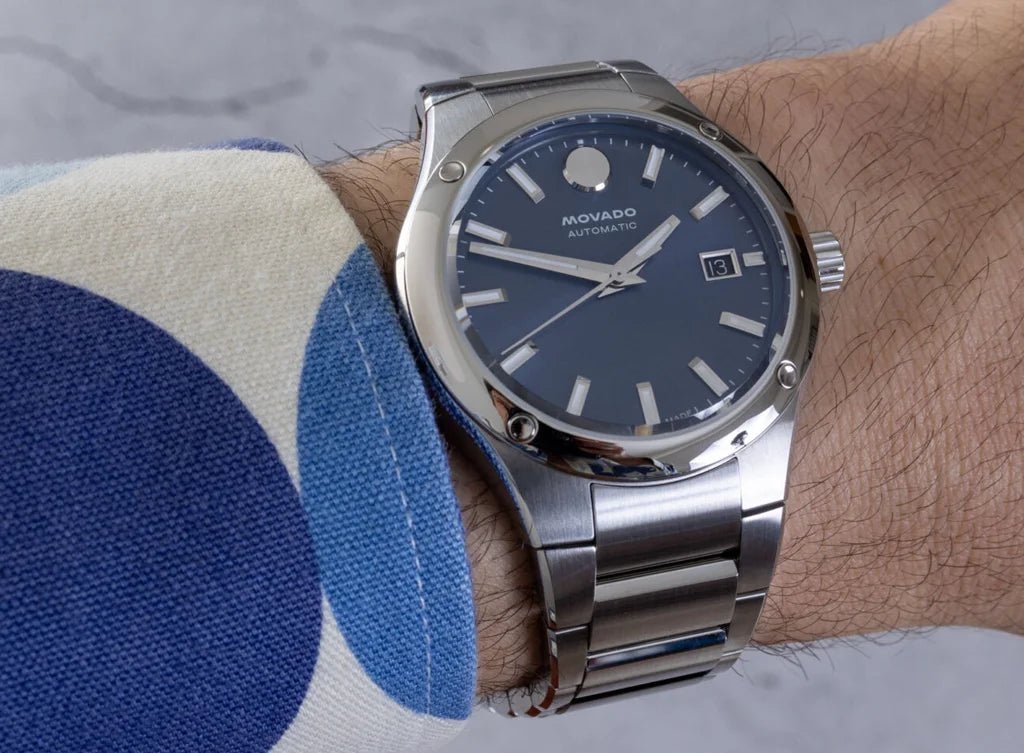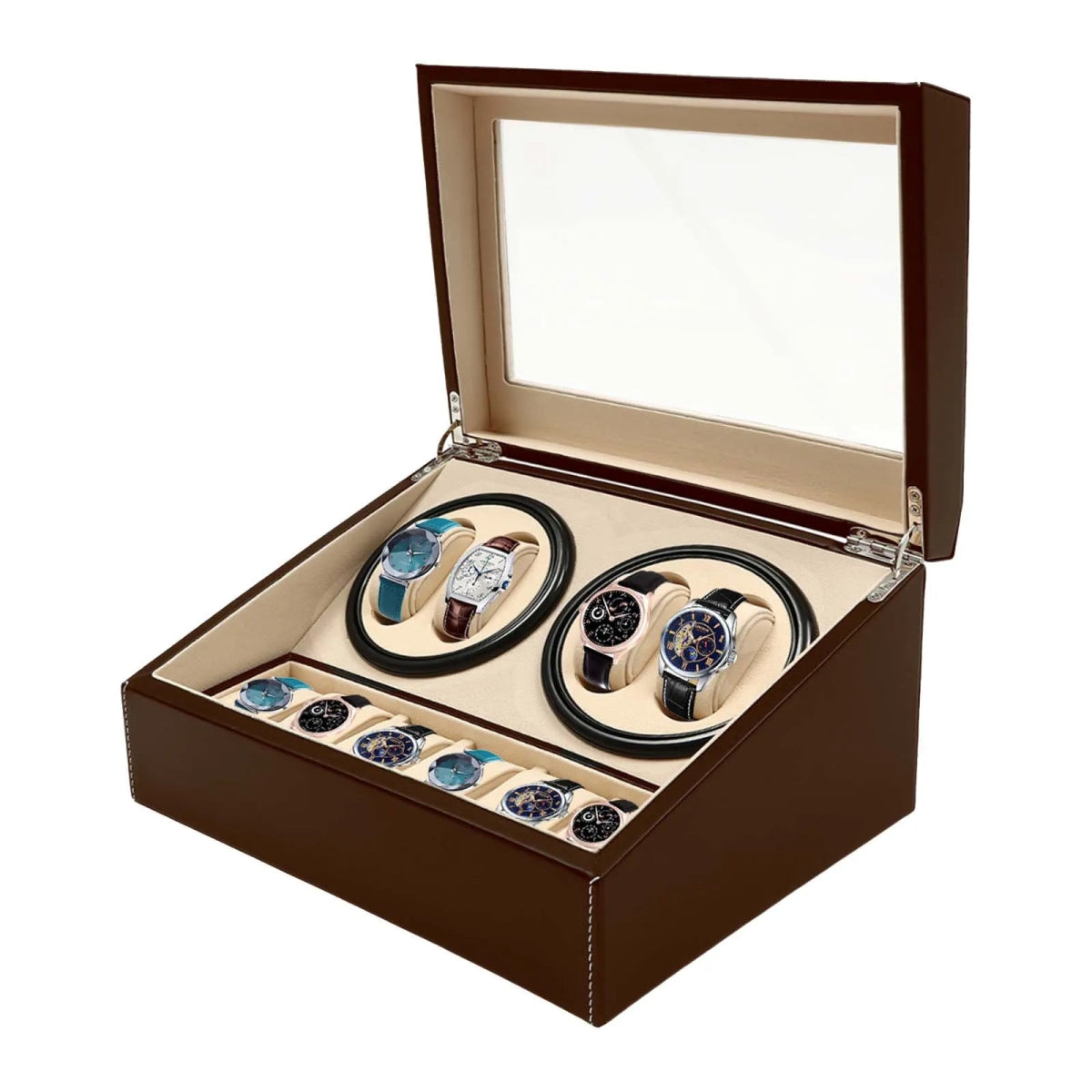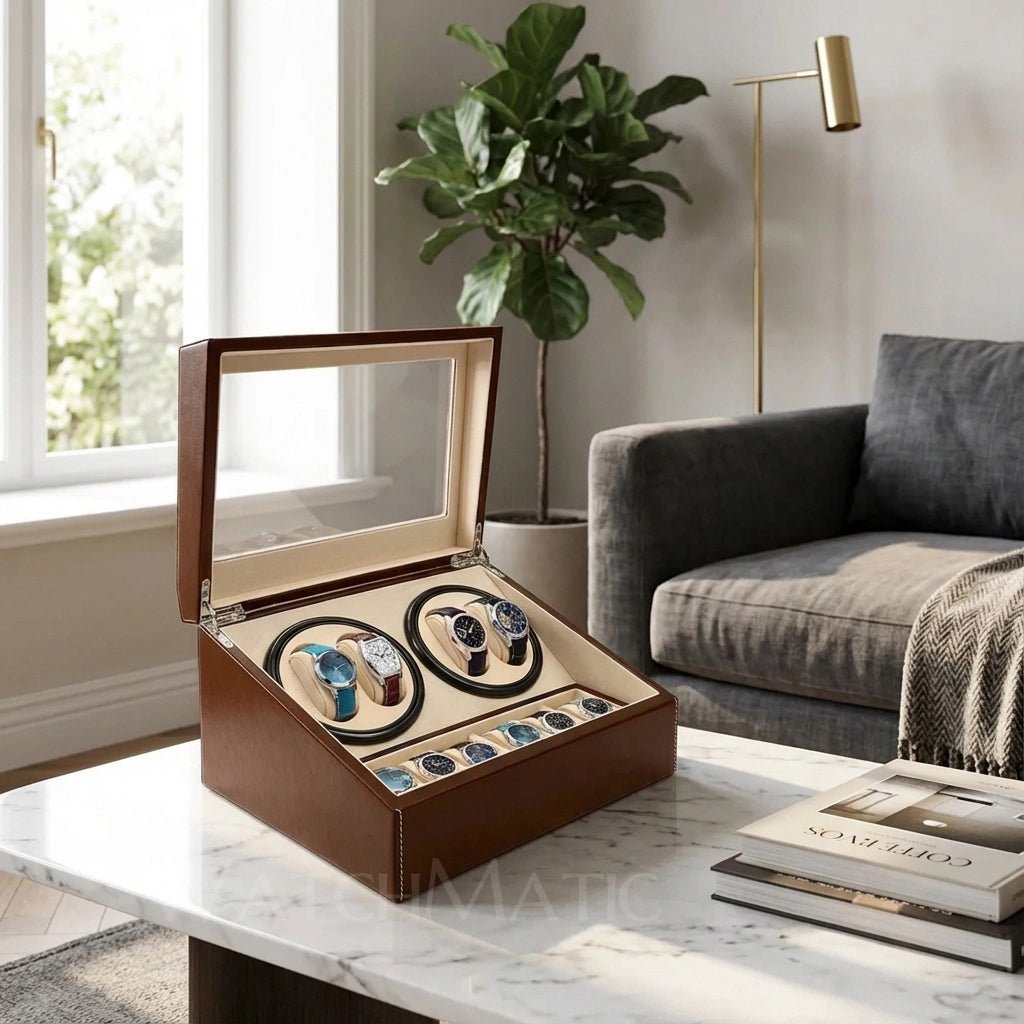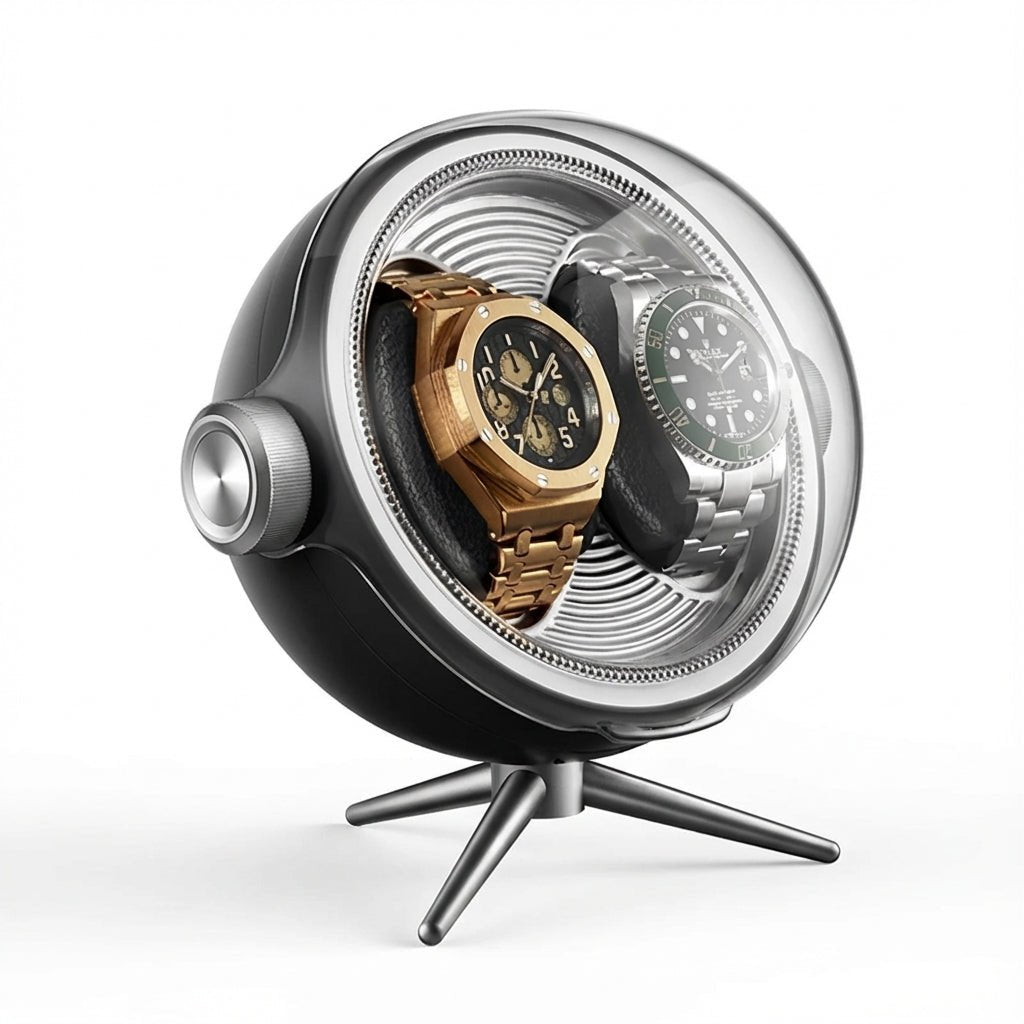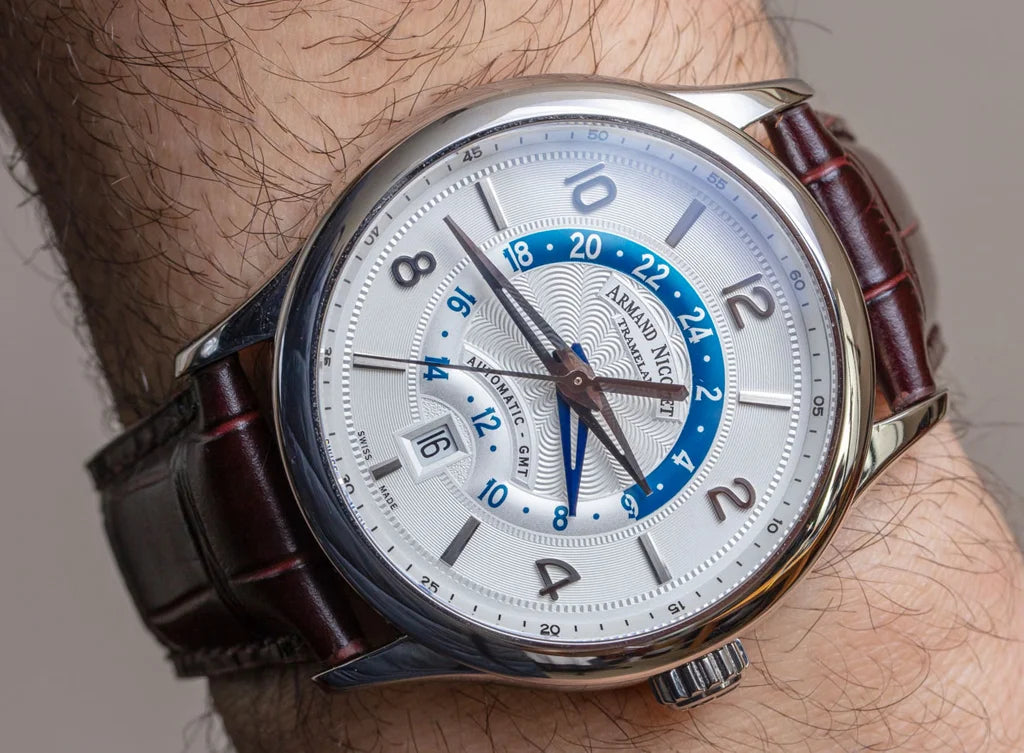
The best watch winder for Armand Nicolet watches is a programmable model with adjustable Turns Per Day (TPD), clockwise and counterclockwise rotation options, controlled winding and rest cycles, independent controls, quiet operation, and secure support for different case and strap sizes.
Many current Armand Nicolet watches are automatic mechanical models, particularly across collections such as:
- J09
- JS9
- MM2
- M02
Important current automatic calibers include:
- AN200 — based on Sellita SW200
- AN280 — based on Sellita SW280
- AN330 — based on Sellita SW330
- AN500 — based on Sellita SW500
- AN1560 — automatic Jumping Hour based on modified SW200
Representative power reserves range from approximately:
38 hours for Date, Moon Phase and Jumping Hour automatics
to:
50 hours for GMT models
while current automatic chronographs can provide approximately:
46 hours.
However, not every Armand Nicolet watch belongs on a conventional winder.
The current M03 Moon Phase uses a quartz Ronda 708 movement, while the O.H.M. Original Historical Movement collection includes both automatic and manually wound calibers.
The correct process is therefore:
Exact Reference → Movement Type → Caliber → Automatic / Manual / Quartz → Power Reserve → Winding Requirement → Winder or Stationary Storage
Does an Armand Nicolet Watch Need a Watch Winder?
No automatic Armand Nicolet mechanically requires a watch winder.
A self-winding mechanical movement uses motion of its oscillating weight to wind the mainspring while the watch is worn.
If the watch remains unworn longer than its available power reserve, it eventually stops.
A watch winder is therefore mainly a convenience tool.
It can help:
- Keep an automatic Armand Nicolet running between wears
- Maintain the time and date
- Keep GMT indications synchronized
- Maintain an automatic moon phase
- Reduce repeated restarting
- Keep a jumping-hour watch ready to wear
- Organize several automatic watches
A winder does not replace servicing or make a mechanical movement inherently healthier simply because it remains running.
For a broader explanation of automatic winding, see the Watch Winder Guide.
Which Armand Nicolet Watches Can Use a Watch Winder?
Representative current and historical-collection watches include:
| Armand Nicolet watch | Caliber / movement | Type | Approx. reserve | Conventional winder? |
|---|---|---|---|---|
| J09 Date | AN200 / SW200 base | Automatic | 38 h | Yes |
| J09 GMT | AN330 / SW330 base | Automatic | 50 h | Yes |
| J09 Chronograph | AN500 / SW500 base | Automatic | 46 h | Yes |
| JS9-41 Date | AN200 | Automatic | 38 h | Yes |
| JS9-41 GMT | AN330 | Automatic | 50 h | Yes |
| MM2 Date | AN200 | Automatic | 38 h | Yes |
| M02 Date | SW200-based | Automatic | 38 h | Yes |
| M02 Moon Phase | AN280 / SW280 base | Automatic | 38 h | Yes |
| M02 Jumping Hour | AN1560 / SW200 base | Automatic | 38 h | Yes |
| M03 Moon Phase | Ronda 708 | Quartz | Battery-powered | No |
| L15 O.H.M. | AN0703A / AS 1883 base | Automatic | 34 h | Yes |
| L06 O.H.M. | AN501 / UT 176 base | Manual | 34 h | No |
This table reveals the most important Armand Nicolet principle:
collection name, complication and power reserve alone do not determine watch-winder compatibility.
Understanding Armand Nicolet's Movement Strategy
Armand Nicolet approaches movement construction in two distinct ways.
The Contemporary Collection primarily uses modern Swiss movements modified to the brand's specifications.
The O.H.M. collection takes a fundamentally different approach by restoring and adapting original historical movements produced decades ago.
That creates unusually broad movement diversity for a brand in this segment.
A collector may own:
- A modern SW200-based automatic
- A modern SW330-based GMT
- A modular jumping-hour automatic
- A quartz moon phase
- A restored historical automatic
- A restored historical hand-wound movement
All bearing the Armand Nicolet name.
That is why exact-reference identification matters.
Armand Nicolet AN200 Automatic
The AN200 is one of the most important calibers across the current catalog.
It is based on the Sellita SW200 and modified according to Armand Nicolet specifications.
Representative specifications include:
- Automatic winding
- Approximately 38 hours of power reserve
- Date
- Central seconds
- Swiss mechanical construction
It appears across several current collections.
Examples include:
- J09 Date
- JS9 Date
- MM2 Date
- M02 Date
This makes AN200 one of the most common Armand Nicolet movements a watch-winder owner is likely to encounter.
Why a 38-Hour Reserve Makes a Winder Useful
A 38-hour power reserve is relatively moderate by current automatic-watch standards.
A watch removed from the wrist on Friday evening may stop well before Monday morning.
For someone rotating multiple watches, that creates repeated:
- Crown winding
- Time setting
- Date setting
A winder can reduce this inconvenience.
For someone wearing the same Armand Nicolet almost every day, however, the benefit may be limited.
Best Watch Winder for Armand Nicolet J09 Date
The J09 Date uses AN200 with approximately:
38 hours of power reserve.
The current J09 case measures approximately:
41 mm
without the crown, with thickness depending on the movement configuration.
For a J09 Date, prioritize:
- Adjustable TPD
- CW/CCW/bidirectional operation
- Controlled rest cycles
- Quiet motor
- Bracelet and leather-strap compatibility
- Stable 41 mm case support
Because the watch has a straightforward date complication, restarting it manually is not particularly difficult.
The winder's value therefore depends strongly on how frequently it is worn.
Armand Nicolet AN330 GMT
The AN330 is based on the Sellita SW330 and modified according to Armand Nicolet specifications.
Current examples provide approximately:
50 hours of power reserve.
It appears in watches such as:
- J09 GMT
- JS9 GMT
- Other applicable GMT references
Compared with the AN200, it provides both:
- Longer autonomy
- Additional GMT functionality
These two factors affect winder convenience in opposite ways.
Longer Reserve vs. GMT Complexity
A 50-hour reserve reduces how quickly the watch stops.
That reduces dependence on a winder.
However, a GMT adds an extra time indication.
If the watch eventually stops, the owner may need to restore:
- Local time
- Date
- GMT/reference time
That makes keeping the watch running more convenient.
Therefore:
longer reserve reduces winder dependence
while:
additional synchronized indications increase convenience value.
Best Watch Winder for Armand Nicolet J09 GMT
For a J09 GMT, prioritize:
- Adjustable TPD
- Multiple rotation directions
- Controlled rest cycles
- Independent programming
- Secure bracelet or strap support
- Quiet operation
The correct TPD and direction should be based on the actual AN330/SW330 winding architecture rather than copying settings from an AN200 watch.
AN200 vs. AN330
| Feature | AN200 | AN330 |
|---|---|---|
| Base movement | SW200 | SW330 |
| Automatic | Yes | Yes |
| Main complication | Date | GMT |
| Approx. reserve | 38 h | 50 h |
| Conventional winder | Yes | Yes |
These movements belong to the same broader modern Swiss ecosystem but should not automatically be treated as identical.
Armand Nicolet AN500 Automatic Chronograph
The AN500 is based on the Sellita SW500 and modified according to Armand Nicolet specifications.
Current J09 Chronograph references provide approximately:
46 hours of power reserve.
The movement includes:
- Automatic winding
- Chronograph
- Date
- Swiss mechanical architecture
The J09 Chronograph therefore adds greater mechanical complexity than the standard AN200 Date.
Best Watch Winder for J09 Chronograph
For a J09 Chronograph, prioritize:
- Adjustable TPD
- CW/CCW/bidirectional programming
- Controlled rest cycles
- Smooth motor operation
- Case and pusher clearance
- Stable strap or bracelet support
The watch should rotate without the chronograph pushers contacting:
- Winder frame
- Adjacent watch
- Door
- Cushion hardware
Does the Chronograph Need More TPD?
Not simply because it is a chronograph.
The additional chronograph mechanism does not create a rule such as:
more complications = more TPD.
A watch winder does not:
- Start the chronograph
- Reset the chronograph
- Exercise the pushers
- Service the chronograph
- Replace lubricants
- Replace professional maintenance
The automatic winding system determines the appropriate program.
46-Hour Chronograph vs. 38-Hour Date
A J09 Chronograph offers somewhat more autonomy than a J09 Date.
However, the difference between approximately 46 and 38 hours is not large enough to fundamentally change storage strategy.
Both can stop during a multi-day rotation.
For collectors owning multiple watches, both can derive practical convenience from winding.
Best Watch Winder for Armand Nicolet JS9-41
The JS9-41 combines automatic Swiss movements with more sports-oriented construction.
Current versions include:
- Date — AN200 / approximately 38 h
- GMT — AN330 / approximately 50 h
The case measures approximately:
41 mm
with around:
13 mm thickness
and professional diving-oriented features.
JS9-41 Water Resistance
Current JS9-41 references can provide approximately:
300 meters of water resistance.
This affects:
- Case construction
- Crown sealing
- Caseback
- Diving suitability
It does not determine:
- TPD
- Winding direction
- Rotor efficiency
- Appropriate rest cycles
Therefore:
300-meter water resistance ≠ higher watch-winder setting.
Dive Watch Does Not Need More Rotation
A robust sports watch may withstand greater external stresses than a dress watch.
That does not mean the winder should rotate it more aggressively.
A quality winder should still provide:
- Smooth rotation
- Controlled cycles
- Rest periods
- Appropriate daily turns
The purpose is maintenance winding, not testing shock resistance.
JS9 Bracelet and Rubber-Strap Fit
Current JS9 models are available with combinations such as:
- Stainless-steel bracelet
- Rubber strap
- Leather strap on related configurations
For a bracelet:
- Use a compressible cushion
- Avoid excessive link tension
- Keep the clasp naturally closed
For rubber:
- Preserve natural curvature
- Avoid excessive stretching
- Ensure the buckle remains clear of rotating components
Physical support is part of winder compatibility.
Best Watch Winder for Armand Nicolet MM2
The MM2 is another current automatic family.
Representative 41 mm and 43 mm Date watches use:
AN200
with approximately:
38 hours of power reserve.
The larger MM2 reaches approximately:
43 mm
while the more compact version measures approximately:
41 mm.
Same Movement, Different Physical Requirements
A 41 mm and a 43 mm MM2 can use the same fundamental AN200 movement.
Their winding requirements may therefore be similar.
But their physical fit may differ.
This is a recurring principle:
same caliber does not necessarily mean same cushion fit.
A winder must address both:
- Movement programming
- Physical watch dimensions
MM2 43 mm and Cushion Stability
The larger MM2 can place more weight farther from the center of the rotor.
A secure cushion helps prevent:
- Watch-head movement
- Strap slippage
- Off-center positioning
A larger case does not need more TPD.
It simply requires more stable physical support.
Armand Nicolet M02 Automatic Collection
The M02 is particularly interesting because it contains several automatic complications using different Sellita-based movements.
Current and recent configurations include:
- Date
- Moon Phase
- GMT
- Chronograph
- Jumping Hour
This makes M02 one of the best collections for demonstrating why the exact reference matters.
M02 Date
The M02 Date uses a SW200-based automatic movement with approximately:
38 hours of power reserve.
For watch-winder purposes, its requirements are broadly comparable to other AN200/SW200-based references.
M02 Moon Phase
The M02 Moon Phase uses:
AN280
based on a modified Sellita SW280.
Its published power reserve is approximately:
38 hours.
This is particularly relevant because its moon-phase indication gives the owner a stronger convenience reason to keep the watch running.
Why an Automatic Moon Phase Benefits From Staying Running
If a simple Date watch stops, restarting it is relatively straightforward.
A moon-phase watch can require restoration of:
- Time
- Date
- Lunar indication
Keeping the movement running can reduce repeated moon-phase correction.
This is a convenience benefit.
The moon-phase mechanism does not mechanically need to run continuously for its health.
M02 Moon Phase vs. M03 Moon Phase
This is one of the strongest distinctions in the entire Armand Nicolet catalog.
M02 Moon Phase
- Mechanical
- Automatic
- AN280 / SW280-based
- Approximately 38 hours
- Can benefit from a conventional watch winder
M03 Moon Phase
- Quartz
- Ronda 708
- Battery powered
- No mechanical winding benefit
Both watches display a moon phase.
Only one needs consideration for rotational winding.
Complication Name Does Not Determine Winder Compatibility
The words:
Moon Phase
tell you what a watch displays.
They do not tell you what powers the watch.
A moon-phase watch can be:
- Automatic
- Manual
- Quartz
Therefore:
complication name ≠ energy architecture.
This is particularly important when comparing M02 and M03.
Armand Nicolet M02 Jumping Hour
The M02 Jumping Hour is one of the most technically distinctive current Armand Nicolet watches.
It uses Caliber:
AN1560
with approximately:
38 hours of power reserve.
The jumping-hour module was developed by Armand Nicolet and assembled onto a modified SW200 automatic base.
This gives the watch a mechanically unusual display while retaining automatic winding.
Best Watch Winder for M02 Jumping Hour
For an M02 Jumping Hour, prioritize:
- Adjustable TPD
- Multiple rotation directions
- Controlled rest cycles
- Smooth motor operation
- Quiet performance
- Secure bracelet or leather-strap support
The watch measures approximately:
41 mm
with thickness around:
12.2 mm.
It should fit comfortably in most properly designed winding chambers.
Does a Jumping Hour Need More TPD?
No.
The jumping-hour mechanism stores and releases energy to change the hour display instantaneously.
That additional mechanism does not create a simple requirement for increased TPD.
The automatic SW200-based winding system remains the relevant consideration.
Therefore:
jumping display ≠ maximum daily turns.
Jumping Hour and Winder Convenience
A jumping-hour watch is not significantly harder to reset than many standard automatic watches.
Therefore, unlike a perpetual calendar or complicated world-time watch, its complication does not make continuous running essential for convenience.
The main practical reason for using a winder remains the relatively moderate 38-hour reserve.
Armand Nicolet M03 Moon Phase Quartz
The current M03 Moon Phase is important because it breaks the assumption that every modern Armand Nicolet complication is automatic.
It uses:
Ronda 708 Quartz
rather than a self-winding mechanical caliber.
Therefore:
a conventional automatic watch winder provides no winding benefit.
Does the M03 Moon Phase Need a Watch Winder?
No.
The Ronda 708 is battery powered.
Rotating the watch does not charge or wind the movement.
This remains true even though the watch has:
- Moon phase
- Analog display
- Traditional Swiss-watch styling
- Sapphire crystal
- Diamond-set versions
Appearance and complication do not make it automatic.
Diamond-Set M03 Watches Still Do Not Need Rotation
Selected M03 Moon Phase watches use cases set with diamonds.
That increases:
- Value
- Decorative complexity
- Physical care requirements
It does not change the quartz movement.
Therefore:
diamond setting ≠ automatic winding
For these watches, stationary storage with soft contact surfaces is more appropriate.
Armand Nicolet O.H.M. Collection
The O.H.M. — Original Historical Movement collection is one of the strongest distinguishing features of Armand Nicolet.
Rather than simply fitting modern movements, the company restores historical Swiss calibers, modifies or upgrades components where necessary, decorates them, and installs them in limited-edition watches.
Movement availability is limited by the number of historical movements the company possesses.
From a watch-winder perspective, this creates an important complication:
some O.H.M. watches are automatic while others are manually wound.
O.H.M. Means Historical Movement, Not Automatic Movement
The designation O.H.M. does not tell the owner whether a conventional winder is useful.
It describes the historical origin of the caliber.
The exact movement must still be identified.
This becomes clear when comparing the L15 and L06.
Armand Nicolet L15 O.H.M.
The L15 uses the historical AN0703A, derived from an AS 1883 movement originally produced in 1967 and subsequently restored and modified by Armand Nicolet.
The movement is:
automatic
with approximately:
34 hours of power reserve.
The watch itself measures approximately:
39 mm
and around:
10 mm thick.
Can the L15 Use a Watch Winder?
Yes.
Because the AN0703A is automatic, controlled rotational movement can provide winding energy.
However, its historical architecture makes a conservative, well-controlled winder particularly appropriate.
Prioritize:
- Adjustable TPD
- Correct direction
- Controlled rest cycles
- Smooth low-vibration operation
- Secure leather-strap support
There is no reason to use aggressive rotation merely because the movement is historical.
Historical Automatic Does Not Need Maximum TPD
A restored vintage-derived movement should not be treated as a reason to select a high-output winding program.
The objective remains:
provide sufficient energy to maintain the movement
not:
maximize rotor activity.
For a historical movement, precision and moderation are more appropriate than excess.
Armand Nicolet L06 O.H.M.
The L06 provides an especially useful contrast.
It uses the historical AN501, derived from UT 176.
Its specifications include:
- Manual winding
- Small seconds
- Approximately 34 hours maximum power reserve
- Historical movement architecture
A conventional rotating winder does not wind it.
L15 vs. L06: Same Reserve, Different Winder Compatibility
This is one of the strongest information-gain examples for Armand Nicolet.
L15
AN0703A
Approximately 34 hours
Automatic
Conventional winder can be useful
L06
AN501
Approximately 34 hours
Manual
Conventional rotating winder provides no winding benefit
The power reserves are essentially the same.
Their storage requirements are fundamentally different.
Therefore:
power reserve does not determine watch-winder compatibility.
Historical Does Not Mean Manual
Another common assumption is that older historical movements must be hand-wound.
The L15 demonstrates that this is not true.
Its historical AS 1883-derived architecture is automatic.
Therefore:
historical movement ≠ manual movement
Just as:
modern movement ≠ automatically self-winding.
The exact caliber remains decisive.
Automatic vs. Manual vs. Quartz Armand Nicolet
| Movement type | Examples | Conventional winder useful? |
|---|---|---|
| Automatic mechanical | J09, JS9, MM2, M02, L15 | Yes, optionally |
| Manual mechanical | L06 and selected O.H.M. references | No |
| Quartz | Current M03 Moon Phase | No |
This distinction should always be established before discussing TPD.
Armand Nicolet Power Reserve Comparison
| Movement | Example | Type | Approx. reserve |
|---|---|---|---|
| AN0703A | L15 O.H.M. | Automatic | 34 h |
| AN501 | L06 O.H.M. | Manual | 34 h |
| AN200 | Date models | Automatic | 38 h |
| AN280 | M02 Moon Phase | Automatic | 38 h |
| AN1560 | M02 Jumping Hour | Automatic | 38 h |
| AN500 | J09 Chronograph | Automatic | 46 h |
| AN330 | GMT models | Automatic | 50 h |
| Ronda 708 | M03 Moon Phase | Quartz | Battery powered |
This is a relatively wide movement landscape for one brand.
Does Longer Power Reserve Mean Greater Winder Need?
No.
Longer reserve generally reduces dependence on a winder.
A 50-hour GMT can remain running longer than a 38-hour Date watch.
However, the GMT's additional indication may make keeping it synchronized more convenient.
The correct analysis considers both:
autonomy
and:
reset complexity.
Armand Nicolet Watch Winder TPD Settings
TPD means Turns Per Day—the approximate number of rotations delivered by a winder during a daily program.
There should not be one universal rule such as:
“Armand Nicolet = 650 TPD.”
The catalog contains:
- SW200-based automatics
- SW280-based moon phases
- SW330-based GMTs
- SW500-based chronographs
- Historical automatics
- Manual historical movements
- Quartz watches
The correct process is:
- Identify the exact reference.
- Identify the movement.
- Confirm whether it is automatic.
- Determine the movement's winding requirements.
- Select appropriate TPD.
- Select appropriate winding direction.
- Confirm that the watch maintains sufficient reserve.
For a deeper explanation of Turns Per Day, see the Watch TPD Guide.
What Rotation Direction Should You Use?
A programmable watch winder should provide:
CW — Clockwise
CCW — Counterclockwise
Bi — Bidirectional
Armand Nicolet's official specifications identify movements and power reserves clearly, but one universal consumer watch-winder direction should not be assumed across the entire brand.
The reliable hierarchy is:
exact reference → caliber → verified winding requirement
rather than:
brand name → generic direction.
Do Quartz and Manual Armand Nicolet Watches Need TPD?
No.
TPD applies to conventional automatic-winding systems.
A manual O.H.M. movement receives energy through the crown.
A quartz M03 receives energy from its battery.
Neither gains useful winding energy from a rotating watch holder.
High TPD Is Not Automatically Better
Selecting the maximum available TPD does not improve an Armand Nicolet simply because it is mechanical.
Once sufficient winding is being supplied, additional rotations may provide no practical benefit.
Higher TPD does not automatically:
- Improve accuracy
- Extend movement life
- Improve lubrication
- Protect a historical movement
- Maintain moon-phase precision
- Service a chronograph
Use an appropriate program rather than the highest program.
Should You Restart a Stopped Watch Before Using a Winder?
A watch winder is generally best understood as a:
maintenance-winding device
rather than the fastest method of starting a completely depleted movement.
For an automatic watch that has stopped:
restart correctly → establish initial reserve → set indications → place on programmed winder → maintain
This approach is preferable to using maximum TPD to recover a completely stopped watch.
What to Look for in an Armand Nicolet Watch Winder
Adjustable TPD
A programmable system provides flexibility across the brand's different automatic calibers.
CW, CCW and Bidirectional Operation
Multiple direction options are preferable to a fixed-direction motor.
Independent Controls
Particularly useful for a mixed collection containing:
- AN200
- AN330
- AN500
- AN1560
- Historical AN0703A
Controlled Rest Cycles
Continuous uninterrupted rotation is unnecessary.
A quality winder should alternate movement and rest.
Smooth Motor Operation
Smooth starts and stops are particularly appropriate for O.H.M. historical movements.
Low Vibration
The objective is controlled wrist-like motion rather than shaking the watch.
Quiet Motors
Low noise matters in:
- Bedrooms
- Dressing rooms
- Offices
- Walk-in wardrobes
- Living spaces
Flexible Cushions
Current Armand Nicolet watches range from approximately:
34 mm M03
to:
43 mm MM2 and other sports watches.
Historical O.H.M. models can also be smaller.
Bracelet and Strap Compatibility
The brand uses:
- Leather
- Rubber
- Canvas
- NATO-style straps
- Stainless-steel bracelets
A flexible holder is preferable.
Best Watch Winder for One Armand Nicolet Automatic
For one Armand Nicolet automatic, a programmable winding position is generally sufficient.
Prioritize:
- Adjustable TPD
- CW/CCW/bidirectional modes
- Controlled rest cycles
- Smooth motor operation
- Quiet performance
- Flexible cushion
- Secure watch positioning
The exact program should be matched to the movement rather than the Armand Nicolet name alone.
Best Watch Winder for Multiple Armand Nicolet Watches
A collection might contain:
- J09 Date
- J09 GMT
- M02 Jumping Hour
- JS9 Date
- M03 Moon Phase
- L15 O.H.M.
- L06 O.H.M.
Five watches in that example are automatic.
One is quartz.
One is manually wound.
A more efficient architecture is:
Automatic references → independently programmable winding positions
M03 Quartz → stationary storage
Manual O.H.M. → stationary storage
This is more logical than automatically assigning every Armand Nicolet a powered rotor.
Vento Watch Winder for Armand Nicolet Automatics

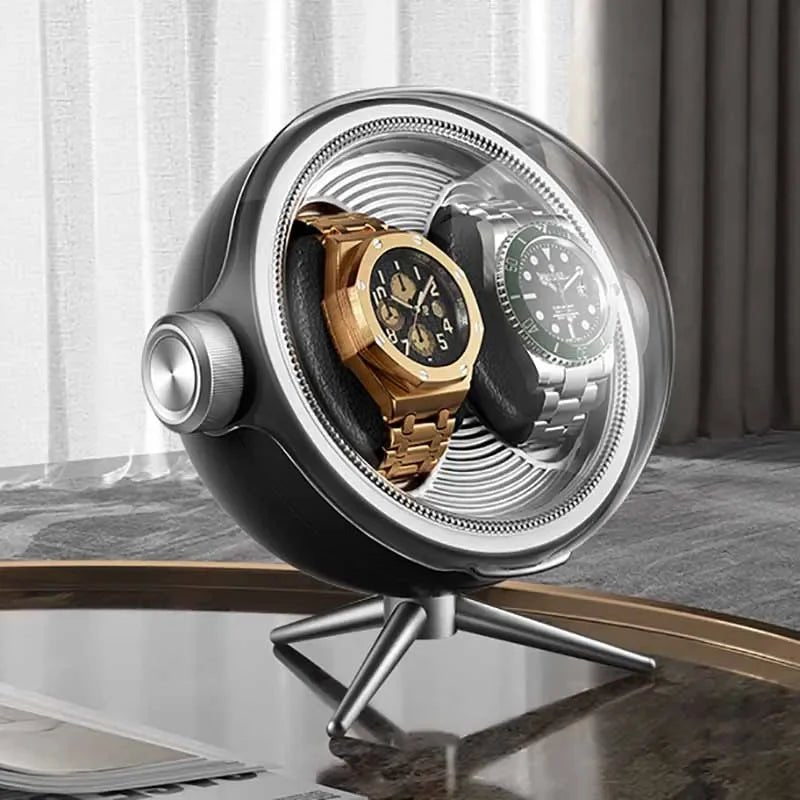
The Vento Luxury Quad Watch Winder is a practical match for a compact Armand Nicolet automatic collection because it provides four independently controllable winding positions.
A four-watch setup could contain, for example:
- J09 Date
- J09 GMT
- M02 Jumping Hour
- L15 O.H.M. Automatic
Independent control allows each position to be configured according to the actual movement rather than forcing AN200, AN330, AN1560 and a historical automatic caliber onto one common program.
Why Vento Is a Proportionate Fit
Current Armand Nicolet pricing and collection structure make a compact four-position winder a proportionate solution for many owners.
It provides:
- Multi-watch capacity
- Independent control
- Compact footprint
without immediately moving to a large safe-style winding cabinet.
For a focused collection of several modern automatics, this is often more relevant than a 20-position system.
O.H.M. Watches Require More Selective Rotor Allocation
An owner collecting O.H.M. should be particularly careful.
Do not automatically place every historical movement on a powered rotor.
Instead:
automatic historical caliber → rotor may be useful
manual historical caliber → stationary storage
The movement's age or historical importance does not determine the answer.
Is It Safe to Keep an Armand Nicolet on a Watch Winder?
A properly configured quality winder can be used with a confirmed automatic Armand Nicolet.
Important considerations include:
- Confirming the movement is automatic
- Selecting suitable TPD
- Selecting appropriate rotation direction
- Using controlled rest cycles
- Supporting the watch securely
- Using smooth low-vibration operation
Historical movements warrant particular care.
If an adequately wound watch displays abnormal reserve, accuracy or operation, professional inspection is more appropriate than increasing TPD repeatedly.
A Watch Winder Does Not Service an Armand Nicolet
A watch winder does not:
- Replace lubricants
- Regulate accuracy
- Restore historical movement components
- Service a chronograph
- Service a jumping-hour module
- Correct moon-phase calibration
- Replace gaskets
- Restore water resistance
Its role is limited to supplying motion to an automatic winding mechanism.
Water Resistance Does Not Determine Winder Settings
Armand Nicolet watches span different water-resistance ratings.
Examples include:
- Dress watches around 50 meters
- Everyday watches around 100 meters
- JS9 sports watches around 300 meters
This has no direct relationship with TPD.
Therefore:
300-meter dive watch ≠ higher daily rotation requirement
and:
50-meter dress watch ≠ lower TPD by default.
The movement determines winding behavior.
Case Size Does Not Determine TPD Either
A 43 mm MM2 does not require more winding merely because it is larger than a 39 mm L15.
Case dimensions affect:
- Cushion fit
- Chamber clearance
- Weight distribution
They do not directly determine automatic winding requirements.
Watch Winder vs. Watch Safe for Armand Nicolet Collectors
For one to four modern Armand Nicolet automatics, a standalone multi-watch winder is usually the more proportionate solution.
A watch winder safe becomes more relevant when the collection expands into a larger multi-brand portfolio or includes rare O.H.M. pieces.
| Feature | Standalone Winder | Watch Winder Safe |
|---|---|---|
| Automatic winding | Yes | Yes |
| Independent controls | Available | Available |
| Manual O.H.M. storage | Possible | Yes |
| Quartz storage | Possible | Yes |
| Physical security | Limited | High |
| Controlled access | Limited | High |
| Small focused collection | Highly suitable | Often unnecessary |
| Large mixed collection | Moderate | More suitable |
Titan Vault 20 for a Larger Armand Nicolet Collection

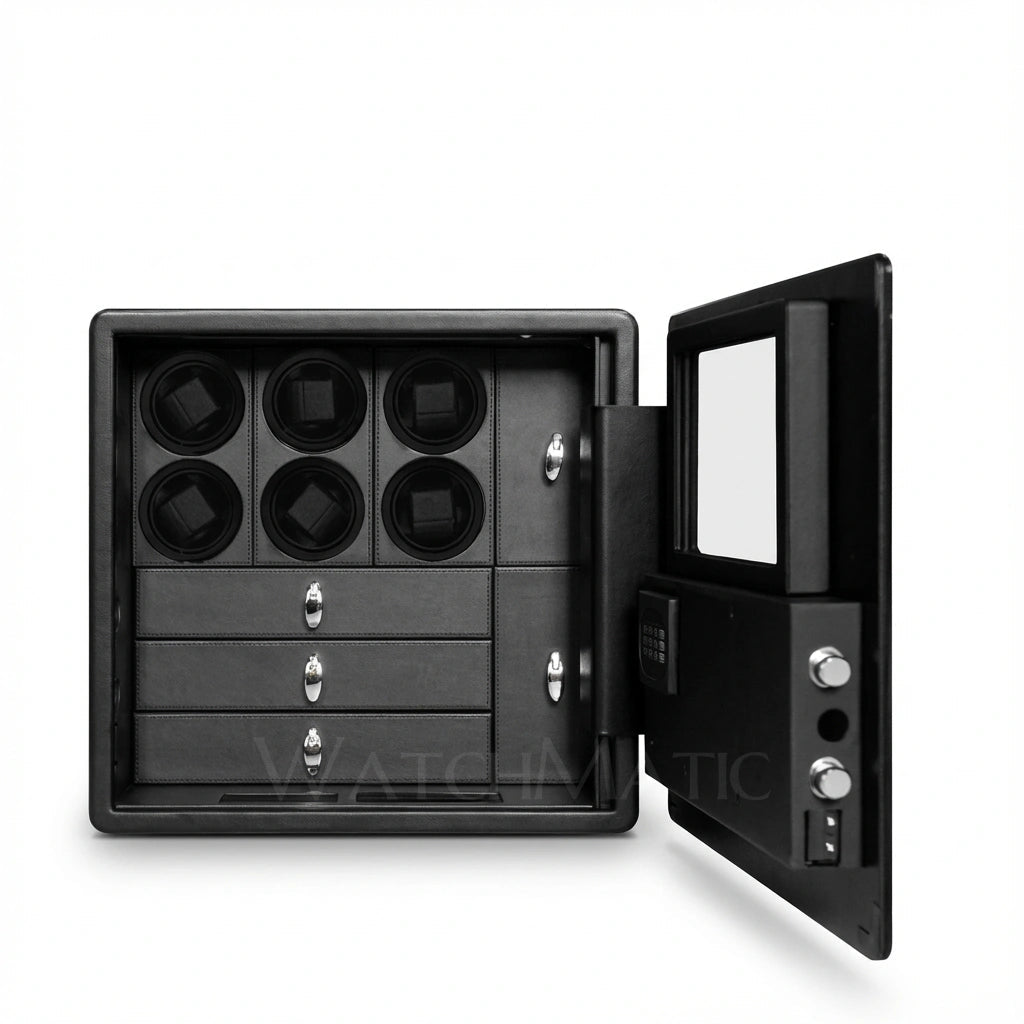
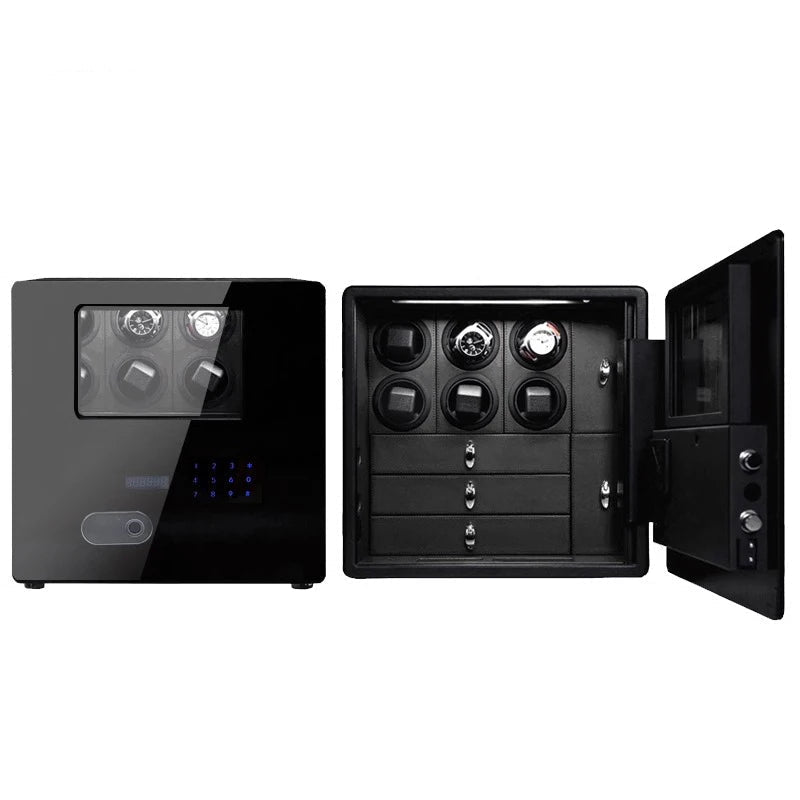
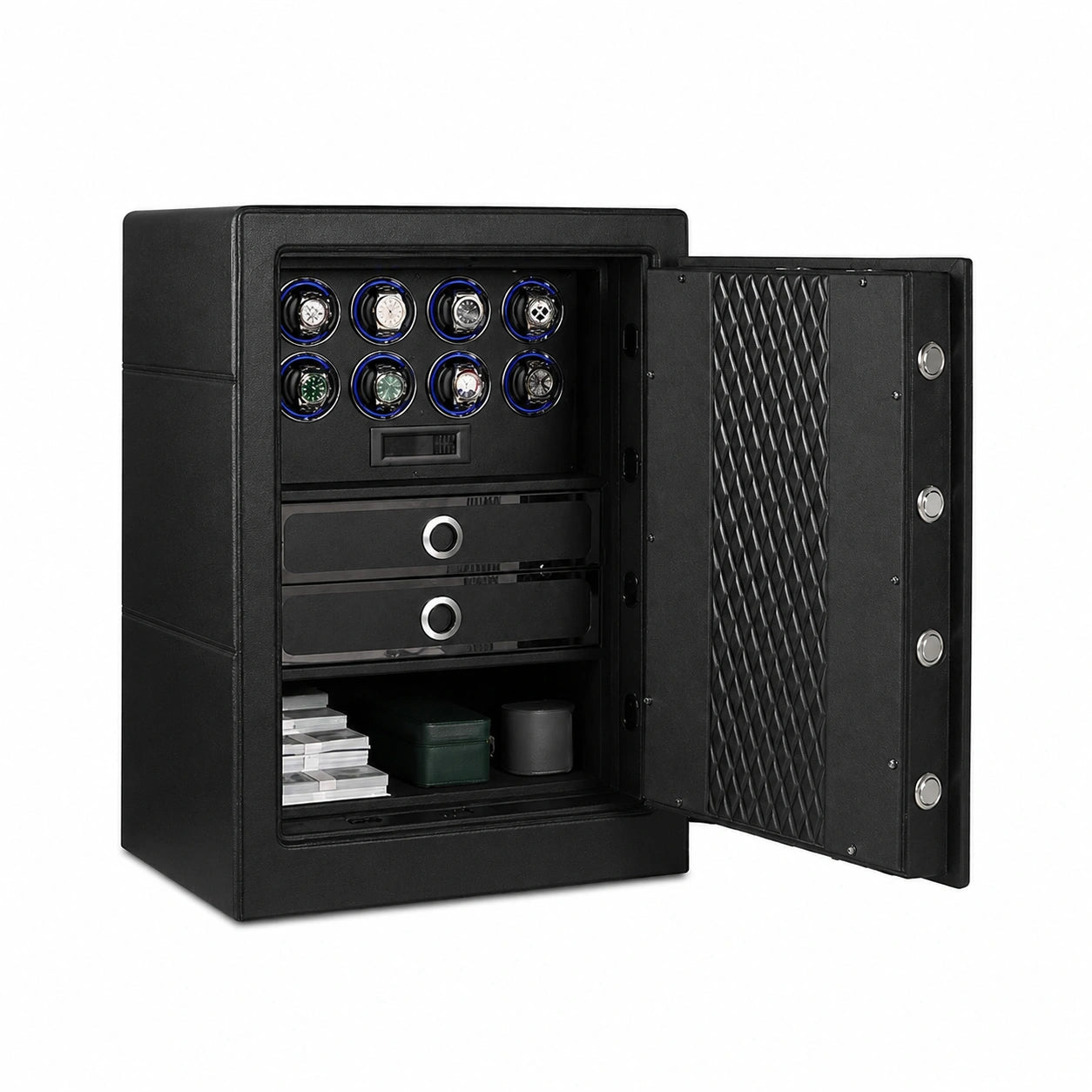
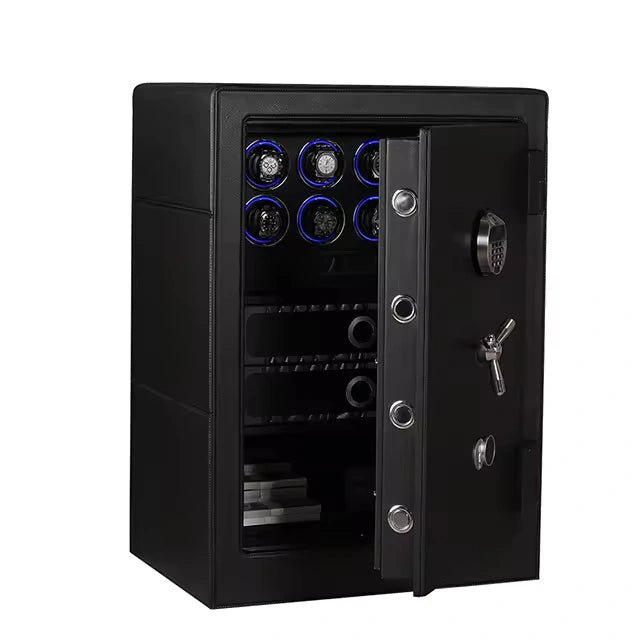
For Armand Nicolet watches within a larger luxury-watch collection, the Titan Vault 20 Watch Winder Safe combines 20 winding positions with secure storage.
Available features include:
- Reinforced safe construction
- Biometric fingerprint access
- Digital passcode
- Manual key access
- Floor anchoring
- Independent winding controls
- Japanese Mabuchi motors
- Adjustable TPD from 650 to 2200
- CW/CCW/bidirectional operation
- Anti-magnetization protection
- LED illumination
- Ultra-quiet operation
- Additional storage compartments
- 10-year warranty
Higher-level fire and burglary certifications are available upon request rather than assumed as standard on every configuration.
When Titan Vault 20 Makes More Sense
Titan Vault 20 becomes more relevant when the collection expands beyond several Armand Nicolet watches.
For example:
- Armand Nicolet J09
- Armand Nicolet O.H.M.
- Longines
- Mido
- EDOX
- Oris
- Omega
- Rolex
At that point, the owner needs to solve both:
automatic winding
and:
physical security.
The safe becomes a collection-level solution rather than simply a larger watch winder.
Rare O.H.M. Pieces Strengthen the Security Case
O.H.M. watches are limited by the number of original historical movements available for restoration.
This gives them a different collecting profile from a standard modern Sellita-based watch.
Even when a particular O.H.M. is manually wound and therefore does not need a rotor, it may deserve more secure storage because of:
- Limited production
- Historical movement
- Authenticity documentation
- Scarcity of replacement movement components
- Collector value
Therefore:
winder relevance and security relevance are separate questions.
When Stationary Watch-Safe Storage Is More Appropriate
A collector whose Armand Nicolet portfolio contains many:
- Manual O.H.M. pieces
- Quartz watches
- Historically significant references
may need fewer winding positions than total watches.
In that situation, secure options from the Luxury Watch Safe Collection may be more relevant than maximizing rotor count.
Armand Nicolet in a Mixed Swiss Collection
Armand Nicolet often sits naturally alongside established Swiss brands with accessible mechanical movements, GMTs, dive watches and historically influenced collections.
A mixed collection might include:
Armand Nicolet + Longines + Mido + EDOX + Certina + Baume & Mercier
Related WatchMatic guides include:
Best Watch Winder for Longines Watches
Best Watch Winder for Mido Watches
Best Watch Winder for EDOX Watches
Best Watch Winder for Certina Watches
Best Watch Winder for Baume & Mercier Watches
Even when several watches use Sellita-derived architectures, exact calibers should still determine the program.
Armand Nicolet vs. Other Sellita-Based Watches
Many Swiss manufacturers use Sellita movements.
That does not mean every implementation is identical.
Armand Nicolet modifies base movements according to its specifications and also develops additional modules such as the M02 Jumping Hour system.
Therefore, use:
exact Armand Nicolet caliber and reference
rather than blindly copying a setting from another SW200-based brand.
How to Choose the Best Watch Winder for Your Armand Nicolet
Step 1: Identify the Exact Collection and Reference
Determine whether the watch is:
- J09
- JS9
- MM2
- M02
- M03
- O.H.M.
- Another current or historical reference
Step 2: Identify the Movement Type
Determine whether it is:
- Automatic mechanical
- Manual mechanical
- Quartz
Step 3: Identify the Caliber
Important examples include:
- AN200
- AN280
- AN330
- AN500
- AN1560
- AN0703A
- AN501
- Ronda 708
Step 4: Check Power Reserve
Representative mechanical values include:
34 hours → 38 hours → 46 hours → 50 hours
depending on the reference.
Step 5: Determine Whether TPD Is Relevant
TPD applies only to automatic watches.
Manual O.H.M. and quartz M03 watches do not need a conventional TPD program.
Step 6: Determine Rotation Direction
Use verified movement-specific winding requirements.
Choose a system offering:
- CW
- CCW
- Bidirectional
Step 7: Consider the Complication
A GMT or automatic moon phase can derive more convenience from staying synchronized than a basic Date watch.
But complication alone does not determine whether the watch is automatic.
Step 8: Check Case and Strap Fit
The collection spans different sizes and configurations, including:
- 34 mm M03
- 39 mm L15
- 41 mm J09 / M02
- 43 mm MM2
- Leather
- Rubber
- Canvas
- Metal bracelet
Step 9: Treat O.H.M. Separately
Identify whether the restored historical movement is automatic or manual.
Do not use one rule for the entire O.H.M. collection.
Step 10: Match Rotor Capacity to Automatic Watches, Not Total Watches
A collection containing quartz and manual O.H.M. pieces may need fewer powered positions than the total number of watches.
For broader resources covering automatic winding, TPD, storage, and collection protection, visit the WatchMatic Guide Hub.
Best Watch Winder for Armand Nicolet Watches: Final Thoughts
Choosing the best watch winder for an Armand Nicolet requires identifying the exact movement rather than relying solely on the collection name.
Much of the contemporary mechanical range uses modified Sellita architectures.
The AN200 provides approximately 38 hours in many Date references.
The AN280 provides approximately 38 hours in the M02 Moon Phase.
The new AN1560 Jumping Hour also provides approximately 38 hours while adding an Armand Nicolet-developed jumping-hour module to a modified SW200 base.
The AN500 automatic chronograph provides approximately 46 hours.
The AN330 GMT extends reserve to approximately 50 hours.
But Armand Nicolet also provides several important exceptions.
The current M03 Moon Phase is quartz, so conventional rotation provides no winding benefit.
The O.H.M. collection can contain both automatic and manual historical calibers.
Most notably:
L15 AN0703A → approximately 34 h → automatic → winder compatible
while:
L06 AN501 → approximately 34 h → manual → no conventional winding benefit
This gives Armand Nicolet a particularly clear lesson:
the same brand, similar power reserve and even similar mechanical heritage can produce completely different watch-winder requirements.
For a confirmed automatic Armand Nicolet, prioritize:
- Adjustable TPD
- CW/CCW/bidirectional programming
- Independent controls
- Controlled rest cycles
- Smooth low-vibration motors
- Flexible cushions
- Suitable case clearance
- Bracelet and strap compatibility
For quartz and manually wound references, use stationary storage instead.
The most reliable decision framework is:
Armand Nicolet Reference → Caliber → Automatic / Manual / Quartz → Power Reserve → Complication → Physical Fit → TPD/Direction → Winder or Stationary Storage
For additional automatic-winding and secure-storage solutions, explore WatchMatic.