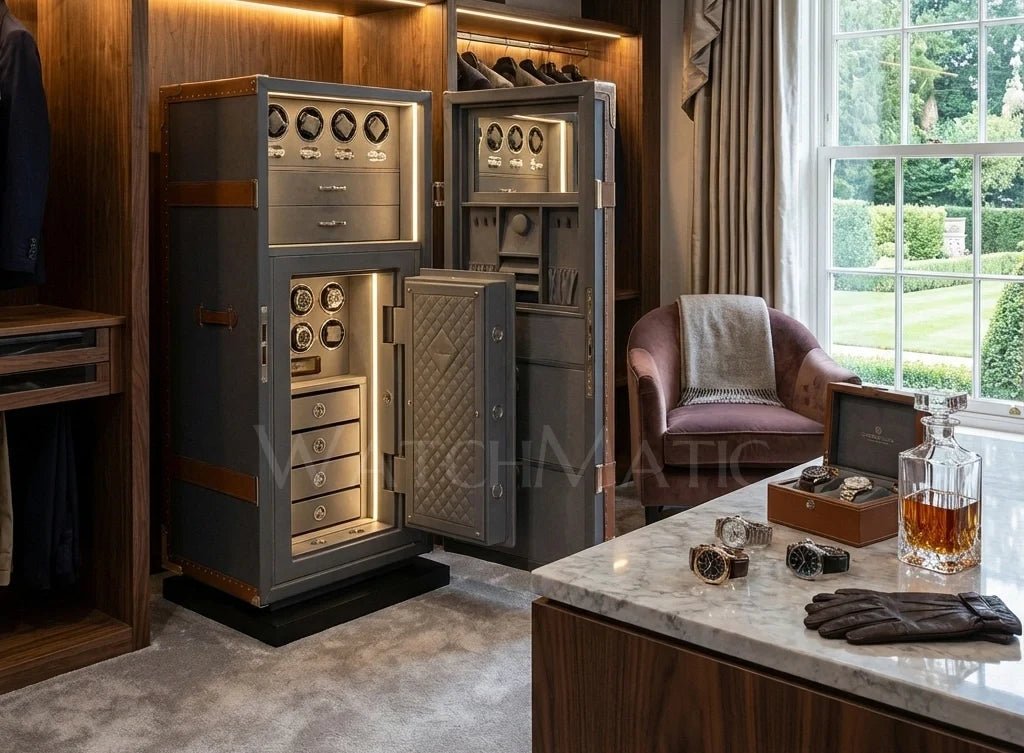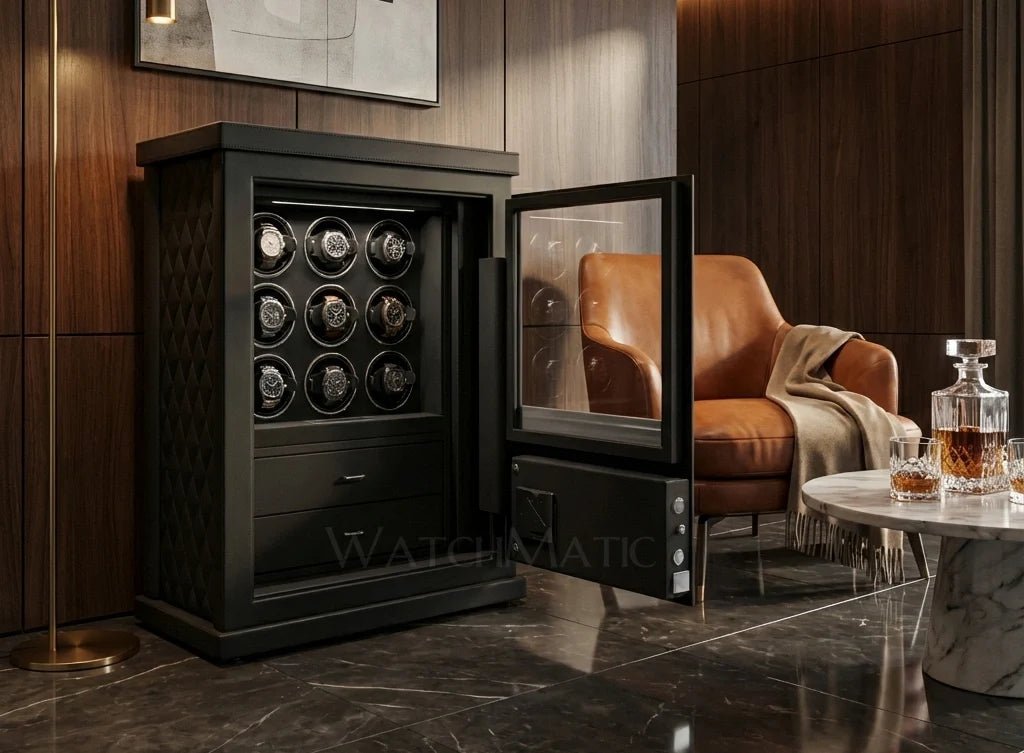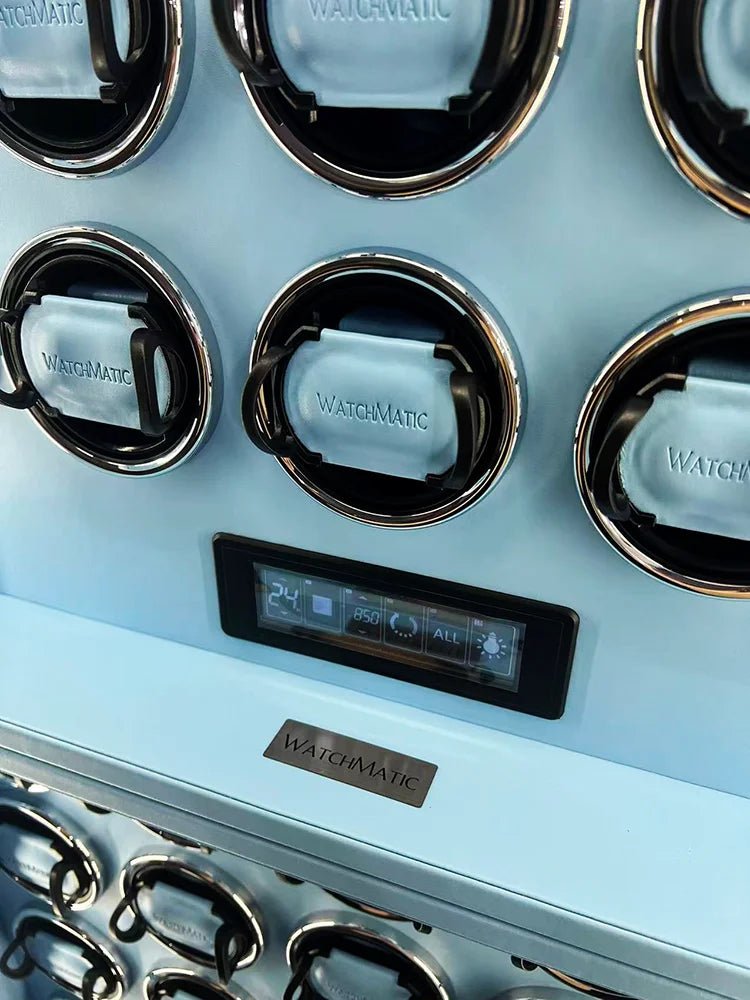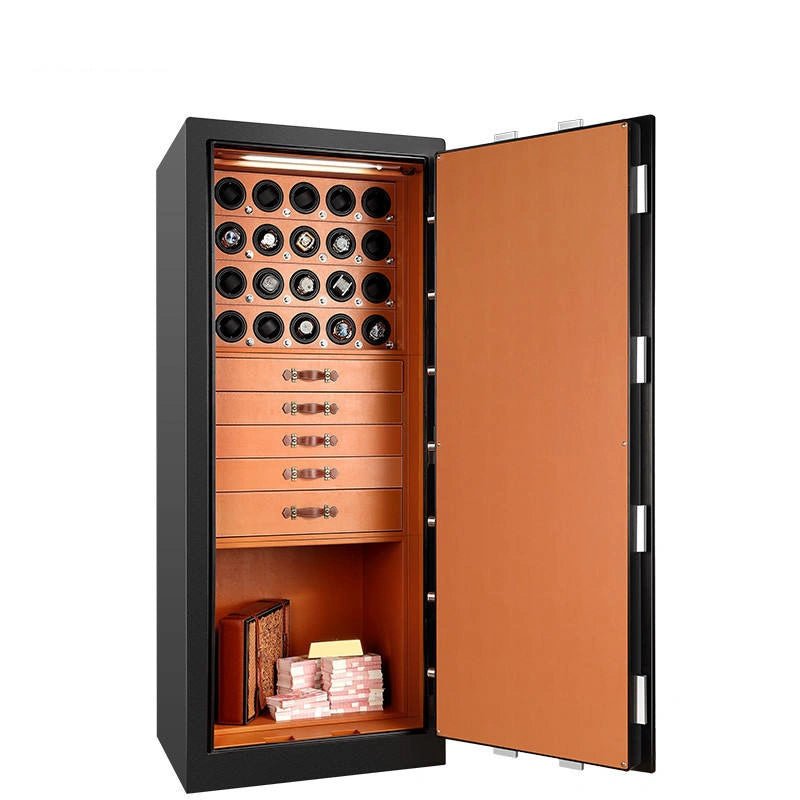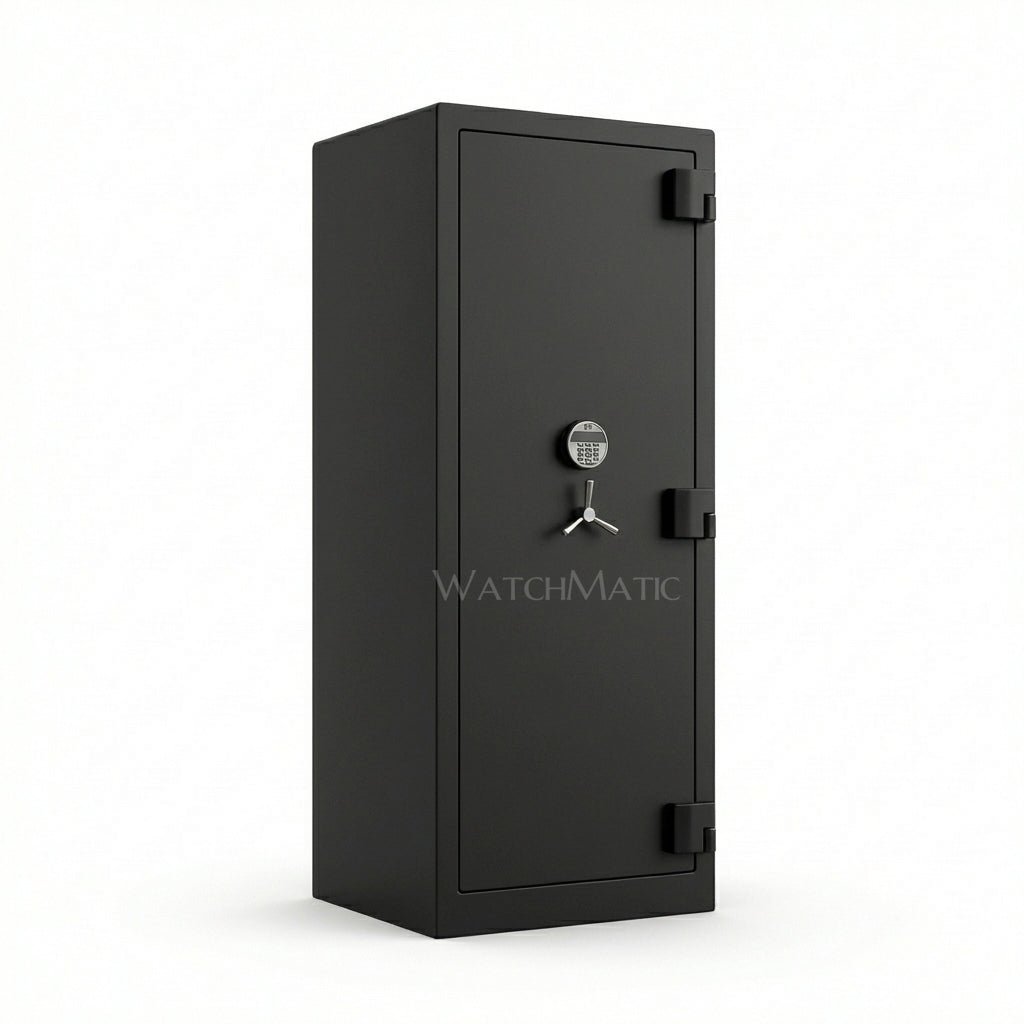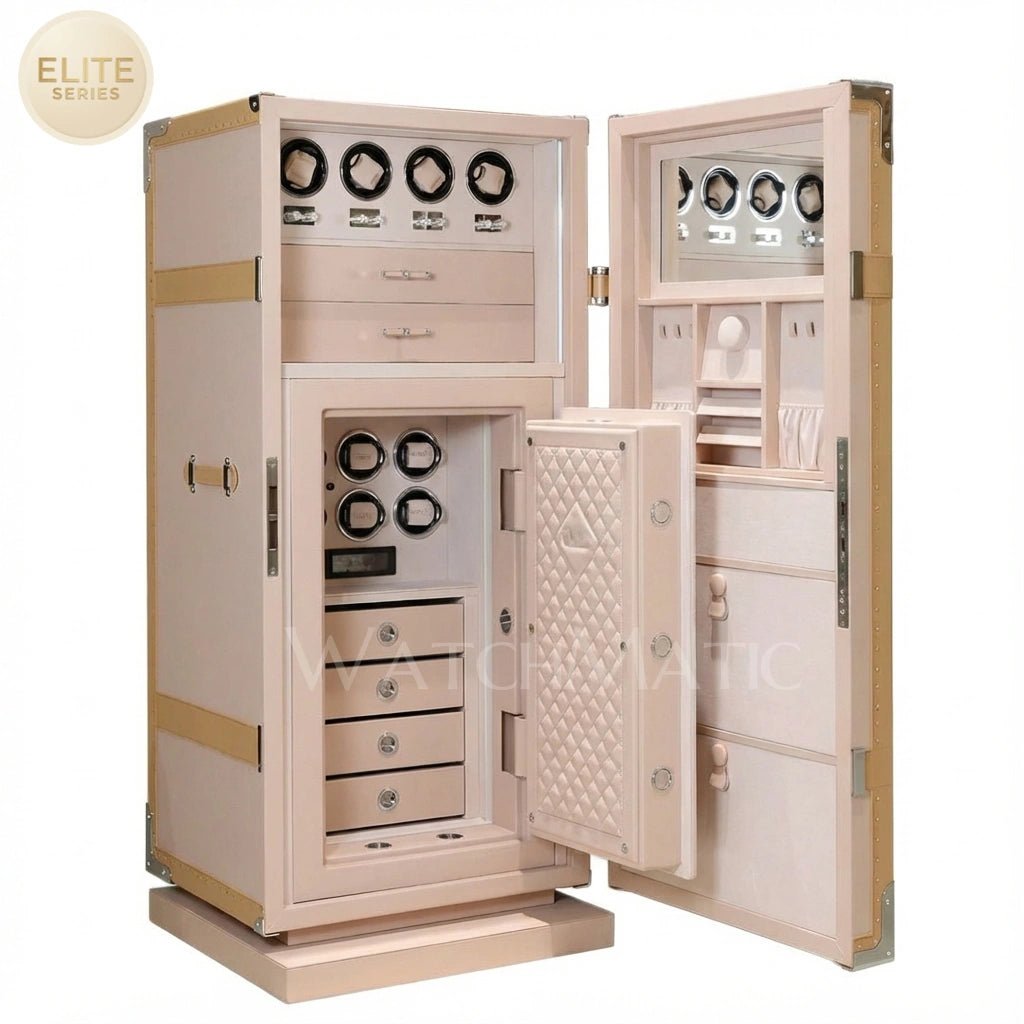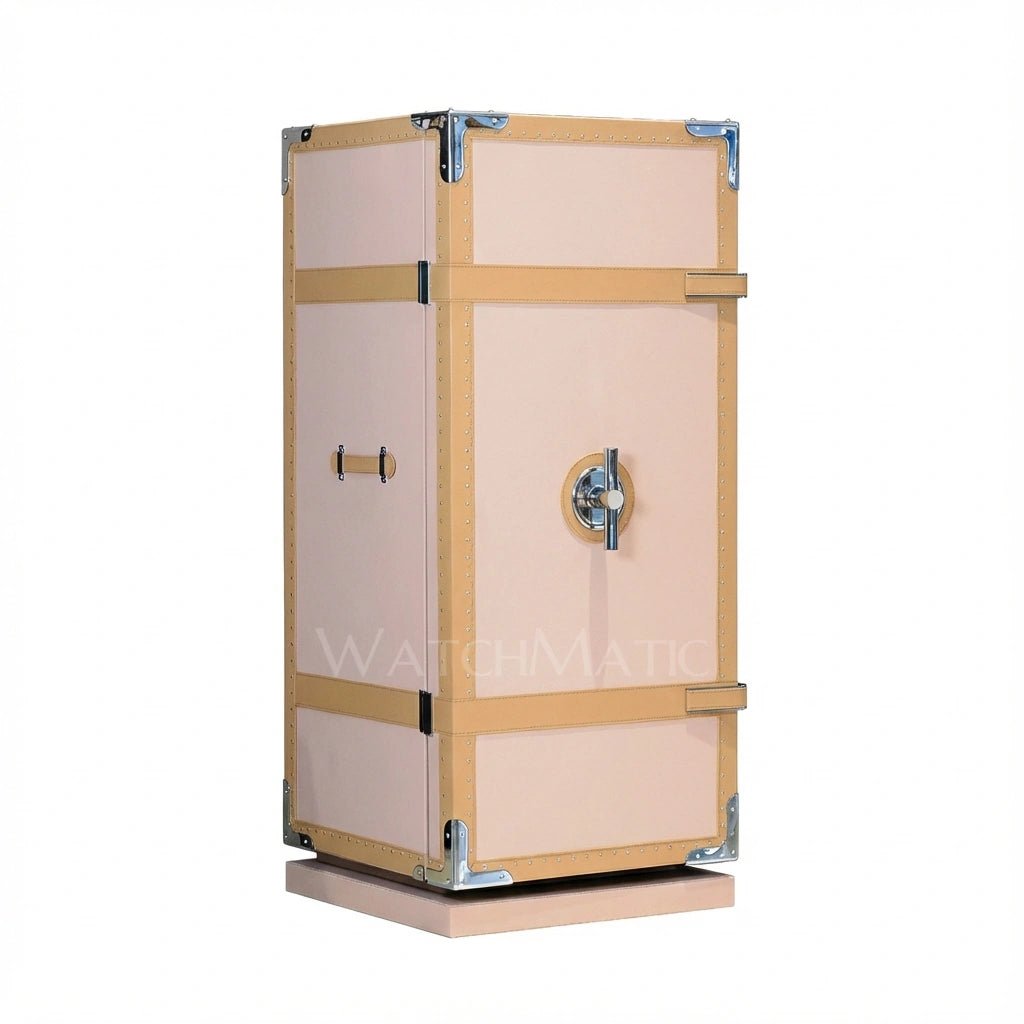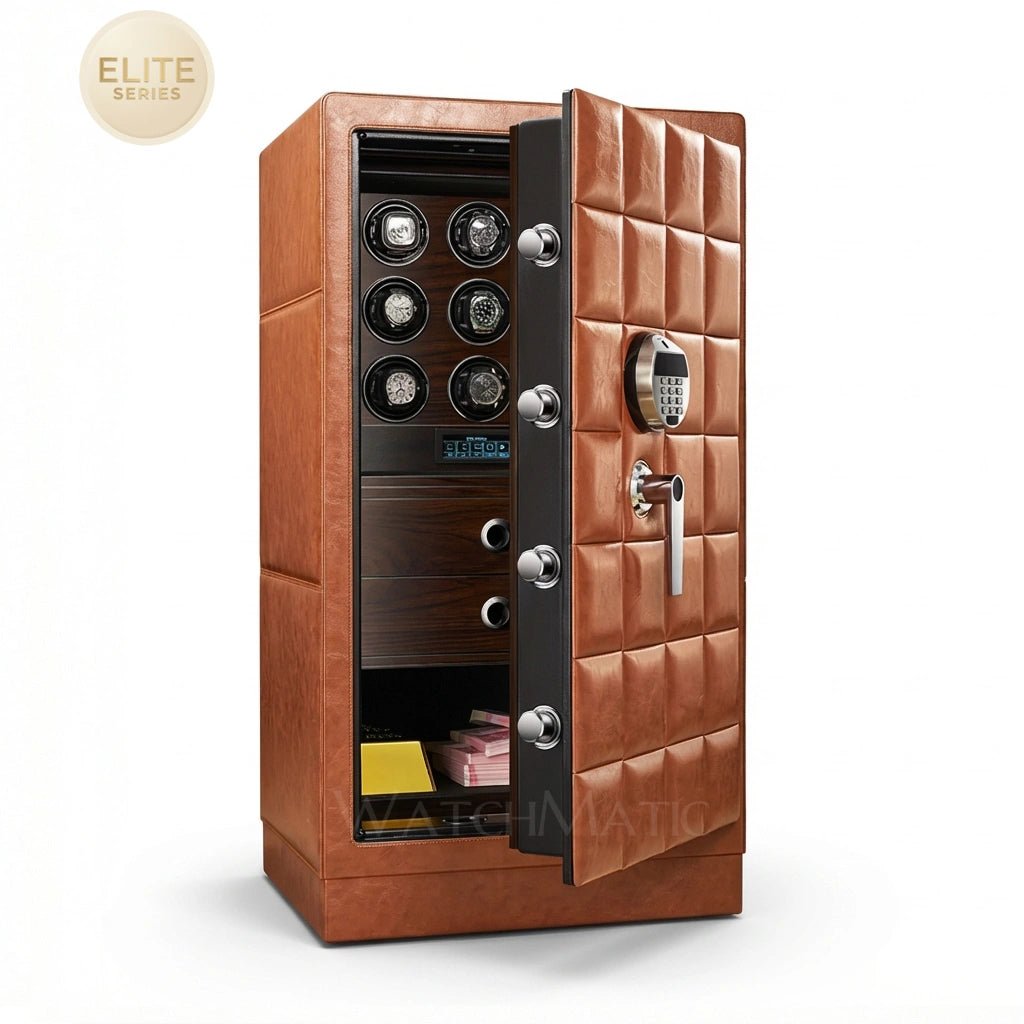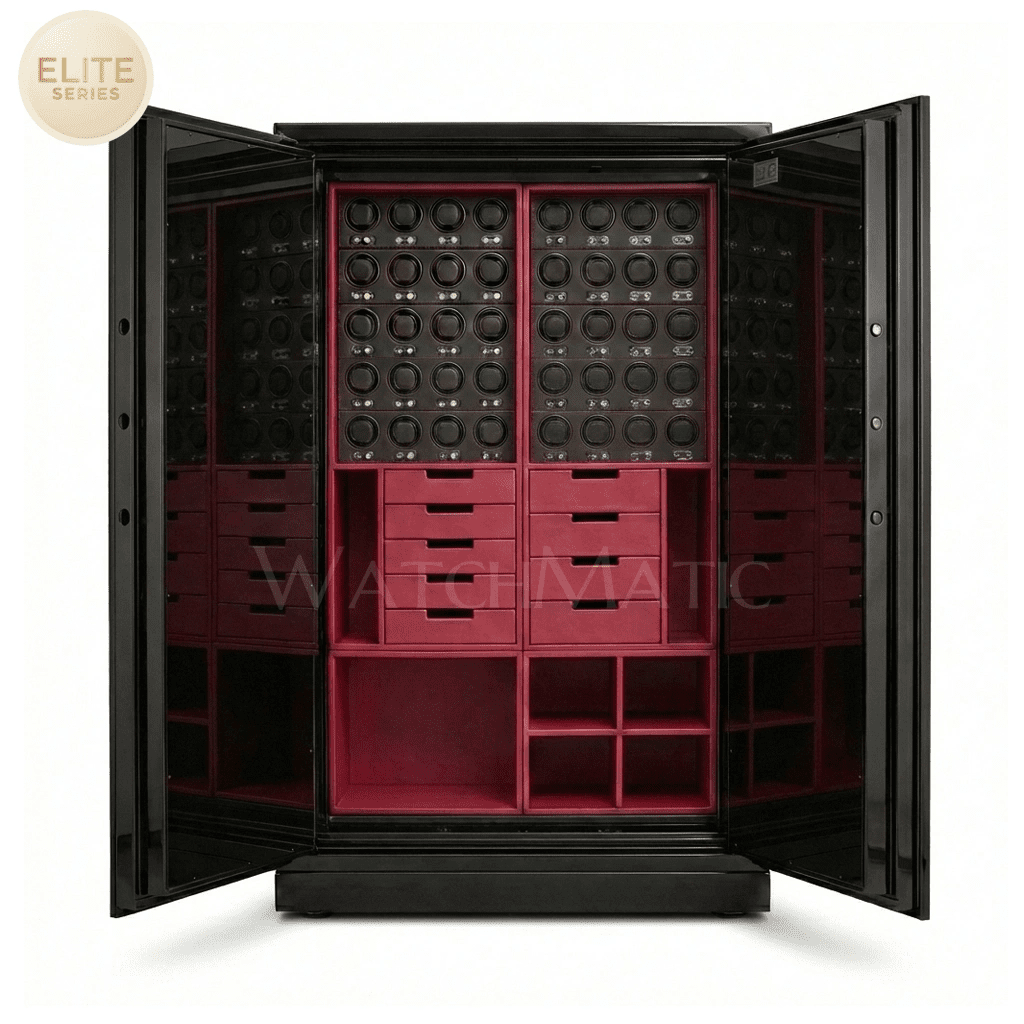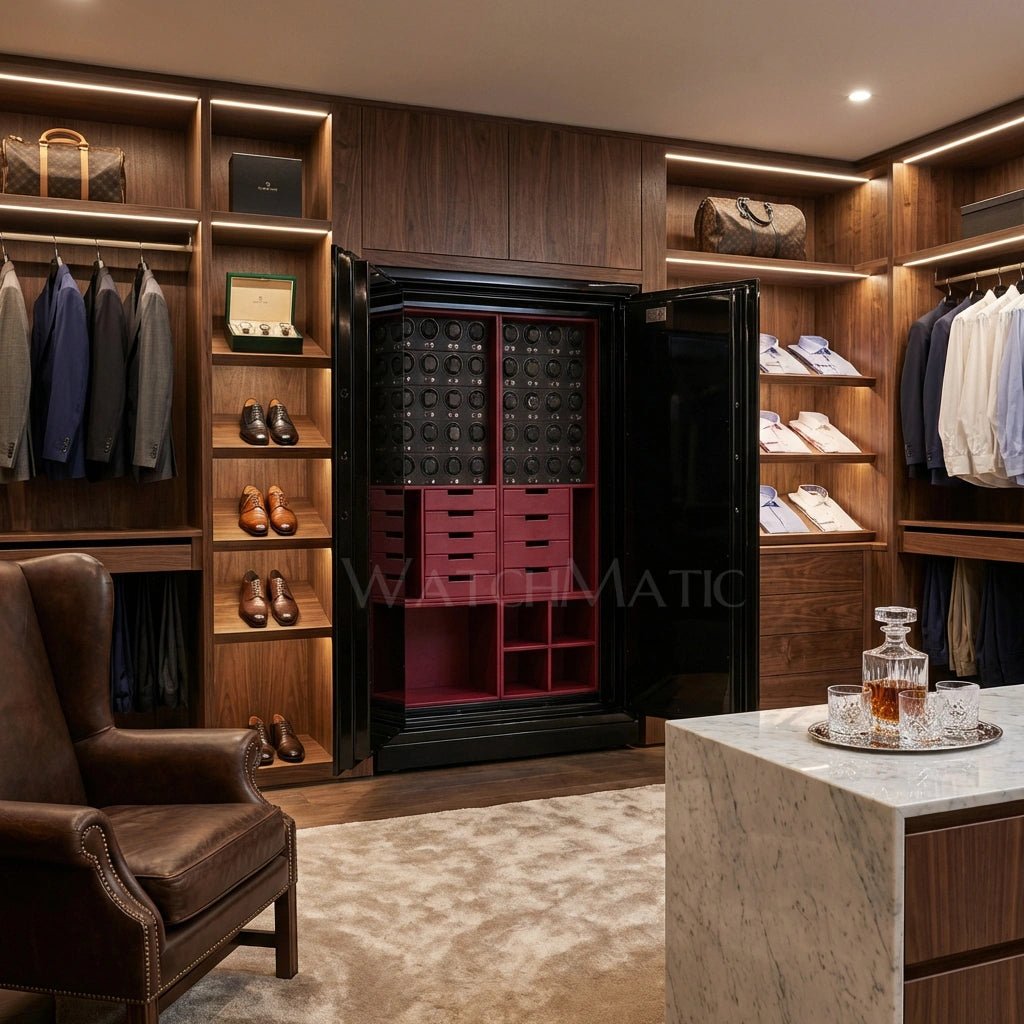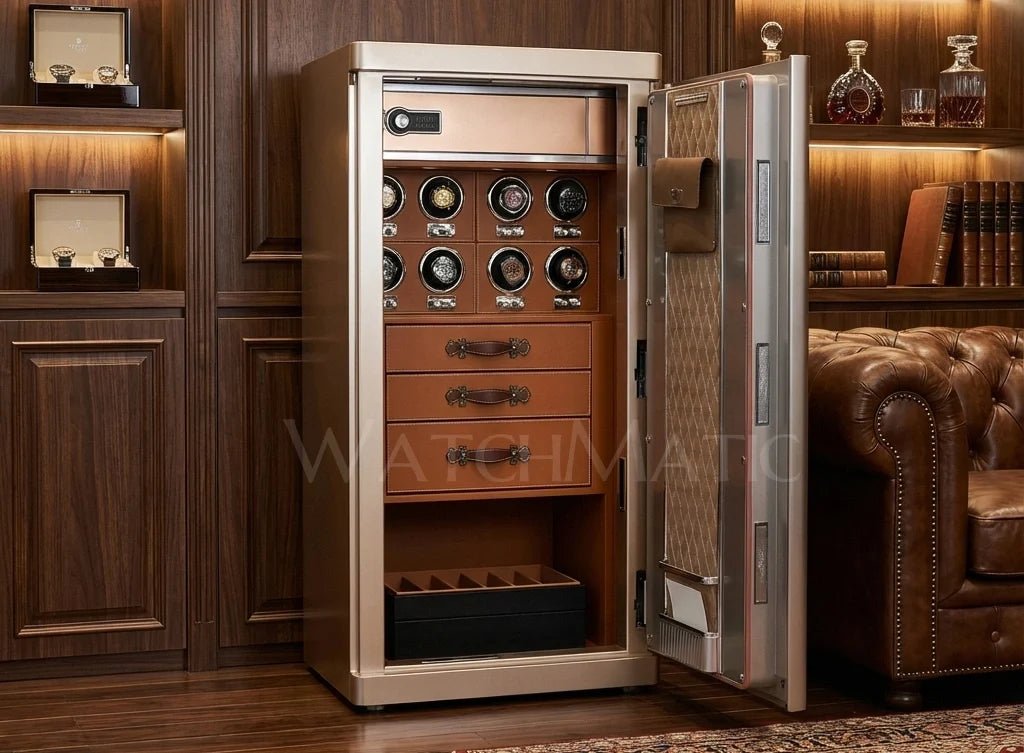
Choosing a watch safe often begins with a simple question: What size watch safe do I really need?
At first, the answer might seem straightforward. If you own eight watches, you look for an eight-watch safe. If your collection includes twenty timepieces, you consider a twenty-watch cabinet.
But watch safe sizing is more complicated than matching the number of watches to the number of available slots.
The right size depends on how many watches you own, how many require automatic winding, the physical dimensions of your timepieces, the storage space needed for accessories, and how much your collection is likely to grow.
There is also another important consideration: the safe must physically fit into your home. A cabinet with the perfect internal configuration is of little use if it cannot pass through your doorway, fit inside an elevator, or be safely supported by the intended floor.
This guide explains how to choose the right watch safe size, understand watch storage capacity, compare compact and large watch safes, and plan for a secure storage system that remains practical for years to come.
Quick Answer: What Size Watch Safe Do You Need?
For most collectors, the best starting point is to choose a watch safe that accommodates the current collection while leaving reasonable room for future acquisitions.
A practical rule of thumb is to reserve approximately 20–30% additional storage capacity if you expect the collection to grow. This is a planning guideline, not a strict requirement.
The following table provides a general starting point for choosing watch safe capacity.
| Collection Size | Suggested Safe Category | Best Suited For |
|---|---|---|
| 1–4 watches | Compact watch safe or small secured storage | Small, carefully selected collections |
| 5–8 watches | 6–8-watch safe | Collectors with a regular watch rotation |
| 9–12 watches | 12-watch safe or larger mixed-storage configuration | Established collections requiring organized storage |
| 13–20 watches | 20-watch safe or customized cabinet | Growing luxury watch collections |
| 21–40 watches | High-capacity watch safe | Serious collectors seeking centralized storage |
| 40+ watches | Large or bespoke watch vault cabinet | Extensive collections requiring tailored capacity |
These are general collection-size categories, not guaranteed capacities for specific products. An eight-winder safe provides eight winding positions, but its additional stationary watch storage depends on the interior layout.
The most suitable safe is not necessarily the largest one available. It is the model that provides the right combination of storage, winding functionality, security, and physical dimensions for your circumstances.
1. Understand the Difference Between Watch Capacity and Safe Size
When shopping for a luxury watch safe, you will encounter two different types of measurements:
- Watch capacity: the number of watches or winding positions the safe can accommodate.
- Physical dimensions: the external height, width, and depth of the safe cabinet.
These measurements are related, but they are not interchangeable.
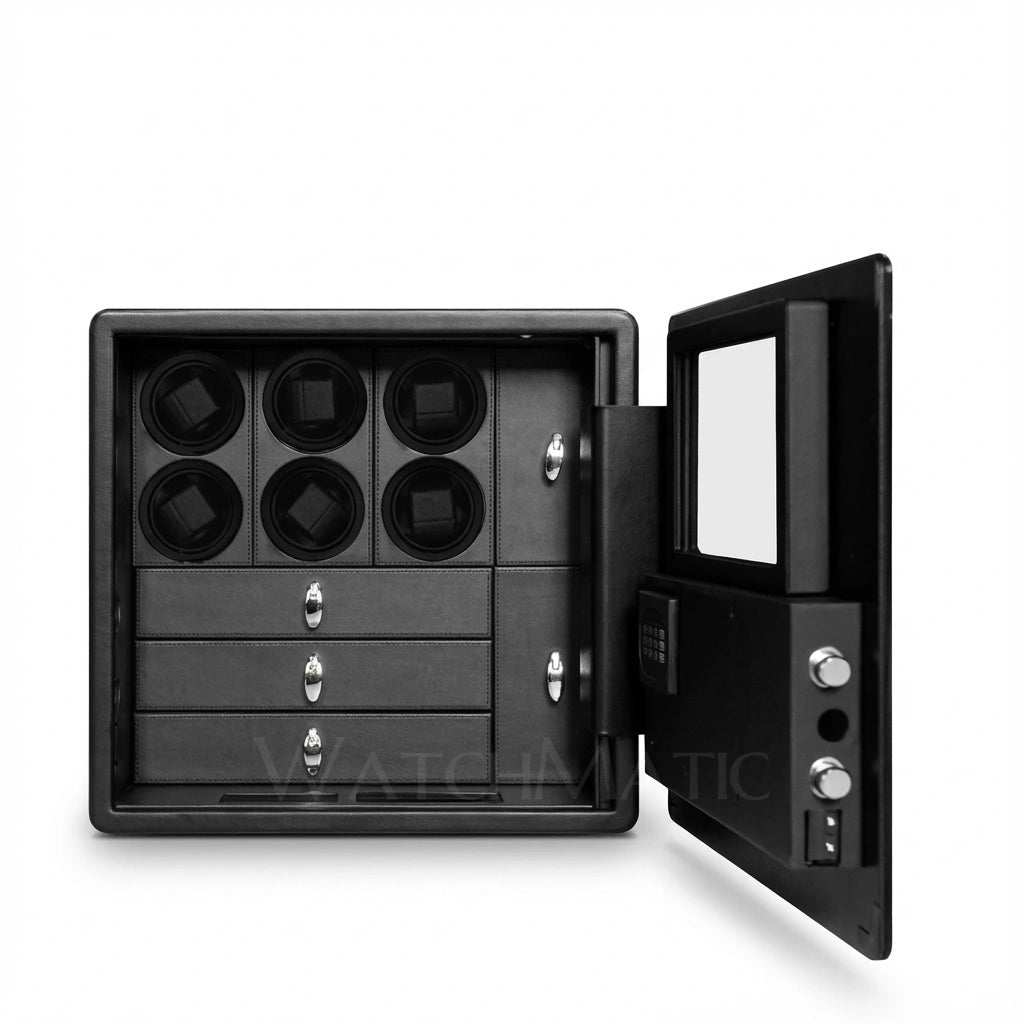
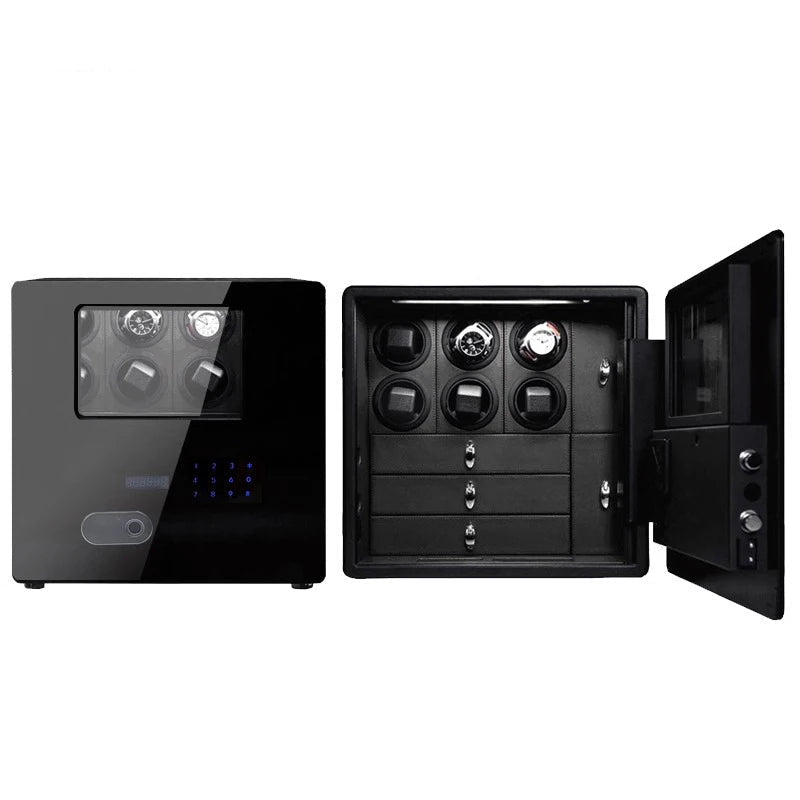
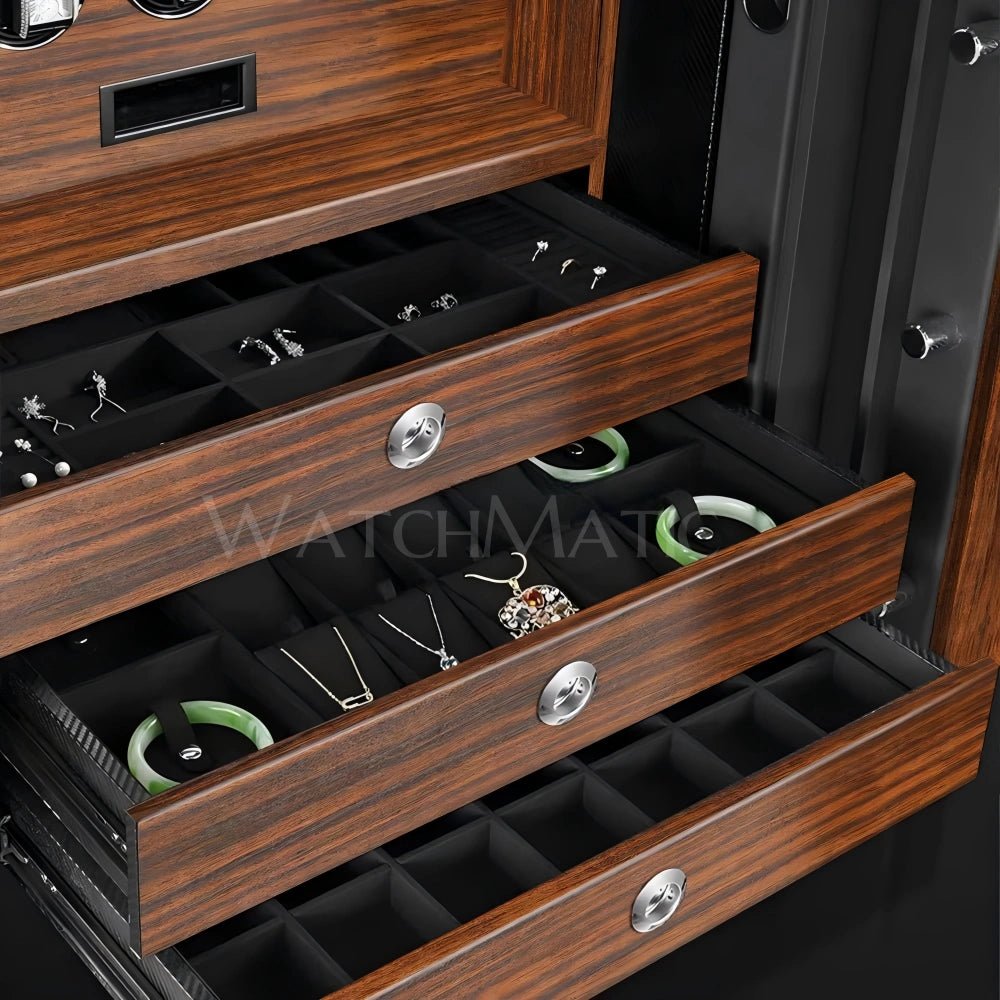
Two safes with similar external dimensions may contain entirely different internal arrangements. One might feature a large number of integrated winding modules, while another uses part of that space for jewelry drawers, watch holders, or additional storage.
Winder Capacity Is Not Always Total Storage Capacity
A safe advertised as a "12-watch winder safe" typically refers to twelve integrated winding positions.
Depending on the model, it may also offer stationary watch compartments or accessory drawers. Alternatively, most of the interior space may be dedicated to the winding system.
For this reason, always ask the manufacturer to clarify:
- How many individual winding positions are included?
- How many additional watches can be stored without winding?
- Are the drawers designed for watches, jewelry, or general storage?
- Can the interior arrangement be modified?
- Are all positions suitable for your watch sizes and bracelet types?
Understanding the actual interior configuration helps prevent a common mistake: purchasing a safe with sufficient winders but inadequate room for the rest of the collection.
2. Count Your Watches by Storage Requirements
Before comparing watch safe dimensions, take inventory of the watches you currently own.
Rather than treating every timepiece identically, divide the collection into categories based on how each watch will be stored.
Automatic Watches Used Regularly
These are automatic watches that you frequently rotate and prefer to keep running between wears.
They are the main candidates for integrated watch winding positions.
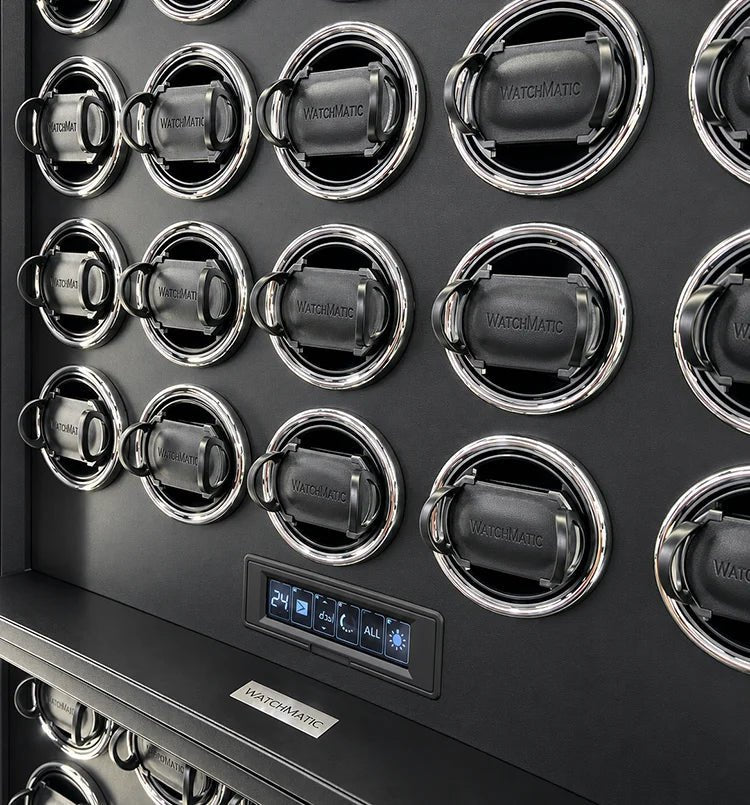
A programmable watch winder can maintain the power reserve of a compatible automatic movement while the watch is not being worn, reducing the need to reset the time, date, or other complications.
Automatic Watches Stored Without Winding
Not every automatic watch needs to remain on a winder.
Watches worn only occasionally can generally be stored stationary according to the movement manufacturer's recommendations.
This distinction can significantly reduce the number of winding modules you need.
Manual-Winding and Quartz Watches
Manually wound mechanical watches and quartz watches do not require conventional automatic watch winding systems.
They should instead be allocated appropriately sized stationary storage positions.
Oversized or Unusually Shaped Watches
Some watches require more physical clearance than others.
A slim dress watch may fit comfortably on a standard cushion, while a large sports chronograph, oversized case, or rigid integrated bracelet may require a different holder.
The number of nominal watch positions is therefore only useful when those positions actually accommodate the watches you own.
For broader storage guidance, read How to Store Luxury Watches at Home.
3. Calculate How Many Watch Winder Slots You Actually Need
One of the most effective ways to determine watch safe capacity is to calculate winding and stationary storage separately.
Begin with three figures:
- The number of automatic watches you want to keep running regularly.
- The number of watches that will remain in stationary storage.
- The number of additional watches you reasonably expect to acquire.
Example: A Collector With 10 Watches
Imagine a collection consisting of:
- Six automatic watches worn in regular rotation.
- Two automatic watches kept for occasional use.
- One manually wound dress watch.
- One quartz watch.
In this situation, the collector does not necessarily need ten winding positions.
Six integrated winders may cover the current daily rotation, while the remaining four watches can occupy stationary storage compartments.
If the collector expects to add two more automatic watches over the next several years, an eight-winder configuration could provide suitable expansion capacity.
However, the safe would also need enough dedicated stationary storage for the other four watches, and potentially additional future acquisitions.
The important distinction is that eight winding positions do not automatically mean the complete safe can hold every watch and accessory in the collection.
A Simple Watch Safe Capacity Formula
Use the following planning method:
Required winding capacity = Automatic watches you intend to keep running + planned additional winding positions.
Required stationary storage = Watches not assigned to winders + planned additional stationary positions.
Check both requirements against the actual interior layout of any safe you are considering.
For a more detailed comparison of winding capacity and collection growth, see our Watch Safe Capacity Planning Guide.
4. How Much Extra Capacity Should You Allow for Future Watches?
Luxury watch collections rarely remain unchanged forever.
New acquisitions, changing preferences, and the addition of watches for different occasions can gradually increase storage requirements.
For collectors who expect steady growth, allowing approximately 20–30% additional capacity is a useful starting point.
For example, a collector with nine watches who expects several new acquisitions might initially plan for approximately twelve total positions.
However, this does not mean that every collector should purchase a safe that is 30% larger than the present collection.
Consider your actual buying habits.
Stable Collections
If you own a carefully curated collection and rarely acquire new watches, a safe closely matching your current storage requirements may be entirely appropriate.
Gradually Growing Collections
If you typically purchase one or two watches each year, a modest reserve of unused capacity can help avoid an early upgrade.
Actively Expanding Collections
Collectors planning multiple acquisitions, especially those with complicated automatic movements, may benefit from choosing a larger cabinet or a bespoke interior from the outset.
The goal is to avoid paying for unnecessary capacity while also recognizing the inconvenience and expense of replacing a heavy safe that has been outgrown.
5. What Size Watch Safe Is Best for Different Collections?
While exact dimensions vary by manufacturer, certain safe formats are better suited to particular collection sizes and storage habits.
Compact Watch Safes: Approximately 4–8 Winding Positions
Compact watch safes are commonly considered by collectors with smaller collections who want to combine secure storage and convenient access.
They may fit in a dressing room, home office, bedroom, or an appropriately designed cabinet area.
Best suited to: collectors with several valuable watches, relatively limited space, and no immediate need for extensive winding capacity.
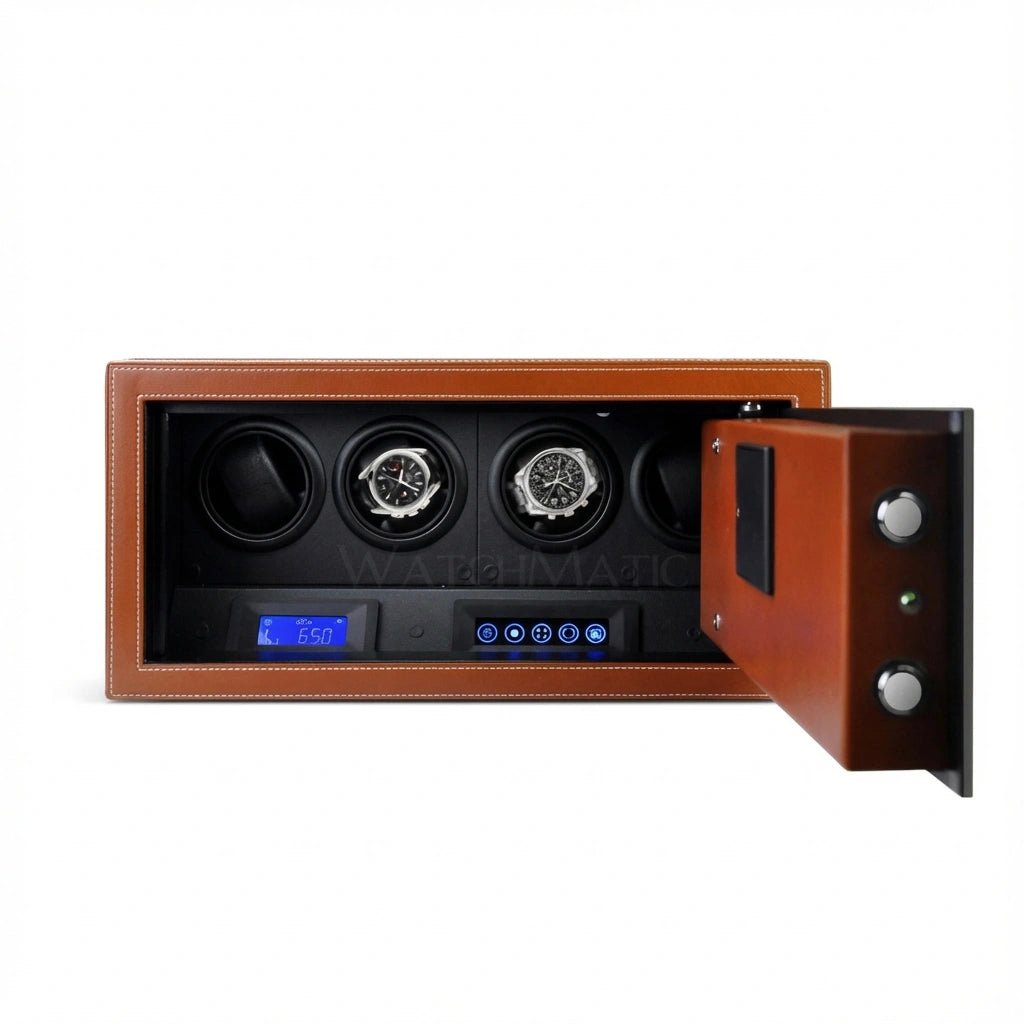
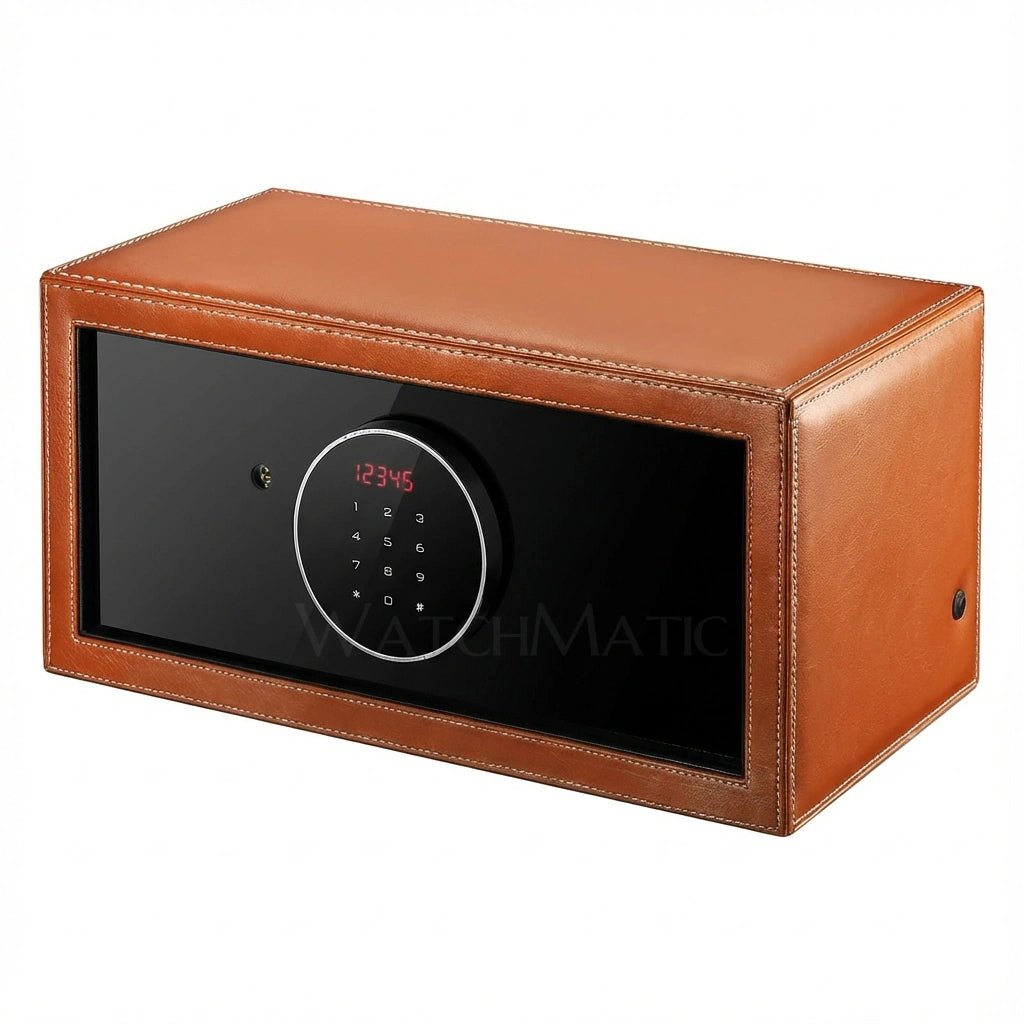
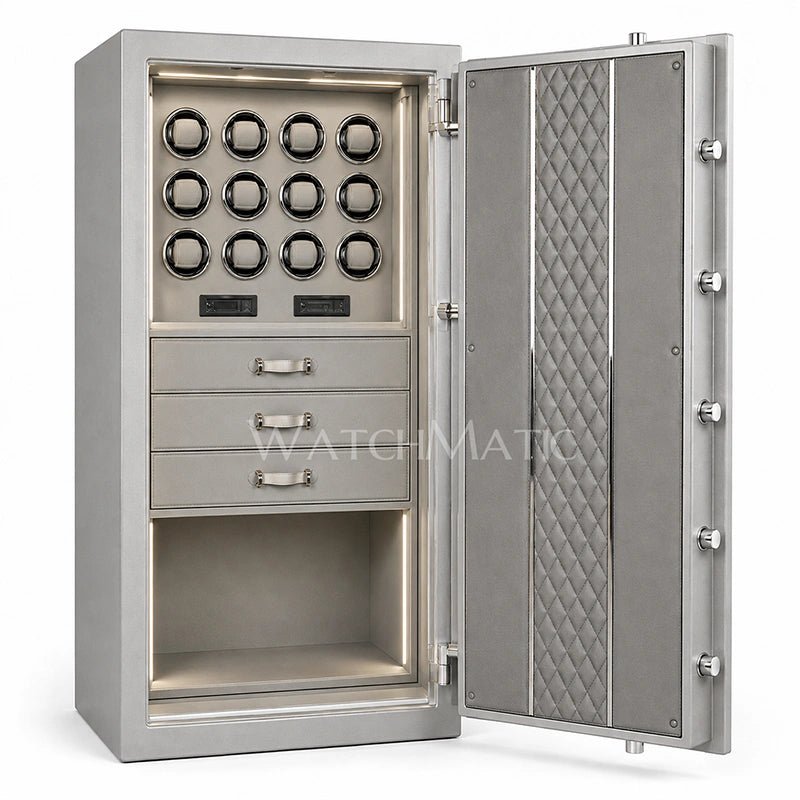
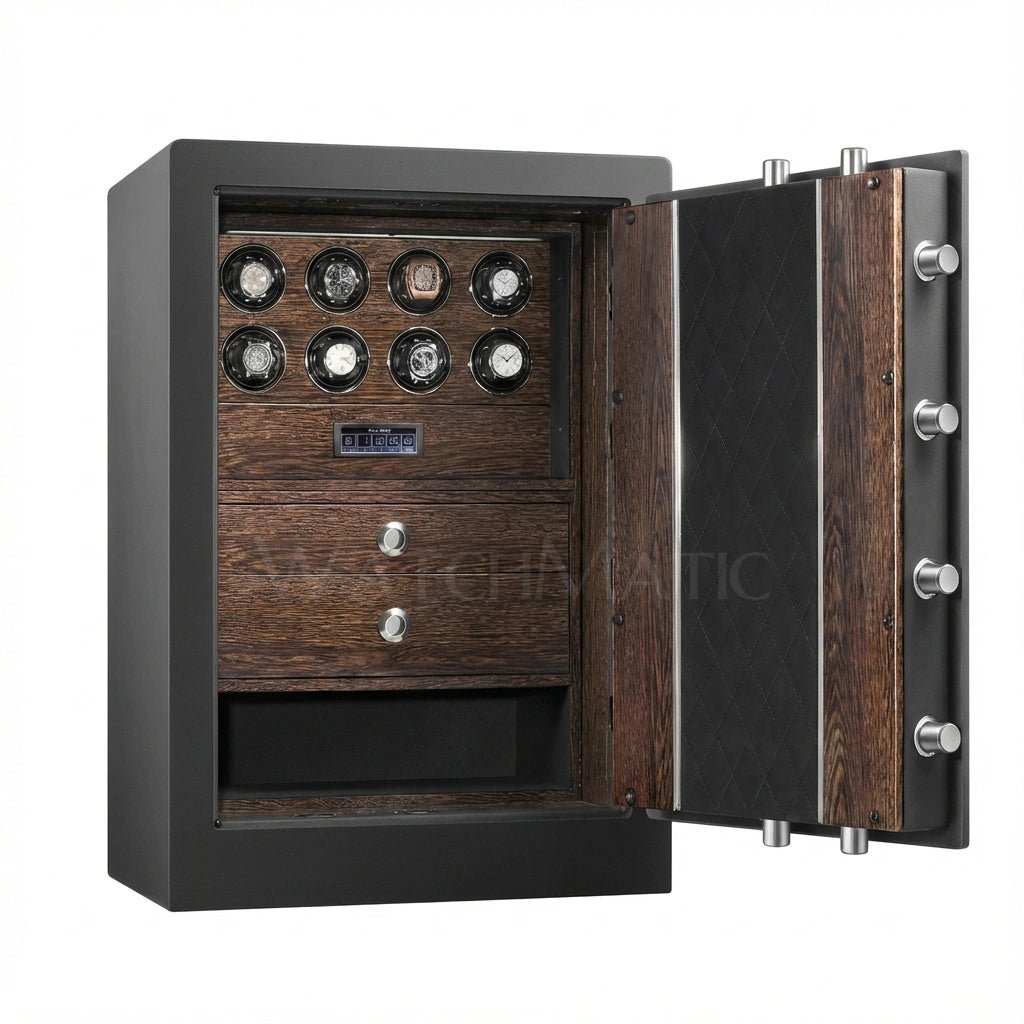
For example, the WatchMatic Titan Vault 8 provides eight integrated winding positions within a floor-standing safe measuring approximately 85 cm high, 60 cm wide, and 45 cm deep.
Although more compact than a full-height cabinet, it remains a substantial security product and requires proper installation planning.
Medium Watch Safes: Approximately 10–12 Winding Positions
A medium-capacity watch safe can be an effective compromise between interior storage and available floor space.
This category often suits collectors who have progressed beyond a small group of everyday watches but do not require a full-height, high-capacity cabinet.
Best suited to: established collections, regular watch rotation, and homeowners seeking greater storage without moving to the largest safe categories.
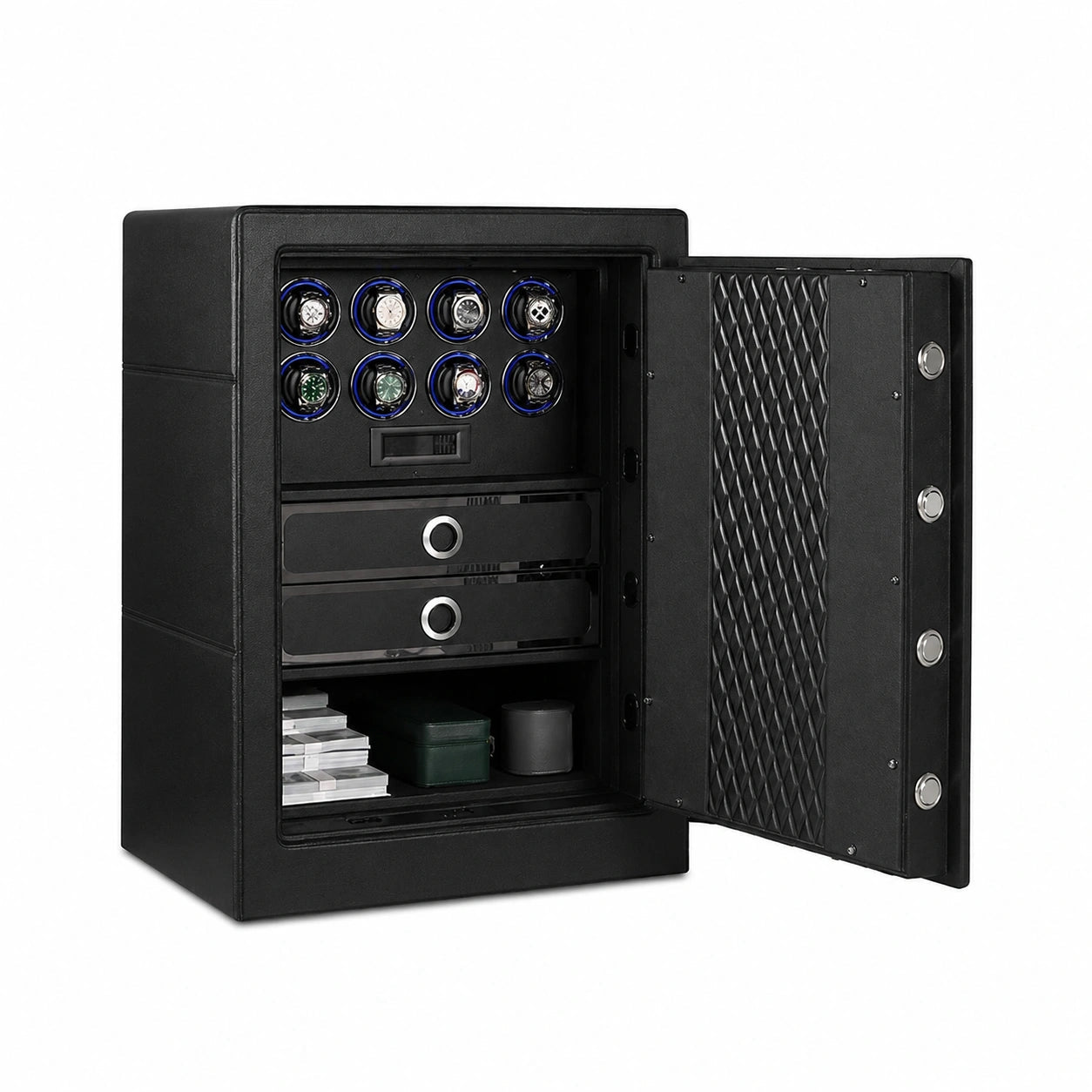
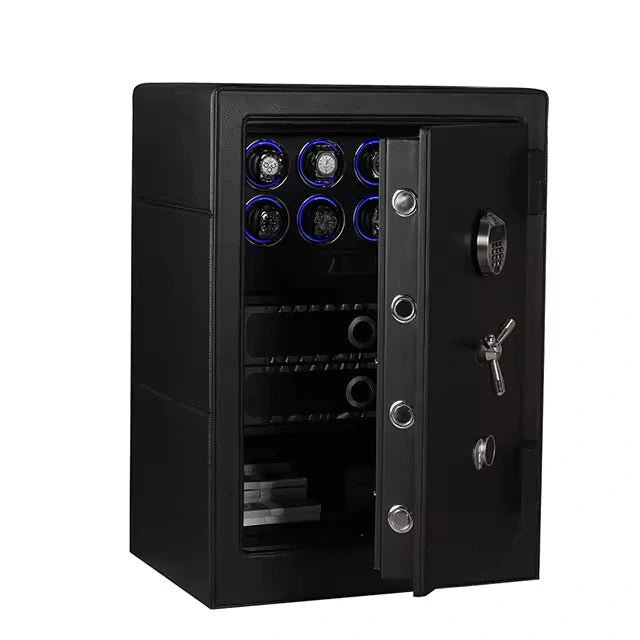
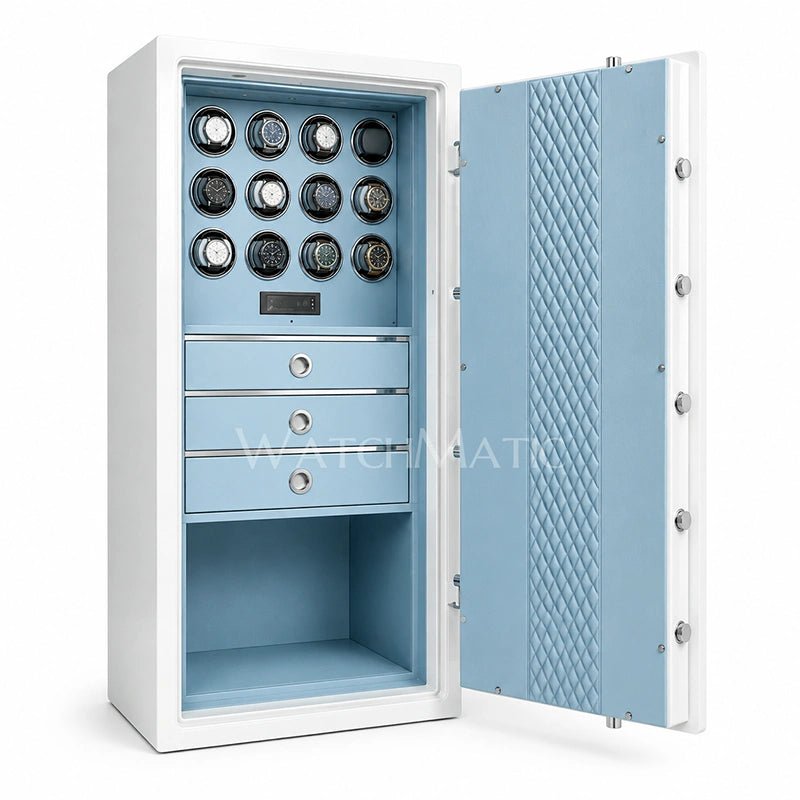
The WatchMatic Titan Vault 12, for example, has published external dimensions of approximately 120 × 60 × 50 cm (height × width × depth).
The taller format provides a different interior arrangement from the eight-winder version, making it worthwhile to compare overall layout rather than winding count alone.
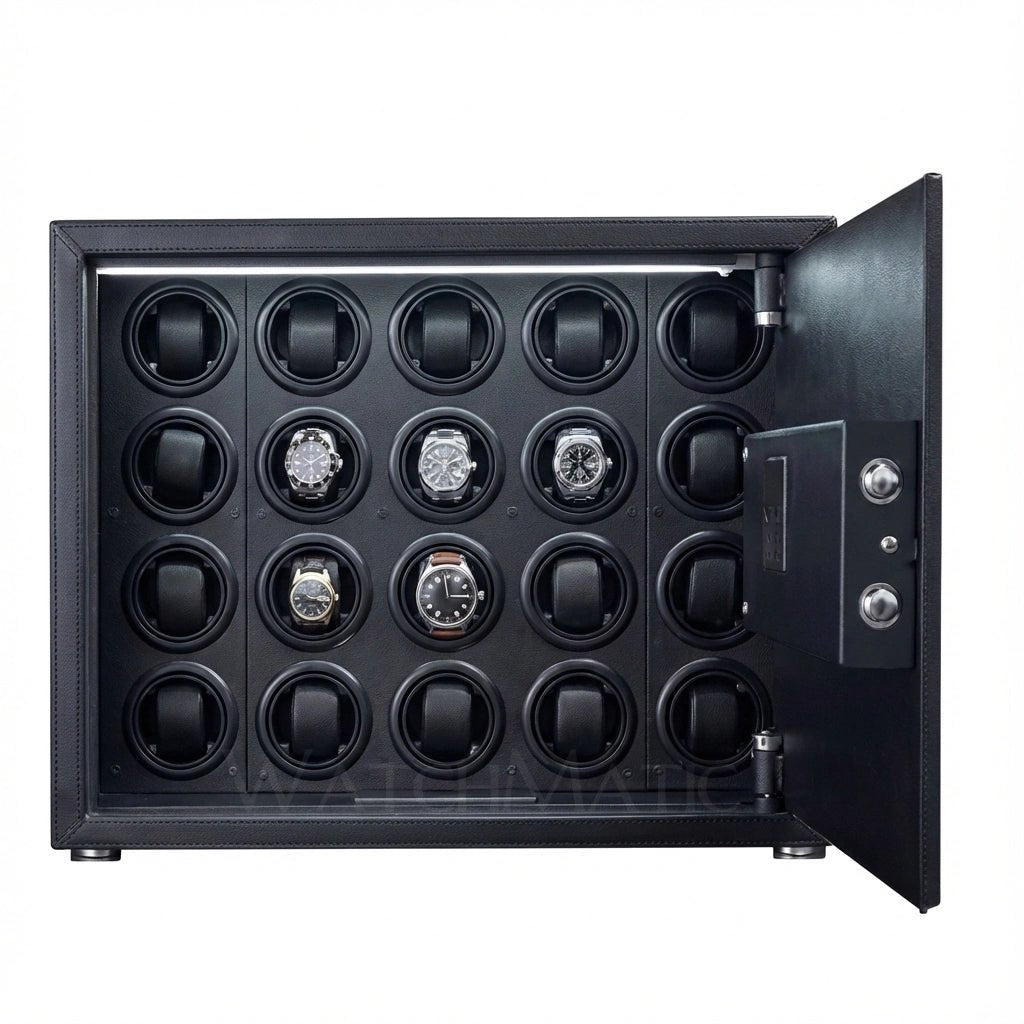
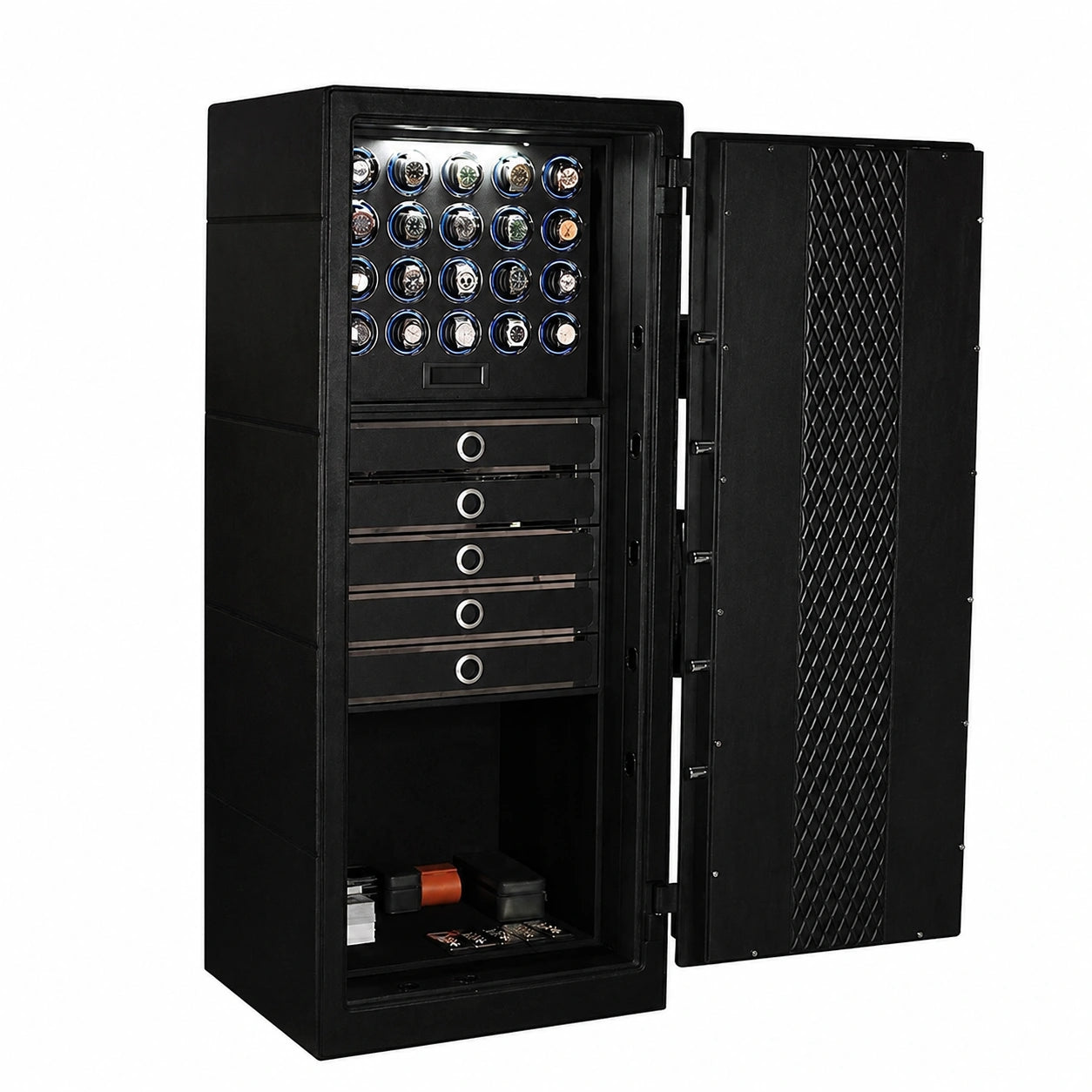
Large Watch Safes: Approximately 20 Winding Positions
A twenty-winder safe is relevant to collectors managing a substantial selection of automatic watches.
At this scale, interior organization becomes especially important. The collector may need separate compartments for daily watches, occasional timepieces, jewelry, spare straps, and accessories.
Best suited to: serious collectors who want centralized storage and considerable winding capacity.
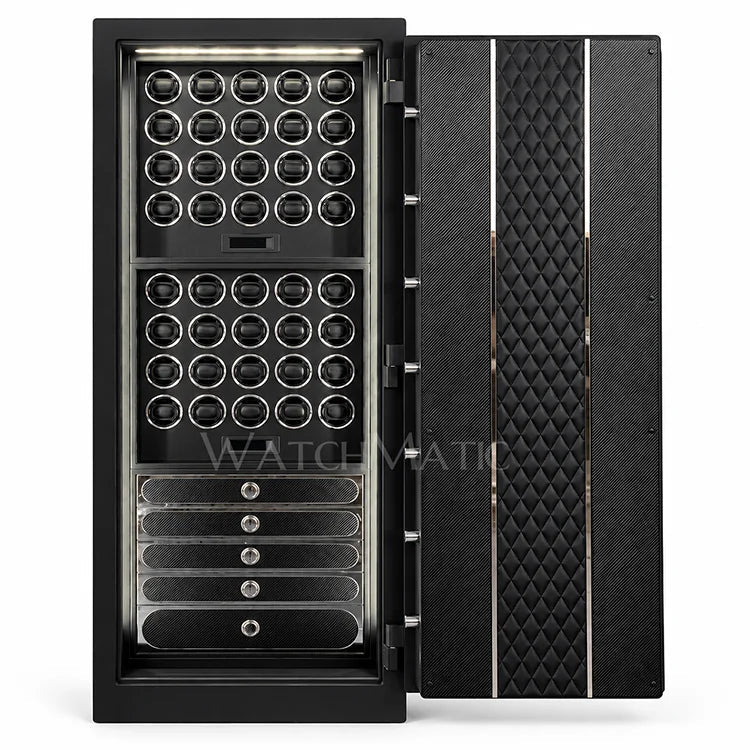
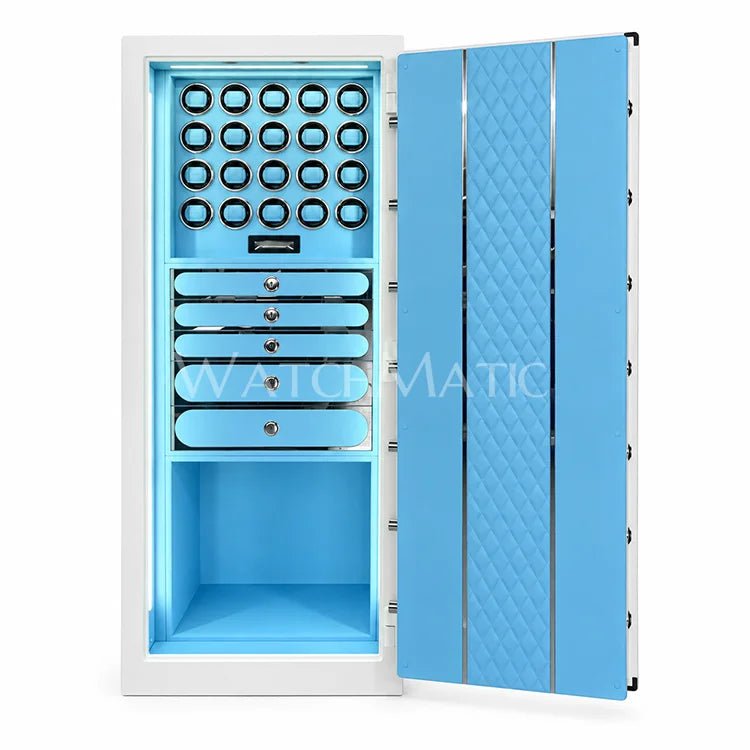
The WatchMatic Titan Vault 20 is a full-height cabinet with twenty integrated winding positions and published exterior dimensions of 170 × 70 × 60 cm.
This type of safe requires careful consideration of floor loading, delivery access, and available room space.
High-Capacity Watch Safes: 40 or More Winding Positions
Collectors with extensive collections may benefit from a large watch safe designed to bring their timepieces into a single organized enclosure.
Higher-capacity systems can offer greater convenience for managing multiple automatic watches, especially when individual winding programs are available.
Best suited to: collectors with large watch portfolios, significant winding requirements, or dedicated watch storage rooms.
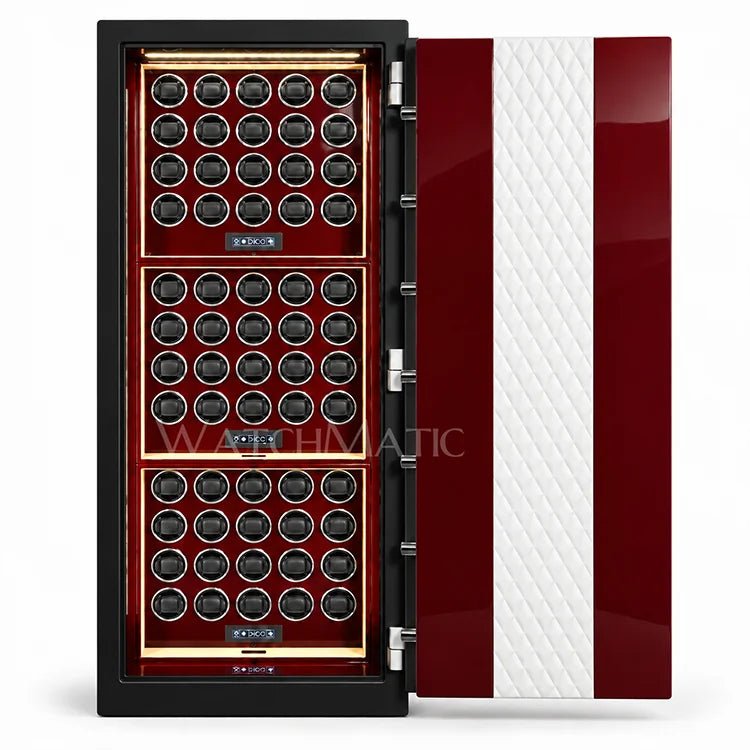
The WatchMatic Titan Vault 40 provides forty winding positions within a substantial floor-standing cabinet.
Notably, its published exterior measurements are similar to those of the Titan Vault 20, illustrating how different internal configurations can influence storage capacity without necessarily increasing the external cabinet size.
For even larger collections, multiple safes or a bespoke watch vault cabinet may be more practical than choosing a standard model.
6. Compare Real Watch Safe Dimensions: WatchMatic Titan Vault Examples
To understand how watch safe capacity relates to cabinet dimensions, consider the published specifications for four WatchMatic Titan Vault configurations.
| Model | Winding Positions | External Size H × W × D | Published Weight |
|---|---|---|---|
| Titan Vault 8 | 8 | 85 × 60 × 45 cm | 190 kg |
| Titan Vault 12 | 12 | 120 × 60 × 50 cm | 250 kg |
| Titan Vault 20 | 20 | 170 × 70 × 60 cm | 420 kg |
| Titan Vault 40 | 40 | 170 × 70 × 60 cm | 420 kg |
Dimensions and weights reflect the listed standard product configurations. Customizations, packaging, and optional upgrades may change the final specifications. Always confirm the approved technical drawing before purchasing or arranging installation.
Several practical observations emerge from this comparison.
More Winding Positions Do Not Always Require a Larger Exterior
The published Titan Vault 20 and Titan Vault 40 dimensions are the same, despite their different winding capacities.
For collectors, this means that choosing between configurations may be less about the space occupied in the room and more about the internal allocation of winding modules and storage compartments.
Height Can Be More Important Than Width
Moving from a compact to a full-height safe does not necessarily require a dramatic increase in floor footprint.
However, the additional height can affect the room's visual design, placement under architectural features, and accessibility of upper winding positions.
Weight Changes the Installation Requirements
A cabinet weighing approximately 190 kg presents different logistical considerations from one weighing 420 kg.
The floor structure, access route, handling equipment, and potential need for specialized installation should be evaluated accordingly.
7. External Dimensions vs. Internal Storage Space
Another common mistake is assuming that a watch safe's external dimensions accurately describe the storage space available inside.
In reality, the protective construction of the safe occupies part of the total volume.
The doors, reinforced body, locking mechanisms, internal panels, winding modules, wiring, and drawer structures all reduce the usable interior space.
Why Internal Dimensions Matter
Two safes measuring the same externally may offer different usable storage volumes because of differences in construction and interior design.
When comparing models, ask for:
- Clear internal height, width, and depth.
- Usable drawer dimensions.
- Watch cushion and winding holder dimensions.
- Spacing between adjacent watch positions.
- Available clearance for large watches and bracelets.
- Storage space remaining after optional equipment is installed.
For a watch collector, functional capacity matters more than the total cubic volume of an empty cabinet.
A carefully planned interior with accessible winding modules and dedicated watch drawers may be more useful than a larger safe with poorly organized shelves.
8. Measure the Space Where You Plan to Install the Safe
Once you have identified your preferred winding and storage capacities, the next step is measuring the available space at home.
This process should be completed before selecting the final configuration.
Measure Height, Width, and Depth
Measure the clear space at the intended installation position, including any surrounding cabinetry, wall projections, ceiling features, and baseboards.
Do not assume that the nominal room dimensions represent usable installation space.
Check for:
- Skirting boards and decorative wall panels.
- Built-in cabinets and shelving.
- Electrical outlets and cable access.
- Air-conditioning or ventilation equipment.
- Ceiling slopes or architectural details.
- Uneven floors and thresholds.
Allow Space for the Safe Door to Open
A safe needs more room than its closed external dimensions suggest.
A large hinged door may require significant clearance, particularly when the handle projects beyond the door surface.
Before installation, verify the hinge position, door-opening angle, handle projection, and clearance needed to access the interior drawers.
Do not place the safe where nearby walls or furniture prevent the door from opening sufficiently.
Consider Access to Drawers and Winding Controls
Even when the door can open, the available space may still be inadequate for everyday use.
Make sure the collector can comfortably stand in front of the safe, remove watches, operate the winding controls, and extend the internal drawers.
A well-positioned safe should be convenient to use without forcing the owner to handle valuable watches in an awkward or restricted space.
9. Check Delivery Access Before Choosing a Large Safe
The route from the delivery vehicle to the installation position is just as important as the final room measurements.
This is particularly relevant for heavy watch safes and full-height luxury cabinets.
Doorways and Hallways
Measure the narrowest clear opening along the delivery route.
Remember that door handles, frames, decorative trim, and hallway turns may restrict access even when the safe's nominal width appears acceptable.
Elevators
If the safe will be installed in an apartment or upper-floor residence, confirm the elevator's internal dimensions, clear doorway opening, and rated load capacity.
The total moving load includes the safe, packaging or moving equipment, and any people or additional equipment traveling with it.
Staircases
Stair installations require specialized planning.
Check the clear stair width, landing dimensions, turns, handrails, ceiling clearance, and the load capacity of the structure.
Do not assume that a safe can be safely moved upstairs simply because its width is smaller than the staircase.
Packaging and Crated Dimensions
The shipping crate is usually larger than the safe itself.
Ask for both product dimensions and packaged dimensions. Where necessary, an experienced installation team should establish whether safe unpacking can take place before the final access route.
For heavy models, professional safe movers or white-glove delivery specialists may be required.
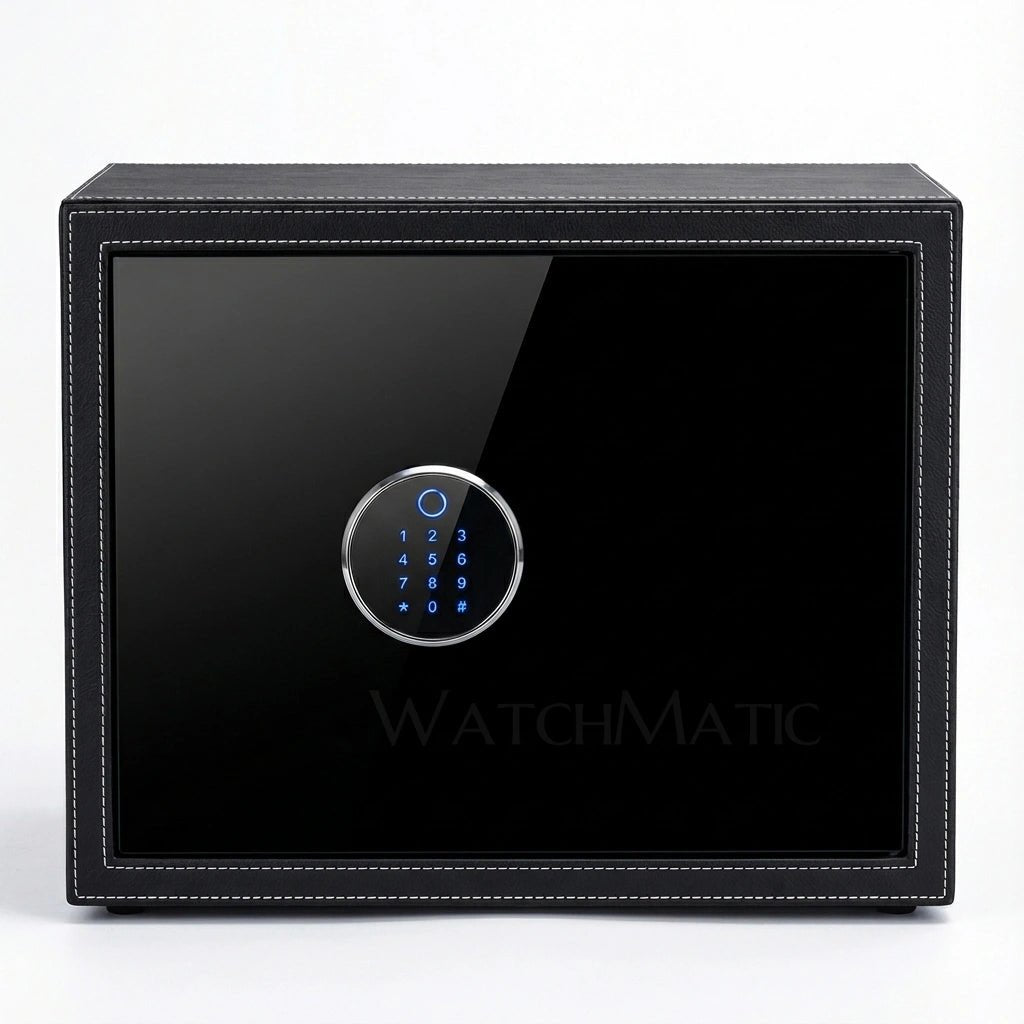
WatchMatic's luxury watch safe cabinet collection includes several full-height options that should be assessed against the intended installation environment before ordering.
10. Does Your Floor Support the Weight of a Large Watch Safe?
Floor capacity is an important consideration when selecting the physical size of a watch safe.
Some large luxury watch safes weigh hundreds of kilograms before any watches or accessories are added.
That load may be concentrated over a relatively small footprint.
For example, a safe measuring 70 cm wide and 60 cm deep occupies a nominal footprint of approximately 0.42 square meters. The actual load transfer to the floor depends on its base construction, anchoring, and contact points.
This is why floor loading should not be evaluated simply by comparing the safe's weight with an assumed residential floor rating.
Ground-Floor Installations
A ground-floor location may simplify delivery and structural planning, but the underlying floor construction must still be suitable for the proposed load.
Upper-Floor Installations
Second-floor rooms, apartments, and other elevated locations require particular attention.
The building's structural system, load distribution, and exact safe position can affect the feasibility of installation.
A qualified structural professional should evaluate substantial installations where the floor capacity is uncertain.
Anchoring and Security
Proper anchoring may be recommended or required depending on the safe design, manufacturer instructions, and security or insurance requirements.
Weight alone does not eliminate the need to consider anchoring.
The correct approach is to coordinate structural suitability, security requirements, and the manufacturer's installation instructions before the safe is delivered.
11. Should You Choose a Floor-Standing or Built-In Watch Safe?
The available space in your home may influence whether a floor-standing or built-in configuration is more appropriate.
Floor-Standing Watch Safes
Floor-standing cabinets are commonly used for medium and large watch collections.
They provide a defined storage enclosure and can be positioned in dressing rooms, home offices, private collection rooms, or other suitable residential locations.
They may also offer greater flexibility if the owner later relocates or redesigns the room, although professional handling can still be required.
Built-In Watch Safes
A built-in configuration can integrate into surrounding cabinetry or an architectural recess.
This approach may be attractive when visual discretion is a priority.
However, built-in installation requires careful attention to door movement, safe anchoring, ventilation where specified, power supply, and access for future servicing.
Decorative cabinetry should not obstruct safe operation or compromise the safe's protective construction.
Bespoke Watch Vault Cabinets
For unusual room dimensions or larger collections, a custom-built safe may provide a better fit than a standard cabinet.
Bespoke projects can be designed around specific winding capacity, drawer arrangements, overall dimensions, and exterior finishes.
These arrangements are particularly relevant for private watch rooms or dressing rooms with detailed architectural requirements.
12. When Is a Custom-Size Watch Safe the Better Option?
Choosing a larger standard model is not always the most effective solution.
Sometimes the challenge is not insufficient capacity, but the need to organize the available space differently.
For example, a collector might require:
- Twenty automatic winding positions within a narrow cabinet.
- A specific safe height to fit inside a dressing room.
- Additional watch drawers instead of unused winding modules.
- A larger number of winders with fewer jewelry compartments.
- A customized door-opening direction.
- Dedicated storage for jewelry, rings, straps, and accessories.
- Specialized locking or environmental-control options.
In these situations, a bespoke luxury watch safe may provide a more suitable balance of physical dimensions and interior capacity.
WatchMatic offers custom configurations for collectors seeking personalized winding arrangements, storage compartments, materials, and selected security features.
The final design should be evaluated as a complete system. Changes to the exterior dimensions, security construction, door, or internal components may affect structural engineering, certification options, and installation requirements.
13. Do Not Choose Safe Size Without Considering Security
Although capacity and dimensions are the focus of this guide, they should never be evaluated independently of security requirements.
A large cabinet with numerous winding positions is not automatically more secure than a smaller safe with independently verified burglary resistance.
For valuable watch collections, consider:
- Safe body and door construction.
- Locking system and emergency access.
- Appropriate anchoring.
- Documented burglary-resistance certification, where required.
- Fire-resistance specifications and their limitations.
- Insurance requirements.
- Professional installation.
Security certification is model-specific. Construction described as comparable to a recognized standard should not be confused with a certification awarded to the complete safe.
The size of your collection and its financial value are different considerations. A collection of five exceptionally valuable watches may justify a higher level of verified security than a much larger collection of modestly valued timepieces.
Explore our Watch Safe Guide for more information about security ratings, safe construction, and long-term protection.
14. Common Mistakes When Choosing Watch Safe Size
Avoiding a few common mistakes can make a significant difference in the usefulness and longevity of your investment.
Buying a Safe Based Only on the Current Watch Count
If the collection is likely to expand, selecting a safe with no spare capacity may result in an earlier-than-expected replacement.
Confusing Winder Capacity With Total Watch Storage
A twelve-winder safe does not necessarily offer twelve additional stationary compartments. Always review the interior drawings and actual storage configuration.
Ignoring Large Watch Cases and Bracelets
Not every watch will fit comfortably into every winding holder or drawer compartment. Confirm dimensions when storing oversized watches or rigid bracelets.
Overlooking Door Clearance
A safe that fits the available wall space may still be impractical if its door cannot open fully or the drawers cannot be accessed comfortably.
Choosing a Heavy Safe Before Checking the Delivery Route
Large safes require more than adequate floor space. Elevators, stairs, hallways, and structural limitations can affect whether installation is feasible.
Paying for Winding Positions You Will Not Use
If many watches are manual-winding, quartz, or intended for stationary storage, additional dedicated watch drawers may be more useful than purchasing a cabinet with the maximum possible number of winding modules.
Prioritizing Capacity Over Appropriate Security
A watch safe should be selected according to the value and risk profile of the collection, not simply the number of timepieces it can hold.
15. Final Watch Safe Size Checklist
Before choosing a model, use this checklist to review the practical requirements of your collection and home.
| Planning Area | What to Confirm |
|---|---|
| Current collection | Number of watches and movement types |
| Winding requirements | Number of automatic watches requiring active winding |
| Stationary storage | Additional watch holders and drawers needed |
| Future growth | Reasonable expansion over the next several years |
| External dimensions | Safe height, width, and depth |
| Interior dimensions | Usable space and compatibility with watch sizes |
| Door clearance | Door swing, handle clearance, and drawer access |
| Delivery route | Doorways, hallways, elevators, stairs, and crate dimensions |
| Floor loading | Structural suitability and required professional assessment |
| Security | Construction, lock, anchoring, and required certifications |
| Customization | Alternative layouts, dimensions, and finishes |
Completing these checks before ordering will help you choose a safe that is suitable not only for the collection, but also for the space in which it will be installed.
Frequently Asked Questions About Watch Safe Sizes
What size watch safe do I need for 5 watches?
For five watches, a compact safe with approximately six to eight storage positions may provide adequate capacity and some room for future additions. If several watches are automatic, consider how many need active winding. The remaining watches may be stored in dedicated stationary compartments, provided the safe includes sufficient interior storage.
Is an 8-watch safe big enough for a growing collection?
An eight-watch safe can work well for a small or moderately growing collection. However, the answer depends on whether the eight positions are all winders, whether additional stationary storage is available, and how many watches you expect to acquire. Collectors anticipating rapid growth may benefit from a larger configuration.
Should I buy a 12-watch safe if I own 10 watches?
A twelve-position safe can be a reasonable option for a ten-watch collection, particularly if you expect modest growth. However, you should first determine how many watches require winding and how many will remain stationary. A mixed-storage configuration with fewer winders and additional watch drawers may be more suitable than twelve winding positions.
How much bigger should my watch safe be than my current collection?
Allowing approximately 20–30% additional capacity is a useful planning guideline for collectors who expect their collections to expand. The appropriate reserve depends on your acquisition habits, available space, and whether you can customize the safe later. Stable collections may need little additional capacity.
What is the difference between a 20-watch safe and a 40-watch safe?
The primary difference is the number of watch positions or integrated winding modules, depending on the model. The external dimensions do not necessarily double with the capacity. For example, WatchMatic publishes the same overall exterior dimensions for its standard Titan Vault 20 and Titan Vault 40 configurations, although the internal layouts differ.
How much floor space does a large watch safe require?
The required footprint depends on the safe's external width and depth, but you must also allow for door swing, drawer access, and installation requirements. A 70 cm wide by 60 cm deep cabinet has a nominal floor footprint of 0.42 square meters, yet the usable space required in front of it may be considerably greater.
Can I put a large watch safe in a bedroom or dressing room?
Yes, provided the room has sufficient space, a suitable floor structure, appropriate access, and safe operating clearance. Full-height cabinets may require professional installation, particularly where narrow hallways, stairs, or elevators are involved.
Can a heavy watch safe be installed upstairs?
Potentially, but the installation must be evaluated individually. The safe's weight, concentrated load, building structure, access route, and installation equipment all matter. A qualified structural professional should assess the proposed location where load-bearing capacity is uncertain.
Does a larger watch safe provide better protection?
Not necessarily. Security depends on the complete construction, locking system, appropriate anchoring, and documented protection ratings. A smaller certified safe may provide greater verified burglary resistance than a larger cabinet without equivalent testing.
Can I order a custom-size watch safe?
Yes. WatchMatic offers bespoke watch safes with configurable dimensions, winding capacity, interior storage, finishes, and selected technical options. Custom sizing can be useful when the standard models do not suit your collection or installation space. Final feasibility depends on structural, security, and engineering requirements.
Final Thoughts: Choose the Right Size for Your Collection and Your Home
The ideal watch safe size is not determined by watch count alone.
A collector with ten watches may need only six integrated winders and several stationary compartments. Another collector with the same number of watches may prefer ten independently controlled winding positions.
Similarly, a larger watch safe is not automatically the better choice if its dimensions, weight, or internal layout do not suit the intended space.
The most effective approach is to evaluate four things together: current watch capacity, future collection growth, physical installation requirements, and appropriate security protection.
By understanding these requirements before purchasing, you can avoid paying for unnecessary space or investing in a safe that becomes inadequate too quickly.
WatchMatic offers a range of luxury watch winder safes, from compact configurations to high-capacity cabinets and bespoke solutions designed around individual collections.
Whether you are protecting your first group of luxury watches or planning a dedicated private watch vault, the objective is the same: choose a safe that provides the right capacity, fits your home, and supports the way you collect and wear your timepieces.