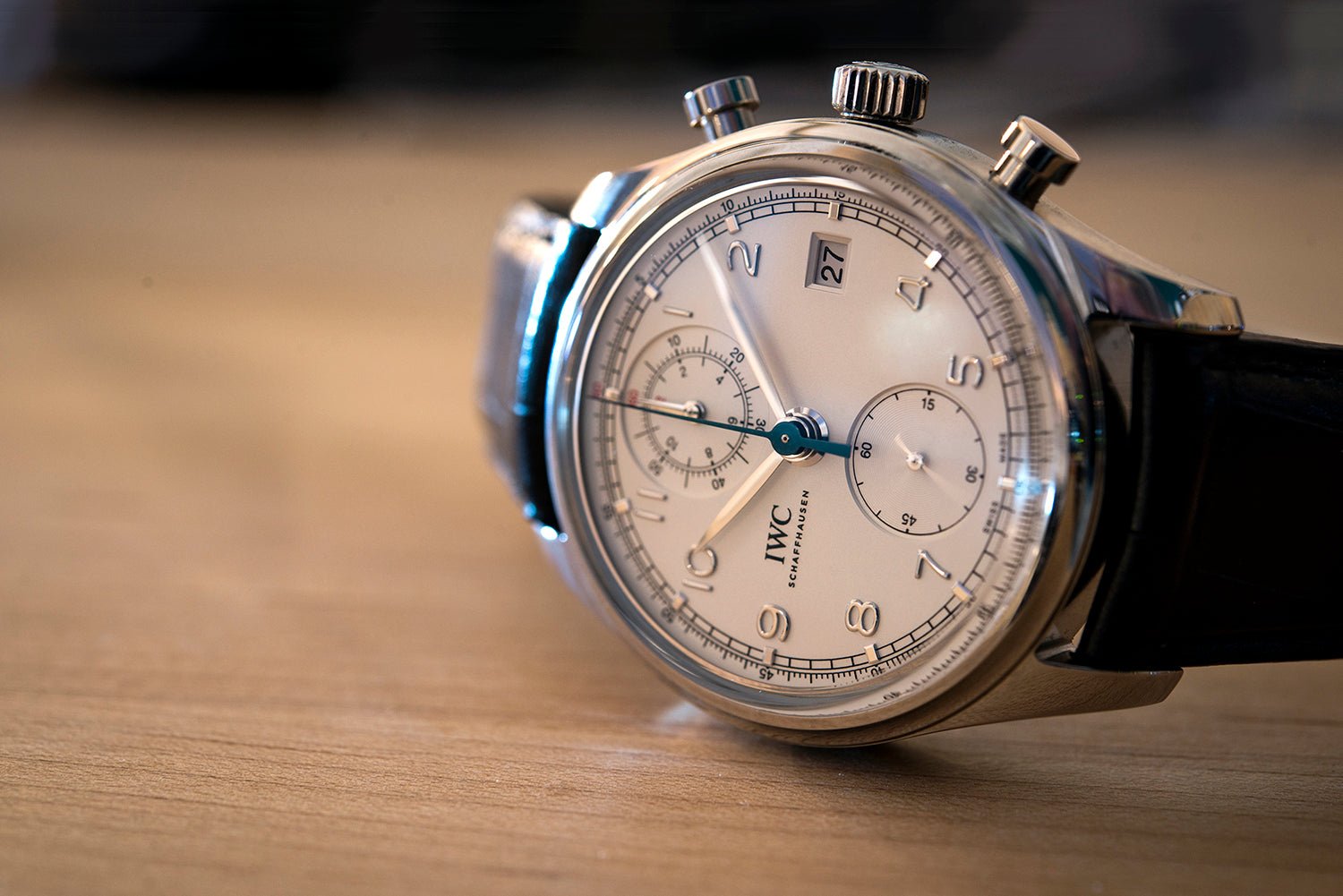
An IWC Schaffhausen timepiece reflects a unique philosophy in watchmaking — one that emphasizes engineering precision, functionality, and mechanical reliability.
From aviation-inspired Pilot’s Watches to the refined Portugieser collection, IWC movements are designed with:
- Robust internal architecture
- Efficient winding systems
- Long-term durability
When not worn regularly, maintaining this performance depends on proper winding — specifically, the correct Turns Per Day (TPD).
Understanding IWC TPD settings ensures:
- Stable power reserve
- Consistent accuracy
- Long-term movement reliability
Understanding TPD in IWC Movements
TPD (Turns Per Day) refers to how many rotations a watch winder performs over a 24-hour period.
IWC movements are known for:
- The Pellaton winding system (in many calibers)
- High efficiency in energy transfer
- Strong focus on mechanical durability
Compared to highly refined movements like Patek Philippe, IWC movements are more robust and tolerant.
Compared to Rolex, they operate within a similar range but often benefit from slightly broader flexibility.
For a broader comparison across brands, refer to our Watch TPD Guide.
Recommended IWC TPD Settings (Expert Baseline)
For most IWC automatic watches:
- TPD: 650 – 800
- Rotation: Bi-directional
This range provides:
- Efficient winding for Pellaton systems
- Stable energy delivery
- Reliable long-term performance
IWC TPD by Model
Pilot’s Watches (Big Pilot, Mark Series)
- Movement: In-house automatic calibers
- Power Reserve: ~60–120 hours
- TPD: 650 – 750
- Direction: Bi-directional
Designed for reliability and long power reserve, requiring stable and controlled winding.
Portugieser
- Movement: Automatic chronograph calibers
- Power Reserve: ~46–168 hours
- TPD: 700 – 800
- Direction: Bi-directional
Chronograph complexity benefits from slightly higher TPD.
Ingenieur
- Movement: Automatic
- Power Reserve: ~42–80 hours
- TPD: 650 – 750
- Direction: Bi-directional
Built with engineering focus and durability.
CW, CCW, or Bi-Directional — What’s Best?
IWC automatic movements are designed to wind efficiently in both directions.
Recommended:
- Bi-directional rotation
This ensures:
- Efficient rotor engagement
- Balanced mechanical operation
- Consistent energy distribution
What Happens If TPD Is Incorrect?
If TPD Is Too Low:
- Watch may stop
- Power reserve not maintained
- Reduced amplitude
If TPD Is Too High:
- Unnecessary rotor movement
- Increased mechanical cycling
- No improvement in accuracy
Even robust engineering benefits from controlled winding, not excess rotation.
How to Set a Watch Winder for IWC
To configure correctly:
- Set TPD between 650–800
- Use bi-directional rotation
- Avoid continuous high-speed operation
For detailed configuration guidance, refer to our watch winder guide.
Choosing the Right Watch Winder for IWC
While IWC movements are engineered for durability, consistency remains critical.
A suitable watch winder should provide:
- Adjustable TPD settings
- Smooth and stable rotation
- Reliable long-term operation
If you're selecting a model specifically for IWC watches, you can explore our curated guide to the best watch winders for IWC watches.
Do All IWC Watches Require the Same TPD?
Not entirely.
Variations depend on:
- Movement type
- Power reserve
- Complications
However, most IWC models operate within a moderate and flexible TPD range, making setup straightforward.
The Role of a Watch Winder in IWC Ownership
For engineering-focused watches, a watch winder serves as:
- A consistency system
- A way to maintain readiness
- A tool for preserving performance
Especially useful for:
- Long power reserve watches
- Chronographs
- Multi-watch collections
Final Thoughts
IWC Schaffhausen watches are built on a foundation of engineering excellence and mechanical reliability.
Maintaining that performance requires:
- Correct TPD settings
- Controlled winding
- Consistent mechanical input
In precision engineering, performance is not only designed — it is sustained through consistency.