A Omega is defined by its pursuit of mechanical precision — from the Co-Axial escapement to Master Chronometer certification.
Yet even the most advanced movement depends on one fundamental condition: consistent motion.
When an Omega watch is not worn daily, maintaining that consistency requires proper winding — and more importantly, the correct Turns Per Day (TPD).
Understanding Omega TPD settings is essential for:
- Preserving chronometric accuracy
- Maintaining optimal amplitude
- Supporting long-term movement stability
This guide provides a detailed breakdown of Omega TPD recommendations, including key models such as the Speedmaster, Seamaster, and Aqua Terra — along with expert insight into how Omega’s movement architecture influences winding requirements.
Understanding TPD in Omega Movements
TPD (Turns Per Day) refers to the number of rotations a watch winder performs over a 24-hour period.
Omega’s modern automatic watches are built around advanced mechanical innovations, most notably:
- The Co-Axial escapement, which reduces friction and improves long-term stability
- High-capacity mainspring barrels, often delivering extended power reserves
- Efficient bi-directional rotor systems
These elements collectively influence how the watch responds to winding cycles.
Unlike some traditional movements, Omega calibers are engineered to operate efficiently with moderate, controlled winding — not excessive rotation.
For a broader understanding of how TPD varies across different watch brands, you can refer to our complete watch TPD guide.
Recommended Omega TPD Settings (Expert Baseline)
While Omega movements vary slightly by caliber, a consistent range applies across most models:
- TPD: 650 – 850
- Rotation: Bi-directional (CW + CCW)
This range ensures:
- Stable power reserve maintenance
- Reduced internal friction
- Balanced mechanical operation over time
Omega TPD by Model (Detailed Reference)
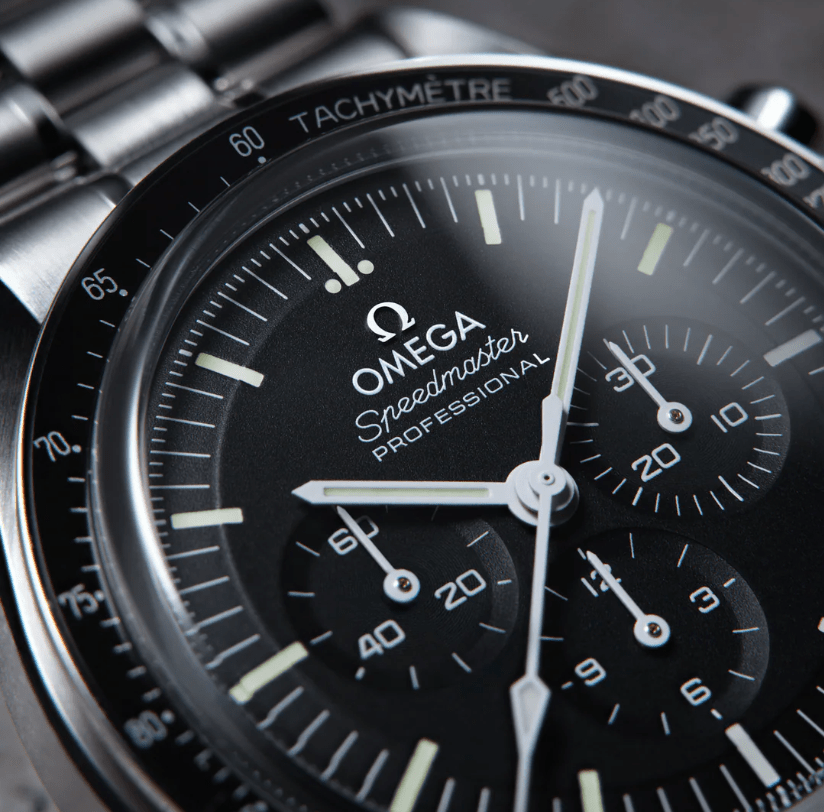
Omega Speedmaster
- Movement: Caliber 3861 (manual wind for Moonwatch) / Automatic variants
- Power Reserve: ~50–72 hours
- TPD: ~650–800 (automatic models)
- Direction: Bi-directional
Note: The classic Moonwatch is manual-winding, meaning TPD does not apply unless referring to automatic Speedmaster variants.
Omega Seamaster Diver 300M
- Movement: Caliber 8800
- Power Reserve: ~55 hours
- TPD: ~650–750
- Direction: Bi-directional
A highly efficient diver’s movement, optimized for consistent amplitude and resistance to external factors such as magnetism.
Omega Aqua Terra
- Movement: Caliber 8900 / 8800
- Power Reserve: ~60 hours
- TPD: 650 – 800
- Direction: Bi-directional
The Aqua Terra’s versatile design is matched by a movement engineered for stable daily performance under moderate winding conditions.
Omega Constellation
- Movement: Caliber 8800 / 8900
- Power Reserve: ~55–60 hours
- TPD: ~650–800
- Direction: Bi-directional
CW, CCW, or Bi-Directional — What’s Best for Omega?
Omega automatic movements are designed to wind efficiently in both directions.
Recommended setting:
- Bi-directional rotation
This allows:
- Continuous rotor engagement
- Even energy distribution
- Reduced mechanical imbalance
What Happens If TPD Is Incorrect?
If TPD Is Too Low:
- Incomplete winding
- Reduced amplitude
- Potential time deviation
If TPD Is Too High:
- Increased internal friction cycles
- No additional benefit to accuracy
- Long-term mechanical inefficiency
Precision is not achieved through more winding — but through correct calibration.
How to Set a Watch Winder for Omega
To maintain optimal performance:
- Set TPD between 650–850
- Use bi-directional rotation
- Avoid unnecessary high-frequency rotation cycles
For a deeper understanding of configuration and winding behavior, refer to our complete watch TPD guide, where different brands and movement types are compared in detail.
If you're selecting a winder specifically for Omega watches, it's important to choose models that offer precise control over TPD and rotation programs. You can explore our curated guide to the best watch winders for Omega watches, where each option is evaluated based on real-world performance and configuration flexibility.
Choosing the Right Watch Winder for Omega
Not all watch winders are calibrated equally — especially when dealing with advanced movements like Omega’s Co-Axial calibers.
A suitable watch winder should offer:
- Adjustable TPD settings
- Reliable motor control
- Consistent rotation programs
For collectors looking to match Omega’s mechanical requirements precisely, selecting a properly engineered watch winder ensures both accuracy and long-term reliability.
Do All Omega Watches Require the Same TPD?
Not entirely.
Omega’s range includes:
- Manual-wind movements (no TPD required)
- Automatic calibers with varying power reserves
However, most modern automatic Omega watches operate efficiently within the 650–850 TPD range, making configuration relatively straightforward.
Final Thoughts
Omega’s approach to watchmaking is rooted in innovation — but precision still depends on how the movement is maintained.
Correct TPD settings ensure:
- Stable amplitude
- Controlled mechanical stress
- Long-term performance consistency
In mechanical watchmaking, small adjustments often define long-term results — and proper winding is one of the most critical.
Compared to Rolex, Omega movements often operate within a slightly broader TPD range due to differences in movement architecture.