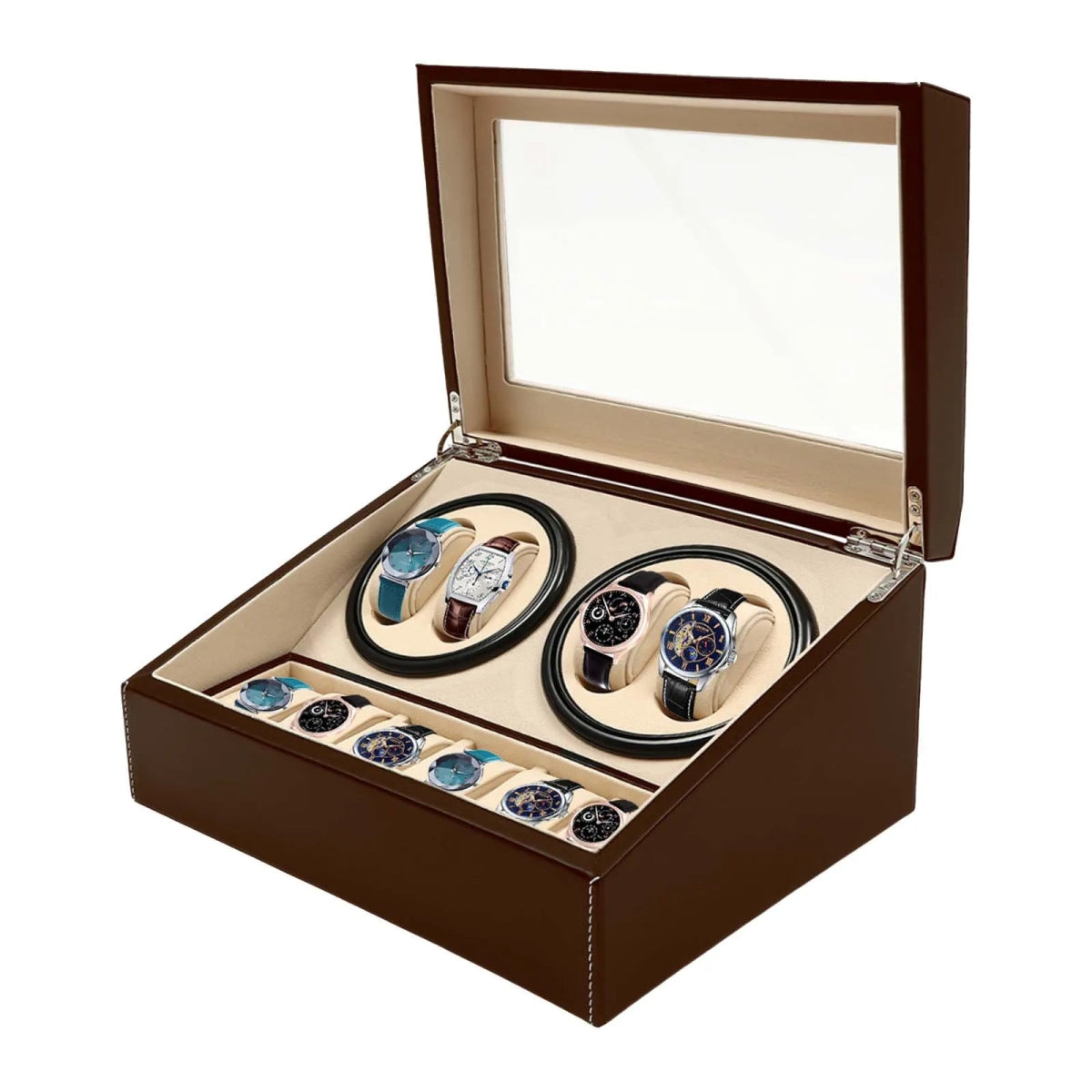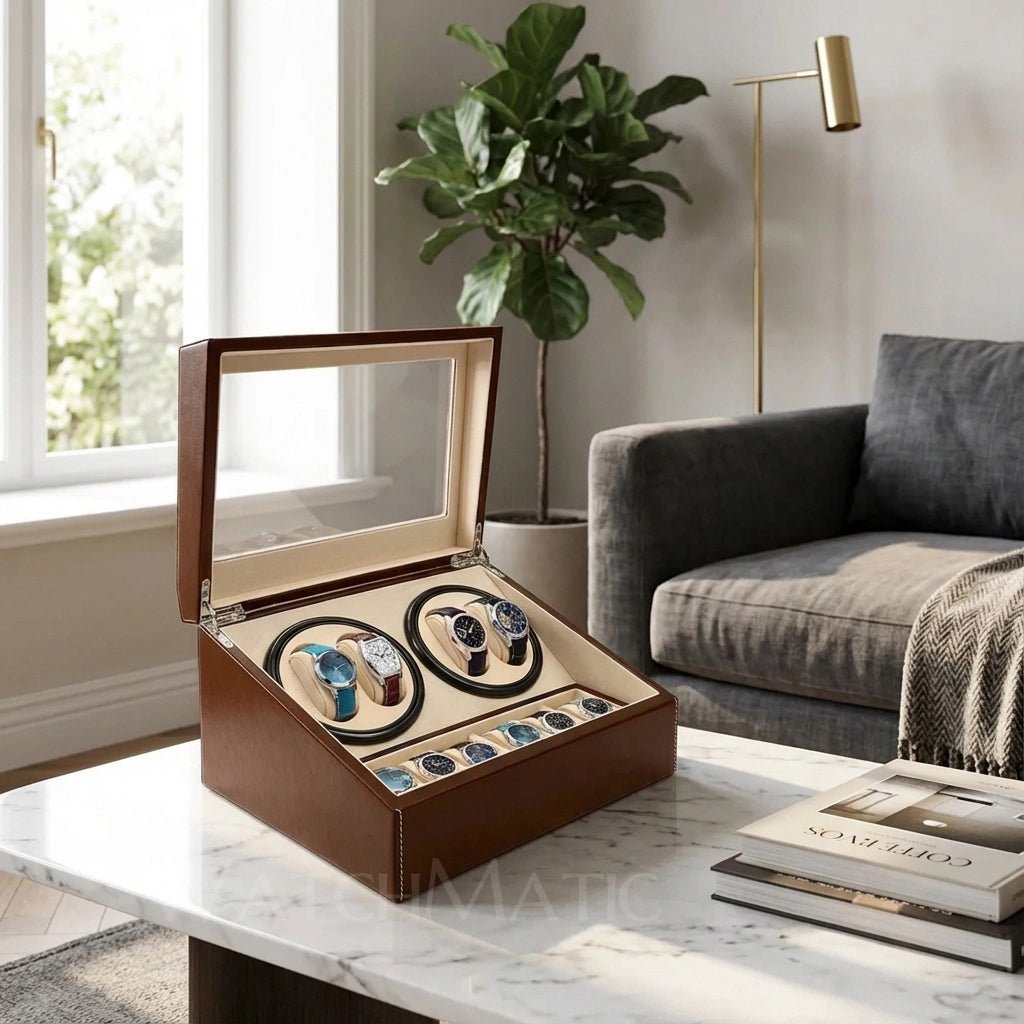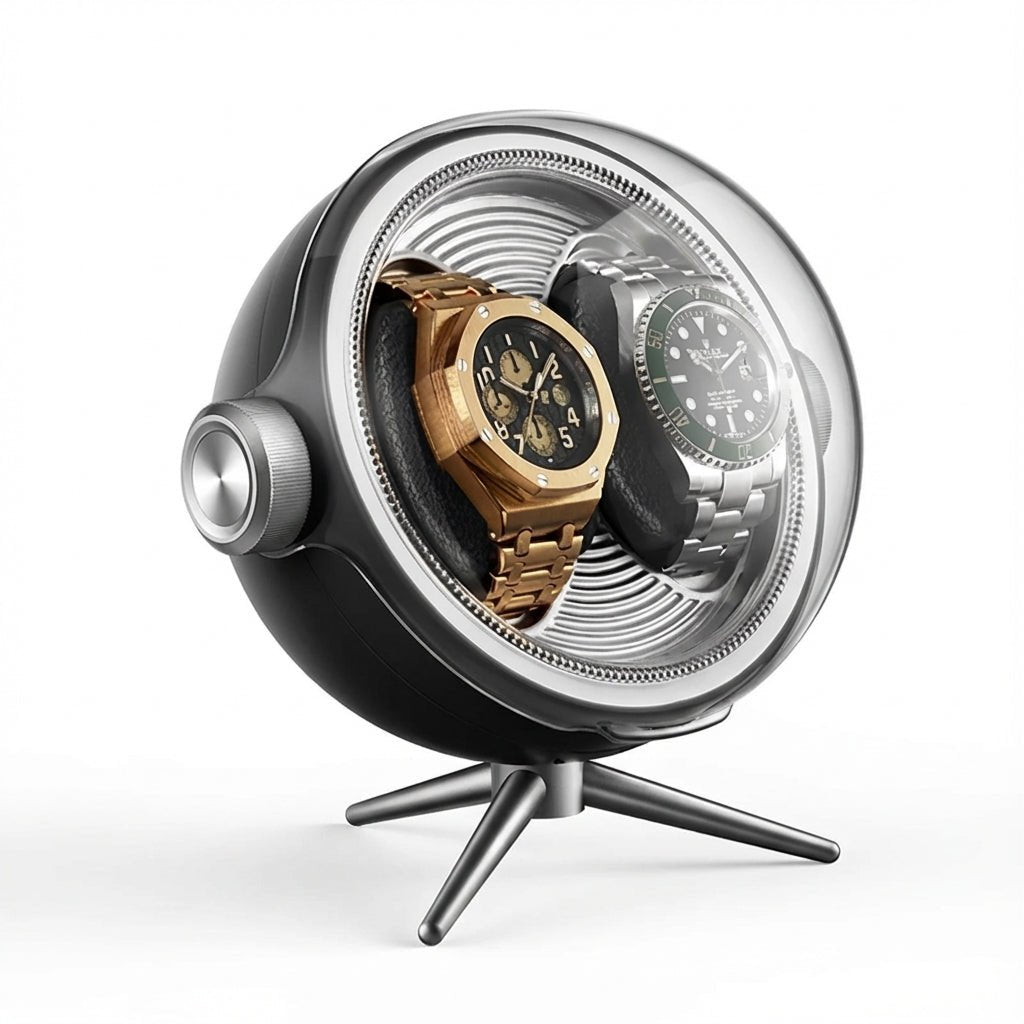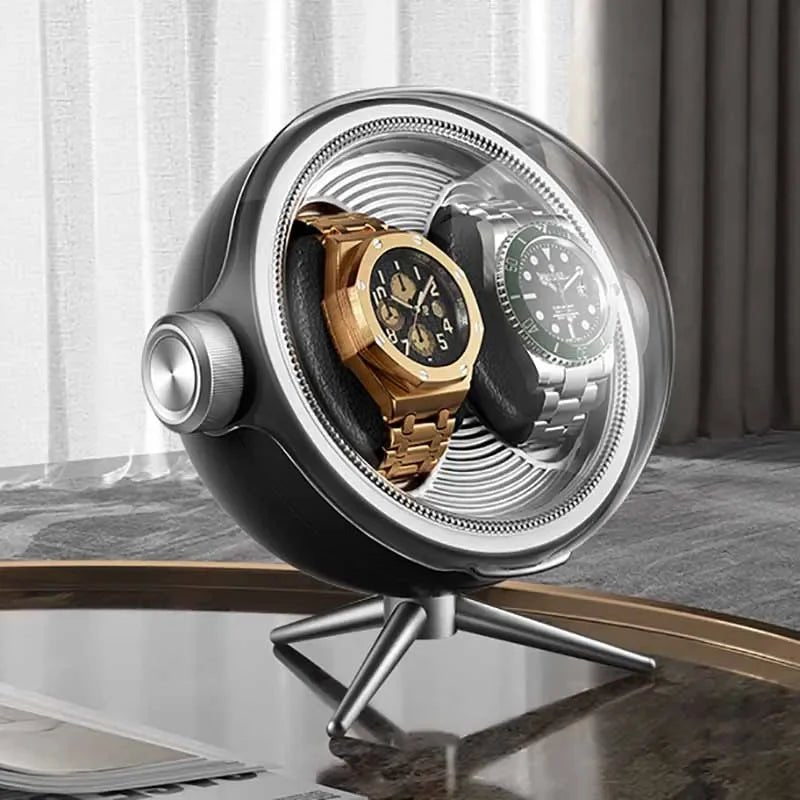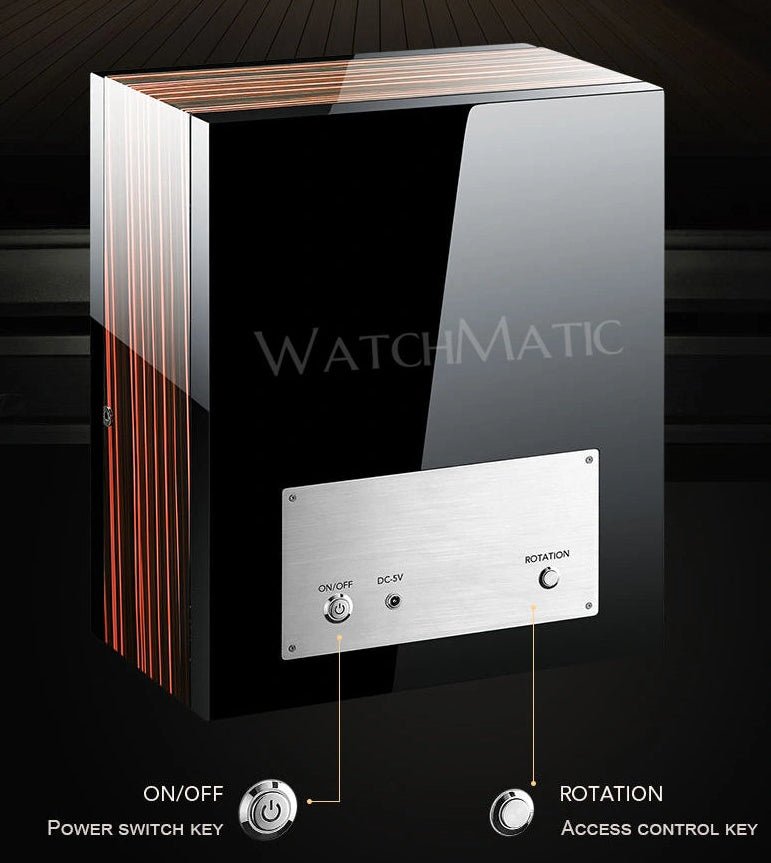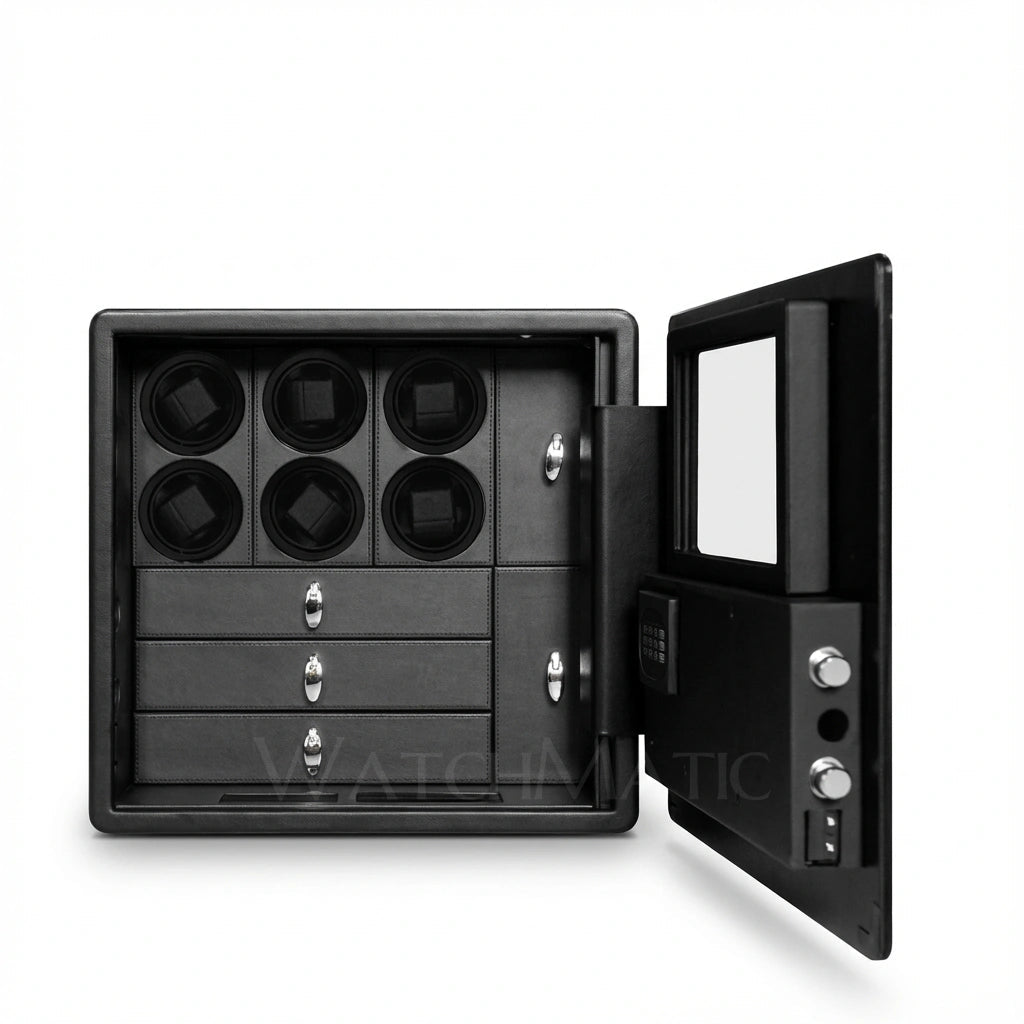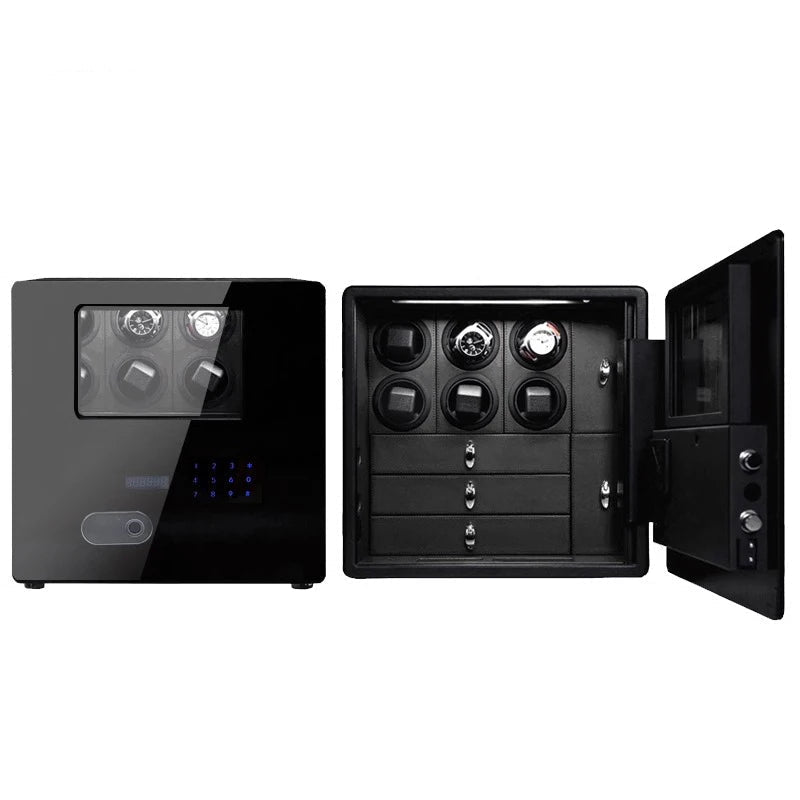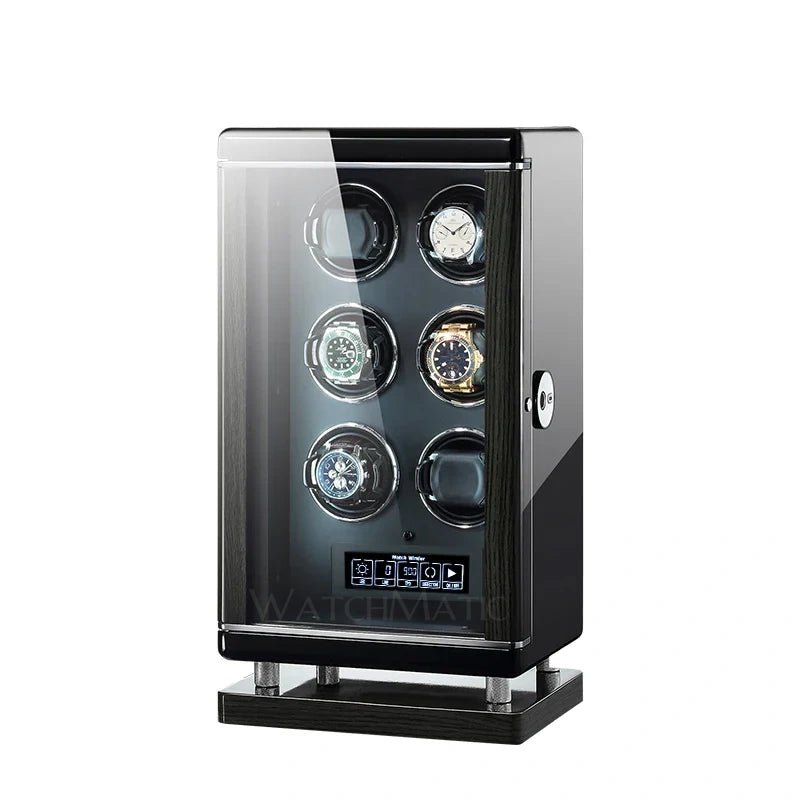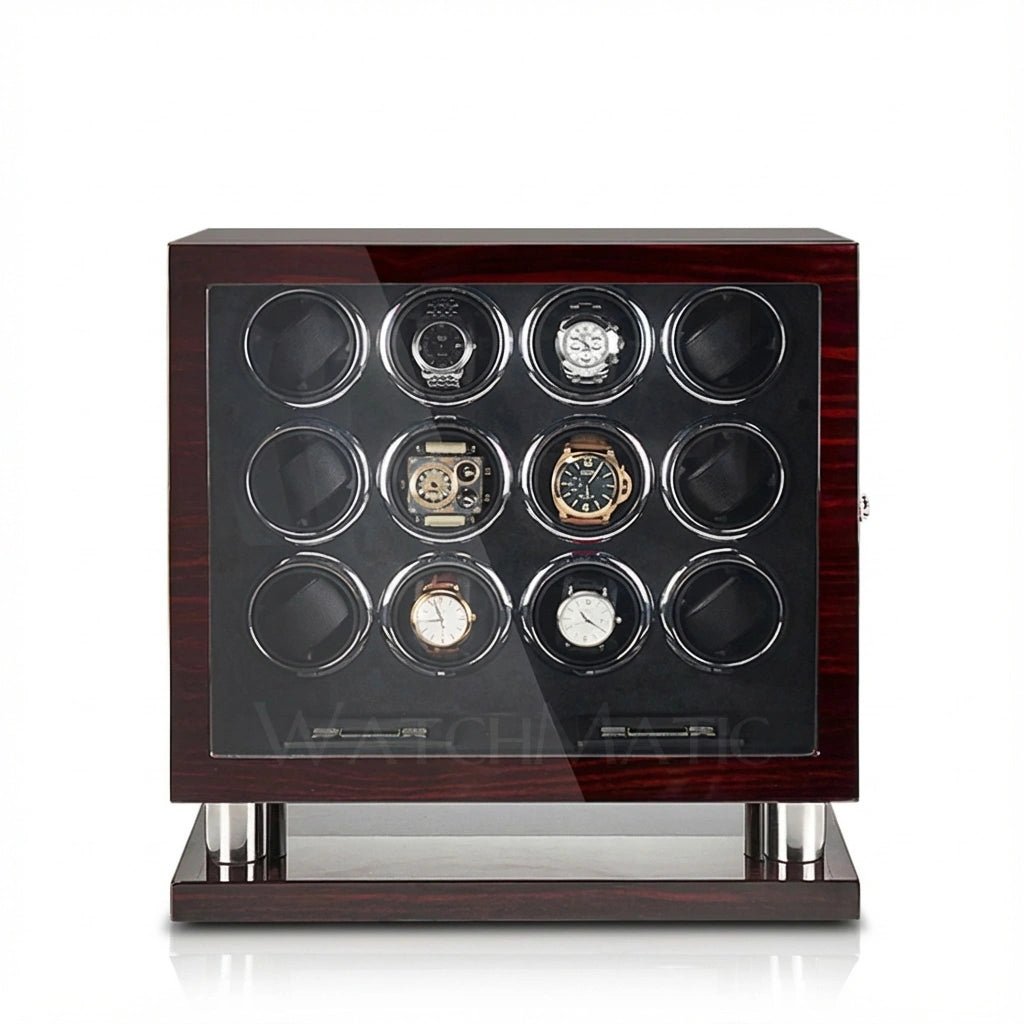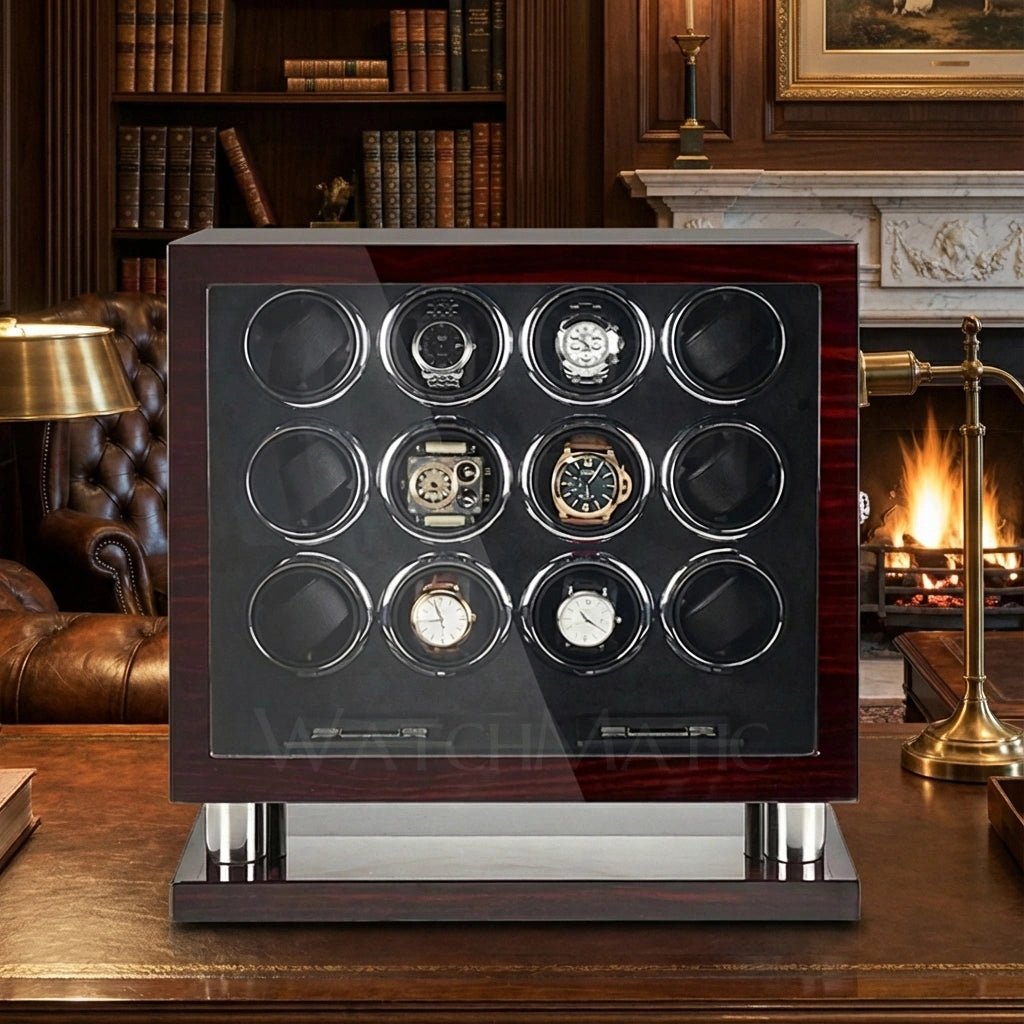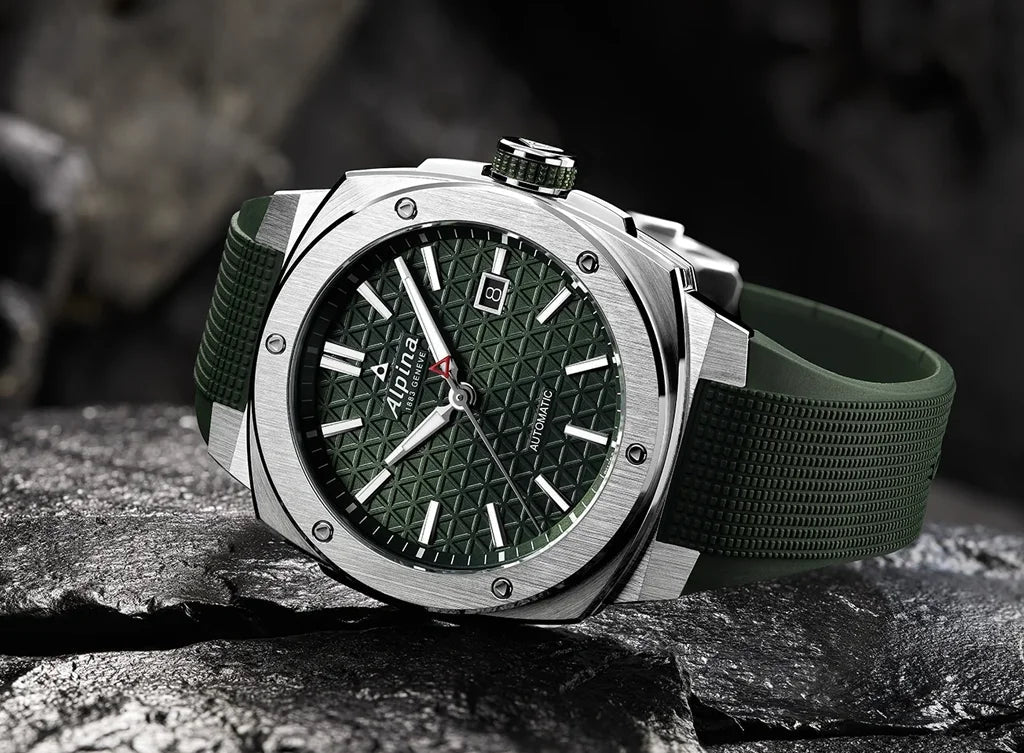
The best watch winder for Alpina watches is a programmable model with adjustable Turns Per Day (TPD), selectable clockwise and counterclockwise rotation, controlled winding and rest cycles, quiet operation, and secure support for sports-watch bracelets and straps.
A conventional watch winder is suitable for automatic mechanical Alpina watches, including models from the Alpiner, Seastrong, Startimer, and Heritage collections.
Current examples include the Alpiner Extreme Automatic, Seastrong Diver Extreme Automatic, Startimer Pilot Automatic, Alpiner Extreme Regulator Automatic, and Heritage Alpiner Carrée Automatic. Alpina also produces automatic chronographs and other mechanical complications.
However, not every Alpina watch should use a winder. Current Heritage hand-wound watches and the new Solarmetre solar-quartz models do not receive the normal winding benefit of a conventional rotating watch winder.
Does an Alpina Watch Need a Watch Winder?
No automatic Alpina mechanically requires a watch winder.
An automatic movement receives winding energy through motion of its rotor while the watch is being worn. If the watch remains off the wrist long enough, its stored power eventually runs down and the watch stops.
A winder is therefore primarily useful for:
- Keeping an automatic Alpina running between wears
- Maintaining the time and date
- Reducing repeated resetting
- Keeping GMT or chronograph-related indications ready
- Organizing several automatic watches
- Keeping an active collection ready to wear
For owners who wear one Alpina nearly every day, normal wrist movement may provide all the winding required.
The practical value of a winder increases as the number of watches in rotation grows.
For a broader explanation of automatic winding and when a winder makes sense, see the Watch Winder Guide.
Which Alpina Watches Can Use a Watch Winder?
Alpina currently offers a broad range of automatic mechanical watches.
Examples include:
| Alpina watch | Example caliber | Movement type | Approx. power reserve |
|---|---|---|---|
| Alpiner Extreme Automatic | AL-525 / SW200 base | Automatic | 38 hours |
| Seastrong Diver Extreme Automatic | AL-525 / SW200 base | Automatic | 38 hours |
| New Startimer Pilot Automatic | AL-525 / La Joux-Perret base | Automatic | 68 hours |
| Heritage Alpiner Carrée Automatic | AL-530 | Automatic | 38 hours |
| Alpiner Extreme Regulator Automatic | AL-650 / SW461 base | Automatic | 38 hours |
| Startimer Pilot Chronograph Automatic IFR | AL-570 | Automatic chronograph | 62 hours |
| Heritage Tropic-Proof | AL-480 | Hand-wound | Winder not useful |
| Alpiner Extreme Solarmetre | AL-140 | Solar quartz | Winder not useful |
These specifications illustrate why an Alpina should be identified at the reference level, not simply by brand or even movement-family name.
Understanding Alpina Automatic Movements
Alpina's mechanical catalog includes both externally based calibers and manufacture movements.
Its official caliber archive lists automatic date, regulator, GMT, chronograph, worldtimer, and manufacture movements alongside hand-wound calibers.
For watch-winder owners, several current movements are particularly relevant.
Alpina AL-525
The AL-525 is one of the most common automatic movement designations in the Alpina catalog.
But there is an important complication:
Not every current AL-525 has the same listed base or power reserve.
For example, the current Alpiner Extreme Automatic lists:
- AL-525
- Sellita SW200 base
- 28,800 vibrations per hour
- 26 jewels
- Approximately 38 hours of power reserve
The current Seastrong Diver Extreme Automatic likewise uses an AL-525 based on the SW200 and specifies approximately 38 hours.
However, Alpina's new-generation Startimer Pilot Automatic also carries the AL-525 designation, while Alpina identifies its base as La Joux-Perret and specifies approximately 68 hours of power reserve.
This is highly relevant when configuring a watch winder.
Do not assume that:
AL-525 automatically means one single movement specification.
Instead, verify the exact watch reference and generation.
Why the AL-525 Difference Matters
Consider two Alpina watches:
Alpiner Extreme Automatic
AL-525 / SW200 base
Approximately 38-hour reserve
New Startimer Pilot Automatic
AL-525 / La Joux-Perret base
Approximately 68-hour reserve
Both are described as AL-525 automatic watches, yet their published movement specifications differ materially.
That means a generic online table stating:
“Alpina AL-525 = one fixed watch-winder setting”
may not provide enough information.
The safer process is:
Reference → generation → movement specification → winding requirements → winder program
Alpina AL-530
The AL-530 appears in the Heritage Alpiner Carrée Automatic.
Current specifications list:
- Automatic movement
- 28,800 vibrations per hour
- 31 jewels
- Approximately 38-hour power reserve
- Small-seconds display
The relatively short reserve means a Carrée Automatic can stop fairly quickly when rotated among several watches.
For an owner who wears it once or twice per week, a watch winder may therefore provide useful convenience.
Because the watch uses a leather strap and a rectangular case, cushion fit is also worth considering.
Alpina AL-650
The current Alpiner Extreme Regulator Automatic uses the AL-650, listed by Alpina as an automatic movement based on the Sellita SW461.
Current specifications include:
- Automatic winding
- 28,800 vibrations per hour
- 31 jewels
- Approximately 38-hour power reserve
- Regulator-style display
A regulator display separates the time indications across different parts of the dial, with central minutes and separate hour and seconds displays.
Although the watch remains relatively easy to reset, owners who rotate several mechanical watches may prefer to keep it running between wears.
Alpina AL-570 Automatic Chronograph
The Startimer Pilot Chronograph Automatic IFR uses the AL-570.
Alpina specifies:
- Swiss-made automatic chronograph
- 28,800 beats per hour
- 25 jewels
- Approximately 62-hour power reserve
- Chronograph
- Second time-zone functionality
- IFR-related functions
A more complicated automatic watch like this creates a stronger convenience argument for keeping it running.
The winder does not maintain or service the chronograph mechanism—it simply keeps the automatic movement supplied with winding energy so that the watch remains running and set.
Alpina Watch Winder TPD Settings
TPD means Turns Per Day—the number of rotations delivered by a watch winder during a programmed daily cycle.
There should not be one universal number such as:
“Alpina = X TPD.”
This is particularly important because even the AL-525 designation can represent references with different published movement bases and power reserves.
The correct process is:
- Identify the exact Alpina reference.
- Confirm that it is automatic.
- Identify the listed caliber and movement base.
- Check the winding requirements for that exact movement.
- Select the appropriate TPD and rotation direction.
- Confirm that the watch maintains adequate power.
For a deeper explanation of TPD, see the Watch TPD Guide.
What Rotation Direction Should You Use for an Alpina Watch?
Most programmable winders offer:
- CW — Clockwise
- CCW — Counterclockwise
- Bi — Bidirectional
Rotation direction should be determined by the specific automatic movement rather than simply selecting one program for all Alpina watches.
Alpina's regular consumer product pages identify movement type, caliber, base movement, frequency, jewels, and power reserve, but they generally do not list consumer watch-winder direction as part of the technical specification.
A winder that offers all three direction modes therefore provides considerably more flexibility than one with a fixed rotation direction.
What to Look for in an Alpina Watch Winder
Alpina's catalog is strongly oriented toward sports, aviation, diving, and adventure watches, so physical support can matter as much as electronic programming.
Adjustable TPD
Multiple TPD settings provide flexibility across different Alpina automatic movements.
Multiple Rotation Directions
Choose a system offering:
CW + CCW + Bidirectional
This is especially useful in mixed-brand collections.
Controlled Rest Cycles
Automatic watches do not need to rotate constantly.
A quality winder should deliver its programmed turns in intervals separated by periods of rest.
Independent Controls
This becomes important when several watches share one unit.
An Alpiner Extreme, Startimer Pilot, and automatic chronograph should not be forced to use one common setting.
Quiet Motors
Low-noise operation is important if the winder is kept in a:
- Bedroom
- Dressing room
- Private office
- Walk-in wardrobe
- Living area
Secure Support for Sports Watches
Many Alpina watches use:
- Steel bracelets
- Rubber straps
- NATO-style straps
- Leather straps
The cushion should support each watch securely without overstretching the bracelet or strap.
Anti-Magnetization Design
A quality watch winder should minimize unnecessary magnetic exposure around mechanical movements.
Best Watch Winder for Alpiner Extreme Automatic
The Alpiner Extreme Automatic is one of Alpina's core contemporary mechanical sports watches.
Current references use the AL-525 based on the Sellita SW200, providing approximately 38 hours of power reserve. The current compact configuration measures approximately 39 x 40.5 mm and offers 200 meters of water resistance.
For an Alpiner Extreme Automatic, prioritize:
- Adjustable TPD
- Multiple rotation directions
- Secure bracelet or rubber-strap support
- Stable positioning
- Quiet operation
- Controlled rest cycles
With a 38-hour reserve, the watch can stop within roughly two days of inactivity depending on its state of wind.
That makes a winder particularly convenient for someone who alternates between several watches during the week.
Best Watch Winder for Alpina Seastrong
The Seastrong Diver Extreme Automatic is another clear candidate.
Current versions use:
- AL-525 automatic movement
- SW200 base
- Approximately 38-hour reserve
- 300-meter water resistance
- Ceramic dive bezel
For a substantial dive watch, the holder system matters.
The winder should keep the case stable during rotation and comfortably accommodate:
- Steel bracelets
- Rubber straps
- Larger watch heads
Avoid a cushion that allows a heavy diver to move or tilt during operation.
Best Watch Winder for Alpina Startimer Pilot Automatic
The Startimer Pilot Automatic is particularly interesting because both the watch and its AL-525 movement have evolved.
An earlier/current 41 mm version listed by Alpina uses:
- AL-525
- SW200 base
- Approximately 38-hour power reserve
The new 40 mm generation uses:
- AL-525
- La Joux-Perret base
- Approximately 68-hour power reserve
This makes the Startimer Pilot one of the clearest examples of why you should not determine a winding program from “AL-525” alone.
If buying a winder for a Startimer, first identify the exact reference.
Best Watch Winder for Alpina Heritage Carrée Automatic
The Heritage Alpiner Carrée Automatic has different physical requirements from Alpina's larger sports watches.
Its current AL-530 movement provides approximately 38 hours of power reserve, while the case measures approximately 32.5 x 39 mm and is paired with an ostrich-leather strap.
For this model, prioritize:
- A compressible cushion
- Gentle leather-strap curvature
- Soft contact surfaces
- Secure but low-tension support
- Programmable winding
A winder designed only around large steel sports bracelets may not provide the ideal fit for this style of watch.
Best Watch Winder for Alpiner Extreme Regulator Automatic
The Alpiner Extreme Regulator Automatic uses the current AL-650 automatic movement with approximately 38 hours of power reserve.
Because the model combines:
- A substantial sports case
- Regulator display
- Steel or rubber configurations
- Relatively short reserve
a programmable winder can be useful for owners who rotate it with several other watches.
Again, convenience rather than mechanical necessity is the reason to use one.
Best Watch Winder for Startimer Pilot Chronograph Automatic
The Startimer Pilot Chronograph Automatic IFR is more complicated than Alpina's standard three-hand automatic watches.
With a 62-hour power reserve, chronograph, second time-zone functionality, and additional aviation-oriented indications, keeping the watch running can reduce the amount of setup required when returning to it.
For this type of watch, prioritize:
- Independent control
- Programmable TPD
- Direction selection
- Stable support for the larger 43 mm case
- Quiet operation
Can a Hand-Wound Alpina Use a Watch Winder?
A conventional rotating watch winder does not wind a manually wound movement.
For example, the current Heritage Tropic-Proof Handwinding uses the AL-480 hand-wound caliber and provides approximately 42 hours of power reserve.
The watch should be wound through its crown as designed.
Therefore:
Automatic Alpina → conventional watch winder can be useful
Hand-wound Alpina → conventional watch winder provides no winding benefit
This distinction matters particularly within Alpina's Heritage collection.
Does Alpina Solarmetre Need a Watch Winder?
No.
Alpina's new Solarmetre technology is solar powered.
The AL-140 is a solar-quartz movement that converts natural or artificial light into electrical energy. Alpina states that a full charge can provide up to approximately 10 months of operation in total darkness.
A rotating automatic watch winder does not provide the type of energy the Solarmetre requires.
Therefore:
Alpiner Extreme Automatic → winder compatible
Alpiner Extreme Solarmetre → powered by light
The same distinction now also applies within the Startimer family because Alpina offers both Pilot Automatic and Pilot Solarmetre models.
Alpina Automatic vs. Solarmetre vs. Hand-Wound
| Movement type | Energy source | Conventional watch winder useful? |
|---|---|---|
| Automatic mechanical | Rotor winds mainspring | Yes, optionally |
| Hand-wound mechanical | Crown winds mainspring | No |
| Solarmetre solar quartz | Light generates electrical energy | No |
This makes movement identification the first step before buying any watch winder.
Does an Alpina Automatic Need to Run All the Time?
No.
An automatic Alpina can stop normally after its power reserve has been exhausted.
There is no general requirement to keep it continuously running.
The practical difference between models can still be considerable.
For example:
Alpiner Extreme Automatic: approximately 38 hours
New Startimer Pilot Automatic: approximately 68 hours
Startimer Pilot Chronograph Automatic: approximately 62 hours
A collector wearing a 68-hour Startimer every few days may rarely see it stop.
A 38-hour Alpiner Extreme that remains unworn for several days is more likely to require restarting.
This is why power reserve + wearing pattern + collection size are more useful considerations than the brand name alone.
Best Watch Winder for One Alpina Automatic
For one automatic Alpina, a compact programmable winder is generally sufficient.
Look for:
- Adjustable TPD
- CW/CCW/bidirectional rotation
- Rest cycles
- Quiet operation
- Secure watch cushion
- Stable support for heavier sports watches
Suitable single-watch and multi-watch configurations can be explored in the WatchMatic Watch Winder Collection.
Best Watch Winder for Multiple Alpina Watches
An Alpina collector might own:
- Alpiner Extreme Automatic
- Seastrong Diver Automatic
- Startimer Pilot Automatic
- Alpiner Extreme Regulator
- Heritage Carrée Automatic
- Startimer Automatic Chronograph
- Heritage hand-wound watches
- Solarmetre watches
This means not every watch in the collection requires rotation.
The most practical architecture is:
Automatic mechanical Alpina watches → individually programmed winding positions
Hand-wound Alpina watches → stationary storage
Solarmetre watches → stationary storage with appropriate light exposure
LuxGuard for Alpina Automatic Collections

A multi-position LuxGuard Watch Winder can be suitable for an Alpina collector managing several automatic watches or a mixed Swiss mechanical collection.
Depending on configuration, features include:
- Independent winding control
- Multiple rotation modes
- Japanese Mabuchi motors
- Quiet operation
- Anti-magnetization protection
- Interior illumination
- Secure individual watch positions
Independent control is particularly relevant with Alpina because even watches carrying the same AL-525 designation can have different current published movement specifications.
Is It Safe to Leave an Alpina on a Watch Winder?
A properly configured quality watch winder can be used with an automatic Alpina.
Important considerations include:
- Confirming that the watch is automatic
- Identifying the exact reference
- Matching the winding program to the movement
- Using controlled operating and rest cycles
- Securing the watch properly on the cushion
Do not increase TPD simply because a watch repeatedly stops.
If an automatic Alpina receives appropriate winding but exhibits unexpectedly short running time or abnormal timekeeping, professional inspection may be more appropriate than additional rotation.
Watch Winder vs. Watch Winder Safe for Alpina Collectors
A standalone watch winder is usually sufficient for a small automatic collection.
As the collection grows, security can become another consideration.
| Feature | Watch Winder | Watch Winder Safe |
|---|---|---|
| Automatic winding | Yes | Yes |
| Independent programming | Model dependent | Available |
| Hand-wound storage | Possible | Yes |
| Solarmetre storage | Possible | Yes |
| Controlled access | Limited | High |
| Physical security | Limited | High |
| Accessory storage | Limited | Available |
| Large collection | Moderate | High |
Collectors who want integrated winding and secure storage can explore the Watch Winder Safe Collection.
Titan Vault for Larger Alpina and Mixed Collections

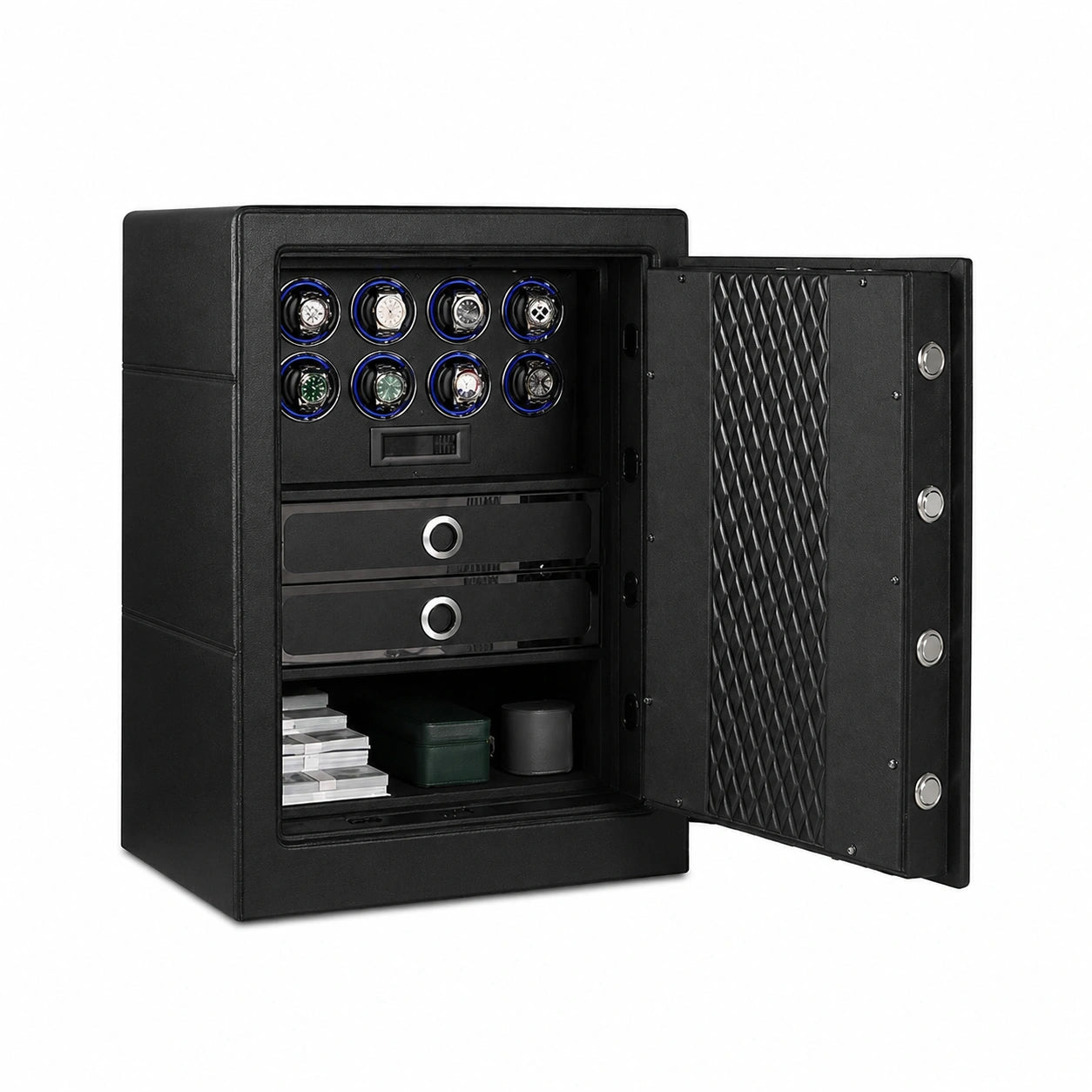
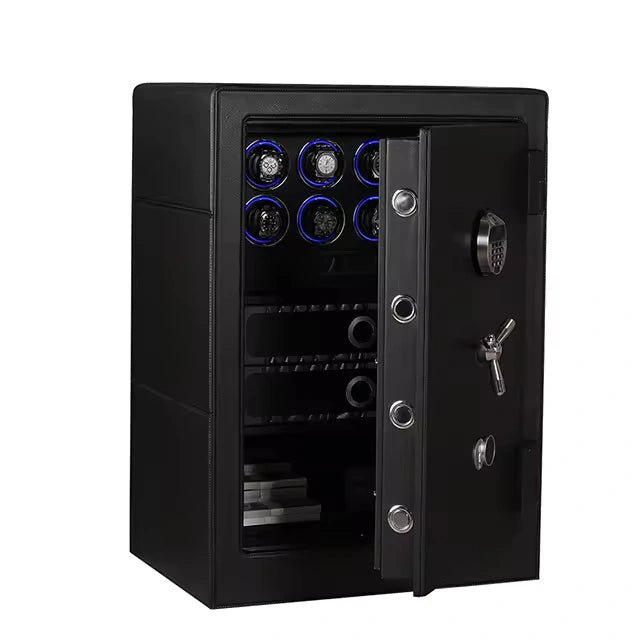
For a larger Alpina or mixed-brand mechanical collection, the Titan Vault Watch Winder Safe combines independently controlled winding positions with secure conventional storage.
Depending on configuration, the Titan Vault series can accommodate approximately 12 to 60 watches, with available features including:
- Reinforced safe construction
- Biometric fingerprint access
- Digital passcode
- Manual key access
- Independent winding controls
- Adjustable TPD
- CW/CCW/bidirectional operation
- Japanese Mabuchi motors
- Anti-magnetization protection
- LED illumination
- Additional storage compartments
Automatic Alpina watches can occupy programmed winding positions while hand-wound watches and other pieces remain securely stored without unnecessary rotation.
Collectors who primarily require physical protection rather than integrated automatic winding can instead explore the Luxury Watch Safe Collection.
Alpina in a Mixed Swiss Watch Collection
Alpina is often collected alongside other Swiss brands offering sports, aviation, diving, and accessible mechanical watches.
A collection might contain:
Alpina + Oris + Longines + Mido + Rado + Frederique Constant
Related WatchMatic resources include:
Best Watch Winder for Oris Watches
Best Watch Winder for Longines Watches
Best Watch Winder for Mido Watches
Best Watch Winder for Rado Watches
Best Watch Winder for Frederique Constant Watches
Independent control becomes particularly useful in this type of collection because movements and winding requirements differ between manufacturers.
How to Choose the Best Watch Winder for Your Alpina
Step 1: Identify the Movement Type
Determine whether the watch is:
- Automatic
- Hand-wound
- Solarmetre solar quartz
- Another movement type
Only the automatic movement needs a conventional watch winder.
Step 2: Identify the Exact Reference
This is particularly important with Alpina.
Do not stop at the collection name or even the movement designation.
Step 3: Check the Movement Base
For example, current AL-525 references can be listed with either:
- SW200 base
- La Joux-Perret base
depending on the watch.
Step 4: Check the Power Reserve
A 38-hour automatic and a 68-hour automatic may behave very differently during the same wearing pattern.
Step 5: Determine the Winding Requirements
Confirm appropriate TPD and rotation behavior for the exact movement.
Step 6: Choose Adjustable TPD
Avoid fixed-speed systems if you expect your collection to grow.
Step 7: Choose Multiple Rotation Directions
CW, CCW, and bidirectional programs provide broader movement compatibility.
Step 8: Check Cushion Fit
Pay particular attention to large dive watches, integrated sports bracelets, rubber straps, and smaller Heritage watches.
Step 9: Use Independent Controls for Multiple Watches
This lets each automatic movement receive its own program.
Step 10: Avoid Using Winder Positions Unnecessarily
Hand-wound and Solarmetre Alpina watches do not need motorized winding positions.
For additional guides covering watch winding, storage, TPD, and collection protection, visit the WatchMatic Guide Hub.
Best Watch Winder for Alpina Watches: Final Thoughts
The best watch winder for Alpina watches should be selected according to the exact movement and reference, rather than the Alpina name alone.
For an automatic Alpina, prioritize:
- Adjustable TPD
- CW/CCW/bidirectional operation
- Controlled rest cycles
- Quiet motors
- Secure watch support
- Independent control for multiple watches
Alpina presents an especially good example of why caliber-level research sometimes needs to go one step further.
Current official specifications show AL-525/SW200 watches with approximately 38 hours of reserve, while the latest Startimer Pilot also carries the AL-525 designation but uses a La Joux-Perret base with approximately 68 hours.
That makes the correct sequence:
Brand → Model → Reference → Movement/Base → Winding Requirement → Watch Winder Setting
rather than simply:
Brand → Generic Setting
Owners should also distinguish automatic Alpina watches from the brand's hand-wound Heritage pieces and new Solarmetre solar-quartz models, neither of which requires a conventional automatic winder.
For additional winding and secure-storage solutions, explore WatchMatic.