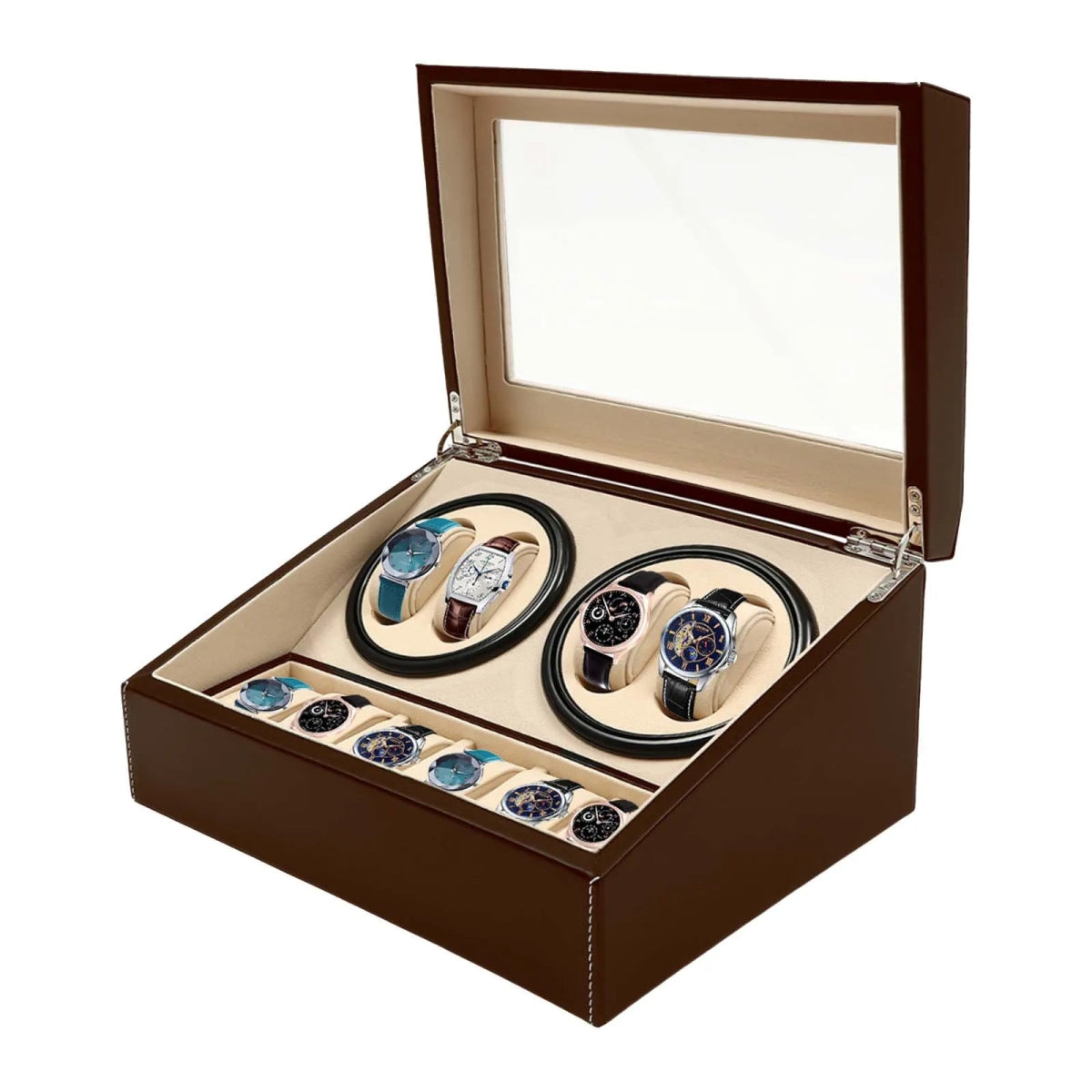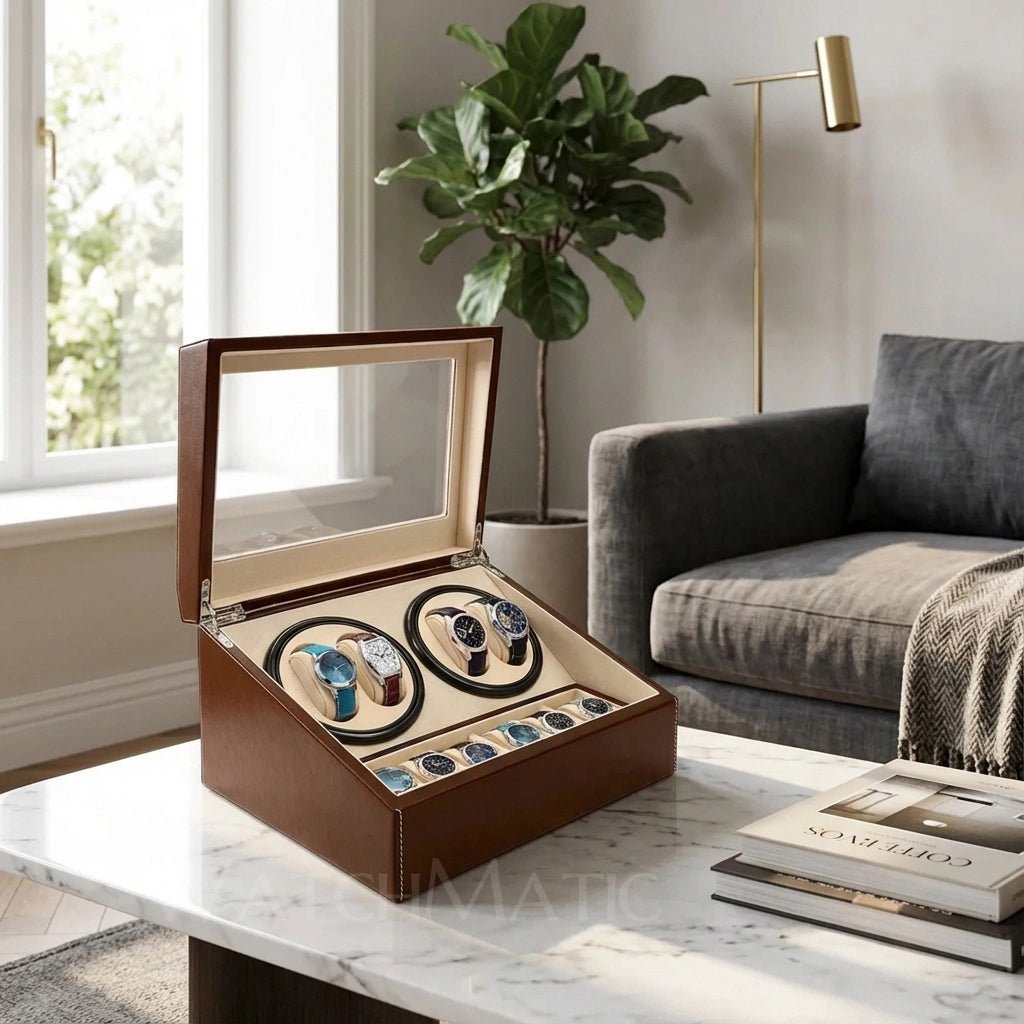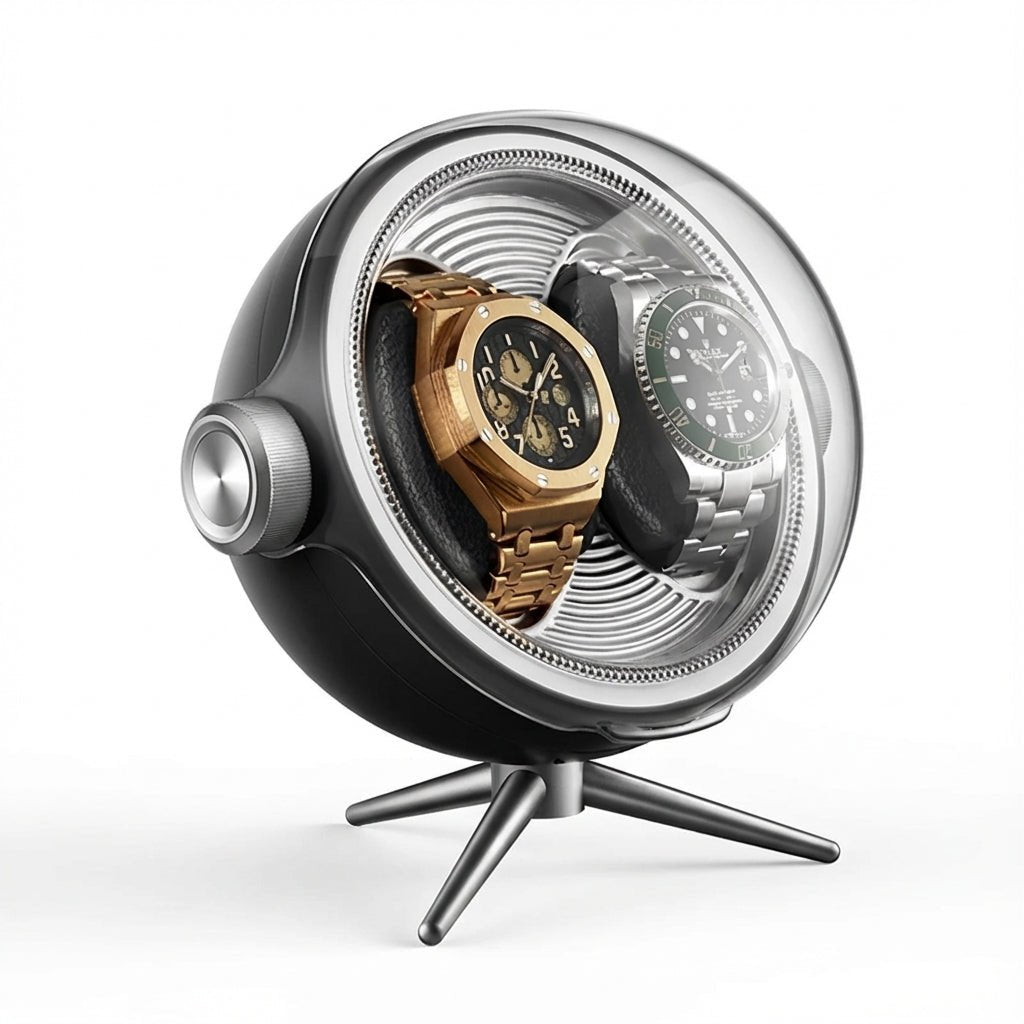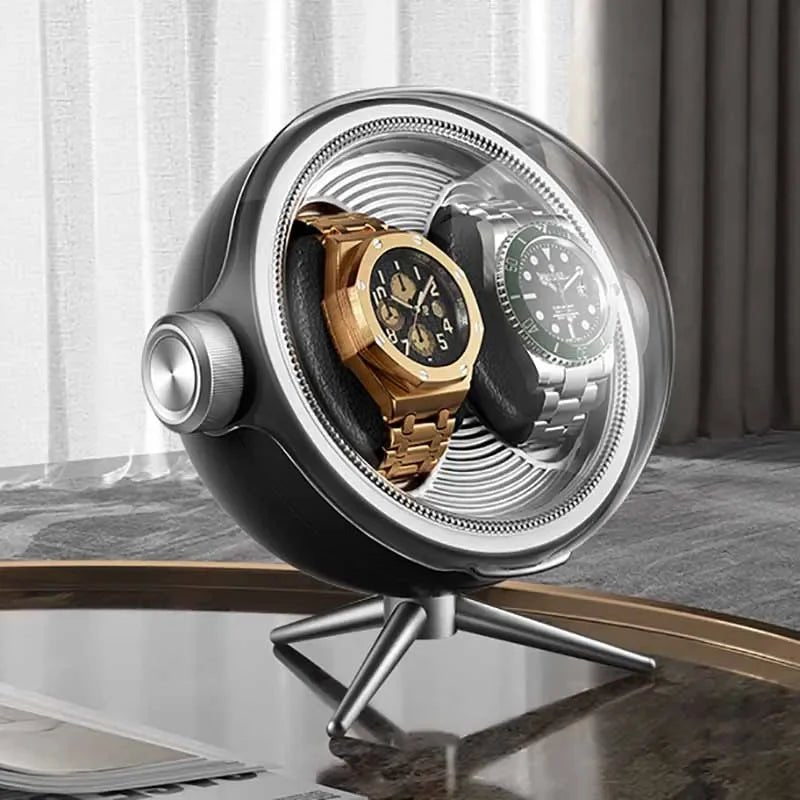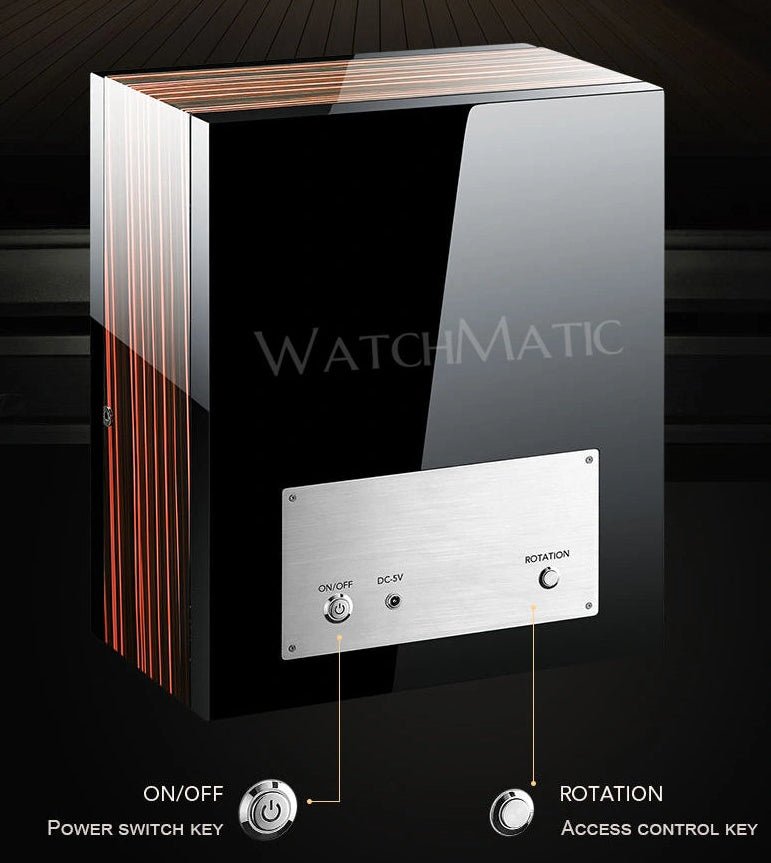
The best watch winder for Angelus watches is a premium programmable model with adjustable Turns Per Day (TPD), clockwise and counterclockwise rotation options, controlled winding and rest cycles, quiet operation, and secure support for high-value watches with unusual case and strap configurations.
However, movement identification is particularly important with Angelus.
The current collection includes both automatic and manually wound manufacture movements.
Important examples include:
- Chronodate — A-500 automatic chronograph
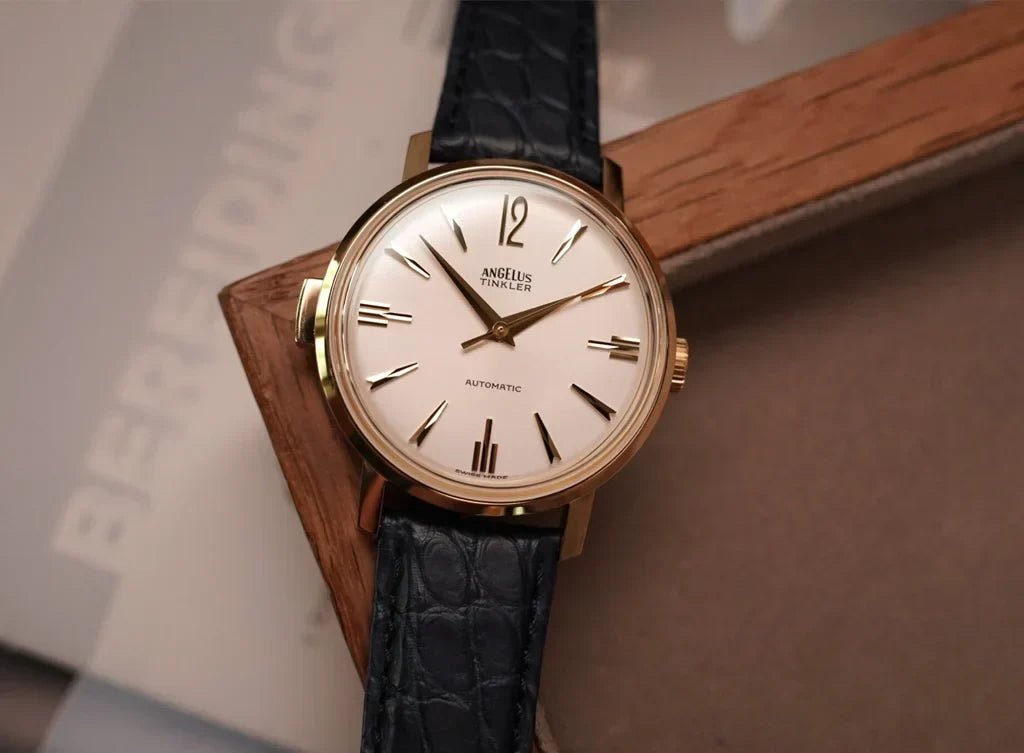
- Tinkler 1958 — A600 self-winding quarter repeater
- Flying Tourbillon Titanium — A-310 hand-wound
- Instrument de Vitesse — A5000 hand-wound
- Chronographe Télémètre — A5000 hand-wound
- Chronographe Médical — A5000 hand-wound
- Instrument de Mesures — A5000 hand-wound
That creates a fundamental rule:
Automatic Angelus → a conventional watch winder can be useful
Hand-wound Angelus → a conventional rotating watch winder provides no winding benefit
The correct process is:
Angelus Reference → Caliber → Automatic or Manual → Power Reserve → Complication → Winding Requirement → Winder or Stationary Storage
Does an Angelus Watch Need a Watch Winder?
No automatic Angelus mechanically requires a watch winder.
A self-winding mechanical movement receives energy from motion of its oscillating weight while the watch is worn.
If it remains unworn long enough, the stored power eventually runs down and the watch stops.
A watch winder is therefore primarily a convenience and collection-management device.
It can help:
- Keep an automatic Angelus running between wears
- Maintain the time and date
- Reduce repeated restarting
- Keep a chronograph watch ready to wear
- Maintain a complicated automatic watch in an active rotation
- Organize a larger haute-horlogerie collection
For a broader explanation of automatic winding and when a winder is useful, see the Watch Winder Guide.
Which Angelus Watches Can Use a Watch Winder?
The current Angelus catalog illustrates the distinction clearly.
| Angelus watch | Caliber | Winding type | Approx. power reserve | Conventional winder? |
|---|---|---|---|---|
| Chronodate | A-500 | Automatic | 60 h | Yes |
| Tinkler 1958 | A600 | Automatic | 70 h | Yes |
| Flying Tourbillon Titanium | A-310 | Manual | 60 h | No |
| Gold & Carbon Flying Tourbillon | A-250 | Manual | Reference-specific documentation should be checked | No |
| Instrument de Vitesse | A5000 | Manual | 42 h | No |
| Chronographe Télémètre | A5000 | Manual | 42 h | No |
| Chronographe Médical | A5000 | Manual | 42 h | No |
| Instrument de Mesures | A5000 | Manual | 42 h | No |
This table reveals one of the most important facts about current Angelus ownership:
many of the Maison's most mechanically sophisticated watches should not be placed on a conventional winder for the purpose of winding them.
Angelus L.A.B. vs. La Fabrique
The current Angelus catalog is divided into two principal design directions.
L.A.B.
L.A.B., or Legacy And Beyond, represents the more contemporary side of Angelus.
It currently includes watches such as:
- Chronodate
- Flying Tourbillon Titanium
- Gold & Carbon Flying Tourbillon
The important watch-winder distinction is that these watches do not all use the same winding architecture.
The Chronodate is automatic.
The current Flying Tourbillon pieces are manually wound.
La Fabrique
La Fabrique revisits Angelus' historical chronographs, measuring instruments, and repeater watches.
Current examples include:
- Instrument de Vitesse
- Chronographe Télémètre
- Chronographe Médical
- Instrument de Mesures
- Tinkler 1958
Most of the current chronograph watches in this collection use the manually wound A5000.
The new Tinkler 1958 is the major exception because its A600 is self-winding.
Therefore:
collection name alone cannot determine watch-winder compatibility.
Understanding Angelus Automatic Movements
Compared with brands dominated by automatic watches, Angelus currently has a relatively concentrated automatic offering.
Two movements are particularly important for contemporary owners:
A-500
and:
A600
Both are self-winding.
But they serve very different complications.
Angelus A-500 Automatic Chronograph
The A-500 powers the current Chronodate family.
It is an in-house automatic chronograph movement with approximately:
60 hours of power reserve
and operates at:
4 Hz / 28,800 vibrations per hour
Its architecture includes:
- Automatic winding
- Column-wheel chronograph
- Horizontal clutch
- Hours
- Minutes
- Seconds
- 30-minute chronograph
- Peripheral date
The movement uses an oscillating weight designed with visual references to historical Angelus automatic movements.
From a watch-winder perspective, the important point is simple:
A-500 is genuinely self-winding and can receive winding energy from rotational motion.
Best Watch Winder for Angelus Chronodate
The Chronodate is currently the most straightforward Angelus candidate for a conventional watch winder.
Current titanium and red-gold Chronodate models use the A-500 automatic movement and provide approximately 60 hours of reserve.
For a Chronodate, prioritize:
- Adjustable TPD
- CW/CCW/bidirectional operation
- Controlled rest periods
- Independent programming
- Smooth motor operation
- Quiet performance
- Secure support for the 42.5 mm case
- Compatibility with bracelet, leather, or rubber configurations
Chronodate Case Size and Winder Fit
Current Chronodate models use a case approximately:
42.5 mm in diameter
and:
14.25 mm thick
on representative references.
That is substantial but not unusually difficult for a properly designed luxury winder.
However, the modular case structure and chronograph pushers make stable positioning important.
Check:
- Crown clearance
- Pusher clearance
- Distance from the watch to the winder door
- Bracelet or strap curvature
- Adjacent rotor spacing
The watch should be supported by its bracelet or strap rather than contacting the walls of the winding chamber.
Chronodate Titanium vs. Red Gold
The current Chronodate is available in different material configurations.
Examples include:
- Titanium and carbon composite
- Red gold and carbon composite
The movement remains an A-500 automatic.
Case material does not change the fundamental winding requirement.
Therefore:
titanium case ≠ different TPD
and:
gold case ≠ different TPD
The exact movement remains the relevant factor.
Does a Chronograph Need More TPD?
Not simply because it is a chronograph.
The A-500 contains considerably more mechanical architecture than a basic three-hand automatic movement.
However, a watch winder acts through the automatic winding system.
It does not:
- Activate the chronograph
- Wind the chronograph separately
- Lubricate the chronograph
- Service the column wheel
- Maintain the horizontal clutch
- Regulate the movement
The appropriate TPD should therefore be based on the automatic winding requirement rather than complication count.
Angelus A600 Self-Winding Quarter Repeater
The A600 is particularly important because it powers the current Tinkler 1958.
Unlike most current La Fabrique chronographs, the Tinkler is automatic.
The A600 provides approximately:
70 hours of power reserve
and operates at:
4 Hz / 28,800 vibrations per hour
It also uses:
- 33 jewels
- Automatic winding
- Tungsten oscillating weight
- Quarter-repeater mechanism
This combination makes the Tinkler 1958 one of the most technically interesting current Angelus watches from a watch-winder perspective.
Best Watch Winder for Angelus Tinkler 1958
The Tinkler 1958 can use a properly configured automatic watch winder.
For this watch, prioritize:
- Adjustable TPD
- Multiple rotation modes
- Controlled rest cycles
- Smooth, low-vibration operation
- Quiet motors
- Soft leather-strap support
- Independent programming
Its approximately 70-hour power reserve already provides substantial autonomy.
That means a frequent wearer may have relatively little need for a winder.
For an owner rotating the watch through a larger collection, however, keeping it running may still provide convenience.
Does the Quarter Repeater Need Continuous Operation?
No.
The quarter-repeater complication does not mechanically require the watch to remain running continuously while stored.
The striking mechanism is activated when requested.
A watch winder does not:
- Exercise the repeater
- Operate the repeater pusher
- Service the gongs
- Maintain the striking mechanism separately
The winder simply helps maintain energy in the self-winding movement through the rotor.
70-Hour Power Reserve and Winder Convenience
The Tinkler 1958 provides approximately 70 hours of reserve.
That is considerably longer than many conventional 38–42-hour automatic watches.
Consider:
Frequent wearer
Wears the Tinkler every second or third day.
The 70-hour reserve may keep it running without a winder.
Large-collection owner
Wears it once every week or two.
The watch will normally stop between wears.
A winder becomes more convenient.
Therefore:
longer power reserve reduces dependence on a winder
but does not make a winder incompatible.
Angelus A5000 Hand-Wound Chronograph
The A5000 is currently one of the most important Angelus manufacture calibers.
It powers several La Fabrique watches, including:
- Instrument de Vitesse
- Chronographe Télémètre
- Chronographe Médical
- Instrument de Mesures
- Other current limited chronograph editions
The key point is:
A5000 is manually wound.
Its published power reserve is approximately:
42 hours
and it operates at:
3 Hz / 21,600 vibrations per hour
Can an Angelus A5000 Use a Watch Winder?
Not for winding.
A conventional watch winder works by moving a watch so that its automatic rotor can wind the mainspring.
The A5000 does not use an automatic rotor.
Therefore, rotating an A5000-powered Angelus inside a conventional winder does not provide the intended winding energy.
The watch must be manually wound through the crown.
Best Storage for Angelus Instrument de Vitesse
The Instrument de Vitesse uses the manually wound A5000.
It therefore does not need a powered winding position.
For this watch, prioritize:
- Soft stationary storage
- Appropriate leather-strap support
- Protection from impact
- Controlled access for high-value collections
Its 39 mm case and relatively slim construction make physical storage straightforward.
The fact that it is a mechanical chronograph does not change its manual winding architecture.
Instrument de Vitesse: Complexity Does Not Mean Automatic
The Instrument de Vitesse contains an integrated monopusher chronograph.
It can measure short timed intervals using its central chronograph seconds hand and tachymeter scale.
That makes it mechanically sophisticated.
But:
mechanical sophistication ≠ automatic winding
A highly complicated hand-wound chronograph receives no normal winding benefit from a rotating winder.
Can a Chronographe Télémètre Use a Watch Winder?
Current Chronographe Télémètre watches also use the manually wound A5000.
A conventional automatic winder therefore provides no winding benefit.
These watches use compact 37 mm cases and vintage-inspired hand-wound chronograph architecture.
For this type of Angelus, secure stationary storage is more appropriate than allocating a powered rotor position.
Can the Chronographe Médical Use a Watch Winder?
No, not for winding.
The current Chronographe Médical also uses the manually wound A5000 movement.
Its pulsometer and asthmometer scales make it functionally distinctive, but the movement still receives its energy manually through the crown.
The presence of:
- Chronograph function
- Medical scales
- Mechanical movement
- Manufacture caliber
does not make the watch automatic.
Can the Instrument de Mesures Use a Watch Winder?
The current Instrument de Mesures also uses the A5000 hand-wound architecture.
It combines several measurement scales in one chronograph concept.
Again, complexity does not alter the winding method.
For this watch:
manual crown winding → yes
conventional automatic winder → no winding benefit
Angelus Flying Tourbillon Titanium
The current Flying Tourbillon Titanium uses Caliber A-310.
It is a:
hand-wound mechanical movement
with approximately:
60 hours of power reserve
and a frequency of:
4 Hz / 28,800 vibrations per hour
Its architecture includes:
- Flying tourbillon
- Openworked movement
- Small seconds
- Large barrel
- Skeletonized construction
Despite its visual and mechanical complexity, it does not benefit from conventional automatic rotational winding.
Can the Angelus Flying Tourbillon Use a Watch Winder?
Not for winding.
The A-310 must be manually wound.
Placing the watch on a conventional rotating winder will move the entire watch, but there is no self-winding rotor converting that movement into useful mainspring energy.
This is an important distinction:
tourbillon ≠ automatic
Some tourbillon watches are automatic.
Others are hand-wound.
The exact movement determines winder compatibility.
Flying Tourbillon and Secure Storage
Although the A-310 does not need a rotating position, the watch itself may warrant premium stationary protection because of:
- Limited production
- High-value movement
- Titanium construction
- Carbon-composite architecture
- Openworked components
- Tourbillon mechanism
This is an example where:
security relevance can be high even when winder relevance is zero.
Gold & Carbon Flying Tourbillon
The Gold & Carbon Flying Tourbillon uses the A-250 family.
It is also a hand-wound mechanical flying tourbillon.
Therefore, regardless of reference-specific technical specifications:
it does not receive winding energy from a conventional automatic watch winder.
For the purposes of storage planning, this is the most important fact.
Why Exact Angelus Documentation Matters
Angelus has produced numerous technically distinctive movements and limited editions.
Specifications can also differ among:
- Movement generations
- Limited editions
- Historical references
- Revised current editions
For that reason, the exact reference should always take priority over a generic brand-level database.
This is especially important for older Angelus watches outside the current L.A.B. and La Fabrique catalogs.
Angelus Watch Winder TPD Settings
TPD means Turns Per Day—the approximate number of rotations supplied by a watch winder during a daily cycle.
There should not be one universal recommendation such as:
“Angelus = 650 TPD.”
That would be misleading because the current catalog includes both:
automatic movements
and:
hand-wound movements
Before discussing TPD, first determine whether the watch can be automatically wound at all.
For an automatic Angelus:
- Identify the exact reference.
- Identify the caliber.
- Confirm that the movement is self-winding.
- Determine the movement's winding requirements.
- Select appropriate TPD.
- Select appropriate rotation direction.
- Confirm that the watch maintains sufficient reserve.
For more information about Turns Per Day and programmable winding, see the Watch TPD Guide.
What Rotation Direction Should You Use for an Angelus Watch?
Premium programmable winders typically provide:
CW — Clockwise
CCW — Counterclockwise
Bi — Bidirectional
The correct direction should be selected according to the exact automatic caliber.
Angelus publishes detailed information about its movement architecture, power reserve, frequency, and winding system, but a universal consumer TPD and rotation-direction setting should not be assumed across the brand.
Choose a winder capable of all three directional programs.
This provides greater flexibility both for current Angelus automatics and for other watches in the collection.
Do Hand-Wound Angelus Watches Need TPD Settings?
No.
TPD is relevant to conventional automatic watch-winder operation.
For a hand-wound Angelus such as an A5000 or A-310 watch:
there is no useful TPD setting for conventional winding purposes.
The movement receives energy through manual crown winding.
A powered rotor position is therefore unnecessary.
Angelus Power Reserve Comparison
| Caliber | Example | Winding type | Approx. reserve |
|---|---|---|---|
| A5000 | Instrument de Vitesse / Chronographe Télémètre | Manual | 42 h |
| A-500 | Chronodate | Automatic | 60 h |
| A-310 | Flying Tourbillon Titanium | Manual | 60 h |
| A600 | Tinkler 1958 | Automatic | 70 h |
This comparison produces an important insight.
Consider:
Chronodate A-500 → 60 hours → automatic
and:
Flying Tourbillon A-310 → 60 hours → manual
They provide approximately the same stated reserve.
Their watch-winder compatibility is completely different.
Therefore:
power reserve does not determine whether a winder works.
The winding architecture does.
60-Hour Automatic vs. 60-Hour Manual
This is perhaps the clearest way to understand Angelus.
Chronodate A-500
- Mechanical
- 60-hour reserve
- Automatic
- Conventional winder can provide winding energy
Flying Tourbillon A-310
- Mechanical
- 60-hour reserve
- Hand-wound
- Conventional winder provides no winding energy
Both are high-end Angelus mechanical watches.
Both provide approximately 60 hours.
Only one belongs on an automatic winding rotor.
Complication Level Does Not Determine Winder Compatibility
Angelus illustrates this principle particularly well.
A watch may contain:
- Flying tourbillon
- Monopusher chronograph
- Quarter repeater
- Column wheel
- Horizontal clutch
- Openworked movement
None of these features independently tells you whether the watch can use a conventional winder.
The only decisive question is:
Does the movement contain a self-winding system?
Automatic Chronograph vs. Manual Chronograph
Angelus also creates a useful direct comparison.
Chronodate
Automatic A-500 chronograph.
Can use a watch winder.
Instrument de Vitesse
Manual A5000 chronograph.
Cannot be wound by conventional rotation.
Chronographe Télémètre
Manual A5000 chronograph.
Cannot be wound by conventional rotation.
Therefore:
chronograph ≠ automatic
The exact movement remains the deciding factor.
Automatic Repeater vs. Manual Tourbillon
Another interesting comparison is:
Tinkler 1958
Automatic A600 quarter repeater.
Can use a conventional watch winder.
Flying Tourbillon Titanium
Manual A-310 flying tourbillon.
Cannot use conventional rotational winding.
This reinforces the same rule:
complication prestige and complexity have no direct relationship with automatic winding compatibility.
Does an Angelus Automatic Need to Run All the Time?
No.
An automatic Angelus can stop normally once its stored reserve is depleted.
There is no general mechanical requirement to keep the movement continuously running.
The usefulness of a winder depends on:
power reserve + wearing frequency + complication + collection size
Consider:
Chronodate
Approximately 60 hours.
Useful on a winder if rotated among many watches.
Tinkler 1958
Approximately 70 hours.
Frequent wearers may not need a winder because of the longer reserve.
A5000 chronograph
Manual.
No conventional winder benefit regardless of how frequently it is worn.
Should You Start a Stopped Angelus Before Using a Winder?
A watch winder is generally best treated as a maintenance-winding system.
If an automatic Angelus has stopped completely, follow the correct starting procedure for that specific movement and establish an initial reserve.
The winder can then maintain the watch between wears.
The better sequence is:
restart correctly → establish reserve → place on programmed winder → maintain
rather than:
stopped watch → maximum TPD
High TPD Is Not Automatically Better
A premium mechanical watch does not become better maintained simply because it receives more rotations.
Once a program provides sufficient energy to maintain the watch's reserve, additional turns may provide no practical benefit.
The objective is:
appropriate winding
not:
maximum winding
This principle is especially relevant for high-value manufacture movements such as Angelus.
What to Look for in an Angelus Watch Winder
Adjustable TPD
Choose a system with several daily rotation programs rather than a single fixed output.
CW, CCW and Bidirectional Rotation
All three modes provide maximum flexibility.
Independent Winding Controls
Independent programming is important if Angelus automatics share the cabinet with other movement families.
Controlled Rest Cycles
A high-quality winder should divide its programmed turns across periods of movement and rest.
Continuous uninterrupted spinning is unnecessary.
Smooth Motor Operation
Angelus watches can contain:
- Manufacture chronographs
- Repeaters
- High complications
- Precious-metal components
- Openworked movements
Smooth starts and stops are preferable to abrupt motion.
Quiet Motors
Low operational noise matters in:
- Bedrooms
- Private offices
- Dressing rooms
- Walk-in wardrobes
- Collector rooms
Flexible Watch Cushions
Angelus currently spans both:
- Compact 37–39 mm La Fabrique watches
- Larger 42.5 mm L.A.B. watches
A compressible cushion provides better fit across this range.
Soft Contact Surfaces
Current watches can use:
- Titanium
- Stainless steel
- 18K gold
- Carbon composite
- Alligator leather
- Rubber
Premium interior contact surfaces reduce unnecessary rubbing.
Angelus Strap and Bracelet Fit
Current Angelus watches use several attachment systems.
These can include:
- Titanium bracelets
- Leather straps
- Rubber straps
- Folding clasps
- Pin buckles
- Interchangeable strap systems
A suitable watch holder should not force the strap or bracelet into an unnatural shape.
For closely fitted bracelets, compressibility is particularly important.
Chronodate Bracelet Fit
Titanium Chronodate configurations can use integrated-looking metal bracelet arrangements.
When placing one on a winder, check:
- Cushion circumference
- Clasp closure
- Watch-head stability
- Clearance around the pushers
- Distance to adjacent watches
A technically correct TPD program is not enough if the watch is physically unstable.
Tinkler Leather-Strap Fit
The Tinkler 1958 uses a more traditional leather strap.
For leather, avoid:
- Excessive bending
- Oversized rigid cushions
- Sharp holder edges
- Excessive buckle tension
The cushion should support the watch approximately as a wrist would.
Best Watch Winder for One Angelus Automatic
For one automatic Angelus, a premium programmable single-watch winder is generally sufficient.
Prioritize:
- Adjustable TPD
- CW/CCW/bidirectional modes
- Controlled rest cycles
- Quiet motor
- Smooth motion
- Flexible cushion
- Appropriate chamber clearance
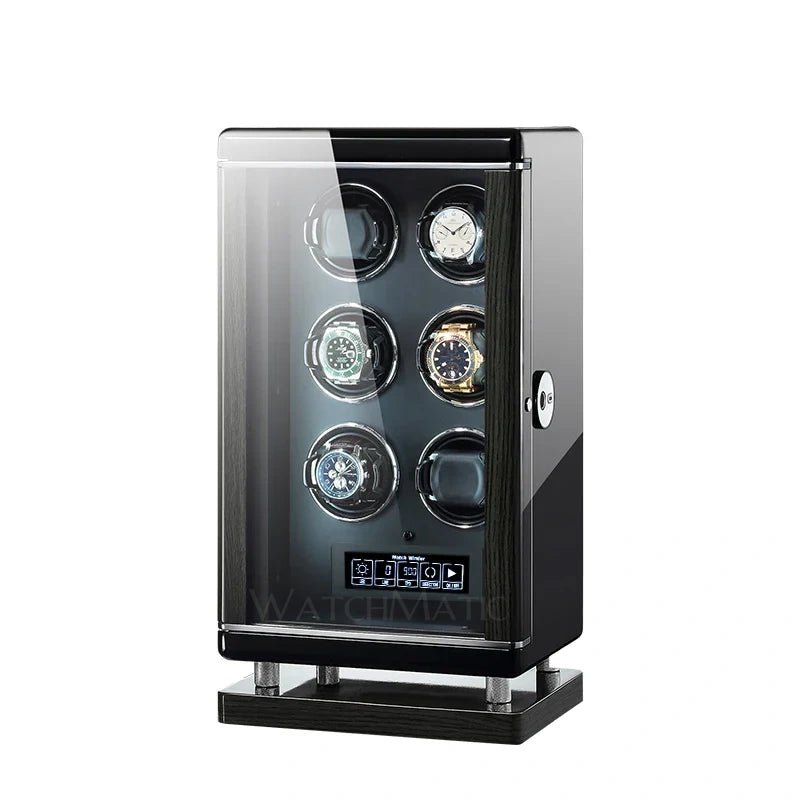
Suitable configurations can be explored in the WatchMatic Watch Winder Collection.
Best Watch Winder for Multiple Angelus Watches
A current Angelus collection might contain:
- Chronodate Titanium
- Chronodate Red Gold
- Tinkler 1958
- Flying Tourbillon Titanium
- Gold & Carbon Flying Tourbillon
- Instrument de Vitesse
- Chronographe Télémètre
Only some of these should occupy powered winding positions.
A more efficient architecture is:
Chronodate and Tinkler automatic watches → independently programmable rotors
A5000 and hand-wound Flying Tourbillon watches → secure stationary storage
This is particularly important for Angelus because a collector could own several mechanical watches while actually needing very few powered rotors.
LuxGuard for Angelus Automatic Watches

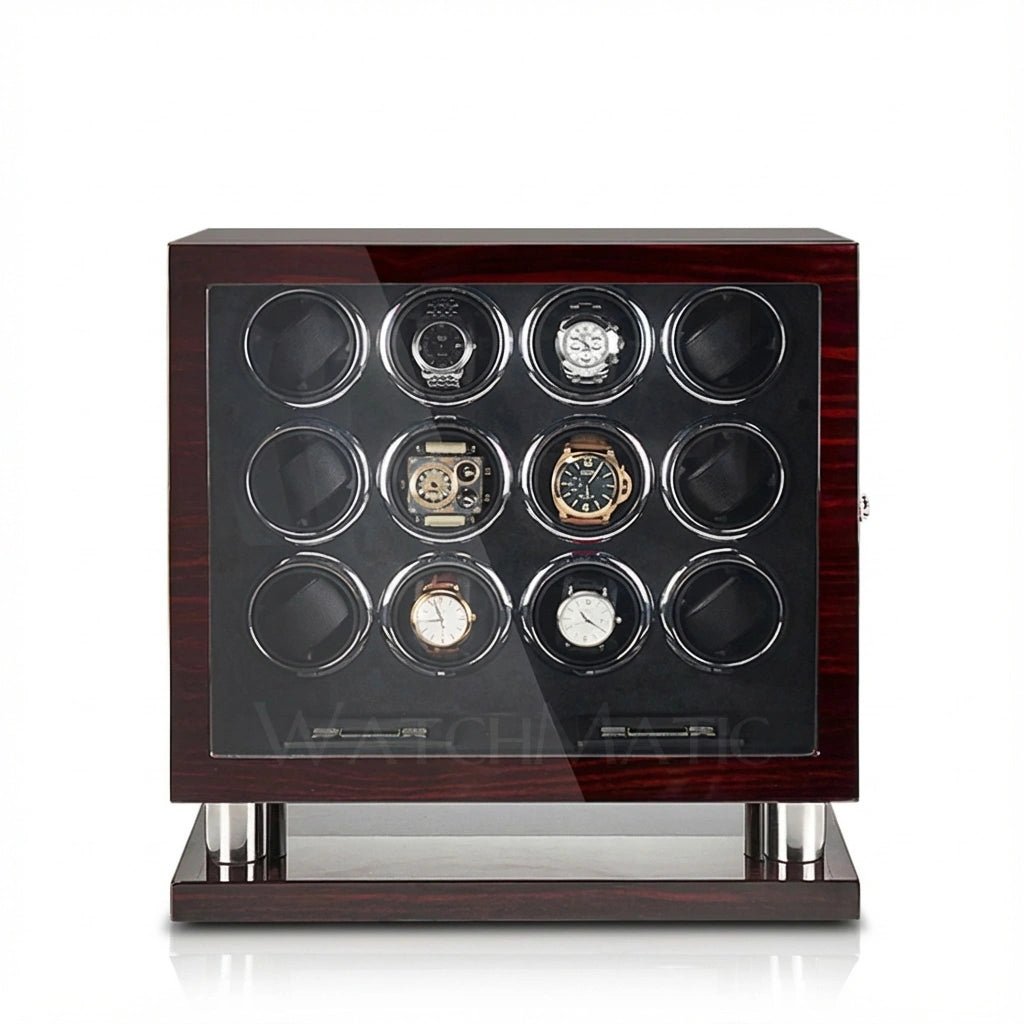
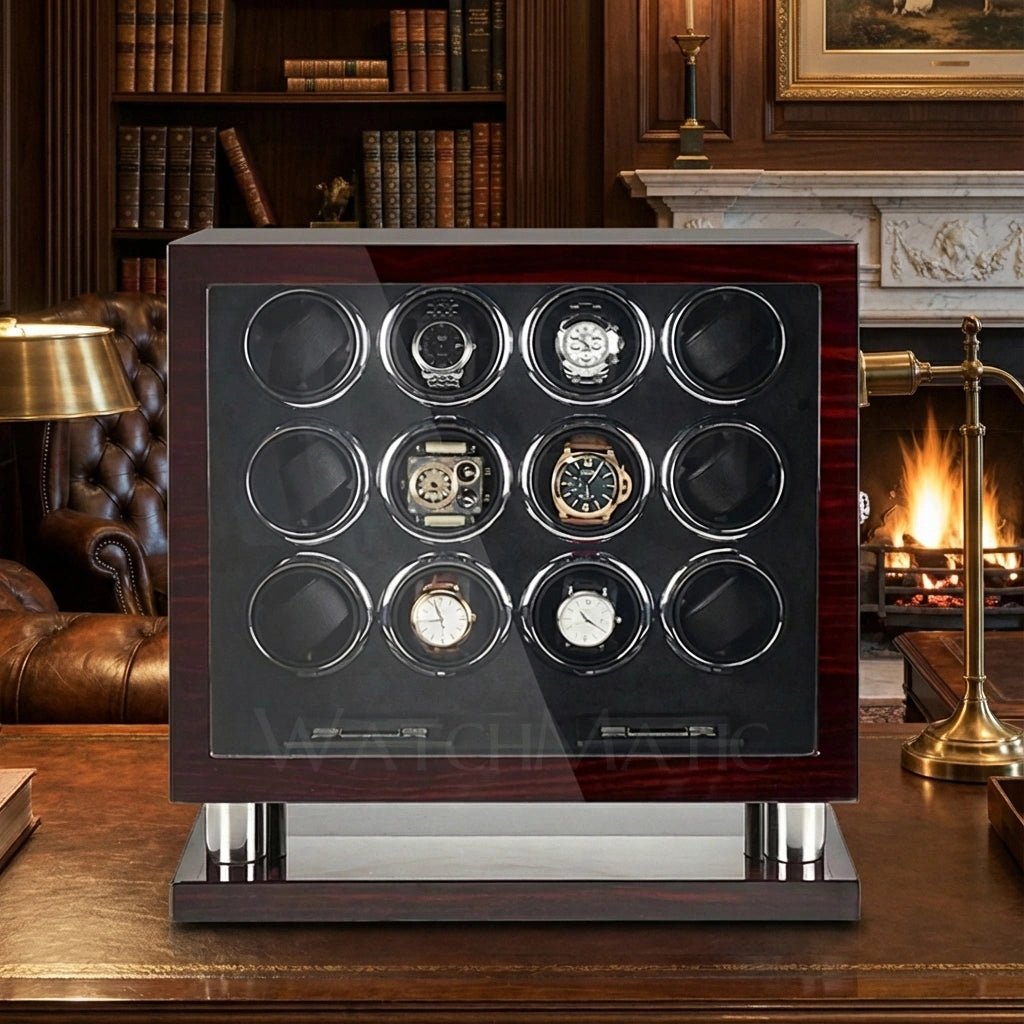
A multi-position LuxGuard Watch Winder can be suitable for collectors managing several Angelus automatic watches or combining Angelus with other automatic haute-horlogerie pieces.
Depending on configuration, features include:
- Independent winding controls
- Multiple rotation modes
- Japanese Mabuchi motors
- Quiet operation
- Anti-magnetization protection
- Interior illumination
- Secure individual watch positions
Independent control is particularly useful when an A-500 Chronodate shares the winder with automatic movements from other manufacturers.
Do Manual Angelus Watches Need to Rotate for Storage?
No.
There is no need to rotate a hand-wound Angelus simply because it is mechanical.
For watches such as:
- Flying Tourbillon Titanium
- Instrument de Vitesse
- Chronographe Télémètre
- Chronographe Médical
- Instrument de Mesures
stationary storage is completely appropriate.
A rotating holder does not provide a useful winding function to these movements.
Is It Safe to Keep an Angelus Automatic on a Watch Winder?
A properly configured high-quality winder can be used with a confirmed automatic Angelus.
Important factors include:
- Confirming the exact movement is automatic
- Choosing appropriate TPD
- Selecting appropriate rotation direction
- Using controlled rest cycles
- Supporting the watch securely
- Minimizing unnecessary magnetic exposure
- Using smooth low-vibration motors
A watch winder should not compensate for abnormal movement behavior.
If a properly wound Angelus shows unexpectedly short running time or abnormal performance, professional inspection is more appropriate than continually increasing TPD.
Does a Watch Winder Maintain an Angelus Movement?
Only in the limited sense of supplying winding motion to an automatic caliber.
A watch winder does not:
- Service the movement
- Replace lubricants
- Regulate accuracy
- Repair components
- Maintain a chronograph mechanism
- Exercise a repeater mechanism
- Service a tourbillon
Regular professional servicing remains separate from automatic winding.
Watch Winder vs. Watch Winder Safe for Angelus Collectors
Angelus is especially suitable for a mixed winding-and-storage approach.
Why?
Because the current catalog combines valuable automatic and valuable manual watches.
| Feature | Watch Winder | Watch Winder Safe |
|---|---|---|
| Automatic winding | Yes | Yes |
| Independent programs | Model dependent | Available |
| Hand-wound storage | Possible | Yes |
| Controlled access | Limited | High |
| Physical security | Limited | High |
| Additional storage | Limited | Available |
| Mixed automatic/manual collection | Moderate | High |
| High-value limited editions | Basic | More suitable |
Collectors requiring both independently programmed rotors and secure storage can explore the Watch Winder Safe Collection.
Titan Vault for an Angelus Collection

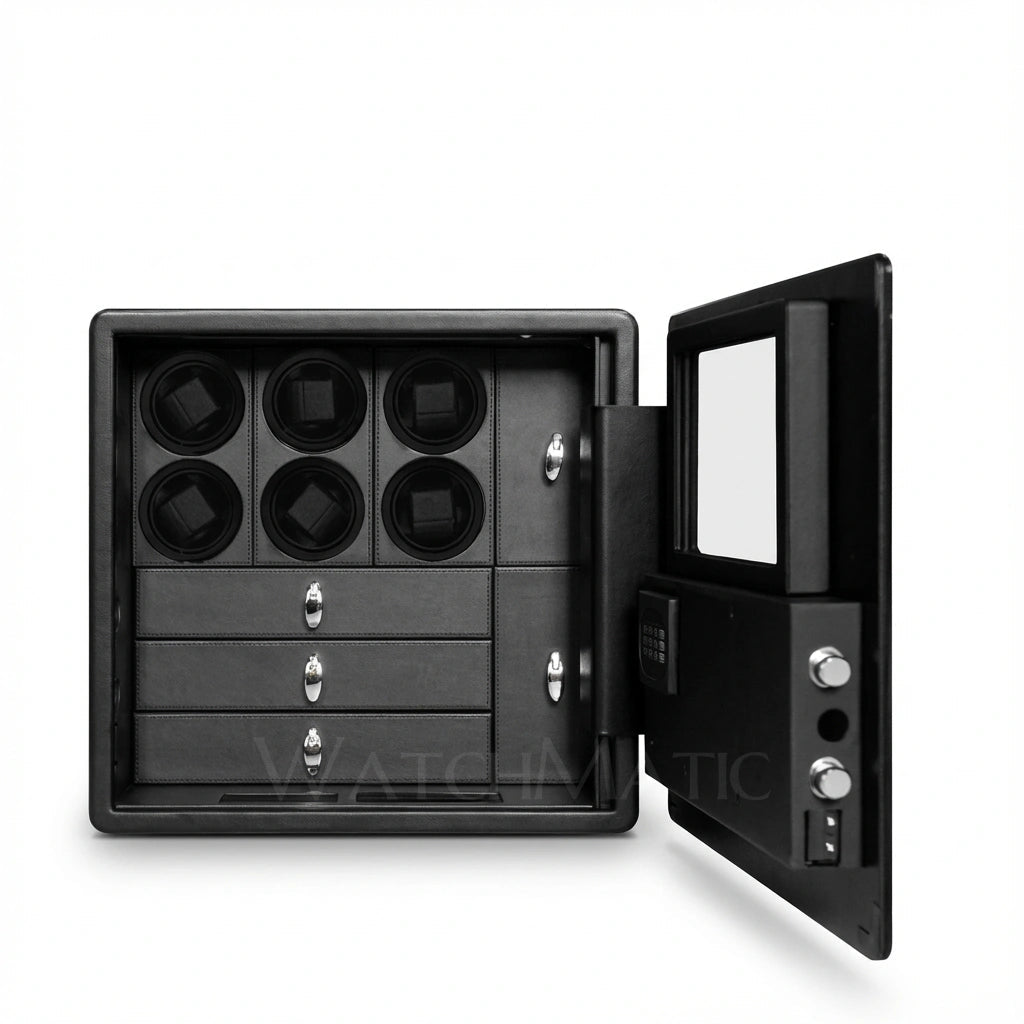
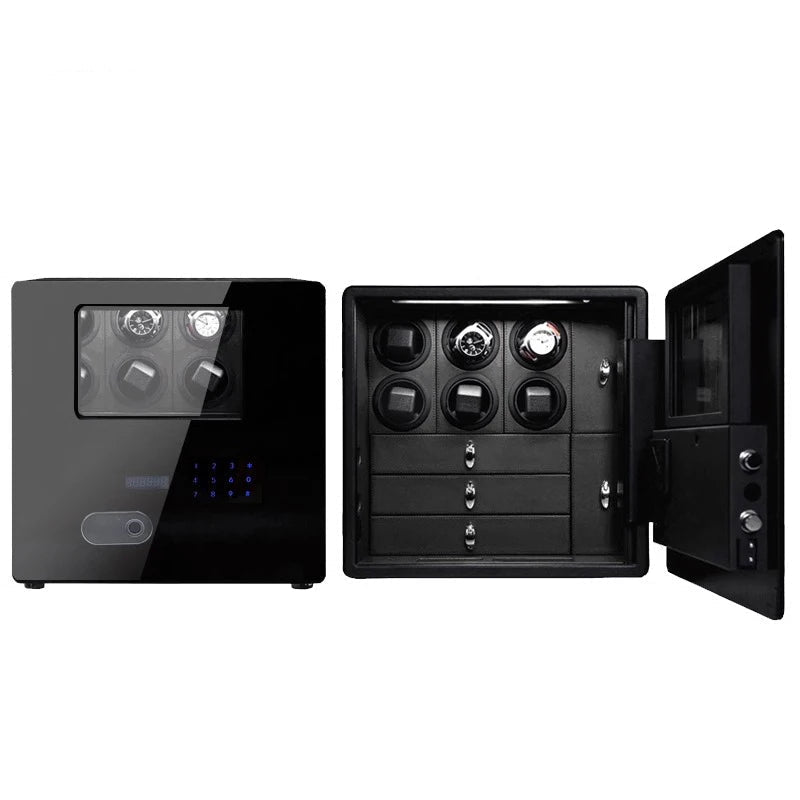
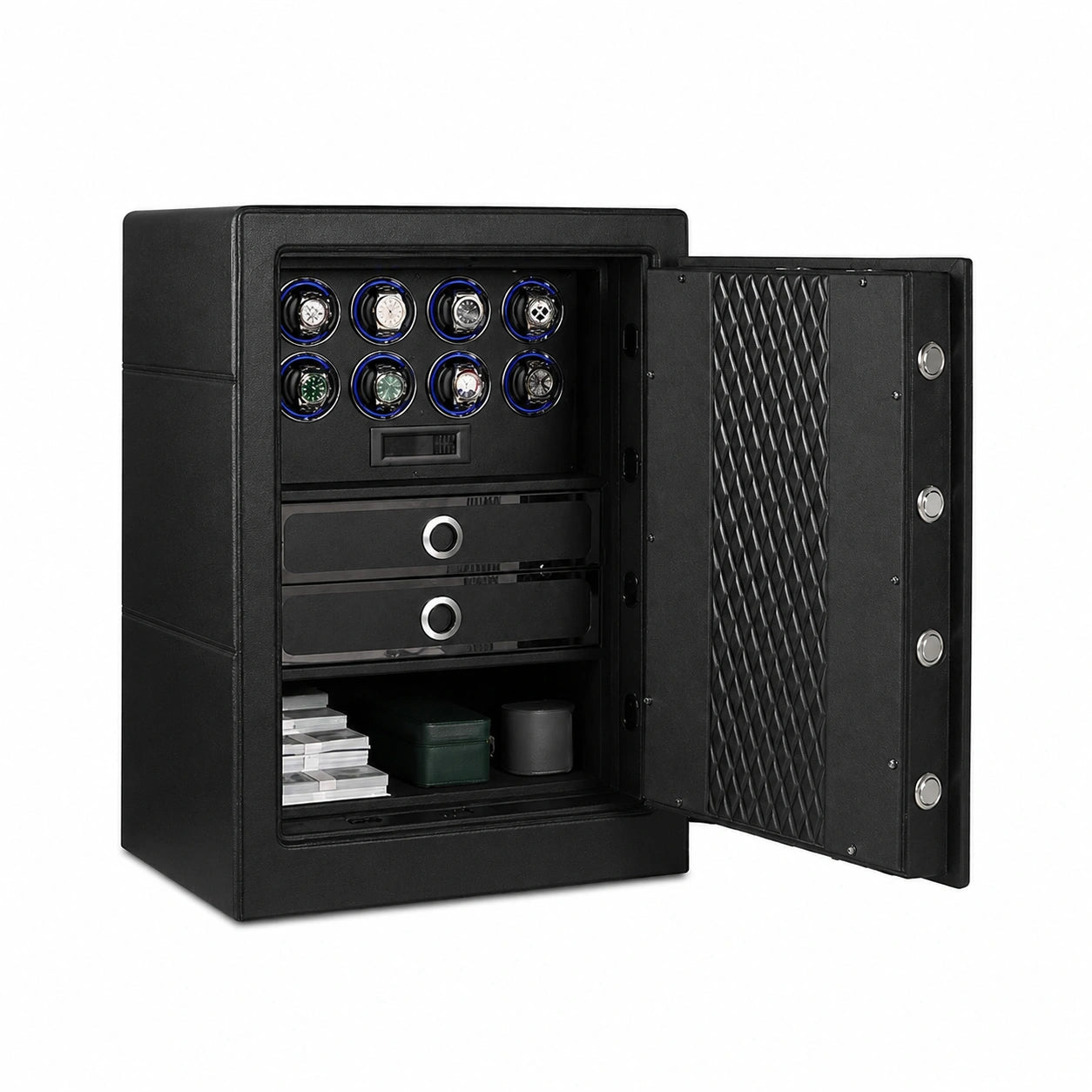
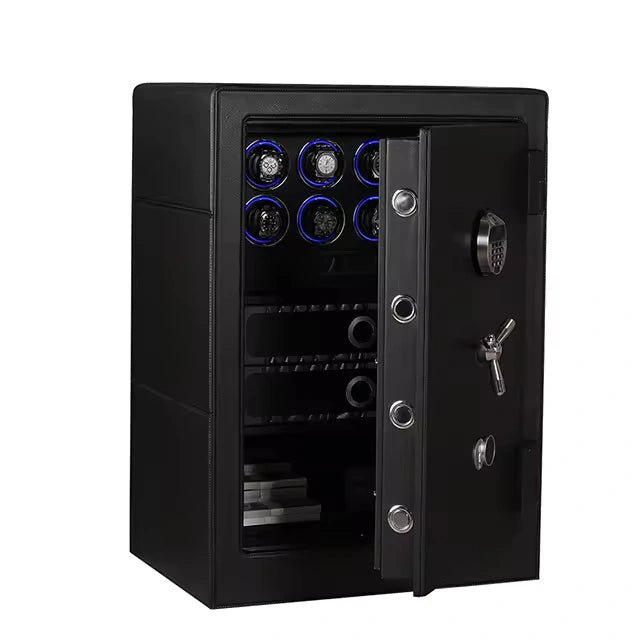
For a larger Angelus or mixed haute-horlogerie collection, the Titan Watch Winder Safe combines programmable winding positions with secure stationary storage.
Depending on configuration, the Titan Vault series can accommodate approximately 12 to 60 watches, with available features including:
- Reinforced safe construction
- Biometric fingerprint access
- Digital passcode
- Manual key access
- Independent winding controls
- Adjustable TPD
- CW/CCW/bidirectional programming
- Japanese Mabuchi motors
- Anti-magnetization protection
- LED illumination
- Additional storage compartments
This architecture is particularly logical for Angelus.
An automatic Chronodate or Tinkler 1958 can occupy a powered rotor.
A hand-wound Flying Tourbillon or A5000 chronograph can remain in secure stationary storage without unnecessary rotation.
For an Angelus collection dominated by hand-wound La Fabrique chronographs and tourbillons, a secure Luxury Watch Safe Collection may be more relevant than maximizing the number of winding motors.
Why Security Is Particularly Relevant for Angelus
Current Angelus watches include:
- Limited-edition production
- Manufacture chronographs
- Flying tourbillons
- Quarter repeaters
- 18K gold cases
- Titanium and carbon construction
- Openworked movements
- Historically inspired collector pieces
For this kind of collection, storage should consider:
winding compatibility + physical protection + controlled access + presentation
rather than motorized winding alone.
Automatic Capacity Should Not Equal Collection Capacity
Suppose a collector owns six Angelus watches:
- Two Chronodates
- One Tinkler 1958
- One Flying Tourbillon
- One Instrument de Vitesse
- One Chronographe Télémètre
The collection contains six mechanical watches.
But only three need automatic-winding positions.
That distinction can materially affect the storage system chosen.
Instead of buying six rotors, the collector may be better served by:
3 programmable rotors + 3 secure stationary positions
This is one of the strongest storage insights for Angelus.
Angelus in a Mixed Haute Horlogerie Collection
Angelus can sit naturally alongside manufacturers known for technically ambitious chronographs, tourbillons, unconventional movement architecture, and limited-production watchmaking.
A mixed collection might include:
Angelus + Ulysse Nardin + Girard-Perregaux + Breguet + Franck Muller + Hublot
Related WatchMatic resources include:
Best Watch Winder for Ulysse Nardin Watches
Best Watch Winder for Girard-Perregaux Watches
Best Watch Winder for Breguet Watches
Best Watch Winder for Franck Muller Watches
Best Watch Winder for Hublot Watches
Independent winding control becomes increasingly useful because watches in this type of collection can contain radically different self-winding systems.
How to Choose the Best Watch Winder for Your Angelus
Step 1: Identify the Exact Reference
Do not stop at:
- L.A.B.
- La Fabrique
- Chronodate
- Flying Tourbillon
Determine the exact watch and generation.
Step 2: Identify the Caliber
Important current examples include:
- A-500
- A600
- A5000
- A-310
- A-250
Step 3: Confirm Automatic or Manual
This is the most important step.
Current examples:
A-500 → automatic
A600 → automatic
A5000 → manual
A-310 → manual
Step 4: Check Power Reserve
Representative current figures include:
A5000 → approximately 42 hours
A-500 → approximately 60 hours
A-310 → approximately 60 hours
A600 → approximately 70 hours
Use the exact reference documentation when available.
Step 5: Determine Whether TPD Is Relevant
TPD matters only when the movement is self-winding.
A hand-wound movement does not require a conventional TPD program.
Step 6: Determine Rotation Direction
For an automatic Angelus, use movement-specific information rather than one brand-wide assumption.
A premium system should provide:
- CW
- CCW
- Bidirectional
Step 7: Consider the Complication
Chronograph or repeater complexity can increase the value of keeping a watch ready to wear, but it does not determine TPD by itself.
Step 8: Check Physical Fit
Current Angelus cases range from:
- Compact 37–39 mm vintage-inspired watches
- 38 mm Tinkler
- 42.5 mm contemporary L.A.B. watches
Choose the holder accordingly.
Step 9: Use Independent Controls
Do not force multiple automatic calibers from a mixed collection onto one fixed program.
Step 10: Reserve Stationary Space for Manual Watches
A serious Angelus collection can contain more hand-wound watches than automatic watches.
Plan storage capacity accordingly.
For broader resources covering automatic winding, TPD, secure storage, and collection protection, visit the WatchMatic Guide Hub.
Best Watch Winder for Angelus Watches: Final Thoughts
Choosing the best watch winder for an Angelus begins with determining whether the exact movement is automatic or manually wound.
This matters more with Angelus than with many brands.
The current Chronodate A-500 is an automatic chronograph with approximately 60 hours of power reserve and can benefit from an appropriately programmed winder.
The new Tinkler 1958 A600 is also self-winding and extends reserve to approximately 70 hours.
By contrast, much of the current La Fabrique chronograph collection uses the A5000 hand-wound caliber, while the Flying Tourbillon Titanium A-310 is also manually wound.
Those watches receive no winding benefit from a conventional rotating watch winder.
The comparison between the Chronodate and Flying Tourbillon is especially instructive:
A-500 Chronodate → approximately 60 hours → automatic → winder compatible
A-310 Flying Tourbillon → approximately 60 hours → manual → no conventional winding benefit
The same power reserve can therefore lead to completely different storage requirements.
For a confirmed automatic Angelus, prioritize:
- Adjustable TPD
- CW/CCW/bidirectional programming
- Controlled rest cycles
- Independent rotor control
- Quiet, smooth motors
- Flexible cushions
- Appropriate case clearance
- Premium contact surfaces
For manually wound Angelus watches, prioritize secure stationary storage rather than unnecessary motorized rotation.
The most reliable decision framework is:
Angelus Reference → Caliber → Automatic or Manual → Power Reserve → Complication → Physical Fit → TPD/Direction → Winder or Stationary Storage
For additional automatic-winding and secure-storage solutions, explore WatchMatic.