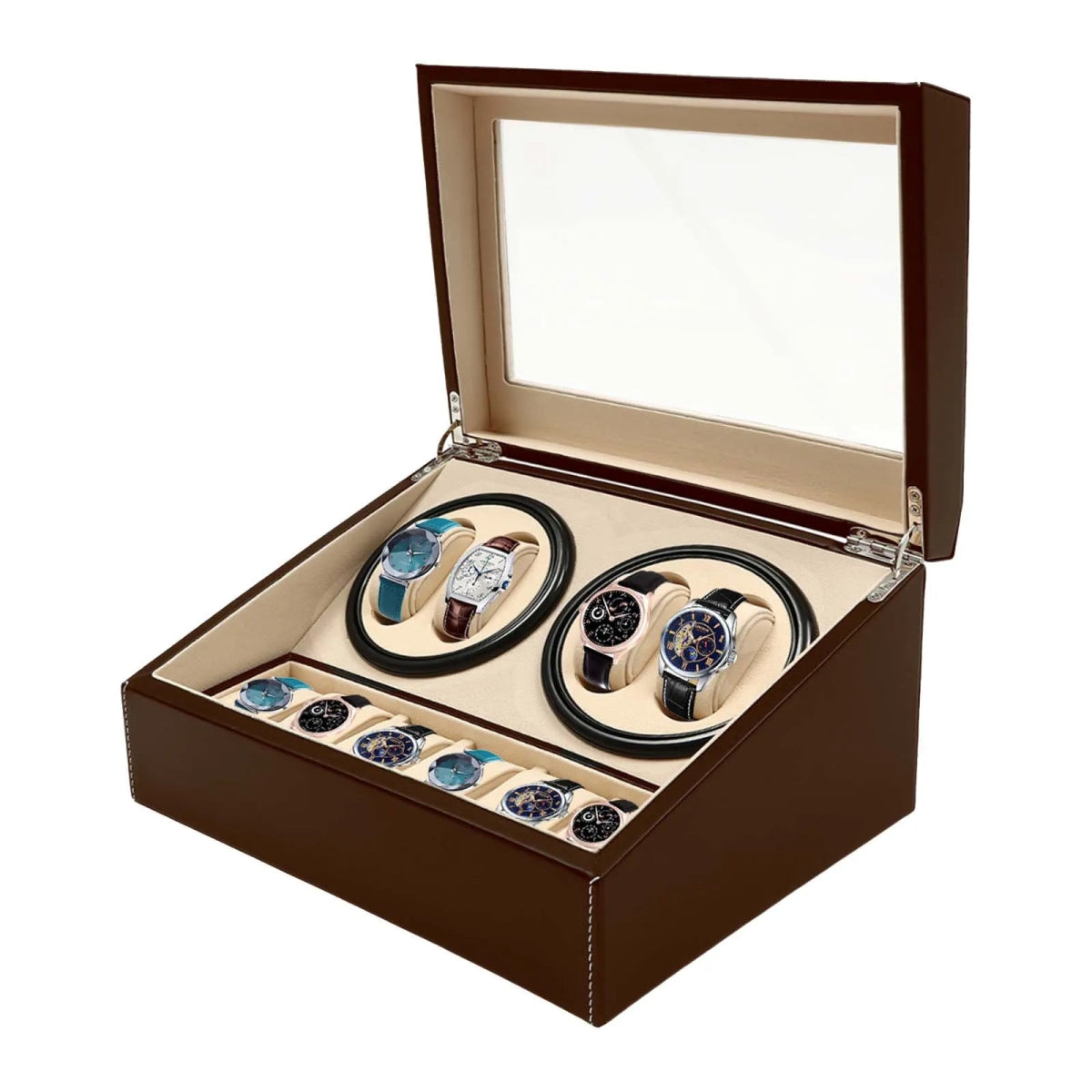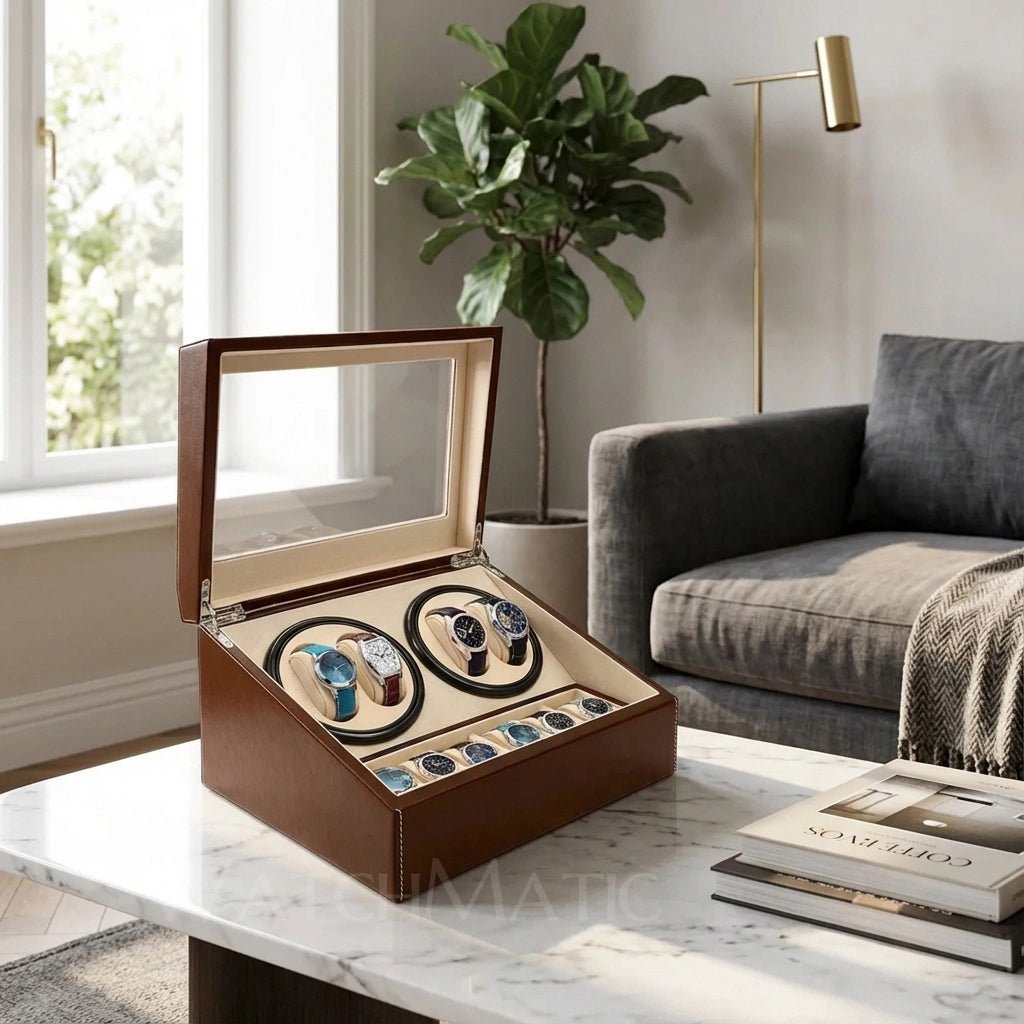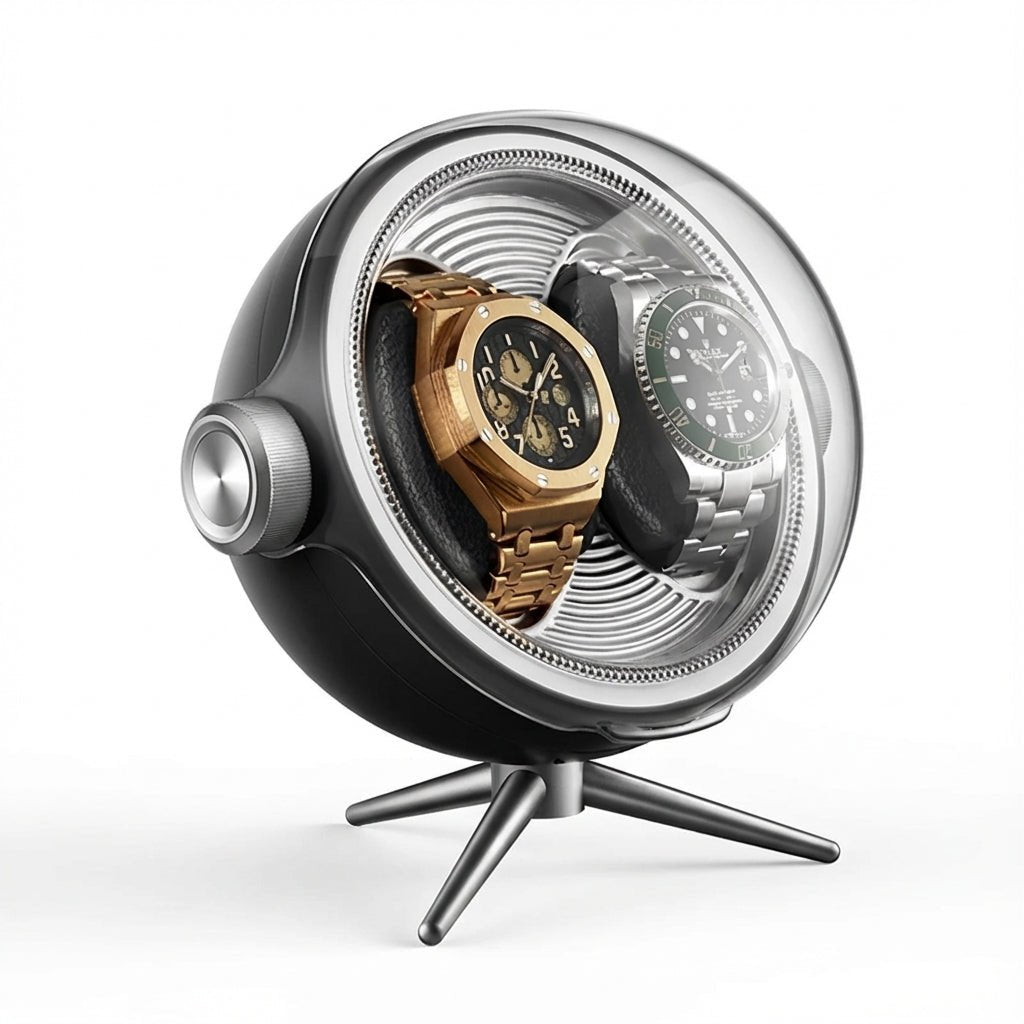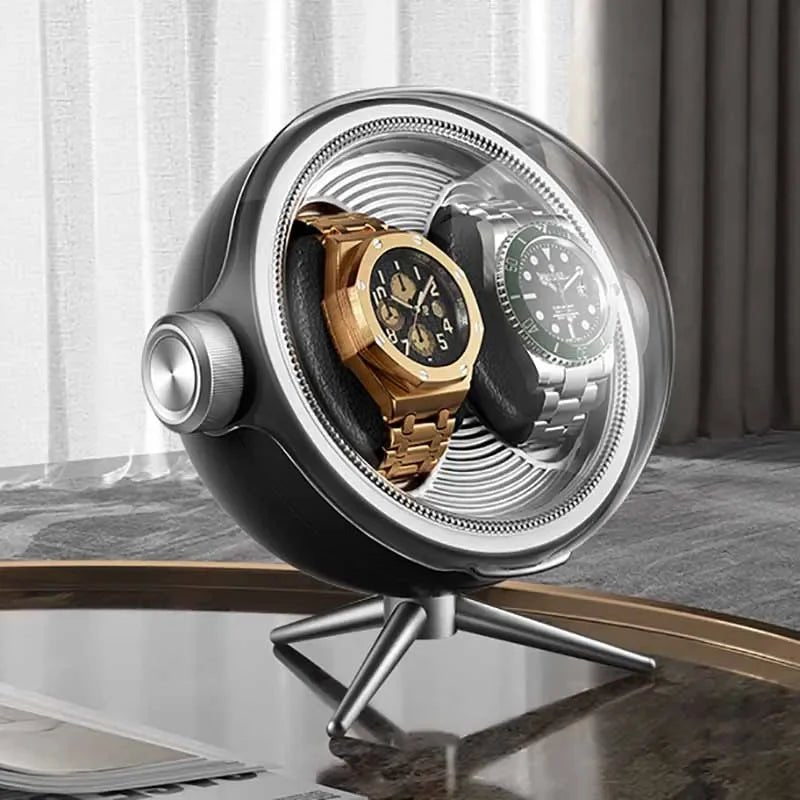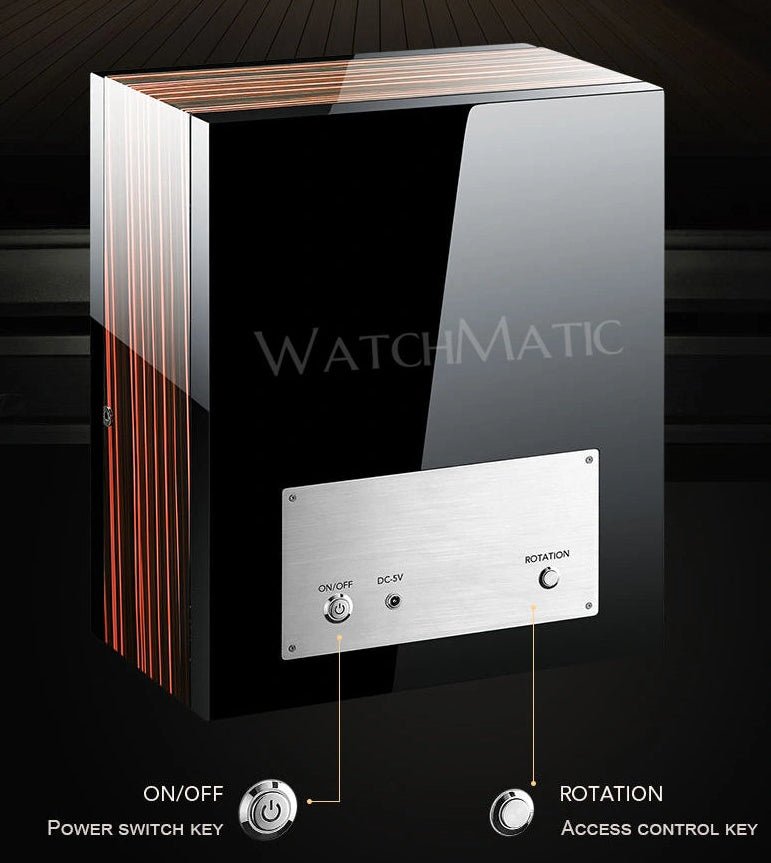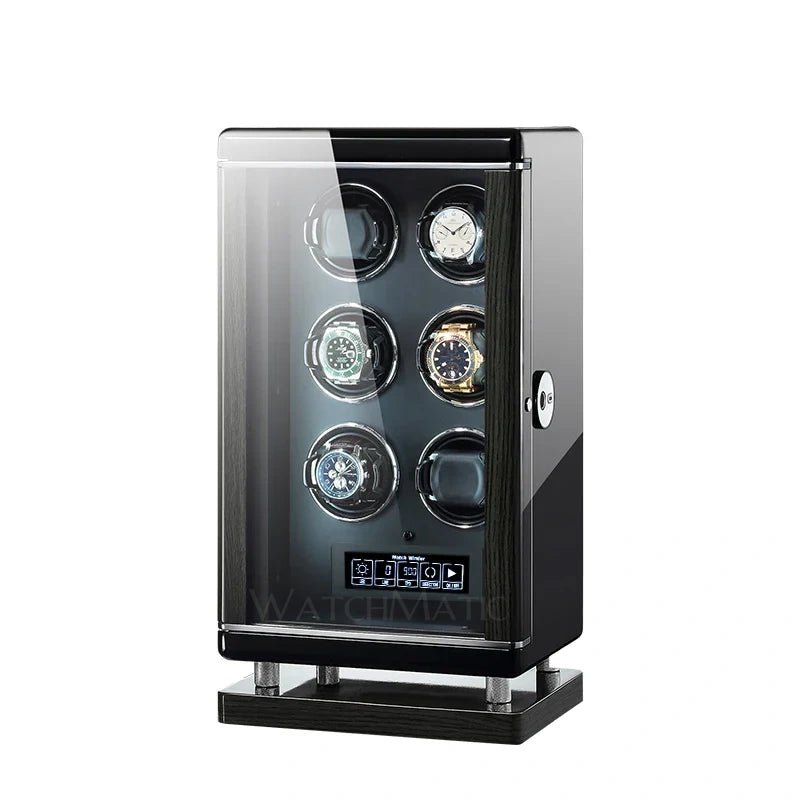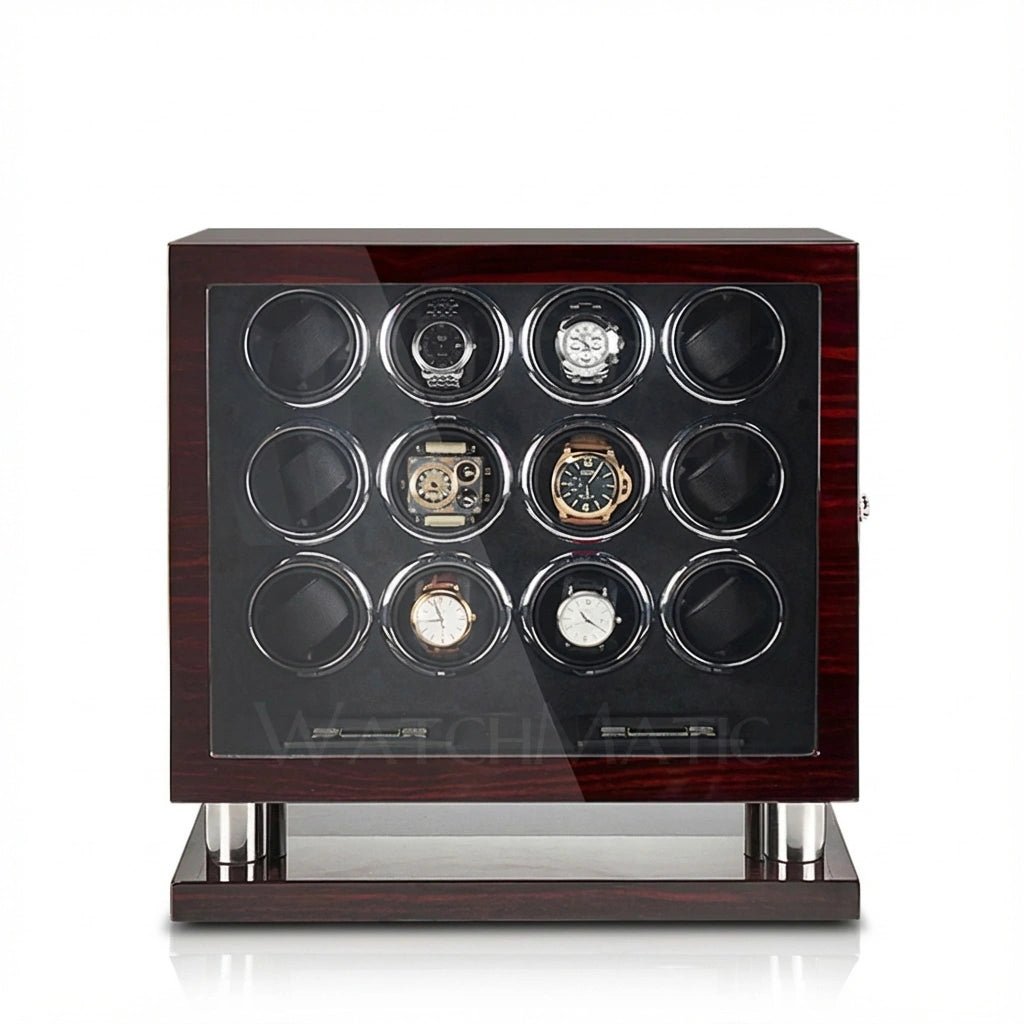
The best watch winder for Arnold & Son watches is a premium programmable model with adjustable Turns Per Day (TPD), clockwise and counterclockwise rotation options, independent controls, controlled winding and rest cycles, quiet operation, and secure support for precious-metal and high-complication watches.
However, movement identification is essential with Arnold & Son.
A significant part of the current collection is manually wound rather than automatic.
Important current automatic examples include:
- Longitude Titanium — A&S6302
- DSTB 42 — A&S6203
- Globetrotter 42 — A&S6122
- Globetrotter 45 — A&S6022
By contrast, prominent collections such as:
- Perpetual Moon
- Luna Magna
- Nebula
- Time Pyramid
- HM
- Ultrathin Tourbillon
- Constant Force Tourbillon
- Double Tourbillon
use manually wound movements in current or recent references.
That creates the fundamental rule:
Automatic Arnold & Son → a conventional watch winder can be useful
Manual-wind Arnold & Son → a conventional rotating watch winder provides no winding benefit
The correct process is therefore:
Exact Reference → Caliber → Automatic or Manual → Power Reserve → Complication → Physical Fit → Winder Program or Stationary Storage
Does an Arnold & Son Watch Need a Watch Winder?
No automatic Arnold & Son mechanically requires a watch winder.
A self-winding mechanical movement uses an oscillating weight to convert motion into mainspring energy while the watch is worn.
If the watch remains unworn longer than its available power reserve, the movement eventually stops.
A watch winder is therefore mainly a convenience and collection-management tool.
It can help:
- Keep an automatic Arnold & Son running between wears
- Maintain local time
- Keep world-time information synchronized
- Preserve date or power-reserve indications where applicable
- Reduce repeated restarting
- Keep several automatic watches ready to wear
It does not replace servicing or make a mechanical watch inherently healthier simply by keeping it running continuously.
For a broader explanation of automatic winding, see the Watch Winder Guide.
Which Arnold & Son Watches Can Use a Watch Winder?
Representative current and recent references include:
| Arnold & Son watch | Caliber | Winding type | Approx. power reserve | Conventional winder? |
|---|---|---|---|---|
| Longitude Titanium | A&S6302 | Automatic | 60 h | Yes |
| DSTB 42 | A&S6203 | Automatic | 55 h | Yes |
| Globetrotter 42 | A&S6122 | Automatic | 55 h | Yes |
| Globetrotter 45 | A&S6022 | Automatic | 45 h | Yes |
| HM | A&S1001 | Manual | 90 h | No |
| Perpetual Moon 41.5 | A&S1512 | Manual | 90 h | No |
| Perpetual Moon 38 | A&S1612 | Manual | 90 h | No |
| Luna Magna | A&S1021 | Manual | 90 h | No |
| Nebula | A&S5201 | Manual | 90 h | No |
| Time Pyramid | A&S1615 | Manual | 90 h | No |
| Ultrathin Tourbillon | A&S8300 | Manual | 100 h | No |
| Constant Force Tourbillon 11 | A&S5219 | Manual | ~100 h | No |
| Double Tourbillon | A&S8513 | Manual | 90 h | No |
This produces one of the clearest Arnold & Son ownership lessons:
many of the Maison's longest-running and most complicated watches are not automatic.
Why Arnold & Son Is Different From Many Luxury Brands
Many contemporary Swiss brands build most of their catalog around automatic movements.
Arnold & Son takes a different approach.
Its current collection contains a strong concentration of manually wound manufacture calibers, especially within:
- Astronomical complications
- Skeleton watches
- Tourbillons
- Constant-force movements
- Historically inspired chronometers
Automatic winding is more concentrated in specific practical collections such as:
- Longitude
- DSTB
- Globetrotter
This means the question:
“What watch winder setting does Arnold & Son use?”
is too broad.
For many Arnold & Son watches, the correct answer is:
no conventional TPD setting is required because the watch is manually wound.
Arnold & Son A&S6302 Automatic Movement
The A&S6302 powers the current Longitude Titanium.
It is a self-winding manufacture caliber with:
- Approximately 60 hours of power reserve
- 28,800 vibrations per hour
- 36 jewels
- Hours
- Minutes
- Small seconds
- Power-reserve indication
- COSC chronometer certification
Its automatic winding system uses a 22-carat gold oscillating weight.
This makes the Longitude one of the clearest current Arnold & Son candidates for conventional watch-winder use.
Best Watch Winder for Arnold & Son Longitude
The Longitude Titanium combines the A&S6302 automatic movement with a 42.5 mm titanium case.
For this watch, prioritize:
- Adjustable TPD
- CW/CCW/bidirectional operation
- Controlled rest cycles
- Independent programming
- Smooth motor operation
- Secure titanium-bracelet support
- Rubber-strap compatibility
- Quiet performance
The approximately 60-hour power reserve already provides useful autonomy.
A frequent wearer may therefore not require a winder.
A collector rotating the Longitude among many watches may find one substantially more convenient.
Longitude Power-Reserve Indicator as Winder Feedback
The Longitude includes a power-reserve display.
That can provide useful practical feedback when evaluating a winder program.
If the reserve remains reasonably stable across repeated storage cycles, the selected program is supplying sufficient winding energy.
If the reserve consistently declines, the program may need to be reviewed.
This is more useful than simply assuming:
higher TPD = better winding.
The correct objective is:
sufficient winding rather than maximum winding.
Does COSC Certification Change the Winder Setting?
No.
The Longitude A&S6302 is COSC certified.
That certification relates to chronometric performance.
It does not directly specify:
- TPD
- Winding direction
- Winder operating time
- Cushion size
Therefore:
COSC certification ≠ special watch-winder setting
Movement architecture remains the relevant factor.
Arnold & Son A&S6203 True Beat Seconds
The A&S6203 powers the current DSTB 42.
It is an automatic manufacture caliber with approximately:
55 hours of power reserve
and operates at:
4 Hz / 28,800 vibrations per hour.
Its automatic system uses a 22-carat gold oscillating weight.
The movement also drives one of Arnold & Son's signature complications:
Dial-Side True Beat seconds.
Best Watch Winder for Arnold & Son DSTB
The DSTB 42 can be used with a properly configured automatic watch winder.
For this watch, prioritize:
- Adjustable TPD
- Multiple direction modes
- Controlled rest periods
- Smooth operation
- Low vibration
- Soft leather-strap support
- Independent programming
The current case measures approximately:
42 mm
with a thickness of roughly:
12.95 mm.
That makes it physically easier to accommodate than some larger Globetrotter references.
Does True Beat Seconds Require More TPD?
No.
The true-beat seconds mechanism makes the seconds hand advance in distinct one-second steps despite the underlying movement operating at a much higher frequency.
That dedicated mechanism does not mean the automatic winding system should simply receive more daily rotation.
A watch winder does not:
- Operate the true-beat mechanism separately
- Service its escapement-like system
- Regulate the seconds mechanism
- Replace movement servicing
Therefore:
true-beat complication ≠ higher TPD
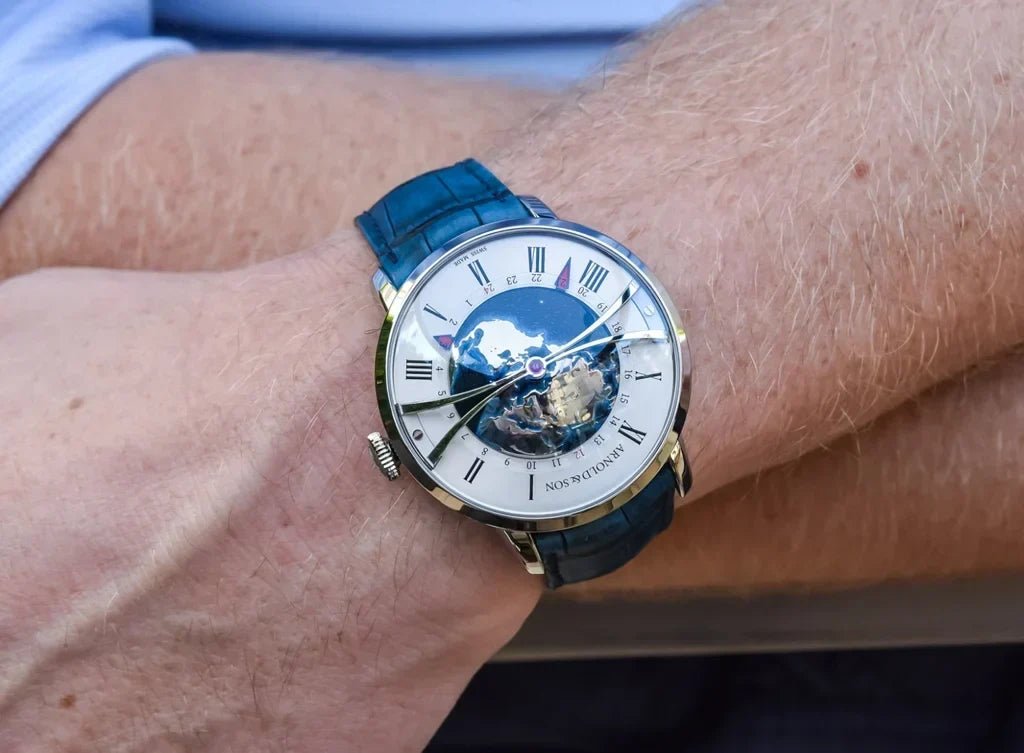
Arnold & Son Globetrotter Automatic Watches
The Globetrotter collection deserves particular attention because the current 42 mm and 45 mm versions do not share identical movement specifications.
This is an excellent example of why collection name alone is not enough.
Globetrotter 42
Uses:
A&S6122
with approximately:
55 hours of power reserve
Globetrotter 45
Uses:
A&S6022
with approximately:
45 hours of power reserve
Both are automatic.
But they are not mechanically identical.
Best Watch Winder for Globetrotter 42
The current Globetrotter 42 uses the A&S6122 self-winding movement.
Its approximate specifications include:
- 55-hour power reserve
- 28,800 vibrations per hour
- 29 jewels
- Local hours and minutes
- 24-hour world-time display
The world-time complication provides a stronger convenience argument for keeping the watch running than a simple two-hand watch.
For a Globetrotter 42, prioritize:
- Adjustable TPD
- Multiple winding directions
- Independent programming
- Controlled rest cycles
- Quiet operation
- Stable leather-strap support
- Adequate chamber depth
Why World Time Benefits From Staying Running
If a simple time-only watch stops, restarting it is relatively straightforward.
A world-time watch contains more synchronized information.
The owner may need to restore:
- Local time
- Reference position of the world-time display
- 24-hour relationship
A winder does not improve the world-time mechanism itself.
It simply reduces the likelihood that the watch stops between wears.
Best Watch Winder for Globetrotter 45
The Globetrotter 45 uses the older/larger A&S6022 self-winding architecture with approximately:
45 hours of power reserve.
That is significantly shorter than the 55-hour reserve of the newer 42 mm model.
Its physical dimensions are also considerably larger.
Representative specifications include approximately:
45 mm diameter
and:
17.26 mm thickness.
This makes physical winder compatibility particularly important.
Globetrotter 45 Chamber Clearance
At more than 17 mm thick with a domed sapphire architecture and prominent world-time globe, the Globetrotter 45 requires more chamber depth than many conventional dress watches.
Check:
- Door clearance
- Distance from crystal to enclosure
- Crown clearance
- Strap curvature
- Adjacent watch spacing
- Watch-head stability
A winder can be electronically compatible while physically unsuitable.
Globetrotter 42 vs. Globetrotter 45
| Feature | Globetrotter 42 | Globetrotter 45 |
|---|---|---|
| Caliber | A&S6122 | A&S6022 |
| Winding | Automatic | Automatic |
| Power reserve | 55 h | 45 h |
| Case diameter | 42 mm | 45 mm |
| Thickness | ~15.1 mm | ~17.3 mm |
| Conventional winder | Yes | Yes |
This is one of the strongest information-gain points for Arnold & Son.
Two watches from the same collection differ in:
- Caliber
- Power reserve
- Size
- Thickness
- Physical winder fit
Therefore:
Globetrotter collection name ≠ one universal winder setup.
Arnold & Son Watch Winder TPD Settings
TPD means Turns Per Day—the approximate number of rotations delivered by a watch winder during a daily program.
There should not be one universal recommendation such as:
“Arnold & Son = 650 TPD.”
That approach would be particularly misleading because a large percentage of Arnold & Son watches are manually wound.
For an automatic Arnold & Son:
- Identify the exact reference.
- Confirm that the movement is automatic.
- Identify the caliber.
- Determine its winding requirements.
- Select appropriate TPD.
- Select appropriate rotation direction.
- Confirm that the watch maintains sufficient reserve.
For more information about Turns Per Day, see the Watch TPD Guide.
What Rotation Direction Should You Use for Arnold & Son?
A premium programmable watch winder should offer:
CW — Clockwise
CCW — Counterclockwise
Bi — Bidirectional
Arnold & Son provides detailed official specifications for its calibers, but its standard current technical documentation does not establish one universal consumer watch-winder direction across every automatic model.
Therefore, avoid assuming:
Arnold & Son = one winding direction.
Instead use:
exact reference → caliber → verified winding requirement → appropriate direction
A programmable system provides more flexibility than a fixed-direction unit.
Automatic Arnold & Son Power Reserve Comparison
| Automatic caliber | Watch | Approx. reserve |
|---|---|---|
| A&S6022 | Globetrotter 45 | 45 h |
| A&S6203 | DSTB 42 | 55 h |
| A&S6122 | Globetrotter 42 | 55 h |
| A&S6302 | Longitude Titanium | 60 h |
The current automatic range therefore spans roughly:
45 to 60 hours.
That is substantially shorter than several manually wound Arnold & Son calibers.
Manual Arnold & Son Power Reserve Comparison
| Manual caliber | Watch | Approx. reserve |
|---|---|---|
| A&S1001 | HM | 90 h |
| A&S1512 | Perpetual Moon 41.5 | 90 h |
| A&S1612 | Perpetual Moon 38 | 90 h |
| A&S1021 | Luna Magna | 90 h |
| A&S5201 | Nebula | 90 h |
| A&S1615 | Time Pyramid | 90 h |
| A&S8513 | Double Tourbillon | 90 h |
| A&S8300 | Ultrathin Tourbillon | 100 h |
| A&S5219 | Constant Force Tourbillon 11 | ~100 h |
This creates an unusual and important comparison:
some manually wound Arnold & Son watches run almost twice as long as certain automatic references.
Yet they still cannot be wound through conventional rotation.
Longer Power Reserve Does Not Mean Winder Compatible
Consider:
Globetrotter 45
45 hours
Automatic
Can use a conventional winder.
Perpetual Moon
90 hours
Manual
Cannot be wound by conventional rotation.
Ultrathin Tourbillon
100 hours
Manual
Cannot be wound by conventional rotation.
Therefore:
power reserve length does not determine watch-winder compatibility.
The winding architecture does.
Arnold & Son Perpetual Moon
The Perpetual Moon is one of Arnold & Son's signature astronomical watches.
Current 41.5 mm references use Caliber A&S1512.
It is manually wound and provides approximately:
90 hours of power reserve.
The moon-phase mechanism is designed for extremely high astronomical accuracy.
However, a conventional automatic watch winder provides no winding benefit.
Can an Arnold & Son Perpetual Moon Use a Watch Winder?
Not for winding.
The A&S1512 is manually wound.
This remains true despite the watch containing a sophisticated astronomical complication.
The owner must wind the watch through the crown.
When it is not being used, stationary storage is entirely appropriate.
Moon-Phase Accuracy vs. Watch-Winder Compatibility
The Perpetual Moon's astronomical display can remain extraordinarily accurate when the watch continues running correctly.
However:
moon-phase precision does not make the movement automatic.
If the watch stops, the moon indication stops with it.
A conventional winder cannot prevent that because there is no automatic winding rotor.
This is a strong example of the difference between:
desire to keep a complication synchronized
and:
ability to use rotational winding.
Perpetual Moon 38 vs. 41.5
Arnold & Son also uses different calibers for different Perpetual Moon sizes.
Representative examples include:
Perpetual Moon 41.5 → A&S1512
Perpetual Moon 38 → A&S1612
Both are manually wound.
Both provide approximately 90 hours of reserve.
Therefore, neither requires a conventional automatic rotor position.
Arnold & Son Luna Magna
The Luna Magna uses the manually wound A&S1021.
Its specifications include approximately:
90 hours of power reserve
and a large three-dimensional moon-phase display.
The movement remains manual despite the significant complexity of the lunar mechanism.
Does Luna Magna Need a Watch Winder?
No conventional watch winder can wind the A&S1021.
The watch should be manually wound and can remain in stationary storage.
The large spherical moon does not change the winding architecture.
Therefore:
3D moon phase ≠ automatic
Luna Magna Physical Storage Considerations
Luna Magna watches measure approximately:
44 mm
and can include:
- Red gold
- Platinum
- Precious stones
- Three-dimensional moon structures
- Hand-finished artistic dials
Even though they do not need a powered rotor, they may require:
- Generous physical clearance
- Soft contact surfaces
- Stable strap support
- High-security storage
This is a good example where security relevance is high while winder relevance is zero.
Arnold & Son Nebula
The Nebula uses Caliber A&S5201 in current references.
It is a fully openworked mechanical movement with approximately:
90 hours of power reserve
from two large barrels.
It is manually wound.
Therefore, a conventional automatic watch winder provides no winding benefit.
Skeleton Watch Does Not Mean Automatic
The Nebula exposes a large amount of its movement architecture.
The motion of:
- Balance
- Gear train
- barrels
- escapement
is clearly visible.
That does not imply automatic winding.
A skeleton movement can be manual or automatic.
The A&S5201 is manual.
Therefore:
visible mechanics ≠ self-winding movement.
Nebula 38, 40 and 41.5
The Nebula family has appeared in:
- 38 mm
- 40 mm
- 41.5 mm
configurations.
Although physical fit differs between versions, their A&S5201 architecture remains manually wound in the current relevant references.
For storage, prioritize:
- Soft cushion sizing
- Appropriate strap or bracelet support
- Protection for openworked/highly finished surfaces
- Secure stationary positioning
No powered rotor is required solely for winding.
Arnold & Son Time Pyramid
The Time Pyramid uses Caliber A&S1615.
Its architecture arranges the movement vertically, with:
- Balance near 12 o'clock
- Gear train arranged along the central axis
- Two mainspring barrels near 6 o'clock
The movement provides approximately:
90 hours of power reserve
and is manually wound.
Can Time Pyramid Use a Watch Winder?
Not for conventional winding.
There is no automatic oscillating weight.
The visually unusual layout does not alter that fact.
The correct process is:
manual winding through the crown → stationary storage when not worn
rather than allocating a powered rotor.
Double Barrel Does Not Mean Automatic
The Time Pyramid uses two mainspring barrels.
That architecture contributes to its extended power reserve.
It does not indicate how the mainsprings are wound.
A movement can have:
- One barrel
- Two barrels
- Multiple barrels
and still be either:
- Automatic
- Manual
Therefore:
barrel count ≠ watch-winder compatibility
Arnold & Son HM
The HM collection uses the ultra-thin A&S1001.
It is manually wound and offers approximately:
90 hours of reserve.
Current HM watches can be exceptionally slim and elegant despite their long autonomy.
A conventional rotating winder provides no winding benefit.
Long Manual Reserve Reduces Storage Complexity
An HM watch can run for several days after a full manual wind.
This reduces how often it needs crown winding if worn intermittently.
But the movement remains manual.
Therefore:
90-hour reserve ≠ automatic
and:
90-hour reserve ≠ requires a winder
Arnold & Son Ultrathin Tourbillon
The current Ultrathin Tourbillon uses the manually wound A&S8300.
Its specifications include:
- Flying tourbillon
- Approximately 100 hours of power reserve
- Double barrel
- 3 Hz frequency
- Movement thickness around 2.97 mm
Despite being one of the brand's most technically sophisticated watches, it has no automatic winding rotor.
Can the Ultrathin Tourbillon Use a Watch Winder?
Not for winding.
A conventional rotating winder cannot supply mainspring energy to the A&S8300.
The watch should be manually wound.
For storage, prioritize:
- Soft stationary support
- Protection of precious-metal case surfaces
- Low-impact handling
- Controlled access
- Appropriate security
Tourbillon Does Not Mean Automatic
Tourbillon describes the regulating architecture.
It does not describe the winding system.
The Arnold & Son Ultrathin Tourbillon is:
- Mechanical
- Highly complicated
- Long-running
- Manually wound
Therefore:
tourbillon ≠ automatic
Arnold & Son Constant Force Tourbillon
The Constant Force Tourbillon 11 uses the manually wound A&S5219.
Its specifications include approximately:
100 hours of power reserve
alongside:
- Constant-force mechanism
- One-minute tourbillon
- True-beat seconds
- Twin-barrel architecture
A conventional automatic winder provides no winding benefit.
Constant Force Does Not Change Winder Compatibility
A constant-force mechanism controls how energy is delivered to the escapement.
It does not determine how the mainspring receives energy.
Therefore:
constant-force mechanism ≠ automatic winding
The A&S5219 must still be manually wound.
Arnold & Son Double Tourbillon
The Double Tourbillon uses the manually wound A&S8513.
Its architecture includes:
- Two tourbillons
- Two gear trains
- Two time displays
- Separate time-zone capability
- Approximately 90 hours of reserve
Despite containing two tourbillons and two functional trains, the movement remains manually wound.
Two Tourbillons Still Do Not Need a Winder
A watch can contain far more mechanical complexity than a conventional automatic watch and still have no use for rotational winding.
The Double Tourbillon demonstrates this clearly.
Compare:
Globetrotter A&S6022 → simpler → automatic → winder compatible
with:
Double Tourbillon A&S8513 → extremely complicated → manual → no conventional winding benefit
Complication level is not the deciding variable.
Automatic vs. Manual Arnold & Son
| Feature | Automatic Arnold & Son | Manual Arnold & Son |
|---|---|---|
| Mechanical movement | Yes | Yes |
| Automatic oscillating weight | Yes | No |
| Conventional winder useful | Yes, optionally | No |
| Manual winding possible | Movement dependent | Yes |
| Power reserve | Often 45–60 h current examples | Often 90–100 h current examples |
| Secure stationary storage useful | Yes | Yes |
Arnold & Son is unusual because its manual movements frequently have longer reserves than its automatic movements.
Does an Arnold & Son Automatic Need to Run All the Time?
No.
An automatic Arnold & Son can stop normally after its power reserve is depleted.
There is no general mechanical requirement to keep it running continuously.
The practical value of a winder depends on:
power reserve + complication + frequency of wear + collection size
For example:
Globetrotter 45
45-hour reserve plus world time.
A relatively strong case for winder convenience in a larger rotation.
DSTB 42
55-hour reserve and true-beat seconds.
Moderate convenience benefit.
Longitude
60-hour reserve.
Frequent wearers may rarely need a winder.
Should You Start a Stopped Arnold & Son Before Using a Winder?
A watch winder is generally best used as a maintenance-winding system.
If an automatic Arnold & Son has stopped completely, follow the correct starting procedure for that reference and establish an initial reserve.
The winder can then maintain the movement.
The preferred sequence is:
restart correctly → establish reserve → set indications → place on programmed winder → maintain
rather than:
stopped watch → maximum TPD
High TPD Is Not Automatically Better
The highest available winder setting is not inherently the best setting.
Once a movement receives sufficient winding to maintain its reserve, additional rotation may provide no practical benefit.
Higher TPD does not automatically:
- Improve accuracy
- Improve lubrication
- Extend service intervals
- Protect a tourbillon
- Improve chronometer certification
- Maintain a complication
Use an appropriate program rather than maximum rotation.
What to Look for in an Arnold & Son Watch Winder
Adjustable TPD
Choose a winder that offers several daily rotation programs.
Do not rely on a fixed-output system for a mixed movement collection.
CW, CCW and Bidirectional Modes
All three options provide greater movement compatibility.
Independent Controls
This is particularly useful if:
- Longitude
- DSTB
- Globetrotter 42
- Globetrotter 45
share the same cabinet.
Different calibers should not automatically be forced onto one program.
Controlled Rest Cycles
Continuous uninterrupted spinning is unnecessary.
A quality winder should divide daily rotations across active and resting periods.
Smooth Motor Operation
Arnold & Son watches can include:
- Precious metals
- High complications
- Large domed crystals
- Delicate artistic dials
- Skeletonized movements
Smooth starts and stops are preferable.
Low Vibration
The objective is controlled motion similar to normal wrist movement rather than mechanical shaking.
Quiet Motors
Low operational noise is particularly useful in:
- Bedrooms
- Dressing rooms
- Private offices
- Walk-in wardrobes
- Collector rooms
Flexible Watch Cushions
Relevant Arnold & Son watches range from approximately:
38 mm to 45 mm
with very different wrist sizes and strap configurations.
Adequate Chamber Depth
This is particularly important for:
Globetrotter 45
because of its substantial thickness and domed architecture.
Soft Contact Surfaces
Precious-metal cases, polished bezels and hand-finished surfaces should not repeatedly contact hard enclosure components.
Best Watch Winder for One Arnold & Son Automatic
For one automatic Arnold & Son, a premium programmable winder is generally sufficient.
Prioritize:
- Adjustable TPD
- CW/CCW/bidirectional operation
- Controlled rest cycles
- Quiet motor
- Smooth rotation
- Flexible cushion
- Appropriate chamber clearance
- Secure watch retention
Suitable configurations can be explored in the WatchMatic Watch Winder Collection.
Best Watch Winder for Multiple Arnold & Son Watches
An Arnold & Son collection might contain:
- Longitude
- DSTB
- Globetrotter 42
- Perpetual Moon
- Luna Magna
- Nebula
- Ultrathin Tourbillon
- Time Pyramid
That collection contains eight mechanical watches.
But only three in this example need conventional automatic-winder positions.
A better storage architecture is:
Automatic Longitude, DSTB and Globetrotter → independently programmable rotors
Manual Perpetual Moon, Luna Magna, Nebula, Ultrathin Tourbillon and Time Pyramid → secure stationary storage
This avoids paying for motorized positions that provide no winding benefit.
LuxGuard for Arnold & Son Automatic Watches

A multi-position LuxGuard Watch Winder can be suitable for collectors managing automatic Arnold & Son watches or combining them with other automatic haute-horlogerie pieces.
Depending on configuration, features include:
- Independent winding controls
- Multiple rotation modes
- Japanese Mabuchi motors
- Quiet operation
- Anti-magnetization protection
- Interior illumination
- Secure individual watch positions
Independent control is particularly useful when an A&S6302 Longitude, A&S6203 DSTB and A&S6122 or A&S6022 Globetrotter share the same winding cabinet.
Do Manual Arnold & Son Watches Need to Rotate in Storage?
No.
There is no conventional winding reason to rotate manually wound watches such as:
- Perpetual Moon
- Luna Magna
- Nebula
- Time Pyramid
- HM
- Ultrathin Tourbillon
- Constant Force Tourbillon
- Double Tourbillon
These watches should be manually wound when appropriate.
Stationary storage is entirely suitable when they are not being worn.
Is It Safe to Keep an Arnold & Son Automatic on a Watch Winder?
A properly configured high-quality winder can be appropriate for a confirmed automatic Arnold & Son.
Important factors include:
- Confirming the exact movement is automatic
- Choosing suitable TPD
- Selecting appropriate direction
- Using controlled rest cycles
- Supporting the watch securely
- Maintaining adequate case clearance
- Minimizing unnecessary magnetic exposure
- Using smooth low-vibration motors
A winder should not compensate for abnormal movement behavior.
If an adequately wound watch shows unexpectedly short reserve or irregular operation, professional inspection is more appropriate than continually increasing TPD.
A Watch Winder Does Not Service an Arnold & Son
A watch winder does not:
- Replace lubricants
- Regulate accuracy
- Service a tourbillon
- Maintain a constant-force mechanism
- Correct moon-phase calibration
- Repair the world-time system
- Renew seals
- Replace scheduled professional maintenance
Its role is limited to supplying rotational motion to an automatic winding mechanism.
Watch Winder vs. Watch Winder Safe for Arnold & Son Collectors
Arnold & Son is particularly well suited to a mixed winding-and-stationary storage strategy.
The reason is simple:
many of its most valuable watches are manually wound.
| Feature | Watch Winder | Watch Winder Safe |
|---|---|---|
| Automatic winding | Yes | Yes |
| Independent programming | Model dependent | Available |
| Manual-watch storage | Possible | Yes |
| Controlled access | Limited | High |
| Physical security | Limited | High |
| Additional storage | Limited | Available |
| Mixed automatic/manual collection | Moderate | High |
| High-value complications | Basic | More suitable |
Collectors looking for integrated winding and physical protection can explore the Watch Winder Safe Collection.
Titan Vault for an Arnold & Son Collection

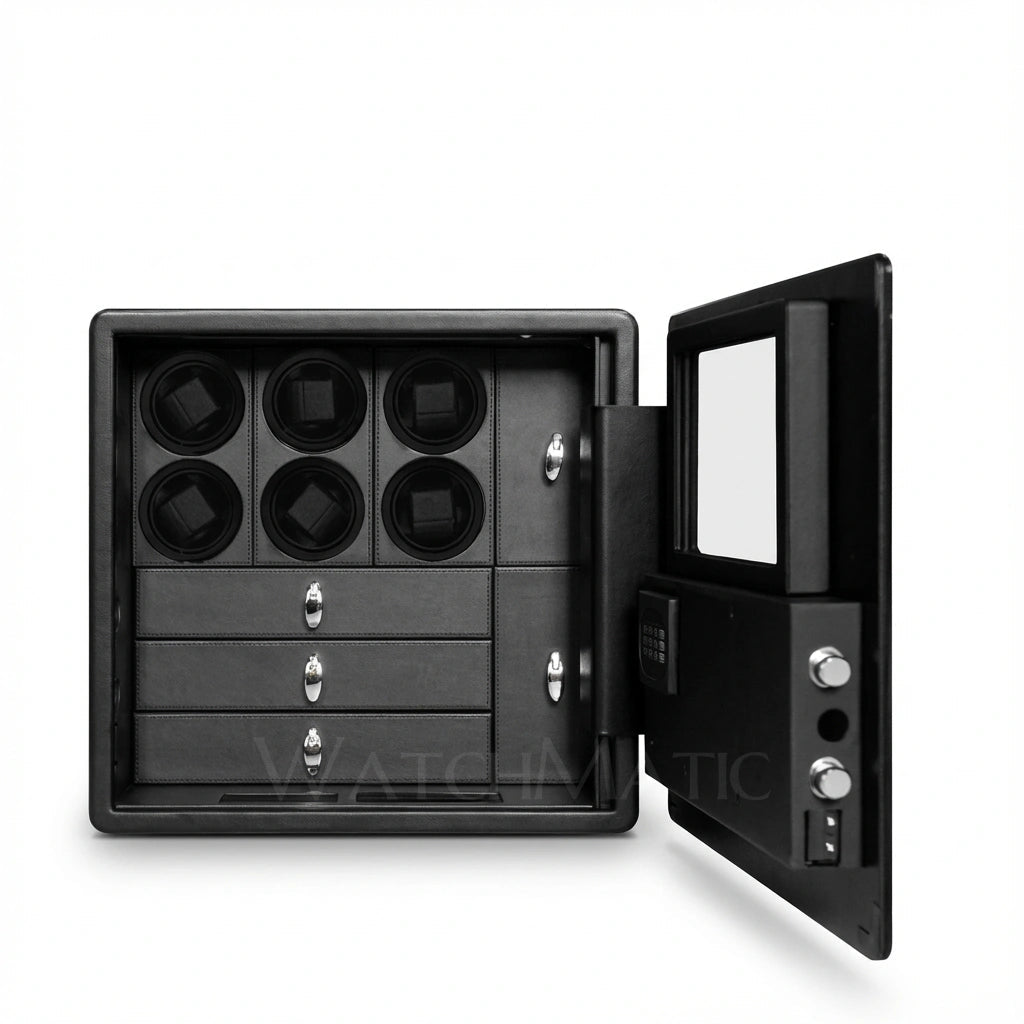
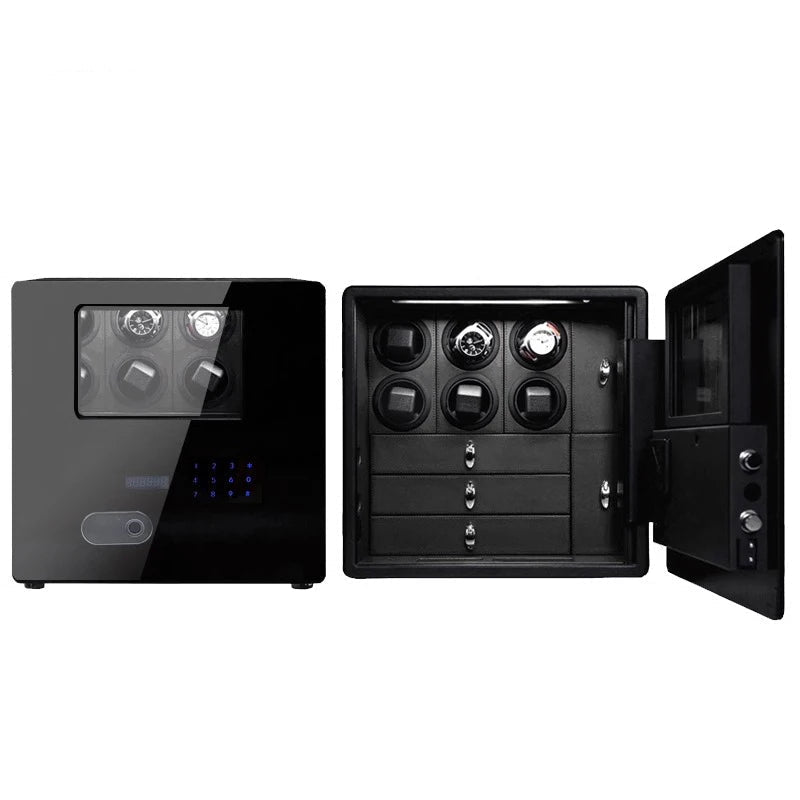
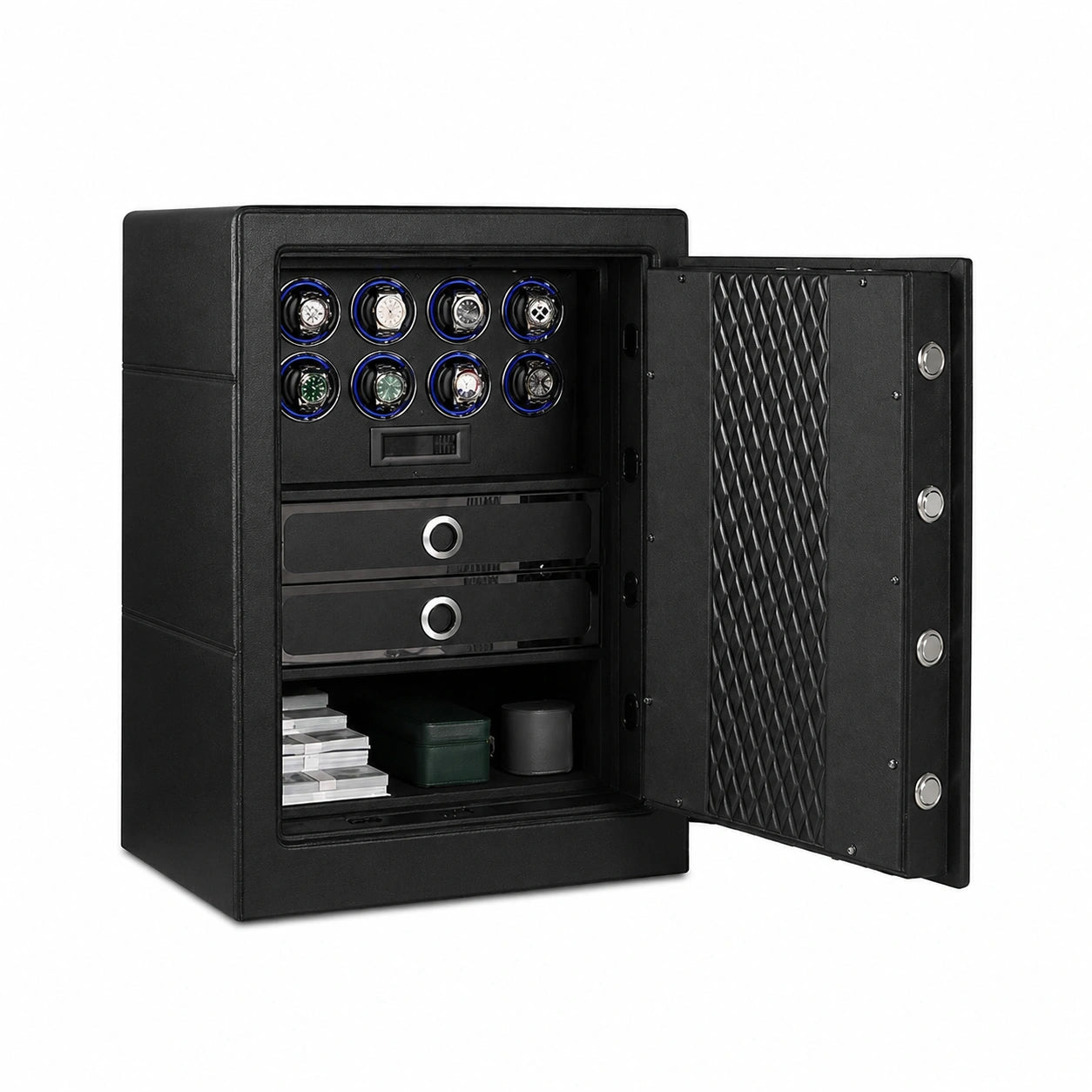
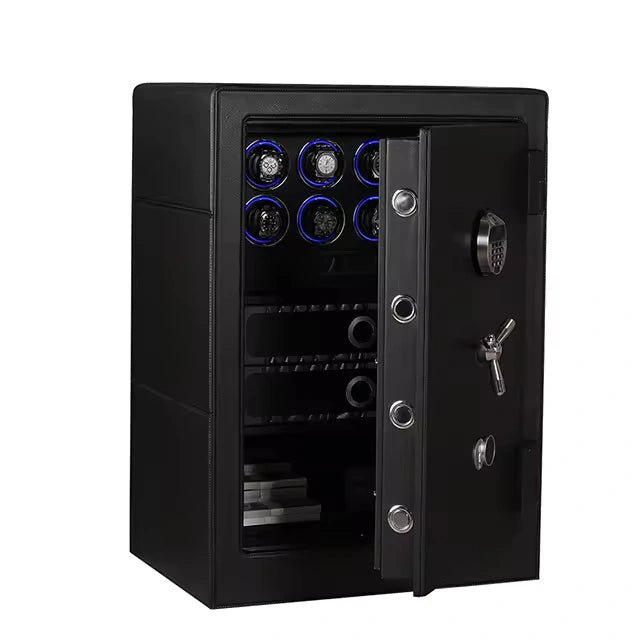
For a larger Arnold & Son or mixed haute-horlogerie collection, the Titan Watch Winder Safe combines independently programmable winding positions with secure stationary storage.
Depending on configuration, available features include:
- Reinforced safe construction
- Biometric fingerprint access
- Digital passcode
- Manual key access
- Independent winding controls
- Adjustable TPD
- CW/CCW/bidirectional programming
- Japanese Mabuchi motors
- Anti-magnetization protection
- LED illumination
- Additional storage compartments
This architecture is particularly logical for Arnold & Son.
Automatic Longitude, DSTB and Globetrotter watches can occupy powered winding positions.
Manual Perpetual Moon, Luna Magna, Nebula, Time Pyramid and tourbillon watches can remain in secure stationary storage without unnecessary rotation.
For a collection dominated by manually wound astronomical watches and tourbillons, a Luxury Watch Safe Collection may be more relevant than maximizing the number of winding motors.
Why Security Matters for Arnold & Son Collectors
Arnold & Son watches can combine:
- Platinum cases
- 18K gold
- Flying tourbillons
- Double tourbillons
- Astronomical moon phases
- Precious stones
- Aventurine
- Hand engraving
- Métiers d'art
- Very limited production
For this type of collection, storage planning should consider:
movement compatibility + physical security + controlled access + physical fit + presentation
rather than automatic winding alone.
Automatic Rotor Capacity Should Not Equal Collection Size
Consider a collection containing:
- Longitude
- DSTB
- Globetrotter
- Perpetual Moon
- Luna Magna
- Nebula
- Time Pyramid
- Ultrathin Tourbillon
That is eight mechanical watches.
Only three in this example need conventional automatic-winding positions.
A more efficient storage system may therefore provide:
3 independently programmable rotors + 5 secure stationary positions
rather than eight powered motors.
This is one of the strongest practical storage lessons for Arnold & Son.
Arnold & Son in a Mixed Haute Horlogerie Collection
Arnold & Son commonly appeals to collectors interested in independent-style horology, astronomical complications and historically influenced high watchmaking.
A mixed collection might include:
Arnold & Son + F.P. Journe + Breguet + Parmigiani Fleurier + A. Lange & Söhne + Jaeger-LeCoultre
Related WatchMatic guides include:
Best Watch Winder for F.P. Journe Watches
Best Watch Winder for Breguet Watches
Best Watch Winder for Parmigiani Fleurier Watches
Best Watch Winder for A. Lange & Söhne Watches
Best Watch Winder for Jaeger-LeCoultre Watches
A collection at this level makes movement-specific independent programming much more useful than one brand-wide setting.
How to Choose the Best Watch Winder for Your Arnold & Son
Step 1: Identify the Exact Reference
Do not stop at:
- Globetrotter
- Perpetual Moon
- Tourbillon
- Nebula
Exact generations and sizes can use different calibers.
Step 2: Identify the Caliber
Important automatic examples include:
- A&S6302
- A&S6203
- A&S6122
- A&S6022
Important manual examples include:
- A&S1001
- A&S1021
- A&S1512
- A&S1612
- A&S1615
- A&S5201
- A&S5219
- A&S8300
- A&S8513
Step 3: Confirm Automatic or Manual
This is the most important compatibility check.
Do not assume a modern mechanical haute-horlogerie watch is automatic.
Step 4: Check Power Reserve
Current automatic examples range approximately:
45 → 55 → 60 hours
while many manual movements provide:
90 → 100 hours.
Step 5: Determine Whether TPD Is Relevant
TPD is relevant only to self-winding watches.
A manual Perpetual Moon or Ultrathin Tourbillon does not need a conventional TPD setting.
Step 6: Determine Rotation Direction
For automatic calibers, use movement-specific winding information rather than one generic Arnold & Son direction.
Choose a system supporting:
- CW
- CCW
- Bidirectional
Step 7: Consider the Complication
World-time functionality can increase the convenience value of remaining synchronized.
Tourbillon or astronomical complexity does not automatically mean the watch can use a winder.
Step 8: Check Case Dimensions
Pay particular attention to:
- Globetrotter 42
- Globetrotter 45
- Luna Magna 44
- Large tourbillon references
Step 9: Use Independent Rotor Controls
Do not force multiple automatic calibers onto one fixed program.
Step 10: Plan Enough Stationary Storage
A serious Arnold & Son collection can contain considerably more manually wound watches than automatic watches.
For broader resources covering automatic winding, TPD, secure storage, and collection protection, visit the WatchMatic Guide Hub.
Best Watch Winder for Arnold & Son Watches: Final Thoughts
Choosing the best watch winder for an Arnold & Son begins with determining whether the exact watch is actually automatic.
This matters particularly strongly with this Maison.
Current automatic examples include:
Longitude A&S6302 → approximately 60 hours
DSTB A&S6203 → approximately 55 hours
Globetrotter 42 A&S6122 → approximately 55 hours
Globetrotter 45 A&S6022 → approximately 45 hours
By contrast, many of Arnold & Son's signature haute-horlogerie watches are manually wound.
The Perpetual Moon, Luna Magna, Nebula, Time Pyramid and HM commonly provide approximately 90 hours of reserve.
The Ultrathin Tourbillon and Constant Force Tourbillon extend to approximately 100 hours.
This creates an unusually clear lesson:
a manually wound Arnold & Son can have twice the power reserve of an automatic Arnold & Son and still receive absolutely no winding benefit from a conventional rotating winder.
For a confirmed automatic Arnold & Son, prioritize:
- Adjustable TPD
- CW/CCW/bidirectional programming
- Independent controls
- Controlled rest cycles
- Smooth low-vibration motors
- Flexible cushions
- Adequate case clearance
- Premium soft-contact surfaces
For manually wound Arnold & Son watches, prioritize secure stationary storage instead.
The most reliable decision framework is:
Arnold & Son Reference → Caliber → Automatic or Manual → Power Reserve → Complication → Physical Dimensions → TPD/Direction → Winder or Stationary Storage
For additional automatic-winding and secure-storage solutions, explore WatchMatic.