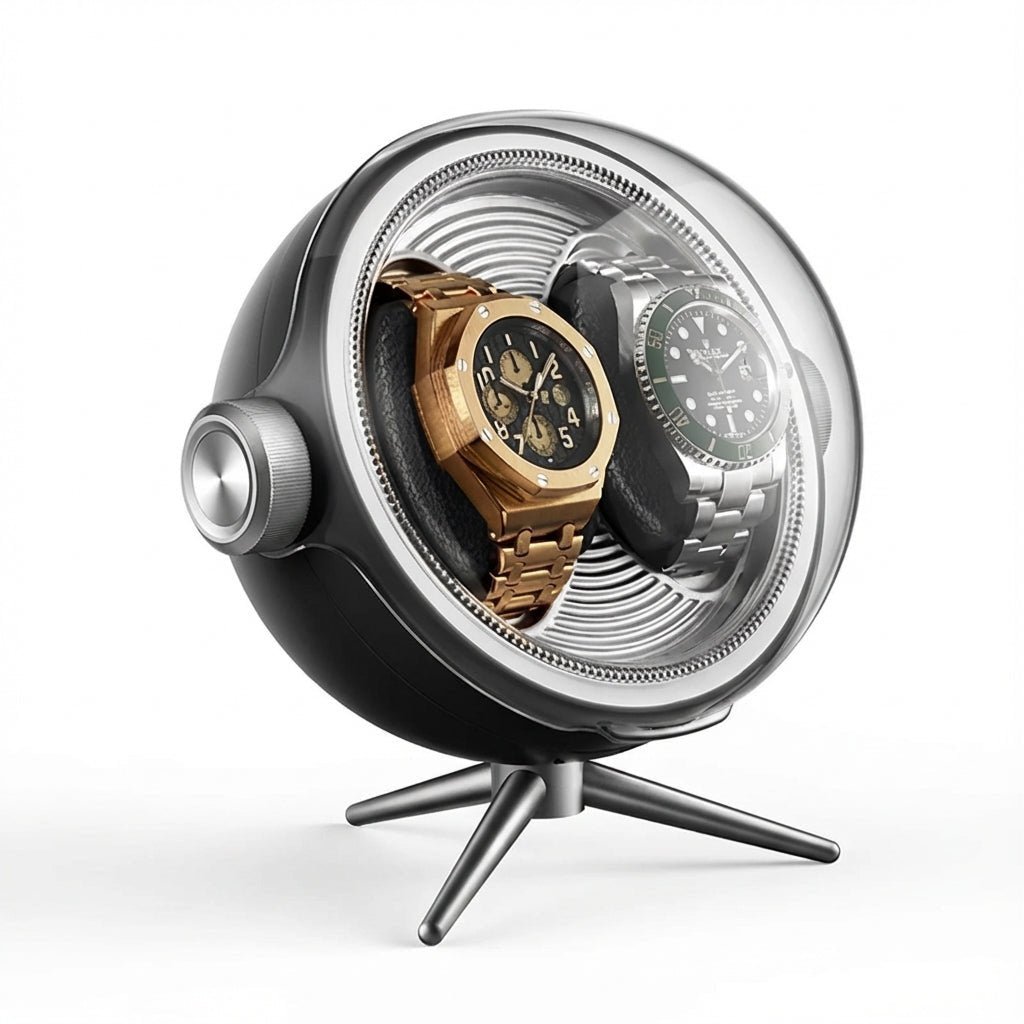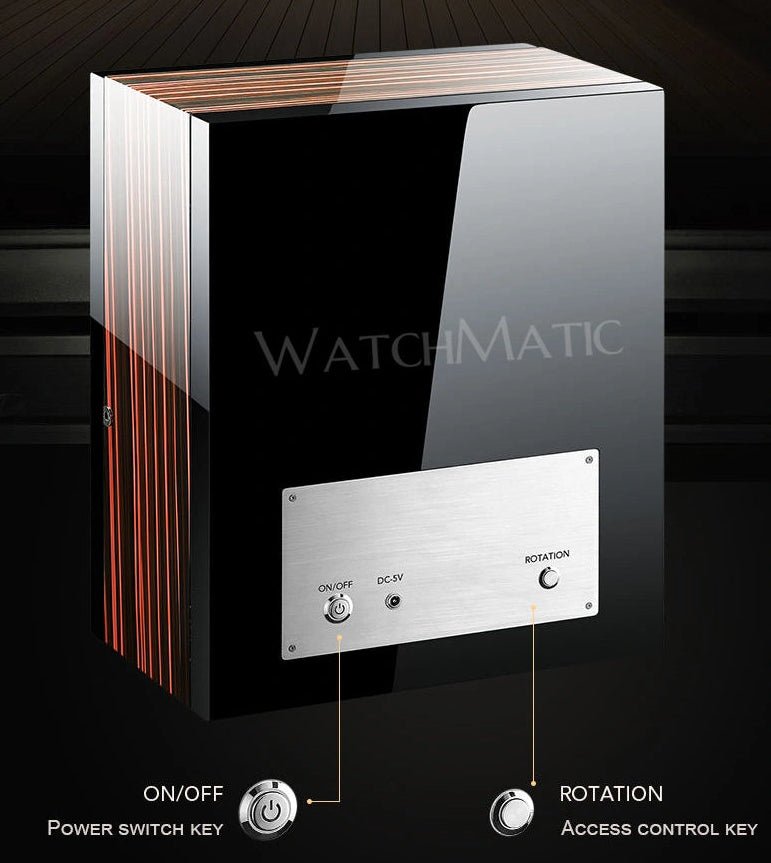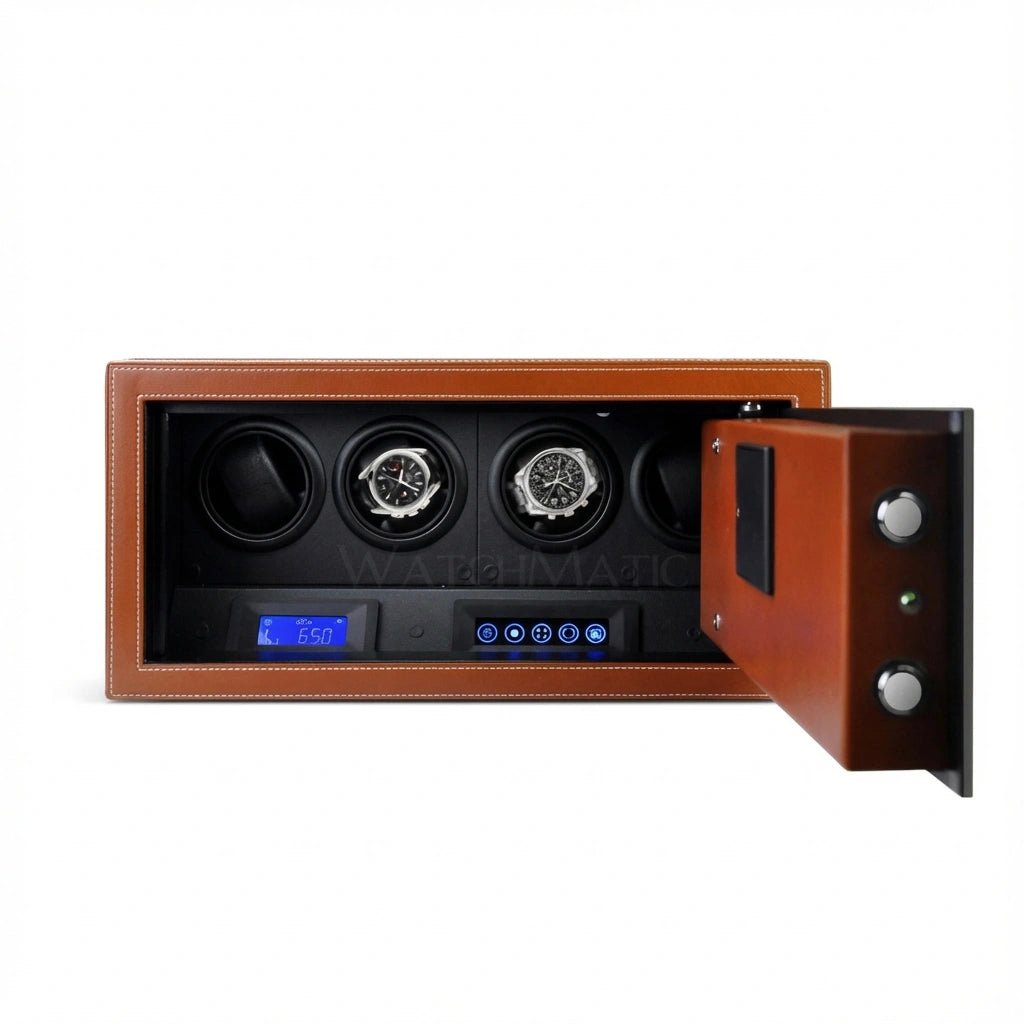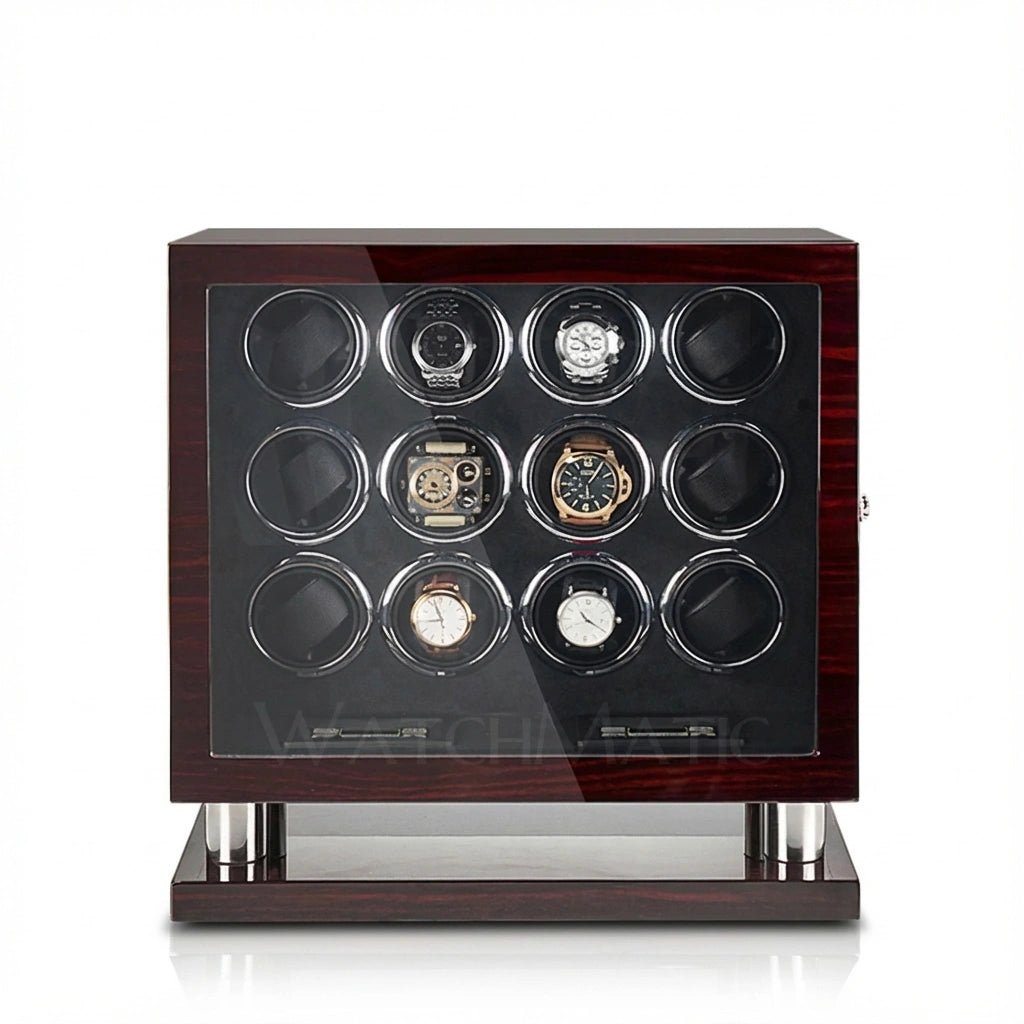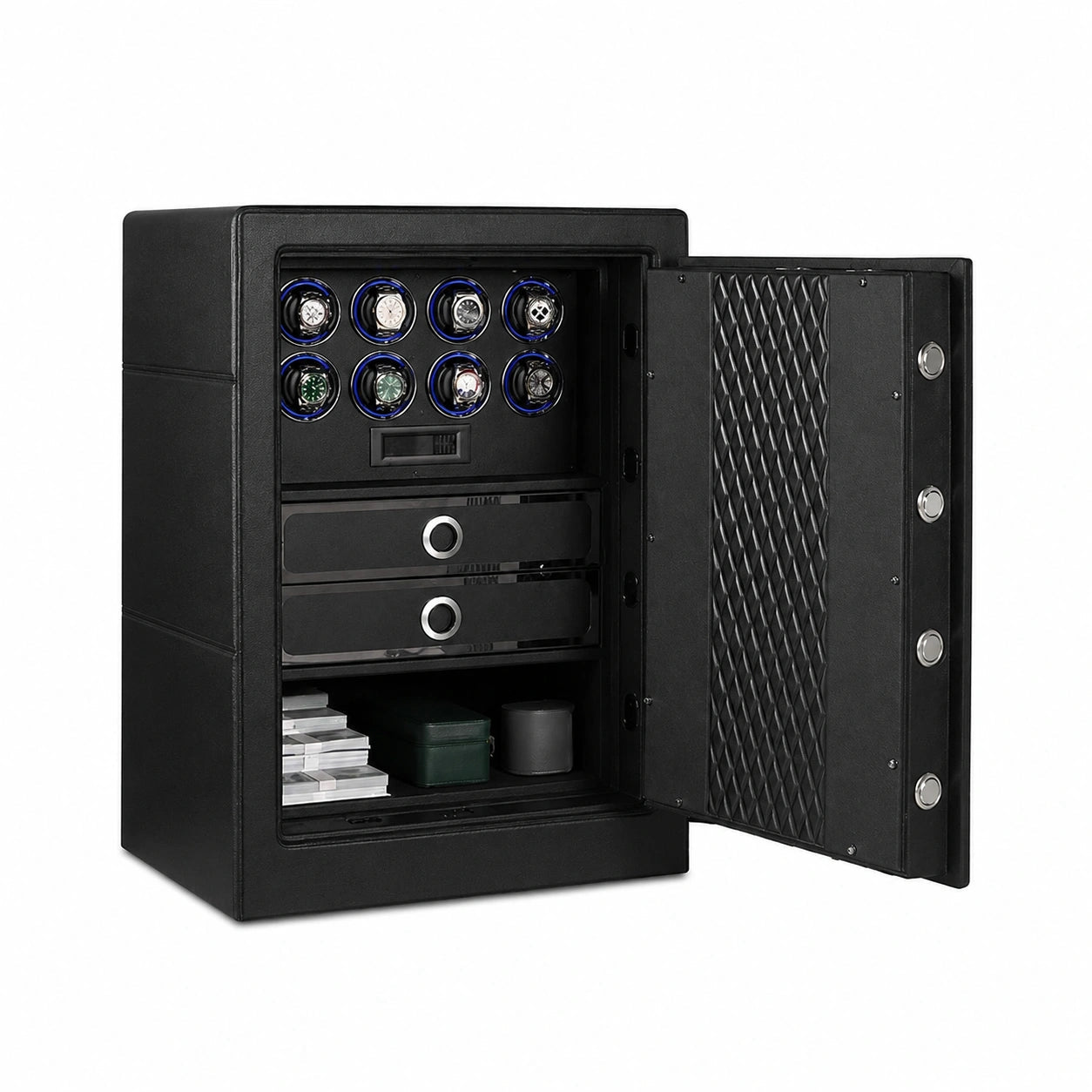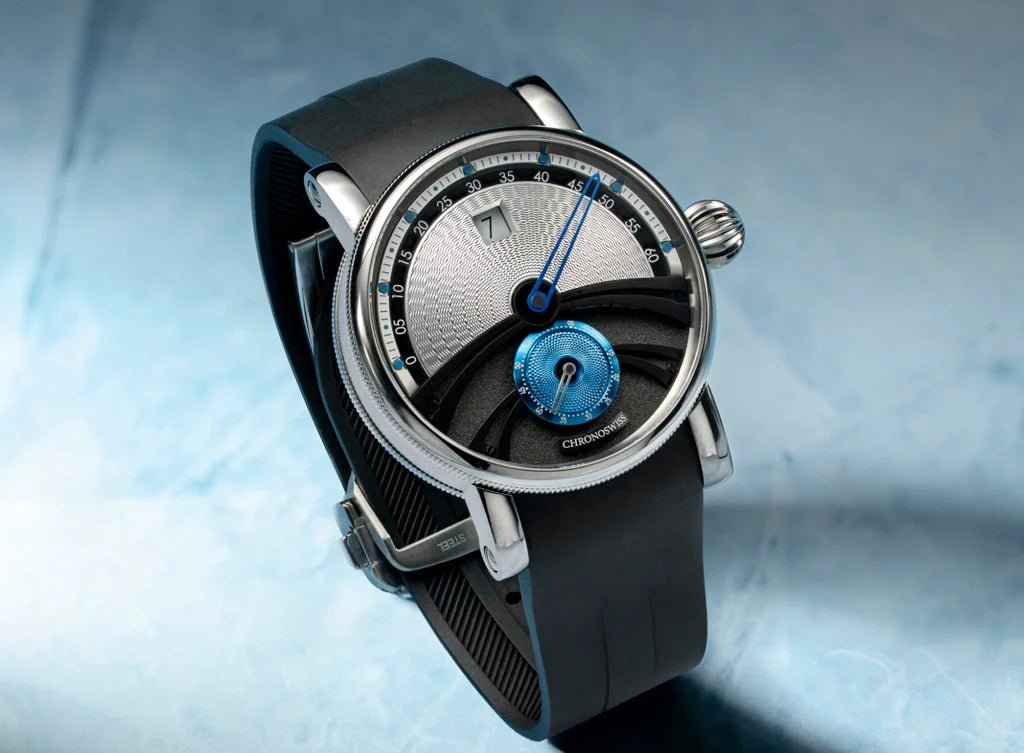
The best watch winder for Chronoswiss watches is a premium programmable model with adjustable Turns Per Day (TPD), clockwise and counterclockwise rotation options, independent controls, controlled winding and rest cycles, quiet operation, and secure support for Chronoswiss' distinctive onion crowns, integrated bracelets, and substantial multi-part cases.
Most current Chronoswiss collections use automatic mechanical movements.
Important automatic examples include:
- Strike Two — C.6000
- Small Second — C.6000
- Pulse One — C.6001
- Pulse GMT — C.6002
- Delphis — C.6004
- ReSec Manufacture — C.6005
- Flying Regulator Open Gear — C.299
- Open Gear ReSec legacy references — C.301
- Space Timer — C.308
- Q-Repeater — C.126
However, not every current Chronoswiss mechanical watch is automatic.
Important manual-wind exceptions include:
- Neo Digiteur — C.85757
- Open Gear Flying Tourbillon — C.303
That creates the fundamental rule:
Automatic Chronoswiss → a properly configured watch winder can be useful
Manual Chronoswiss → a conventional rotating watch winder provides no winding benefit
The correct decision process is:
Exact Reference → Generation → Caliber → Automatic or Manual → Power Reserve → Complication → Physical Fit → TPD/Direction or Stationary Storage
Does a Chronoswiss Watch Need a Watch Winder?
No automatic Chronoswiss mechanically requires a watch winder.
A self-winding mechanical movement uses an oscillating rotor to convert motion into energy stored in the mainspring.
If the watch remains unworn longer than its available reserve, the movement eventually stops.
A watch winder is therefore mainly a convenience and collection-management device.
It can help:
- Keep an automatic Chronoswiss running between wears
- Maintain the time
- Keep GMT indications synchronized
- Maintain date and moon-phase information where applicable
- Reduce repeated restarting
- Keep automatic complications ready to wear
- Manage several Chronoswiss movements in one collection
Allowing an automatic Chronoswiss to stop normally is not inherently harmful.
A winder should not be presented as a replacement for servicing or as a way to improve lubrication simply by keeping the movement continuously active.
For a broader explanation of automatic winding, see the Watch Winder Guide.
Which Chronoswiss Watches Can Use a Watch Winder?
Representative current and recent calibers include:
| Chronoswiss watch | Caliber | Winding type | Approx. power reserve | Conventional winder? |
|---|---|---|---|---|
| Strike Two | C.6000 | Automatic | 55 h | Yes |
| Small Second | C.6000 | Automatic | 55 h | Yes |
| Pulse One | C.6001 | Automatic | 55 h | Yes |
| Pulse GMT | C.6002 | Automatic | 55 h | Yes |
| Delphis | C.6004 | Automatic | 55 h | Yes |
| ReSec Manufacture | C.6005 | Automatic | 55 h | Yes |
| Flying Regulator Open Gear | C.299 | Automatic | 42 h | Yes |
| Open Gear ReSec | C.301 | Automatic | 42 h | Yes |
| Space Timer | C.308 | Automatic | 42 h | Yes |
| Q-Repeater | C.126 | Automatic | 35 h | Yes |
| Neo Digiteur | C.85757 | Manual | 48 h | No |
| Open Gear Flying Tourbillon | C.303 | Manual | 60 h | No |
This table reveals two important Chronoswiss principles:
complication level does not determine winding architecture
and:
collection generation can materially change the movement underneath the watch.
Chronoswiss Movement Evolution Matters
Chronoswiss is currently in the middle of a significant movement transition.
Earlier modern references frequently use calibers such as:
- C.299
- C.301
- C.308
with power reserves around:
42 hours.
The newer manufacture generation includes:
- C.6000
- C.6001
- C.6002
- C.6004
- C.6005
with approximately:
55 hours of power reserve.
These newer movements were developed in collaboration with La Joux-Perret and share several architectural and finishing characteristics.
This matters because an older and newer Chronoswiss with a similar regulator aesthetic may not use the same movement.
Exact Reference Matters More Than Dial Design
Chronoswiss has a very recognizable visual language:
- Regulator displays
- Open Gear architecture
- Onion crowns
- Hand guilloché
- Multi-level dials
- Strong case knurling
But visual similarity does not mean mechanical identity.
For example:
older Open Gear → C.299 / 42 h
while newer:
Strike Two → C.6000 / 55 h
and:
ReSec Manufacture → C.6005 / 55 h.
Therefore:
appearance < exact reference < exact caliber
when selecting a watch-winder program.
Chronoswiss C.6000 Automatic Movement
The C.6000 powers current Strike Two and Small Second references.
Representative specifications include:
- Automatic winding
- Tungsten rotor
- Approximately 55 hours of power reserve
- 28,800 vibrations per hour
- 25 jewels
- Ball-bearing rotor
- Manufacture architecture developed with La Joux-Perret
This makes C.6000 one of the main current Chronoswiss movements for watch-winder owners.
Best Watch Winder for Chronoswiss Strike Two
Current Strike Two watches use C.6000 and provide approximately:
55 hours of power reserve.
Representative dimensions are:
40 mm diameter
and approximately:
12.7 mm thickness.
For a Strike Two, prioritize:
- Adjustable TPD
- CW/CCW/bidirectional operation
- Controlled rest cycles
- Quiet motor
- Soft leather-strap support
- Independent programming
- Smooth starts and stops
The 40 mm case is comparatively easy to accommodate physically.
Horizontal Regulator Does Not Change TPD
Strike Two rearranges the traditional Chronoswiss regulator concept horizontally.
Its indications include:
- Decentralized hour
- Central minute
- Small seconds
That display architecture does not alter the fundamental automatic winding requirement.
Therefore:
dial layout ≠ TPD setting.
The caliber remains the relevant variable.
Small Second and Strike Two Share C.6000
Current Small Second references also use C.6000 with approximately:
55 hours of power reserve.
That means the two collections share important underlying mechanical architecture despite having different display layouts.
Same Movement Can Support Different Designs
Compare:
Strike Two
Horizontal regulator architecture.
Small Second
More conventional central hours/minutes with subsidiary seconds.
Both use:
C.6000 automatic / approximately 55 hours.
This demonstrates the opposite lesson from several other Chronoswiss comparisons:
sometimes radically different-looking watches can share the same movement.
Best Watch Winder for Chronoswiss Small Second
For a current Small Second, prioritize:
- Adjustable TPD
- Multiple winding directions
- Controlled rest cycles
- Quiet operation
- Compressible cushion
- Soft contact surfaces
Representative current cases measure approximately:
40 mm.
Gold, two-tone, and steel versions do not require fundamentally different TPD simply because the case material changes.
Gold Does Not Change the Winding Requirement
Current Small Second and Strike Two references can use:
- Stainless steel
- 18K red gold
- Mixed precious-metal configurations
These materials affect:
- Weight
- Value
- physical support
- security relevance
They do not directly determine:
- TPD
- winding direction
- power reserve
Chronoswiss C.6001 and Pulse One
The Pulse One uses manufacture Caliber:
C.6001
with approximately:
55 hours of power reserve.
It is automatic and features:
- Off-center hours
- Central minutes
- Retrograde seconds
- Tungsten rotor
- 4 Hz frequency
- Integrated Grade 5 titanium bracelet
The watch measures approximately:
41 mm
and:
12.75 mm thick.
Best Watch Winder for Chronoswiss Pulse One
For a Pulse One, prioritize:
- Adjustable TPD
- Multiple direction modes
- Independent control
- Controlled rest cycles
- Highly compressible cushion
- Integrated-bracelet compatibility
- Smooth motor movement
Its integrated titanium bracelet creates a more important physical-fit question than the movement itself.
Integrated Bracelet Fit Matters
A bracelet sized for a smaller wrist may not close naturally around a large rigid watch-winder cushion.
Look for:
- Compressible holder
- Natural clasp closure
- Minimal bracelet tension
- Stable watch-head positioning
This is especially relevant to Pulse One.
Titanium Does Not Reduce TPD
Pulse One's Grade 5 titanium construction makes the watch lighter than an equivalent steel watch.
That affects physical weight.
It does not directly alter:
- Rotor architecture
- daily turns
- winding direction
- power reserve
Therefore:
lighter titanium case ≠ fewer TPD.
Retrograde Seconds Do Not Require Extra Winding
Pulse One uses a retrograde seconds display.
The seconds hand travels through an arc and returns to its starting position.
That additional display behavior does not mean the automatic rotor should receive extra turns.
Therefore:
retrograde display ≠ higher TPD.
Chronoswiss Pulse GMT C.6002
Current Pulse GMT references use Caliber:
C.6002
with approximately:
55 hours of power reserve.
The collection adds a true GMT function to Chronoswiss' horizontal regulator concept.
Current configurations include:
- Titanium
- Gold
- Rubber strap
- Integrated titanium bracelet
- Integrated gold bracelet on exceptional references
Best Watch Winder for Chronoswiss Pulse GMT
A Pulse GMT has a stronger convenience case for staying synchronized than a simple time-only automatic.
If it stops, the owner may need to restore:
- Local time
- Reference/home time
- GMT relationship
For a Pulse GMT, prioritize:
- Adjustable TPD
- CW/CCW/bidirectional capability
- Independent programming
- Controlled rest cycles
- Integrated-bracelet support
- Smooth low-vibration operation
True GMT Does Not Need More TPD
An independently adjustable local-hour architecture does not create a direct increase in winding requirement.
The GMT system and automatic winding train perform different jobs.
Therefore:
true GMT ≠ maximum TPD.
Gold Pulse GMT and Cushion Stability
Selected Pulse GMT references can use a substantial integrated gold bracelet.
That increases:
- Weight
- value
- stress on the holder
It does not alter the movement's required winding program.
For heavy precious-metal configurations, physical retention becomes particularly important.
Chronoswiss Delphis C.6004
The Delphis is one of the most mechanically distinctive current Chronoswiss collections.
It uses manufacture Caliber:
C.6004
with approximately:
55 hours of power reserve.
The movement drives:
- Jumping digital hour
- Retrograde central minute
- Analog seconds
It remains fully automatic.
Best Watch Winder for Chronoswiss Delphis
For a Delphis, prioritize:
- Adjustable TPD
- Multiple direction options
- Controlled rest cycles
- Smooth motor operation
- Adequate case clearance
- Stable strap support
Representative current Delphis cases are approximately:
42 mm
and:
14.5 mm thick.
That requires more chamber depth than a Strike Two or Small Second.
Jumping Hour Does Not Mean Manual Winding
This is particularly important because Chronoswiss also sells the Neo Digiteur.
Both watches display time in unusual mechanical-digital formats.
But:
Delphis C.6004 → automatic
while:
Neo Digiteur C.85757 → manual.
Therefore, digital-style display architecture does not tell you how the watch is wound.
Delphis vs. Neo Digiteur
This is one of the strongest comparisons in the article.
Delphis
- Mechanical digital hour
- Retrograde minute
- Automatic
- C.6004
- Approximately 55 hours
- Winder compatible
Neo Digiteur
- Jumping hour
- Digital minute
- Digital-style seconds
- Manual
- C.85757
- Approximately 48 hours
- No conventional winding benefit
The visual concept is related.
The winding architecture is completely different.
Digital Display Does Not Mean Quartz Either
Neither watch should be confused with a quartz digital watch.
Both are fully mechanical.
The difference is:
automatic mechanical
versus:
manual mechanical.
This makes Chronoswiss particularly useful for explaining why the word "digital" refers to display style, not necessarily electronic technology.
Delphis Complication and Winder Convenience
If a Delphis stops, several indications need to resume correctly after restart.
Keeping the movement running can therefore reduce repeated resetting.
That is a convenience benefit.
The jumping-hour or retrograde mechanism does not mechanically require continuous operation.
Chronoswiss C.6005 ReSec Manufacture
Current ReSec Manufacture references use:
C.6005
with approximately:
55 hours of power reserve.
The movement powers Chronoswiss' signature retrograde-seconds architecture.
Current references include variations such as:
- Vertical Blue
- Beast
- Green Monster
- Helium
- Snake
- Obsidian
depending on market availability and edition.
Best Watch Winder for ReSec Manufacture
For a current C.6005 ReSec, prioritize:
- Adjustable TPD
- CW/CCW/bidirectional modes
- Controlled rest cycles
- Smooth motor transitions
- Quiet operation
- Secure support for the 42 mm titanium case
The current Manufacture generation represents a meaningful movement upgrade over older ReSec watches.
Older ReSec vs. Current ReSec Manufacture
This is another major Chronoswiss-specific distinction.
Legacy Open Gear ReSec
Caliber C.301
Automatic
Approximately 42 hours
Representative case: 44 mm
Current ReSec Manufacture
Caliber C.6005
Automatic
Approximately 55 hours
Representative case: 42 mm
Both are called:
ReSec
and both use retrograde seconds.
But they are not the same movement generation.
Do Not Copy a Legacy ReSec Setting to C.6005 Without Checking
A search for:
“Chronoswiss ReSec watch winder setting”
may return information written for C.301.
Owners of a newer C.6005 reference should identify the caliber first.
This is precisely why:
reference + generation
matter more than collection name.
Retrograde Seconds Do Not Determine Winder Direction
The retrograde display is powered downstream by the movement's gear train.
It does not tell you:
- rotor direction
- TPD
- winding efficiency
Therefore, do not use the presence of retrograde seconds to infer a winding program.
Chronoswiss Flying Regulator Open Gear C.299
The Flying Regulator Open Gear uses Caliber:
C.299
with approximately:
42 hours of power reserve.
It is automatic.
Representative specifications include:
- 4 Hz frequency
- 31 jewels
- Skeletonized rotor
- Central minutes
- Off-center hours
- Small seconds
- Open Gear architecture
Best Watch Winder for Open Gear C.299
For a C.299 Open Gear, prioritize:
- Adjustable TPD
- Multiple winding directions
- Controlled rest periods
- Quiet motor operation
- Stable leather or textile strap support
Representative cases measure around:
41 mm
and roughly:
13.8 mm thick.
Open Gear Does Not Mean Skeleton Automatic
The term Open Gear describes Chronoswiss' display and movement-layout concept.
It should not be confused with one specific caliber or winding type.
Current and recent Open Gear-related watches include:
- C.299 automatic
- C.301 automatic ReSec
- C.303 manual Flying Tourbillon
- C.308 automatic Space Timer
- C.6005 automatic ReSec Manufacture
Therefore:
Open Gear ≠ one movement
and:
Open Gear ≠ automatically self-winding.
Chronoswiss C.301 Open Gear ReSec
Earlier Open Gear ReSec references use:
C.301 automatic
with approximately:
42 hours of power reserve.
Representative watches are around:
44 mm
and:
13.35 mm thick.
These remain compatible with conventional automatic winding.
C.301 vs. C.6005
The evolution from C.301 to C.6005 is important for owners researching second-hand and current watches.
| Feature | Legacy ReSec | ReSec Manufacture |
|---|---|---|
| Caliber | C.301 | C.6005 |
| Winding | Automatic | Automatic |
| Reserve | ~42 h | ~55 h |
| Representative diameter | 44 mm | 42 mm |
| Generation | Earlier | Current/newer manufacture |
Do not assume one technical profile applies to both.
Chronoswiss Space Timer C.308
The Space Timer uses automatic Caliber:
C.308
with approximately:
42 hours of power reserve.
The collection includes highly visual references inspired by:
- Moon
- Jupiter
- Sun
- Deep space
- Black holes
- Supernovae
Its architecture includes:
- Open Gear regulator display
- Moon phase
- Multi-layer dial construction
- Automatic rotor
Best Watch Winder for Chronoswiss Space Timer
For a Space Timer, prioritize:
- Adjustable TPD
- Multiple direction modes
- Controlled rest cycles
- Large chamber clearance
- Smooth movement
- Stable strap support
Representative dimensions are substantial:
44 mm diameter
and approximately:
15.2 mm thick.
This makes chamber depth especially important.
Moon Phase Strengthens Convenience Value
The Space Timer's moon-phase indication gives owners an additional reason to keep the watch running.
If the movement stops, the moon phase stops too.
A winder can reduce repeated synchronization.
This is a convenience issue.
The moon-phase mechanism does not need uninterrupted operation for mechanical health.
Nano-Printed Dial Does Not Affect TPD
Space Timer references can use extremely complex:
- Laser structures
- Nano printing
- Multi-layer dials
- ITR2 elements
- Titanium lunar displays
These features do not change the movement's winding requirement.
Therefore:
dial technology ≠ TPD.
Large Case Does Not Need More Rotation
A 44 × 15.2 mm Space Timer is larger than a 40 mm Strike Two.
That does not mean its movement should receive additional turns simply because the case is larger.
Physical size and movement winding are independent variables.
Chronoswiss Q-Repeater C.126
The Q-Repeater is one of the most interesting current Chronoswiss watches from a winder perspective.
It uses the legacy:
C.126 automatic caliber
with approximately:
35 hours of power reserve.
Its functions include:
- Hours
- Minutes
- Small seconds
- Quarter repeater
- Two gongs
- All-or-nothing repeater safety mechanism
Despite being a chiming complication, it is automatic.
Best Watch Winder for Chronoswiss Q-Repeater
For a Q-Repeater, prioritize:
- Adjustable TPD
- Multiple winding directions
- Controlled rest cycles
- Smooth low-vibration motor
- Generous case clearance
- Soft strap support
Representative dimensions are:
42 mm diameter
and approximately:
16.2 mm thick.
It is one of the thicker current Chronoswiss watches.
Q-Repeater Has the Shortest Reserve in This Group
At approximately:
35 hours
the Q-Repeater has less autonomy than:
- C.299 — 42 h
- C.308 — 42 h
- C.85757 — 48 h
- C.6000-series — 55 h
- C.303 — 60 h
That makes a winder relatively useful if the watch is rotated infrequently.
Repeater Does Not Mean Manual
Many haute-horlogerie repeaters are manually wound.
Chronoswiss provides a counterexample.
The Q-Repeater C.126 is:
automatic.
Therefore:
repeater ≠ manual winding.
A Watch Winder Does Not Operate the Repeater
Even though Q-Repeater is automatic, a winder only supplies motion to the automatic winding system.
It does not:
- Activate the quarter repeater
- Operate the hammers
- Strike the gongs
- Exercise the repeater pusher
- Service the chiming mechanism
The complication and automatic winding system remain distinct.
Chronoswiss Neo Digiteur C.85757
The Neo Digiteur is one of the clearest current manual-wind exceptions.
It uses:
C.85757
with approximately:
48 hours of power reserve.
It is:
hand-wound.
Its display includes:
- Jumping hour
- Digital minute
- Sweeping seconds
- In-house developed display module
Does the Neo Digiteur Need a Watch Winder?
No.
A conventional rotating watch winder cannot wind C.85757.
The movement has no automatic rotor.
It must receive energy through manual crown winding.
Neo Digiteur Has a Digital Look but Manual Mechanical Movement
This is a particularly useful clarification.
Neo Digiteur looks almost like a mechanical interpretation of a digital display.
But it is neither:
- Quartz
- Electronic
- Automatic
It is:
fully mechanical and manually wound.
Therefore:
digital-style display ≠ electronic
and:
mechanical ≠ automatic.
Neo Digiteur Rectangular Case Fit
Neo Digiteur also creates an unusual physical-storage challenge.
Representative dimensions are approximately:
48 × 30 mm
with:
9.7 mm thickness.
A rectangular watch should not be evaluated only by nominal width.
Check:
- Total case length
- Corner clearance
- Crown position
- strap alignment
- drawer dimensions
Because it does not need a powered rotor, stationary storage can be optimized around its shape.
Chronoswiss Open Gear Flying Tourbillon C.303
The Open Gear Flying Tourbillon uses manufacture Caliber:
C.303
with approximately:
60 hours of power reserve.
Critically:
C.303 is manually wound.
It includes:
- Flying tourbillon
- 60-second tourbillon rotation
- Semi-skeletonized architecture
- 4 Hz frequency
- Skeletonized mainspring barrel
Does a Chronoswiss Flying Tourbillon Need a Watch Winder?
Not for winding.
A conventional winder moves the entire watch to activate an automatic rotor.
C.303 has no automatic rotor.
It must be wound manually through the crown.
Tourbillon Does Not Mean Automatic
This is one of the central Chronoswiss comparisons.
Compare:
Q-Repeater
Complicated chiming watch
Automatic
35 h
Winder compatible
Flying Tourbillon
High complication
Manual
60 h
No conventional winding benefit
The more complicated-looking tourbillon has the longer reserve.
It is still the one that does not belong on a powered rotor for winding.
60-Hour Manual vs. 55-Hour Automatic
Another useful comparison:
C.6004 Delphis
55 hours
Automatic
Conventional winder compatible
C.303 Flying Tourbillon
60 hours
Manual
No conventional winding benefit
The manual movement runs longer.
Power reserve alone therefore tells you nothing about winder compatibility.
Flying Tourbillon Physical Dimensions
Representative Open Gear Flying Tourbillon models measure approximately:
44 mm
and:
13.1–13.35 mm thick.
They do not need powered winding, but their case and value justify careful stationary storage.
Chronoswiss Power Reserve Comparison
| Caliber | Example | Type | Approx. reserve |
|---|---|---|---|
| C.126 | Q-Repeater | Automatic | 35 h |
| C.299 | Open Gear | Automatic | 42 h |
| C.301 | Legacy ReSec | Automatic | 42 h |
| C.308 | Space Timer | Automatic | 42 h |
| C.85757 | Neo Digiteur | Manual | 48 h |
| C.6000 | Strike Two / Small Second | Automatic | 55 h |
| C.6001 | Pulse One | Automatic | 55 h |
| C.6002 | Pulse GMT | Automatic | 55 h |
| C.6004 | Delphis | Automatic | 55 h |
| C.6005 | ReSec Manufacture | Automatic | 55 h |
| C.303 | Flying Tourbillon | Manual | 60 h |
This table shows why a single brand-level watch-winder recommendation is inadequate.
The Shortest Reserve Is Automatic
Q-Repeater provides approximately:
35 hours
and is automatic.
The Longest Reserve Here Is Manual
Flying Tourbillon provides approximately:
60 hours
and is manual.
Therefore:
reserve length and winding architecture are separate specifications.
Chronoswiss Watch Winder TPD Settings
TPD means Turns Per Day—the approximate number of rotations a watch winder delivers during its programmed daily cycle.
There should not be one blanket statement such as:
“Chronoswiss = 650 TPD.”
Current and recent automatic movements include:
- C.126
- C.299
- C.301
- C.308
- C.6000
- C.6001
- C.6002
- C.6004
- C.6005
These should not automatically be assigned one identical program.
The correct process is:
- Identify the exact Chronoswiss reference.
- Identify the generation.
- Identify the caliber.
- Confirm that it is automatic.
- Determine the caliber's winding requirements.
- Select appropriate TPD.
- Select appropriate rotation direction.
- Confirm that the watch maintains adequate reserve.
For a deeper explanation of Turns Per Day, see the Watch TPD Guide.
What Rotation Direction Should You Use for Chronoswiss?
A premium programmable winder should provide:
CW — Clockwise
CCW — Counterclockwise
Bi — Bidirectional
Chronoswiss publishes detailed technical information about its calibers, but one universal consumer winding direction should not be assumed for the entire brand.
Use:
exact caliber → verified winding requirement → appropriate direction
rather than:
Chronoswiss → one fixed program.
Do Manual Chronoswiss Watches Need TPD?
No.
TPD has no useful winding role for:
- Neo Digiteur C.85757
- Flying Tourbillon C.303
These watches receive mainspring energy through manual crown winding.
There is therefore no conventional automatic-winder TPD target to calculate for them.
Current C.6000-Series vs. Earlier Automatic Movements
Chronoswiss' current movement evolution creates another useful comparison.
Earlier Automatic Generation
C.299 / C.301 / C.308
Typical reserve:
approximately 42 hours
Newer Manufacture Generation
C.6000 / C.6001 / C.6002 / C.6004 / C.6005
Typical reserve:
approximately 55 hours
The newer generation generally provides more autonomy.
That reduces how quickly a watch stops off the wrist.
Longer Reserve Reduces Winder Dependence
A C.6000-series watch can remain running roughly half a day longer than a 42-hour automatic, depending on starting reserve and usage.
That means:
movement evolution can reduce the owner's dependence on a winder.
It does not automatically increase the required TPD.
55 Hours Does Not Mean One Shared TPD
Several C.6000-series calibers provide approximately 55 hours.
That does not mean:
C.6000 = C.6001 = C.6002 = C.6004 = C.6005 for every winder parameter.
They perform different functions.
For example:
- C.6000 — Small Second / Strike Two
- C.6001 — retrograde seconds
- C.6002 — GMT
- C.6004 — jumping hour / retrograde minute
- C.6005 — retrograde seconds
Use exact movement guidance rather than power-reserve similarity.
Complication Does Not Determine TPD
Chronoswiss makes this especially clear.
A movement can contain:
- Retrograde seconds
- Jumping hours
- GMT
- Moon phase
- Quarter repeater
and still use conventional automatic winding.
Another can contain:
- Flying tourbillon
and be manual.
TPD follows the automatic winding architecture—not the complication count.
Does a Chronoswiss Automatic Need to Run All the Time?
No.
A Chronoswiss automatic can stop normally after its available reserve has been used.
There is no general mechanical requirement for uninterrupted operation.
Winder usefulness depends on:
power reserve + wearing frequency + complication + collection size.
Which Chronoswiss Watches Gain the Most Convenience From a Winder?
Stronger convenience case
- Q-Repeater — short 35-hour reserve
- Space Timer — moon phase
- Pulse GMT — second timezone
- Delphis — jumping-hour/retrograde display
- Legacy 42-hour automatics in a larger rotation
Moderate convenience case
- Strike Two
- Small Second
- Pulse One
- ReSec Manufacture
No conventional winding benefit
- Neo Digiteur
- Open Gear Flying Tourbillon
This is a practical classification, not a ranking of watch quality.
Should You Start a Stopped Chronoswiss Before Using a Winder?
A watch winder is generally best treated as a:
maintenance-winding device.
If an automatic Chronoswiss is completely stopped, follow the appropriate starting procedure for the exact watch before using the winder to maintain its reserve.
A sensible sequence is:
restart correctly → establish initial reserve → set indications → place on programmed winder → maintain
rather than:
stopped watch → maximum TPD.
High TPD Is Not Automatically Better
The highest available TPD does not provide superior care simply because a watch is expensive or complicated.
Once sufficient winding is supplied, more turns may provide no practical advantage.
Higher TPD does not automatically:
- Improve accuracy
- Improve lubrication
- Extend servicing intervals
- Improve a retrograde display
- Maintain a repeater
- Improve a tourbillon
- Increase the stated power reserve
The objective is:
appropriate maintenance winding
rather than:
maximum rotation.
Hand Guilloché Does Not Affect Winder Settings
Chronoswiss is strongly associated with hand guilloché.
Dial craftsmanship can substantially increase:
- Artistic value
- production complexity
- collectability
It does not affect:
- TPD
- rotor direction
- power reserve
- winding efficiency
The movement remains the determining factor.
CVD, DLC and Titanium Do Not Determine TPD
Chronoswiss uses a wide range of materials and coatings including:
- Stainless steel
- Grade 5 titanium
- 18K gold
- CVD coatings
- DLC coatings
These change physical properties and appearance.
They do not establish winding requirements.
Water Resistance Does Not Determine TPD
Chronoswiss references span different water-resistance ratings.
A 10-bar Open Gear does not require more daily turns than a 3-bar Strike Two merely because its case is more water-resistant.
Case sealing and automatic winding are independent systems.
The Onion Crown Creates Physical Clearance Considerations
Chronoswiss' signature onion crown is visually distinctive and often projects farther from the case than a low-profile crown.
When selecting a winder, check:
- Crown clearance
- distance from enclosure wall
- adjacent watch spacing
The crown should not contact the winder during rotation.
Large Cases Need Chamber Clearance
Several Chronoswiss watches are physically substantial.
Representative examples include:
- Strike Two — 40 × 12.7 mm
- Pulse One — 41 × 12.75 mm
- Delphis — 42 × 14.5 mm
- Q-Repeater — 42 × 16.2 mm
- ReSec Manufacture — 42 mm
- Flying Tourbillon — 44 × ~13.3 mm
- Space Timer — 44 × 15.2 mm
The Q-Repeater and Space Timer deserve particular attention for depth.
Thickness Can Matter More Than Diameter
A 42 mm watch at 16.2 mm thick can create more enclosure difficulty than a 44 mm watch that is thinner.
Therefore, check:
diameter + thickness + crown + crystal profile
rather than diameter alone.
Integrated Bracelet vs. Leather Strap
Chronoswiss currently spans:
- Integrated titanium bracelets
- Integrated gold bracelets
- Rubber
- Calfskin
- Nubuck
- Cordura-style textile
Different configurations need different cushion behavior.
Integrated Bracelets Need Compressible Cushions
Pulse One and selected Pulse GMT watches are especially relevant.
A bracelet sized closely to the wrist should not be forced around an oversized rigid holder.
Choose a cushion that:
- Compresses
- allows natural closure
- minimizes link tension
- keeps the watch centered
Leather Straps Should Not Be Over-Curved
For Open Gear, Delphis and other leather-strap watches, avoid:
- Excessive bending
- sharp folds
- oversized rigid cushions
- unnecessary buckle tension
Long-term physical fit matters independently from the motor program.
Best Watch Winder for One Chronoswiss Automatic
For one automatic Chronoswiss, choose a premium programmable system with:
- Adjustable TPD
- CW/CCW/bidirectional modes
- Controlled rest cycles
- Quiet operation
- Smooth low-vibration movement
- Flexible cushion
- Adequate crown and case clearance
Broader options can be explored in the WatchMatic Watch Winder Collection.
Best Watch Winder for Multiple Chronoswiss Watches
Consider a collection containing:
- Strike Two
- Pulse GMT
- Delphis
- ReSec Manufacture
- Neo Digiteur
- Flying Tourbillon
There are six mechanical watches.
Only four in this example need conventional automatic winding.
The more rational architecture is:
Strike Two + Pulse GMT + Delphis + ReSec → independently programmed rotor positions
Neo Digiteur + Flying Tourbillon → secure stationary storage
This prevents wasting powered capacity on hand-wound movements.
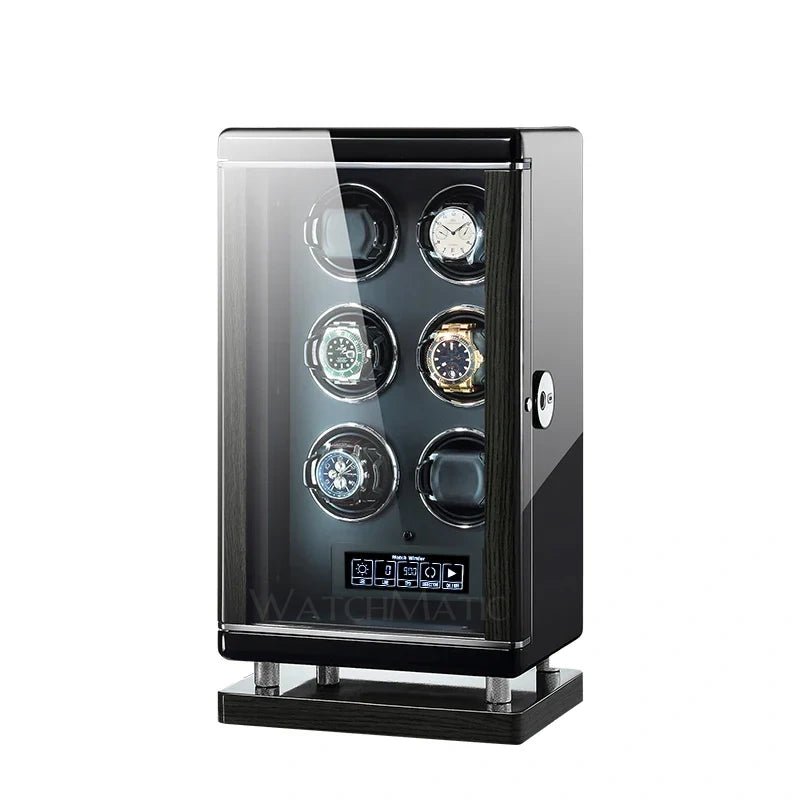
Vento Watch Winder for Chronoswiss Automatics

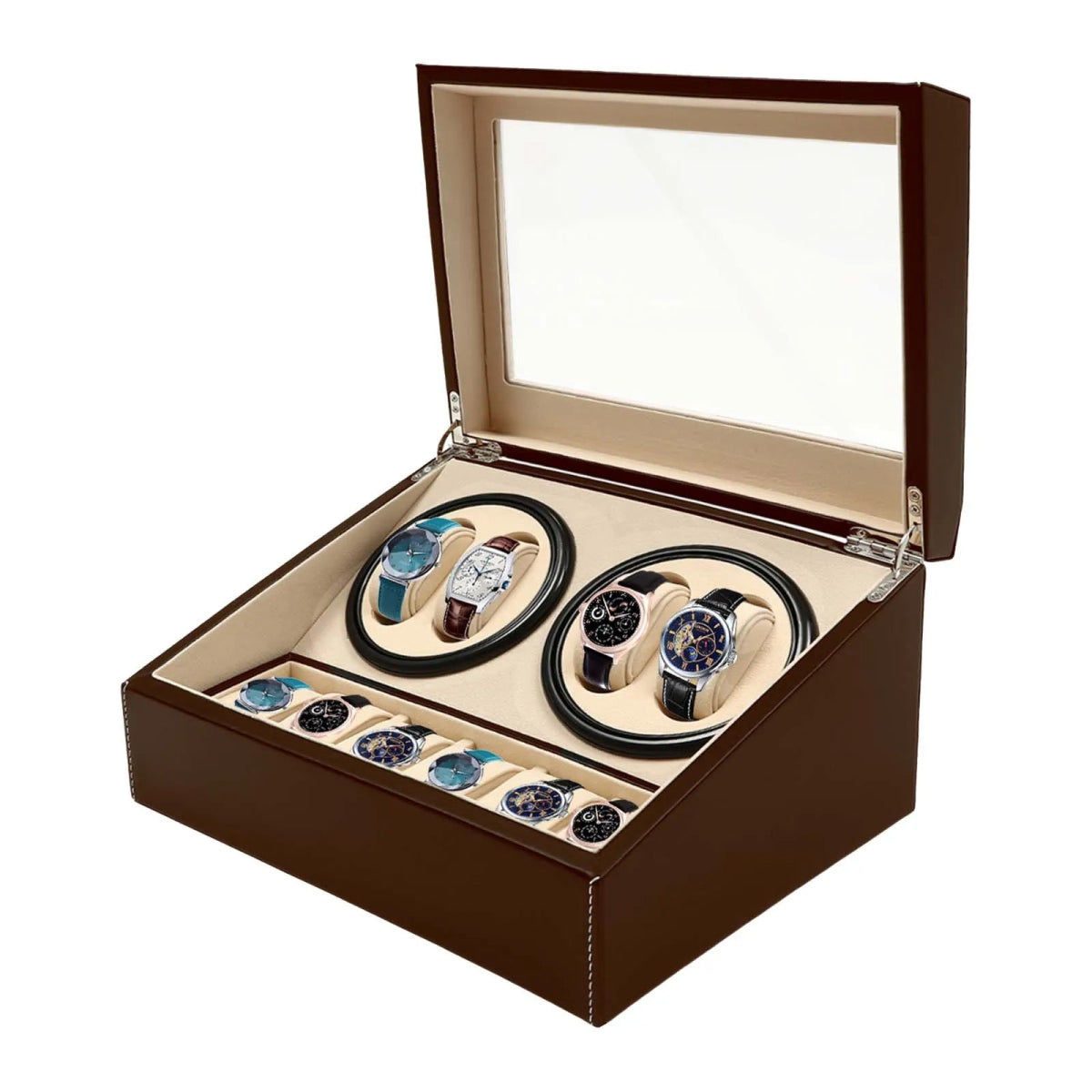
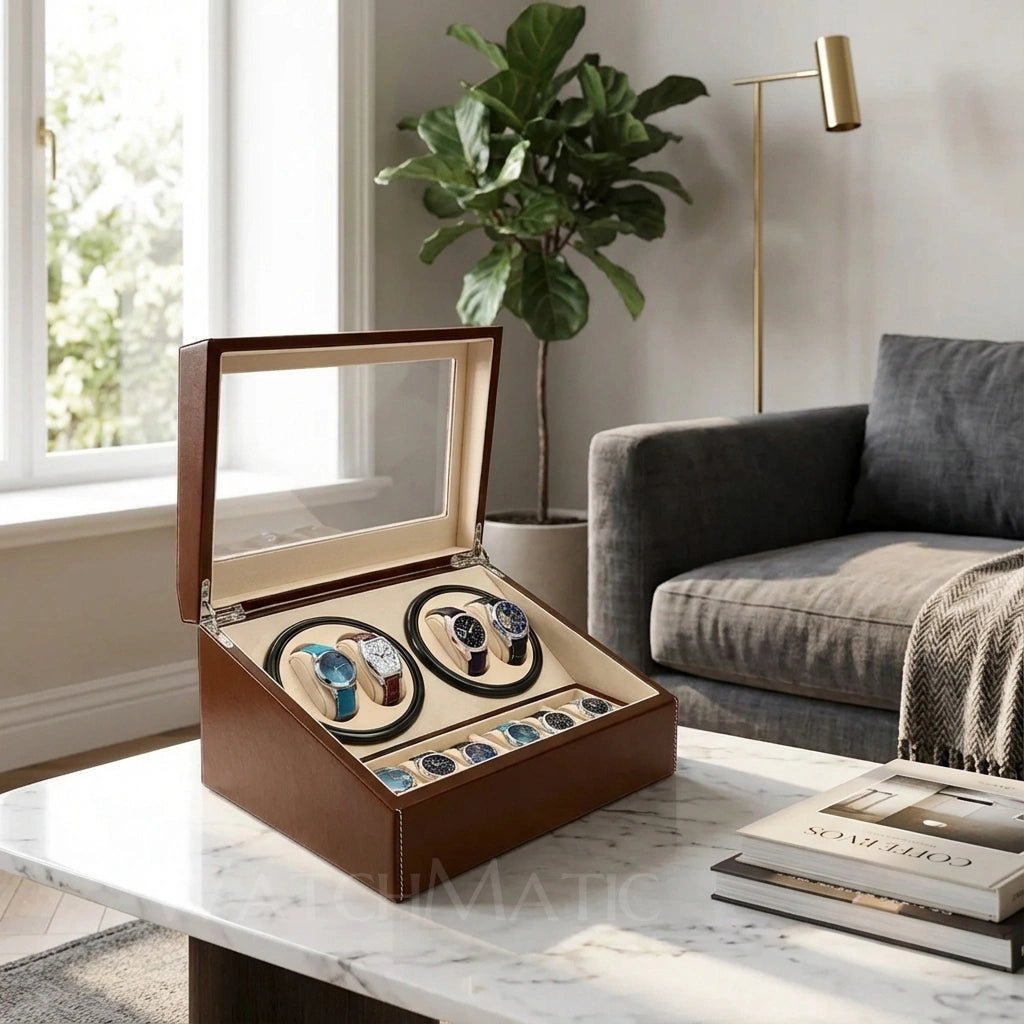
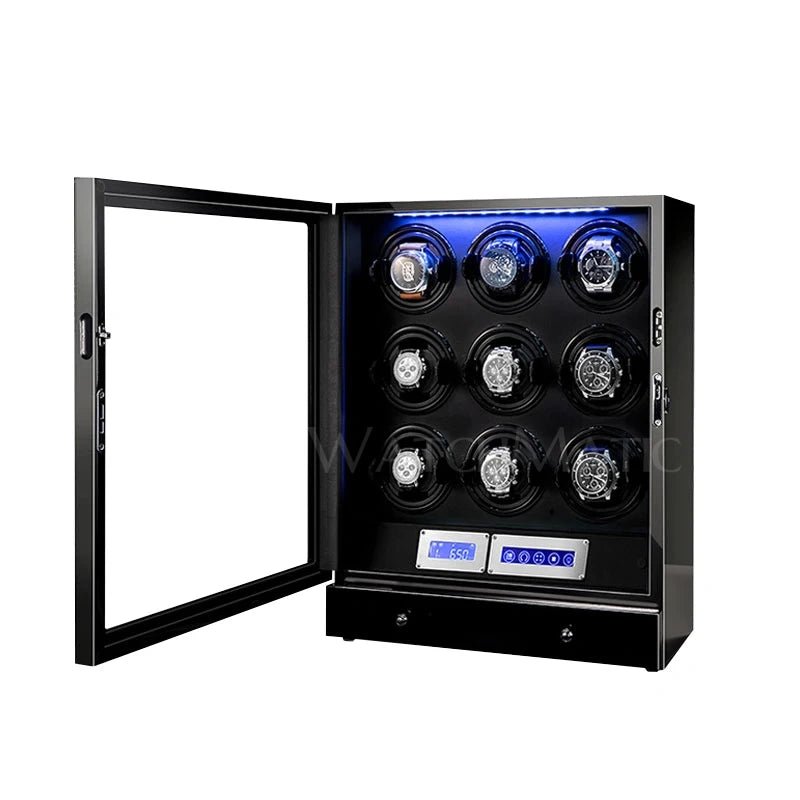
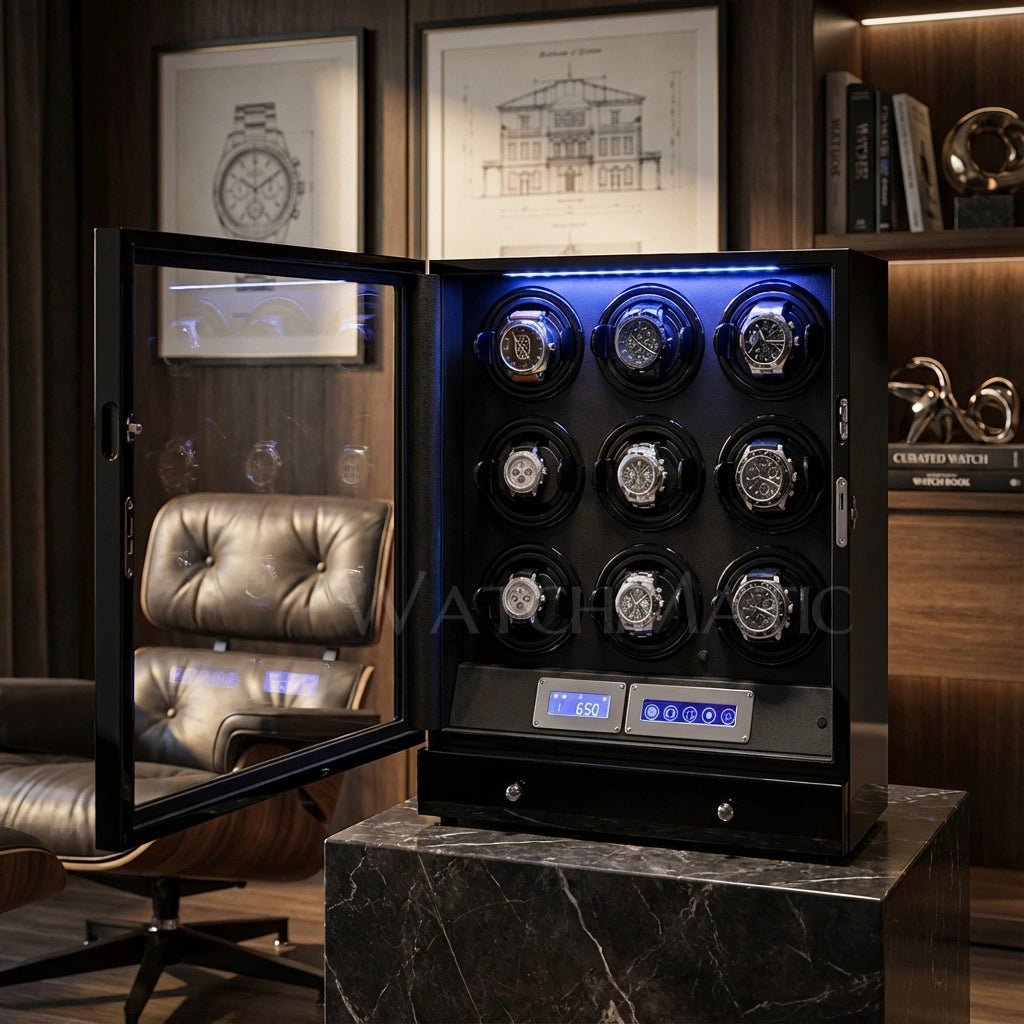
The Vento Luxury Quad Watch Winder is a logical fit for a compact Chronoswiss automatic collection because it provides four independently controlled winding positions.
A four-watch configuration could contain:
- Strike Two C.6000
- Pulse GMT C.6002
- Delphis C.6004
- ReSec Manufacture C.6005
Each position can be programmed individually rather than assuming that every 55-hour Chronoswiss movement requires an identical setup.
Why Independent Control Still Matters Across C.6000-Series Watches
The new movements share important platform characteristics.
But they do not perform identical functions.
Independent control preserves flexibility as the collection includes:
- GMT
- retrograde
- jumping-hour
- small-seconds
- regulator architectures
It also allows the winder to accommodate older C.299/C.301/C.308 watches in the same cabinet.
Vento and Large Chronoswiss Cases
Before placing a:
- Delphis
- Space Timer
- Q-Repeater
inside any compact multi-watch winder, verify chamber clearance.
This is especially important for:
Q-Repeater at approximately 16.2 mm thick
and:
Space Timer at approximately 15.2 mm thick.
Do Not Rotate Neo Digiteur Just to Fill a Position
Neo Digiteur can physically sit on a winding cushion.
That does not mean rotation winds it.
The same applies to C.303 Flying Tourbillon.
Powered positions are more efficiently used for confirmed automatic calibers.
Is It Safe to Keep an Automatic Chronoswiss on a Watch Winder?
A properly configured quality winder can be used with a confirmed automatic Chronoswiss.
Important factors include:
- Exact reference identification
- Exact caliber identification
- Appropriate TPD
- Appropriate winding direction
- Controlled rest periods
- Secure cushion fit
- Sufficient crown and case clearance
- Low-vibration motor operation
If a properly wound Chronoswiss shows unexpectedly short reserve or irregular behavior, professional inspection is more appropriate than continually increasing TPD.
A Watch Winder Does Not Service a Chronoswiss
A watch winder does not:
- Replace lubricants
- Regulate accuracy
- Service a retrograde mechanism
- Service a jumping hour
- Maintain a quarter repeater
- Repair a tourbillon
- Restore water resistance
- Replace professional maintenance
Its mechanical role is limited to supplying motion to an automatic winding system.
Watch Winder vs. Watch Safe for Chronoswiss Collectors
Chronoswiss sits in an interesting middle ground.
Many current watches are automatic, so rotor capacity can be useful.
But the collection can also contain:
- Manual tourbillons
- Neo Digiteur
- Gold pieces
- high-complication repeaters
- limited editions
| Feature | Standalone Winder | Watch Winder Safe |
|---|---|---|
| Automatic winding | Yes | Yes |
| Independent programming | Available | Available |
| Manual-watch storage | Possible | Yes |
| Physical security | Limited | High |
| Controlled access | Limited | High |
| Integrated-bracelet storage | Yes | Yes |
| High-value limited editions | Moderate | More suitable |
| Larger mixed collection | Moderate | High |
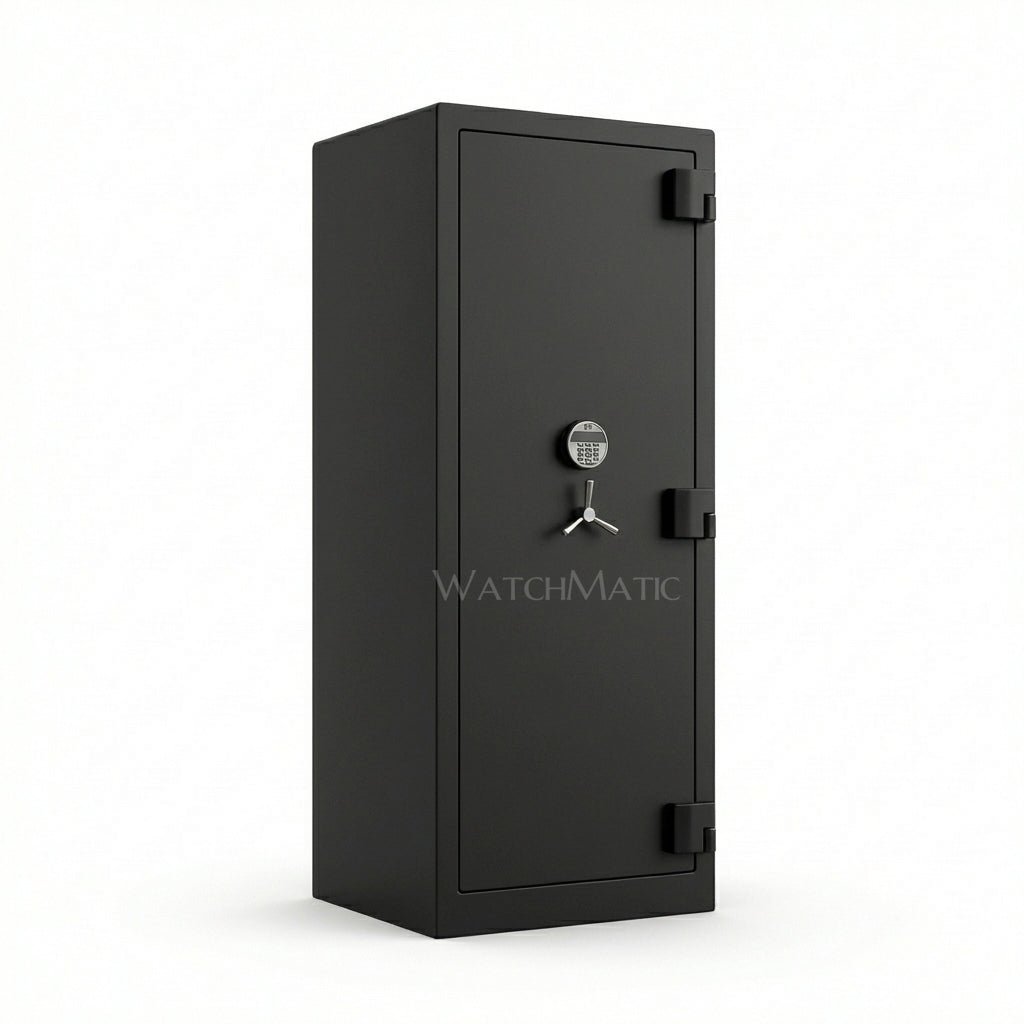
Collectors requiring integrated winding and secure storage can explore the Watch Winder Safe Collection.
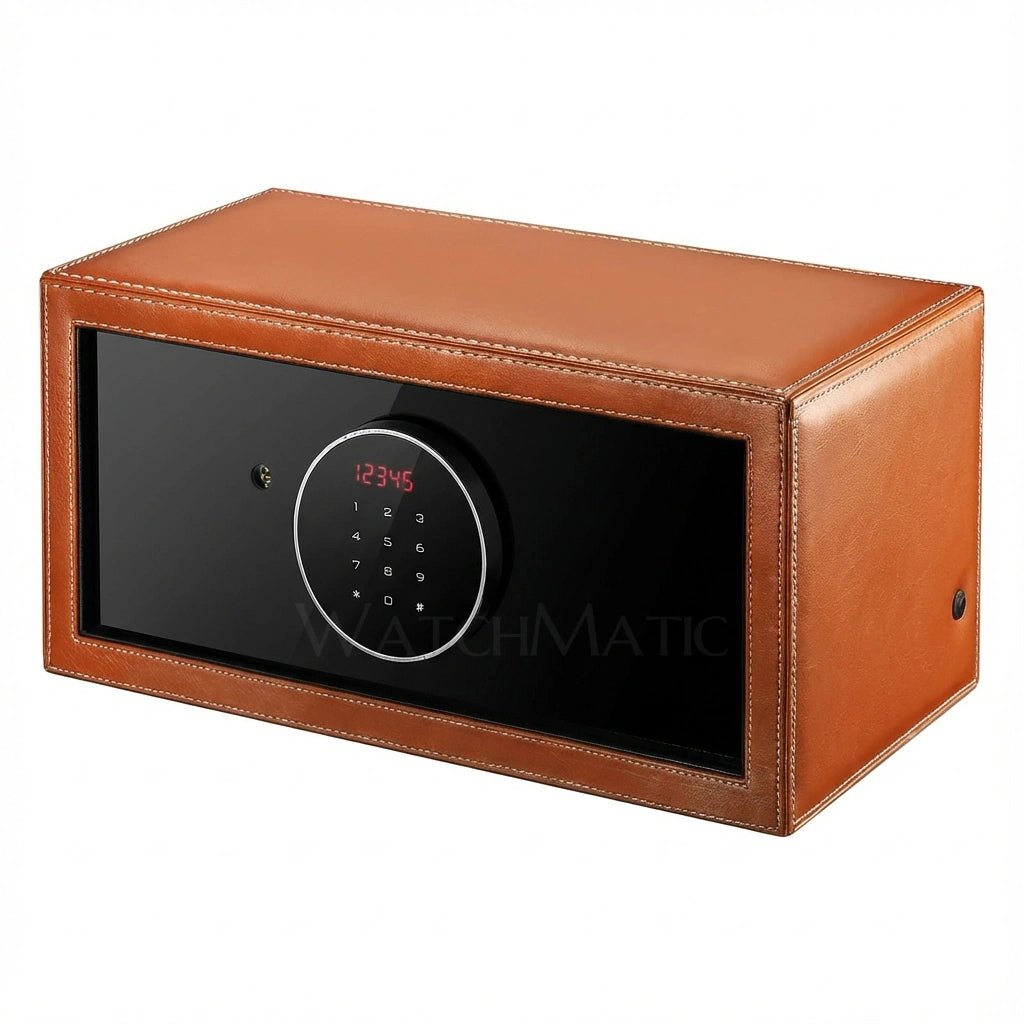
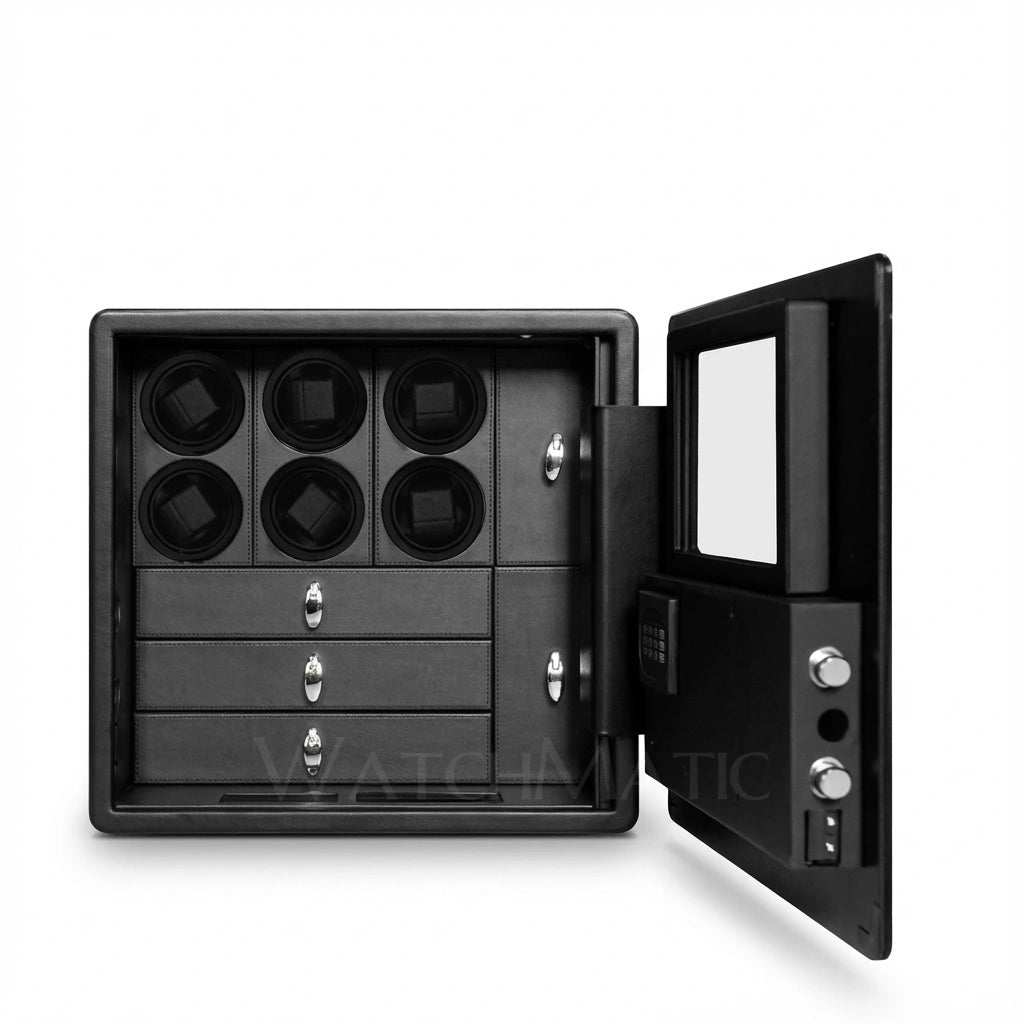
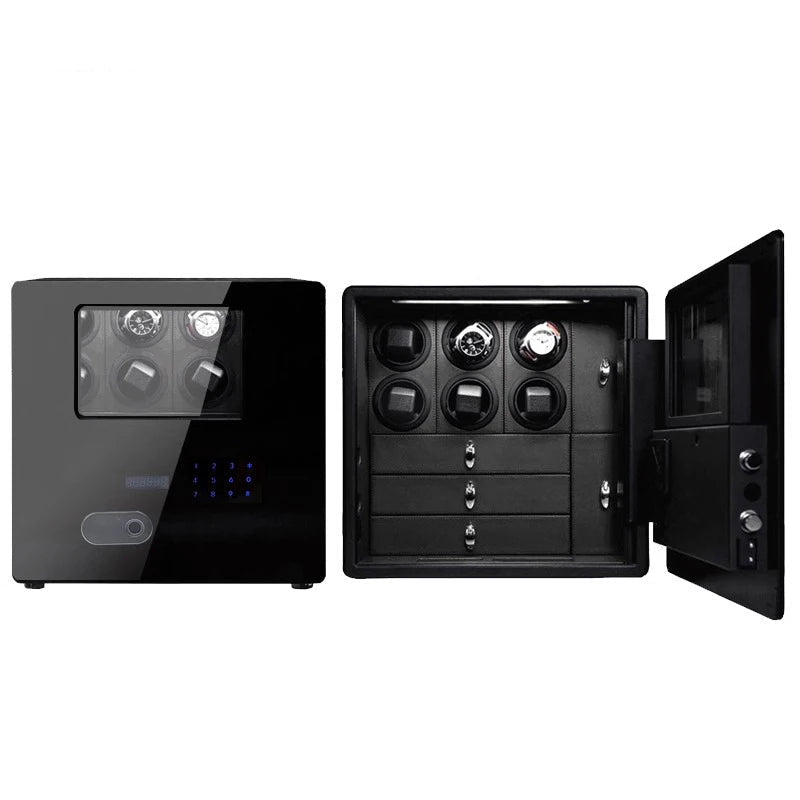
Titan Vault 20 for a Chronoswiss Collection

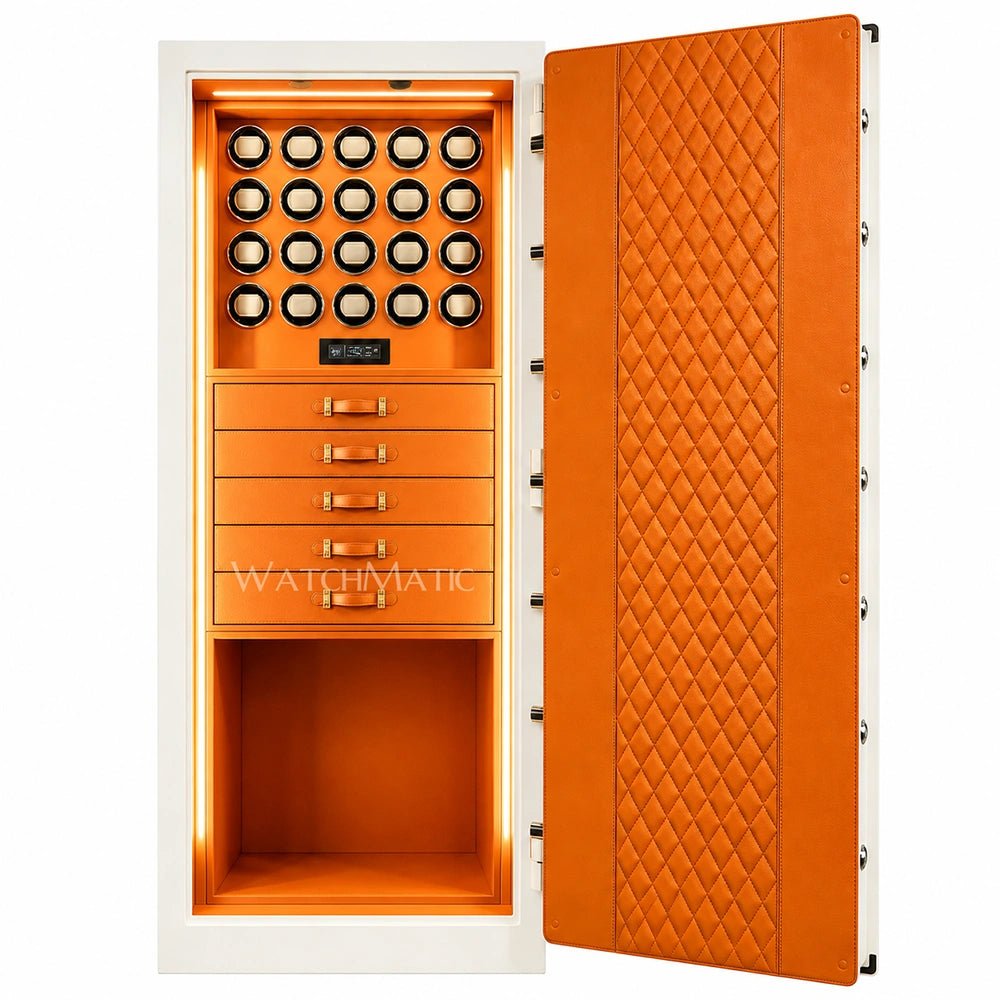
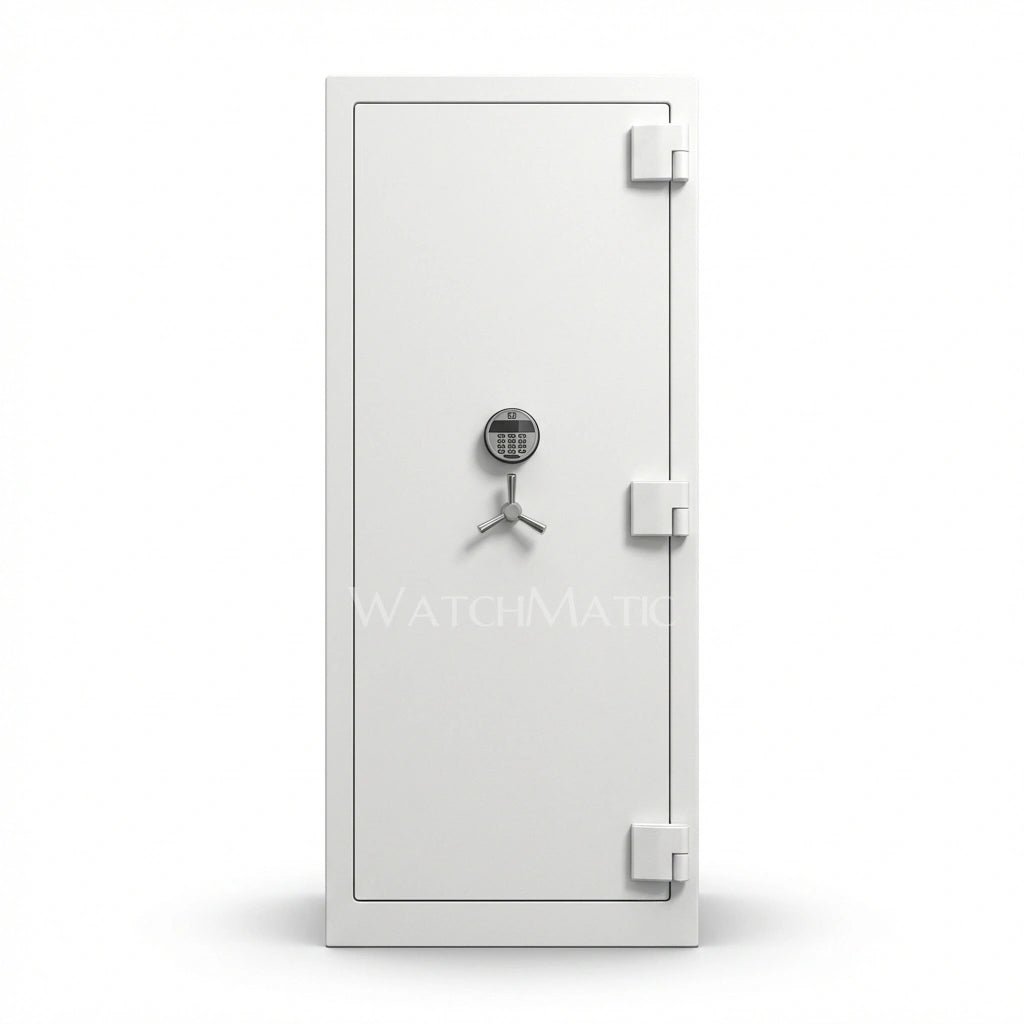
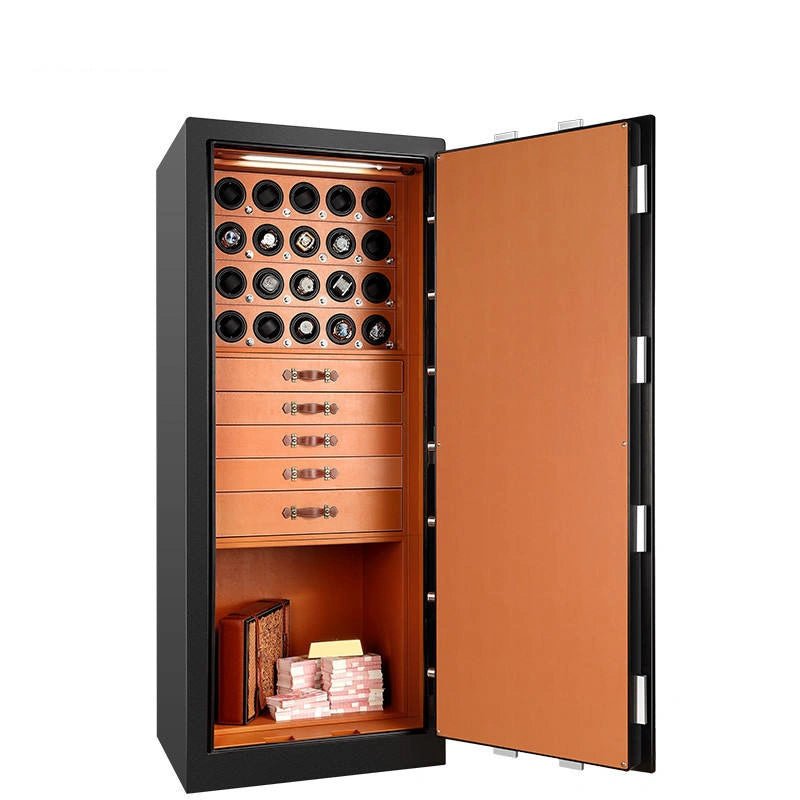
For a larger Chronoswiss or mixed luxury-watch collection, the Titan Vault 20 Watch Winder Safe combines 20 independently controlled winding positions with secure storage architecture.
Available features include:
- Monolithic solid-steel body
- 10-layer reinforced exterior shell
- Biometric fingerprint access
- Digital passcode
- Manual key access
- Floor anchoring
- LCD touchscreen
- Japanese Mabuchi motors
- Independent winding controls
- Adjustable TPD from 650 to 2200
- CW/CCW/bidirectional operation
- Anti-magnetization protection
- Adjustable LED illumination
- Ultra-quiet operation below 10 dB
- 10-year warranty
Higher-level fire and burglary certifications are available upon request rather than assumed as standard on every configuration.
Why Titan Vault 20 Can Make Sense for Chronoswiss
Chronoswiss spans a broad price range.
A collection might contain:
- Steel Strike Two
- Pulse GMT
- Gold Delphis
- Q-Repeater
- Flying Tourbillon
- Limited Open Gear models
At that point, the storage problem is not only automatic winding.
It also includes:
- Theft protection
- Access control
- precious-metal storage
- manual-watch storage
- collection organization
Automatic and Manual Watches Can Share One Secure System
A suitable mixed architecture could assign:
automatic Chronoswiss → individually programmed rotor positions
while:
C.303 Flying Tourbillon and C.85757 Neo Digiteur → stationary secure positions
This is more efficient than rotating every mechanical watch.
Security Relevance Does Not Depend on Winding Type
A manual Flying Tourbillon can be substantially more valuable than an automatic Strike Two.
Yet:
Strike Two → needs rotor consideration
while:
Flying Tourbillon → needs no rotor for winding.
Therefore:
security value and winding requirement must be evaluated separately.
Precious-Metal Pulse and Delphis References Strengthen the Security Case
Current Chronoswiss references can include:
- 18K red gold
- integrated gold bracelet
- enamel
- limited production
- elaborate hand guilloché
These characteristics increase security relevance without changing automatic winding requirements.
When Stationary Watch-Safe Storage Is More Appropriate
If a collection is dominated by:
- Open Gear Flying Tourbillon
- Neo Digiteur
- other manual historical Chronoswiss pieces
then maximizing powered rotor count may be unnecessary.
Secure stationary options from the Luxury Watch Safe Collection may be more appropriate.
Historical Chronoswiss Watches Need Separate Research
Chronoswiss has been producing mechanical watches since the early 1980s.
Older references can use very different movement architecture from the current collection.
Historical examples may include:
- Regulator variants
- Chronographs
- Opus
- Lunar Chronograph
- Grand Regulator
- earlier tourbillons
- older repeater calibers
Do not assume that settings for a current C.6000-series movement apply to a vintage Chronoswiss.
Current Movement Advice Should Not Be Applied to Every Chronoswiss Ever Made
For older watches, identify:
- Reference
- Approximate production generation
- Caliber
- Automatic or manual status
before choosing a winder.
This is especially important in secondary-market collecting.
Chronoswiss in a Mixed Independent and Haute Horlogerie Collection
Chronoswiss can sit naturally alongside manufacturers known for:
- Regulator displays
- unconventional movement layouts
- guilloché
- high complications
- independent watchmaking
A mixed collection might include:
Chronoswiss + Armin Strom + Roger Dubuis + Breguet + Arnold & Son
Related WatchMatic resources include:
Best Watch Winder for Armin Strom Watches
Best Watch Winder for Roger Dubuis Watches
Best Watch Winder for Breguet Watches
Best Watch Winder for Arnold & Son Watches
Independent programming becomes increasingly important because watches at this level can use radically different winding architectures.
Chronoswiss vs. Armin Strom
Both brands produce highly distinctive Swiss independent-style watchmaking.
But current Armin Strom has many important manual-wind references.
Current Chronoswiss is much more heavily weighted toward automatics, particularly through the C.6000-series.
Therefore, two collections with similar enthusiast appeal can require very different rotor capacity.
Chronoswiss vs. Roger Dubuis
Both manufacturers illustrate why complication level cannot identify winding architecture.
Roger Dubuis has automatic grande complications and manual tourbillons.
Chronoswiss has an automatic quarter repeater but a manual flying tourbillon.
The correct lesson is the same:
identify the caliber first.
Chronoswiss vs. Breguet
Both brands have deep historical relationships with regulator-style and traditional mechanical watchmaking.
However, their movement specifications should never be transferred across brands simply because the watches share classical horological language.
TPD remains caliber-specific.
How to Choose the Best Watch Winder for Your Chronoswiss
Step 1: Identify the Exact Reference
Determine whether the watch is:
- Strike Two
- Small Second
- Pulse One
- Pulse GMT
- Delphis
- ReSec
- Open Gear
- Space Timer
- Q-Repeater
- Neo Digiteur
- Flying Tourbillon
Step 2: Identify the Generation
This is particularly important for:
- ReSec
- Open Gear
- historical regulator models
A current ReSec Manufacture does not use the same movement as every earlier ReSec.
Step 3: Identify the Caliber
Important examples include:
- C.126
- C.299
- C.301
- C.303
- C.308
- C.85757
- C.6000
- C.6001
- C.6002
- C.6004
- C.6005
Step 4: Confirm Automatic or Manual
Current examples:
C.126 → automatic
C.299 → automatic
C.301 → automatic
C.308 → automatic
C.6000-series → automatic
C.85757 → manual
C.303 → manual
Step 5: Check Power Reserve
Representative values include:
35 h → Q-Repeater
42 h → C.299 / C.301 / C.308
48 h → Neo Digiteur manual
55 h → C.6000-series automatics
60 h → C.303 Flying Tourbillon manual
Step 6: Determine Whether TPD Is Relevant
TPD is relevant only to self-winding calibers.
Do not assign conventional TPD to:
- C.303
- C.85757
Step 7: Determine Rotation Direction
Use verified caliber-specific winding information.
Choose a winder supporting:
- CW
- CCW
- Bidirectional
Step 8: Consider the Complication
GMT and moon-phase watches can have stronger convenience value from remaining synchronized.
A repeater, jumping hour, or tourbillon does not itself determine winding type.
Step 9: Check Physical Fit
Pay particular attention to:
- Q-Repeater 16.2 mm thickness
- Space Timer 15.2 mm thickness
- 44 mm tourbillon cases
- signature onion crowns
- integrated Pulse bracelets
Step 10: Match Rotor Capacity to Automatic Watches
Do not equate:
number of mechanical watches
with:
number of powered winding positions required.
For broader resources covering automatic winding, TPD, secure storage, and collection protection, visit the WatchMatic Guide Hub.
Best Watch Winder for Chronoswiss Watches: Final Thoughts
Choosing the best watch winder for a Chronoswiss begins with identifying the exact reference, generation and caliber.
The current catalog is heavily automatic.
The newer manufacture generation includes:
C.6000 Strike Two / Small Second → approximately 55 hours
C.6001 Pulse One → approximately 55 hours
C.6002 Pulse GMT → approximately 55 hours
C.6004 Delphis → approximately 55 hours
C.6005 ReSec Manufacture → approximately 55 hours
Earlier automatic architectures include:
C.299 Open Gear → approximately 42 hours
C.301 legacy ReSec → approximately 42 hours
C.308 Space Timer → approximately 42 hours
and the unusual:
C.126 Q-Repeater → approximately 35 hours → automatic.
But Chronoswiss also offers important manual exceptions.
The Neo Digiteur C.85757 provides approximately 48 hours and is hand-wound.
The Open Gear Flying Tourbillon C.303 provides approximately 60 hours and is also hand-wound.
This creates two especially useful comparisons:
Q-Repeater C.126 → 35 h → automatic → winder compatible
versus:
Flying Tourbillon C.303 → 60 h → manual → no conventional winding benefit
and:
Delphis C.6004 → mechanical digital display → automatic
versus:
Neo Digiteur C.85757 → mechanical digital display → manual.
The lesson is clear:
neither complication, display style nor power reserve determines watch-winder compatibility.
For a confirmed automatic Chronoswiss, prioritize:
- Adjustable TPD
- CW/CCW/bidirectional programming
- Independent controls
- Controlled rest cycles
- Smooth low-vibration operation
- Flexible cushions
- Onion-crown clearance
- Integrated-bracelet compatibility
- Adequate chamber depth
For Neo Digiteur and Open Gear Flying Tourbillon watches, prioritize secure stationary storage instead.
The most reliable decision framework is:
Chronoswiss Reference → Generation → Caliber → Automatic or Manual → Power Reserve → Complication → Physical Fit → TPD/Direction → Winder or Stationary Storage
For additional winding and secure-storage solutions, explore WatchMatic.