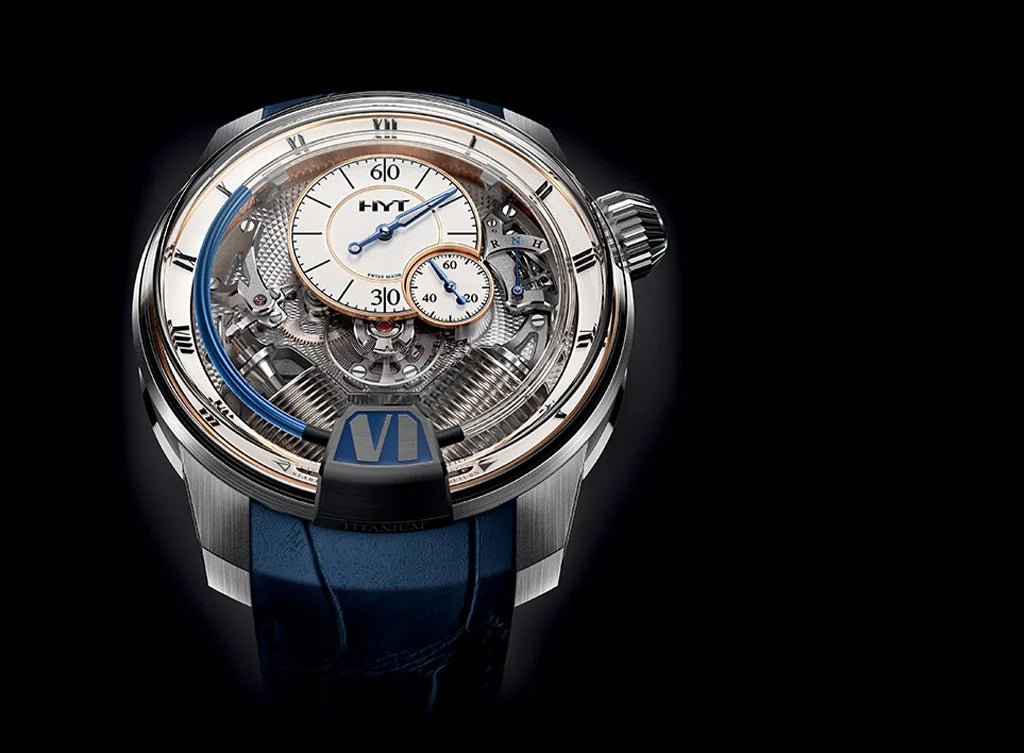
HYT watches generally do not need a conventional watch winder. The current HYT collections—S1, T1, Hastroid, Moon Runner and Conical Tourbillon—use manually wound mechanical movements.
A conventional watch winder rotates the entire watch to activate an internal automatic rotor. The HYT calibers in these collections do not use that mechanism.
Current HYT movements include:
-
501-CM — Manual winding, approximately 72 hours; used in S1, T1 and Hastroid.
-
601-MO — Manual winding, approximately 72 hours; used in Moon Runner.
-
701-TC — Manual winding using a dedicated winding tool or the crown as described in its user guide, approximately 40 hours; used in Conical Tourbillon.
Therefore:
HYT S1 / T1 / Hastroid → manual → conventional watch winder unnecessary
HYT Moon Runner → manual → conventional watch winder unnecessary
HYT Conical Tourbillon → hand-wound with dedicated tool → conventional watch winder unnecessary
For HYT collectors, the more useful priorities are correct manual winding, manufacturer-specified fluidic storage procedures, physical protection, suitable environmental conditions and secure stationary storage.
A watch winder can still serve a mixed collection containing HYT alongside automatic watches from other manufacturers—but it should not be purchased specifically to wind a manually wound HYT.
Do HYT Watches Need a Watch Winder?
No, not for the currently documented HYT collections.
Although HYT watches are exceptionally complex mechanical timepieces, their current movements use manual winding.
They do not rely on the motion of an internal automatic rotor to replenish their mainsprings.
A conventional watch winder therefore cannot supply the intended winding energy.
This distinction is especially important because HYT's fluid-based displays create the impression that the watches contain self-operating mechanisms.
They do—but self-operating time displays are not the same as self-winding movements.
For a broader explanation of automatic winding technology, see the Watch Winder Guide.
Which HYT Watches Can Use a Conventional Watch Winder?
The following table summarizes current collections and selected historical references.
|
HYT watch |
Movement |
Winding type |
Approx. power reserve |
Conventional winder benefit |
|---|---|---|---|---|
|
S1 Series |
501-CM |
Manual |
72 h |
No |
|
T1 Series |
501-CM |
Manual |
72 h |
No |
|
Hastroid |
501-CM |
Manual |
72 h |
No |
|
Moon Runner |
601-MO |
Manual |
72 h |
No |
|
Conical Tourbillon |
701-TC |
Manual / dedicated tool |
40 h |
No |
|
Historical H1 |
Reference-specific hand-wound caliber |
Manual |
65 h |
No |
|
Historical H2 |
Reference-specific hand-wound caliber |
Manual |
8 days |
No |
|
Historical H3 |
Reference-specific hand-wound caliber |
Manual |
170 h |
No |
|
Historical H4 |
Reference-specific hand-wound caliber |
Manual |
65 h |
No |
|
Historical H0 |
Reference-specific hand-wound caliber |
Manual |
65 h |
No |
|
Historical H5 |
Reference-specific hand-wound caliber |
Manual |
65 h |
No |
Historical specifications should always be checked against the precise reference and production documentation.
The decisive conclusion is:
No automatic-winding capability should be assumed merely because an HYT contains moving liquids, bellows, multiple barrels, a tourbillon or a complex mechanical indication.
Understanding HYT's Hydromechanical Technology
HYT is known for combining traditional mechanical watchmaking with fluidic time indication.
Instead of displaying hours exclusively through conventional hands, HYT uses a fluid module that converts mechanical movement into the controlled motion of liquids.
Its distinctive system includes:
-
Two bellows
-
Two immiscible liquids
-
A glass capillary
-
Mechanical transmission
-
A moving liquid boundary, or meniscus
The colored liquid indicates elapsed hours.
The transparent liquid represents the remaining portion of the display.
Their meeting point shows the hour.
How HYT's Bellows Work
The mechanical movement drives the fluidic module through two miniature bellows.
As one bellows compresses, it displaces liquid through the capillary.
The other bellows accommodates the corresponding movement of the second liquid.
This changes the position of the meniscus and therefore the displayed hour.
The system is mechanically powered.
However, nothing about this process means that the mainspring is wound automatically.
Fluid Movement Is Not Rotor Movement
This is the most important conceptual distinction.
In an automatic watch:
movement of the watch → automatic rotor → winding train → mainspring
In a current manually wound HYT:
crown or dedicated winding tool → mainspring → mechanical movement → bellows → fluidic hour display
The energy travels in the opposite functional direction.
The flowing liquid is the result of energy being consumed.
It is not the mechanism that replenishes that energy.
Why This Matters for Watch Winders
A conventional watch winder rotates the whole watch.
If there is no automatic rotor connected to the mainspring, that external rotation does not perform the intended winding function.
Therefore:
moving fluid ≠ automatic winding
and:
rotating the entire HYT ≠ winding its movement.
What Is HYT's Fluidic Rewind?
HYT uses the term rewind for an important feature of its liquid-hour display.
When the colored liquid reaches the end of the 12-hour indication, it returns toward its starting position.
This happens through the fluid system and bellows.
It is a retrograde display action.
Fluidic Rewind Is Not Mainspring Rewinding
The word rewind can create confusion.
There are two unrelated concepts.
Fluidic rewind
The colored liquid returns to the beginning of its hour display.
Mechanical winding
Energy is added to the mainspring.
HYT's fluidic rewind accomplishes the first task.
It does not automatically accomplish the second.
Why HYT's Retrograde Display Does Not Need a Watch Winder
The return of the colored liquid happens as part of normal movement operation, provided the watch has sufficient energy.
A conventional watch winder does not need to rotate the case to trigger this event.
It is governed by the mechanical and fluidic movement itself.
Best Watch Winder for HYT S1
The current HYT S1 uses:
Caliber 501-CM
with:
-
Manual winding
-
Approximately 72 hours of power reserve
-
352 movement components
-
41 jewels
-
28,800 vibrations per hour
-
Fluidic retrograde hours
-
Central minutes
-
Small seconds on selected references
-
Power-reserve indicator
Does an HYT S1 Need a Watch Winder?
No.
The 501-CM must be wound manually.
A conventional watch winder does not provide mainspring energy to this caliber.
S1's 72-Hour Power Reserve
The S1 offers approximately three days of autonomy when adequately wound.
That means the owner does not necessarily need to wind it every day.
However, if the watch remains unworn longer than its available reserve, it will eventually stop.
This is normal.
S1 Sport Design Does Not Mean Automatic
The S1 is positioned as a hydromechanical sports watch.
It includes:
-
Contemporary titanium construction
-
Quick-change straps
-
Bold hour indication
-
Technical case architecture
But the word Sport does not imply self-winding.
The movement remains manual.
S1 Physical Dimensions
Representative S1 dimensions are approximately:
-
Width: 45.3 mm
-
Length: 46.3 mm
-
Thickness: 17.2 mm
Its thickness is particularly relevant for secure storage.
A shallow drawer or tightly enclosed holder may not provide enough clearance.
S1 Titanium vs. Gold Variants
Current references use materials including:
-
Titanium
-
DLC-coated titanium
-
5N gold
-
Ceramic-coated details
These change:
-
Weight
-
Appearance
-
Surface-care requirements
-
Collector value
They do not change the manual winding architecture.
Colored Fluids Do Not Change Winding
S1 references may display:
-
Red liquid
-
Blue liquid
-
Green liquid
-
Black liquid
The color of the liquid does not determine:
-
Winding method
-
Power reserve
-
TPD
-
Rotation direction
Best Storage for HYT S1
For an S1, prioritize:
-
Secure stationary storage
-
Suitable case-height clearance
-
Soft support surfaces
-
Correct strap curvature
-
Protection from excessive temperature
-
Following the reference-specific HYT storage procedure
A powered rotor is unnecessary.
HYT T1 Series
The T1 Series also uses:
501-CM
with approximately:
72 hours of power reserve.
It combines the signature hydromechanical display with a more restrained design.
Current versions include titanium and precious-metal configurations.
Does an HYT T1 Need a Watch Winder?
No.
T1 is manually wound.
The presence of a flowing-liquid display does not convert its 501-CM into an automatic movement.
T1 vs. S1
|
Feature |
S1 |
T1 |
|---|---|---|
|
Movement |
501-CM |
501-CM |
|
Winding |
Manual |
Manual |
|
Reserve |
72 h |
72 h |
|
Display |
Fluidic hours |
Fluidic hours |
|
Conventional winder |
No |
No |
|
Main difference |
Sport-oriented presentation |
More restrained design |
Their visual identities differ.
Their conventional watch-winder compatibility does not.
T1's Interchangeable Strap System
T1 features a dedicated quick-change strap system.
That improves convenience for the owner.
For storage, the important considerations are:
-
Avoiding strap distortion
-
Keeping the case supported
-
Preventing unwanted contact with the buckle
-
Providing adequate clearance
The strap system does not affect winding requirements.
Guilloché Does Not Change Winding
Selected T1 references feature guilloché dials.
This affects craftsmanship and aesthetic value.
It does not change the manually wound movement.
HYT Hastroid
The Hastroid collection also uses:
501-CM
with approximately:
72 hours of reserve.
The Hastroid is among HYT's most visually technical collections.
Representative features include:
-
Fluidic retrograde hours
-
Central minutes
-
Small seconds
-
Power-reserve indicator
-
Large sculptural case
-
Domed sapphire crystal
-
Titanium, carbon and composite materials
Does HYT Hastroid Need a Watch Winder?
No.
The 501-CM is manually wound.
Rotating the complete watch does not replenish its mainspring.
Hastroid Case Dimensions
Representative dimensions are approximately:
-
Width: 48 mm
-
Length: 52.3 mm
-
Thickness: 17.2 mm
This makes Hastroid notably larger than a conventional sports watch.
Hastroid Requires More Than a Standard Watch Cushion
A typical holder may be designed for round watches approximately 38–44 mm in diameter.
Hastroid's unusual geometry requires additional attention.
Check:
-
Overall width
-
Overall length
-
Sapphire height
-
Crown projection
-
Strap angle
Case Material Does Not Change Winding
Hastroid references can incorporate:
-
Titanium
-
Carbon
-
Composite materials
-
Bronze-related finishes
These influence weight and surface characteristics.
They do not alter the winding method.
Hastroid's Large Case Does Not Need Higher TPD
This statement is important because a large, heavy-looking mechanical watch can be mistaken for a demanding automatic movement.
In this case, TPD is not merely different.
It is not applicable to the manually wound 501-CM.
Best Storage for Hastroid
The preferred solution is a stationary compartment with:
-
Generous horizontal clearance
-
Adequate height
-
Soft surfaces
-
No pressure against the crown
-
Stable strap positioning
-
Secure access
HYT Moon Runner
The Moon Runner uses:
Caliber 601-MO
with:
-
Manual winding
-
Approximately 72 hours of power reserve
-
516 components on documented configurations
-
Fluidic retrograde hours
-
Central minutes
-
Three-dimensional moon phase
-
Day/date indication
-
Month indication
Does HYT Moon Runner Need a Watch Winder?
No.
The 601-MO is manually wound.
A conventional watch winder cannot add useful winding energy to the movement.
Moon Runner Is a Strong Example of Convenience Without Compatibility
Moon Runner includes more indications than a simple time-only watch.
If it stops, the owner may need to restore:
-
Time
-
Day/date
-
Month
-
Moon phase
From a practical perspective, keeping it running would be convenient.
However, the movement is manual.
Therefore:
high resetting inconvenience does not create conventional watch-winder compatibility.
Moon Phase Does Not Mean Automatic
Moon-phase watches can contain:
-
Automatic movements
-
Manual movements
-
Quartz movements
The current HYT Moon Runner uses a manually wound mechanical movement.
Moon Runner's 72-Hour Reserve
The 601-MO provides approximately three days of autonomy.
A fully wound movement can therefore continue running through a substantial short break from wear.
But after the reserve expires, the watch will stop.
A conventional rotating box cannot prevent this.
Moon Runner Physical Dimensions
Representative versions measure:
48 × 52.3 × 17.2 mm.
Certain executions are thicker, reaching approximately:
21.8 mm.
These differences make reference-specific storage dimensions important.
Moon Runner's Domed Sapphire Requires Clearance
The moon-phase display and dome are major visual features.
A storage compartment must not place pressure against:
-
The sapphire
-
Crown
-
Strap attachment
-
Adjacent watches
Moon Runner's Three-Dimensional Display Does Not Need Rotation
The moon-phase sphere and calendar mechanisms are driven by the mechanical movement.
They do not receive mainspring energy from external case rotation.
Long-Term Storage Matters Particularly for Moon Runner
HYT's Moon Runner user instructions contain specific procedures for positioning the colored liquid before extended storage.
This is a significant distinction from ordinary mechanical-watch storage.
The manufacturer describes returning the colored fluid into its dedicated bellows rather than simply leaving the watch with the liquid at an arbitrary point in the capillary.
Owners should follow the exact manual for their reference.
Moon Runner Should Not Be Treated Like a Generic Manual Watch
A conventional manually wound watch usually requires attention to:
-
Crown winding
-
Time setting
-
Physical storage
Moon Runner adds:
fluidic display management.
That makes the manufacturer's instructions particularly important.
HYT Conical Tourbillon
The Conical Tourbillon is among HYT's most technically ambitious creations.
It uses:
Caliber 701-TC
with:
-
Manual winding
-
Approximately 40 hours of power reserve
-
533 movement components
-
61 jewels
-
21,600 vibrations per hour
-
Fluidic retrograde hours
-
Central minutes
-
Conical tourbillon
-
Additional animated rotating spheres
Does HYT Conical Tourbillon Need a Watch Winder?
No.
The 701-TC does not use a conventional self-winding rotor.
Its mainspring must be wound manually using the procedure specified by HYT.
What Does “Winding: With Winder Tool” Mean?
This is probably the most important HYT-specific search question.
HYT's Conical Tourbillon product specifications describe winding with a:
winding tool.
That does not mean a conventional rotating watch-winder box.
It refers to a dedicated tool used to wind the movement mechanically.
The official user guide also describes winding through the crown, with the tool available for that purpose.
Winding Tool vs. Watch Winder
|
Feature |
HYT winding tool |
Conventional watch winder |
|---|---|---|
|
Purpose |
Mechanically wind the movement |
Move the entire watch |
|
Method |
Actuate the manual winding mechanism |
Rotate a holder |
|
Useful for 701-TC |
Yes |
No |
|
Requires automatic rotor |
No |
Yes |
|
Replacement for the other |
No |
No |
The terminology is similar.
The mechanical function is different.
Why Google Searches Can Be Misleading
Someone searching:
“HYT Conical Tourbillon winder”
may encounter the official phrase:
“Winding: With winder tool.”
That can create the false impression that an electric watch winder is required.
The correct interpretation is:
manual winding with a dedicated tool.
Conical Tourbillon Has a 40-Hour Reserve
The 701-TC provides approximately:
40 hours of autonomy.
This is noticeably shorter than the 72-hour movements used in:
-
S1
-
T1
-
Hastroid
-
Moon Runner
But the shorter reserve does not make a conventional winder useful.
Short Power Reserve Does Not Mean Higher TPD
In this case, TPD is entirely inapplicable.
A 40-hour manually wound movement does not become automatic simply because it runs for a shorter period.
The Tourbillon Rotates—But Does Not Wind the Watch
The Conical Tourbillon completes a revolution approximately every:
30 seconds.
This is a regulating mechanism.
It is not an automatic rotor.
Animated Spheres Do Not Provide Winding Energy
HYT's conical-tourbillon display also features animated spheres rotating at different rates.
Selected configurations include spheres completing approximately:
-
Four revolutions per minute
-
Five revolutions per minute
-
Six revolutions per minute
These motions are part of the mechanical display.
They do not replenish the mainspring.
Why This Comparison Matters
The Conical Tourbillon contains an extraordinary amount of visible rotational movement.
Yet it remains manually wound.
Therefore:
more internal rotation does not mean more automatic winding.
Conical Tourbillon Physical Dimensions
Representative dimensions are approximately:
-
Width: 48 mm
-
Length: 52.3 mm
-
Thickness: 25.15 mm
The height is especially significant.
25.15 mm Thickness Is a Major Storage Consideration
Many watch holders and drawers are designed around conventional watches with significantly lower case heights.
An HYT Conical Tourbillon requires careful evaluation of:
-
Internal drawer clearance
-
Sapphire dome clearance
-
Crown position
-
Strap support
-
Separation from adjacent watches
A Powered Rotor Offers No Benefit
Given its:
-
Manual movement
-
Dedicated winding procedure
-
Significant case height
-
High monetary value
a properly configured stationary secure compartment is more appropriate than a conventional rotating winder.
Conical Tourbillon High-Jewellery Editions
The family includes editions such as:
-
Infinity Diamonds
-
Infinity Sapphires
-
Panda
-
Black Eklipse
-
Titanium Blue
-
Midnight Blue
These can contain elaborate:
-
Gem setting
-
Precious metals
-
Ceramic coatings
-
Hardstone details
None changes the basic winding architecture of the 701-TC.
High Jewellery Does Not Mean Higher TPD
Retail value, diamonds and decorative craftsmanship do not determine whether a watch has an automatic rotor.
In the Conical Tourbillon, the movement is manual regardless of the case's decorative treatment.
HYT Conical Tourbillon vs. HYT S1
|
Feature |
S1 |
Conical Tourbillon |
|---|---|---|
|
Caliber |
501-CM |
701-TC |
|
Winding |
Manual |
Manual / dedicated tool |
|
Reserve |
72 h |
40 h |
|
Components |
352 |
533 |
|
Tourbillon |
No |
Yes |
|
Approx. thickness |
17.2 mm |
25.15 mm |
|
Conventional watch winder |
No |
No |
The Conical Tourbillon is considerably more complicated and physically larger.
But neither watch benefits from automatic rotational winding.
Older HYT Watches: H1, H2, H3, H4, H0 and H5
HYT's earlier watchmaking history is also important because collectors frequently purchase historical references through specialist retailers and the secondary market.
The brand's earlier models used highly innovative mechanical architectures.
However, they were also predominantly hand-wound.
Historical HYT H1
The original H1 helped establish HYT's hydromechanical concept.
Representative characteristics include:
-
Manual winding
-
Fluidic hour display
-
Approximately 65 hours of reserve
A conventional watch winder provides no winding benefit.
Historical HYT H2
The H2 introduced a more elaborate movement architecture developed with Audemars Piguet Renaud & Papi.
Important characteristics include:
-
Manual winding
-
Twin-barrel architecture
-
Approximately eight days of reserve
-
Thermal indication on relevant references
Despite the exceptionally long reserve, H2 remains manual.
Eight Days Does Not Mean Automatic
The H2 is one of the strongest examples of why power reserve is not a winding-type indicator.
Compare:
H2 → eight days → manual
with:
S1 → 72 hours → manual.
Both are unsuitable for conventional automatic winding.
H2 Thermal Indicator Is Relevant to Handling
Selected H2 references include a thermal indicator.
The user instructions describe temperature-dependent handling precautions.
For those models, owners should follow the reference-specific temperature guidance before manipulating the fluidic display.
This is a maintenance and handling issue, not a watch-winder setting.
Historical HYT H3
The H3 uses a particularly unusual linear time display.
Representative characteristics include:
-
Manual winding
-
Linear liquid indication
-
Approximately 170 hours of reserve
Its highly unconventional display does not imply automatic winding.
Historical HYT H4
The H4 introduced mechanically powered lighting on selected versions.
Representative specifications include:
-
Manual winding
-
Approximately 65 hours of movement reserve
-
Dedicated mechanical light-generation system on applicable references
Mechanically Powered Lighting Does Not Mean Automatic Winding
The presence of a dynamo or manually energized lighting mechanism does not mean the watch winds itself through wrist movement.
The movement remains manual.
Historical HYT H0
The H0 uses:
-
Manual winding
-
Fluidic hour indication
-
Approximately 65 hours of power reserve
It does not require a conventional watch winder.
Historical HYT H5
The H5 also uses a manually wound mechanical movement.
Representative power reserve:
65 hours.
Again, the visually complex fluidic mechanism does not create automatic-winder compatibility.
Historical Watches Require Reference-Specific Verification
HYT has produced numerous limited editions and technological variations.
For a historical reference, verify:
-
Exact model
-
Reference number
-
Movement
-
Winding procedure
-
Power reserve
-
Crown configuration
-
Temperature and handling guidance
-
Manufacturer service requirements
Do not automatically apply current 501-CM instructions to every earlier HYT.
HYT Power Reserve Comparison
|
HYT movement / reference |
Winding type |
Approx. reserve |
|---|---|---|
|
Conical Tourbillon 701-TC |
Manual / tool |
40 h |
|
Historical H1 |
Manual |
65 h |
|
Historical H0 |
Manual |
65 h |
|
Historical H4 |
Manual |
65 h |
|
Historical H5 |
Manual |
65 h |
|
Current 501-CM |
Manual |
72 h |
|
Current 601-MO |
Manual |
72 h |
|
Historical H3 |
Manual |
170 h |
|
Historical H2 |
Manual |
192 h |
This table reveals the primary HYT-specific lesson:
Power reserve varies dramatically, but conventional automatic-winder usefulness does not.
HYT's Shortest Reserve Does Not Need a Watch Winder
The Conical Tourbillon provides around:
40 hours.
But it is manual.
HYT's Longest Historical Reserves Do Not Need Watch Winders Either
The H2 provides roughly eight days.
The H3 provides approximately 170 hours.
Both are manual.
Therefore, neither:
-
Short reserve
-
Long reserve
determines watch-winder compatibility.
What TPD Should You Use for an HYT Watch?
For the current manually wound HYT collections:
TPD is not applicable.
TPD means Turns Per Day.
It is a programming parameter for a watch winder designed to activate the rotor of a self-winding mechanical watch.
Current HYT movements discussed here do not use that rotor architecture.
HYT TPD Settings by Collection
|
Collection |
Caliber |
TPD setting |
|---|---|---|
|
S1 |
501-CM |
Not applicable |
|
T1 |
501-CM |
Not applicable |
|
Hastroid |
501-CM |
Not applicable |
|
Moon Runner |
601-MO |
Not applicable |
|
Conical Tourbillon |
701-TC |
Not applicable |
For general education on how TPD works in genuinely automatic watches, see the Watch TPD Guide.
Is 650 TPD Suitable for HYT?
No conventional TPD target is required for these manual movements.
Selecting:
-
650 TPD
-
800 TPD
-
1,000 TPD
-
2,200 TPD
does not turn a manual HYT into an automatic watch.
Is Clockwise Rotation Better for HYT?
Not for conventional automatic winding.
The current manually wound movements do not gain winding energy from clockwise rotation of the whole watch.
Is Counterclockwise Rotation Better?
No.
The same limitation applies.
Is Bidirectional Rotation Better?
No.
Alternating CW and CCW motion is useful for certain automatic movements.
It does not provide a manual HYT with an automatic rotor.
Why Changing Direction Cannot Solve the Problem
A programmable watch winder can change:
-
Number of daily turns
-
Rotation direction
-
Rest cycles
But it cannot create an automatic winding mechanism inside a movement that does not contain one.
Should an HYT Run Continuously?
There is no general requirement to keep an HYT running continuously by external rotation.
Instead, follow HYT's specific instructions concerning:
-
Manual winding
-
Fluidic display
-
Time setting
-
Long-term storage
-
Servicing
HYT Long-Term Storage: An Important Special Case
HYT is different from ordinary mechanical watches because its fluidic module can require specific preparation before extended storage.
The official Moon Runner and Conical Tourbillon manuals instruct owners to return the colored fluid to its designated bellows for long-term storage.
This is more specific than simply allowing the mechanical movement to stop.
Why Fluid Position Matters
The HYT system uses two immiscible liquids contained within a sealed capillary-and-bellows assembly.
The manufacturer specifies a particular fluid position for extended storage on relevant models.
That makes the fluidic display part of the storage procedure.
Manufacturer Instructions Take Priority
For Moon Runner and Conical Tourbillon, the relevant manuals describe a procedure involving moving the indication toward approximately 06:15, reversing to 06:00 and allowing the colored liquid to return to its starting zone.
They also describe leaving the crown in the specified time-setting position for prolonged storage.
This procedure should not be generalized automatically to every HYT model.
Use the exact owner's manual and consult HYT if the watch's instructions are unclear.
Crown Position Must Be Considered in Storage Design
If the manufacturer requires a crown to remain extended during long-term storage, the compartment must provide sufficient clearance.
Avoid a storage configuration where:
-
The crown is pressed against a wall
-
The drawer touches the crown
-
A cushion forces the case sideways
-
The door can accidentally actuate the crown
The manufacturer-prescribed storage state should always take priority over a generic storage recommendation.
Long-Term Storage and Everyday Storage Are Different
An HYT that is:
-
Worn regularly
-
Manually wound
-
Reset frequently
may require a different procedure from a watch being stored for many months.
Follow the reference-specific instructions.
Does Keeping an HYT Moving Protect Its Fluid?
A conventional watch winder should not be presented as a fluid-preservation system.
HYT does not specify that the current manual movements must be continuously rotated externally to keep their fluids healthy.
The proper approach is to follow the official fluidic handling and storage instructions.
Can a Watch Winder Circulate the Colored Liquid?
Not as an intended winding or fluid-maintenance function.
A conventional winder rotates the entire watch.
The colored liquid moves through its capillary because the mechanical movement drives the bellows.
External rotation is not a substitute for that mechanism.
Does the Fluid Return Automatically Every 12 Hours?
While the movement is operating normally, the fluidic hour indication performs its retrograde return at the end of its 12-hour cycle.
The automatic return of the liquid is a display function.
It does not mean that the watch has an automatic mainspring-winding system.
What Happens When an HYT Stops?
As the mainspring's stored energy is exhausted, the movement eventually stops.
The fluidic display no longer progresses normally.
Before restarting or adjusting the watch, the owner should follow the exact model's instructions.
Do not force the display rapidly through a large time-setting interval.
HYT Time Setting Requires Care
HYT manuals describe careful manipulation of the crown when setting the fluidic hour display.
This is particularly important when approaching a retrograde return.
Owners should allow the colored fluid to complete its prescribed return before continuing to manipulate the display.
Fluidic Rewind Should Not Be Forced
HYT user guides describe a return process that can take approximately one minute.
Attempting to rush that process is not equivalent to ordinary hand-setting on a conventional wristwatch.
Authorized Service Is Important
HYT's fluid module is specialized.
The manufacturer's warranty guidance states that the fluid system should only be replaced by authorized HYT professionals.
A conventional watchmaker unfamiliar with the technology may not have the appropriate tools or expertise.
A Watch Winder Cannot Replace Fluidic Servicing
A watch winder does not:
-
Replace fluids
-
Repair a bellows
-
Service the capillary
-
Correct a meniscus problem
-
Repair a leaking fluidic module
-
Restore sealing
-
Regulate the mechanical movement
These require appropriate professional service.
Temperature and Environmental Considerations
Because HYT combines mechanical and fluidic technologies, the storage environment deserves attention.
Avoid:
-
Prolonged excessive heat
-
Direct intense sunlight
-
Excessive moisture
-
Repeated impacts
-
Unstable physical support
Specific HYT instructions take priority over generic watch-storage advice.
Avoid Excessive Heat
The Moon Runner and Conical Tourbillon manuals warn against prolonged exposure above approximately:
50°C / 122°F.
This should be understood as a manufacturer warning threshold, not as a recommended operating or storage target.
A stable indoor environment is preferable.
Humidity Control Is a Storage Issue, Not a Winding Issue
Humidity control can help protect:
-
Straps
-
Packaging
-
Case surfaces
-
The storage environment
But a watch winder does not automatically provide environmental control.
The relevant feature must exist in the actual storage system.
Does HYT Need to Be Stored Vertically?
There is no universal vertical-storage rule that should be assigned to every HYT based solely on its fluidic display.
Follow the orientation and fluid-position requirements specified for the exact reference.
Do not substitute an assumption about gravity for manufacturer instructions.
Sapphire and Case Protection
HYT watches often have:
-
Tall domed sapphire crystals
-
Layered cases
-
Exposed three-dimensional components
-
Large crowns
-
Technical straps
This makes storage fit unusually important.
HYT Case Size Comparison
|
Collection |
Approx. width |
Approx. length |
Approx. thickness |
|---|---|---|---|
|
S1 |
45.3 mm |
46.3 mm |
17.2 mm |
|
T1 |
45.3 mm |
46.3 mm |
17.2 mm |
|
Hastroid |
48 mm |
52.3 mm |
17.2 mm |
|
Moon Runner |
48 mm |
52.3 mm |
17.2–21.8 mm |
|
Conical Tourbillon |
48 mm |
52.3 mm |
25.15 mm |
Dimensions vary by reference, and the actual usable storage compartment must be checked.
Thickness Is Often More Important Than Width
A 48 mm watch is large.
But the Conical Tourbillon's approximately 25.15 mm thickness is a more significant issue for drawer clearance.
Similarly, selected Moon Runner variants use unusually tall sapphire architecture.
Measure the Complete Watch
Before purchasing a storage system, check:
-
Case width
-
Case length
-
Total height
-
Sapphire dome
-
Crown projection
-
Strap angle
-
Buckle
-
Manufacturer-required storage position
Why a Standard Rotating Holder May Be Unnecessary
For current HYT movements, a rotating holder adds no useful winding benefit.
It can also introduce unnecessary design constraints around:
-
Cushion fit
-
Door clearance
-
Rotation envelope
A stationary compartment gives more freedom to accommodate unusual case geometry.
What to Look for in HYT Watch Storage
For an HYT-focused collection, prioritize:
Secure Stationary Compartments
Because current HYT movements are manual, motorized positions are unnecessary for winding.
Adequate Internal Height
Especially important for Conical Tourbillon and selected Moon Runner references.
Soft Interior Surfaces
Protect polished and coated cases against unwanted contact.
Appropriate Strap Support
Avoid forcing rubber, leather or technical straps around rigid supports.
Adequate Crown Clearance
Particularly relevant when following manufacturer-specific long-term storage instructions.
Stable Indoor Environment
Avoid unnecessary temperature and humidity extremes.
Controlled Access
High-value HYT collections can justify secure storage.
Configurable Drawer Layout
A customized arrangement can accommodate watches with different dimensions.
Best Watch Winder for One HYT Watch
For one current HYT watch, a conventional automatic watch winder is not the appropriate first purchase.
A more suitable solution is:
premium stationary watch storage.
The owner should prioritize:
-
Correct HYT winding procedure
-
Reference-specific fluidic care
-
Correct compartment dimensions
-
Secure access
Best Watch Winder for Multiple HYT Watches
Consider a collection containing:
-
S1
-
T1
-
Hastroid
-
Moon Runner
-
Conical Tourbillon
All five are mechanical.
None of the listed current calibers benefits from conventional automatic winding.
Therefore:
five mechanical HYT watches do not require five powered winding positions.
Mechanical Watch Count Is Not Rotor Count
This is especially clear with HYT.
A collector could own ten HYT watches and still have no need for conventional automatic winding positions for the documented manual calibers.
When Can a Watch Winder Still Be Relevant to an HYT Collector?
A winder becomes useful when the collection includes other genuine automatic watches.
For example:
-
HYT S1
-
HYT Moon Runner
-
Rolex Datejust
-
Omega Seamaster
-
H. Moser Streamliner
-
Czapek Antarctique
The HYT watches remain stationary.
The automatic watches can receive programmed winding.
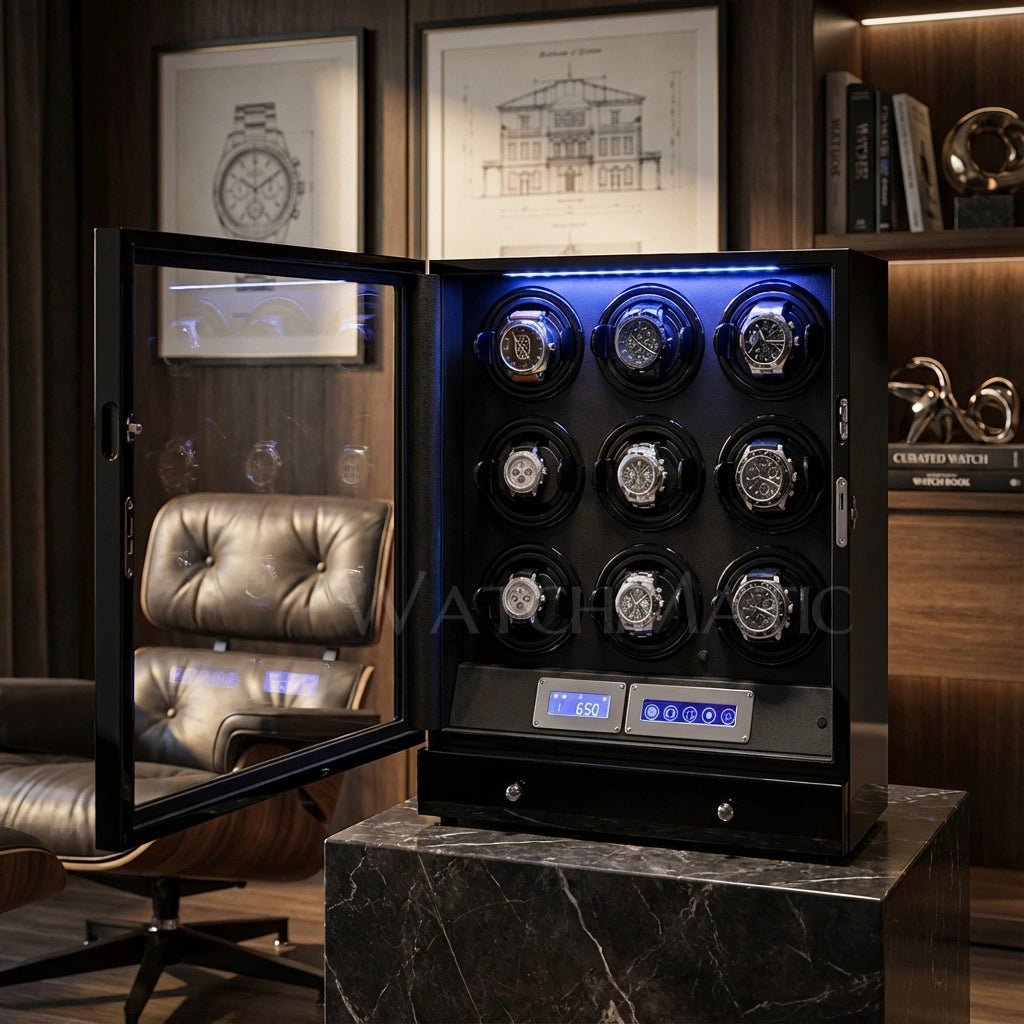
Vento Watch Winder for a Mixed Collection

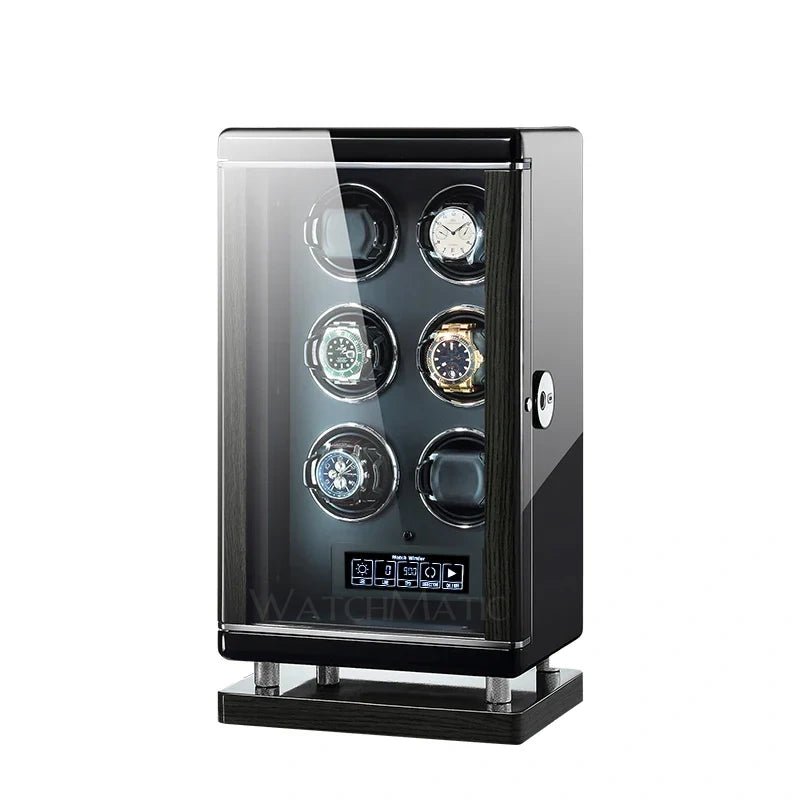
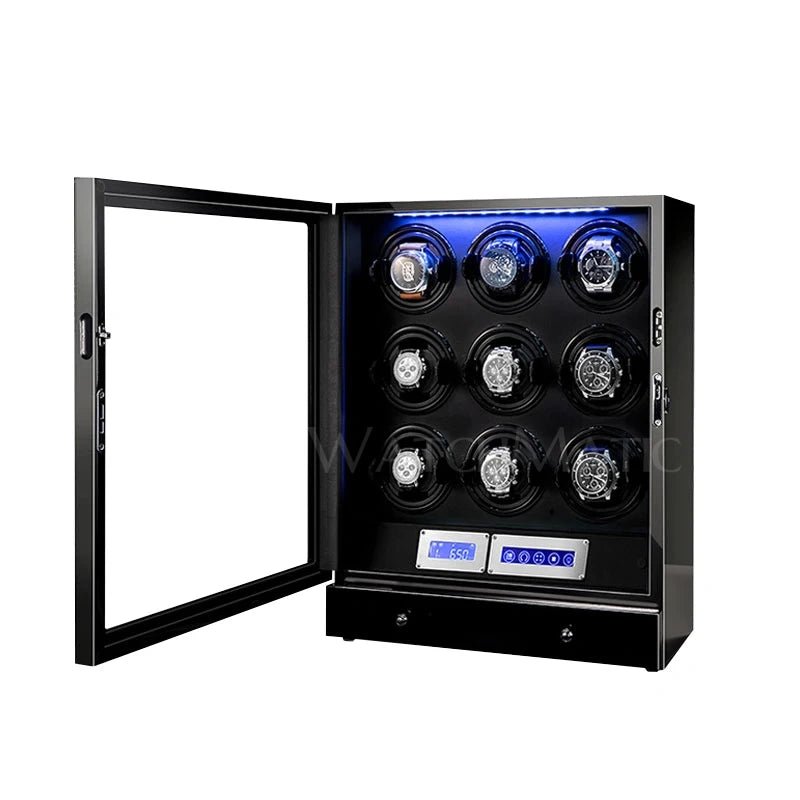
The Vento Luxury Quad Watch Winder provides four independently controlled winding positions.
It can be useful when an HYT collector also owns several automatic watches from other manufacturers.
For example:
-
Rolex automatic
-
Omega automatic
-
H. Moser automatic
-
Czapek automatic
Each can receive independent settings for:
-
TPD
-
Rotation direction
-
Winding mode
Vento Is Not a Winding Solution for Current HYT Calibers
This distinction should be explicit.
The Vento does not wind:
-
501-CM
-
601-MO
-
701-TC
merely by rotating the watches.
Why This Product Positioning Matters
A luxury watch winder should be recommended because the movement can actually benefit from its winding function.
For HYT, that is not the case with the documented current lineup.
For a mixed collection, however, a separate multi-position winder can remain useful.
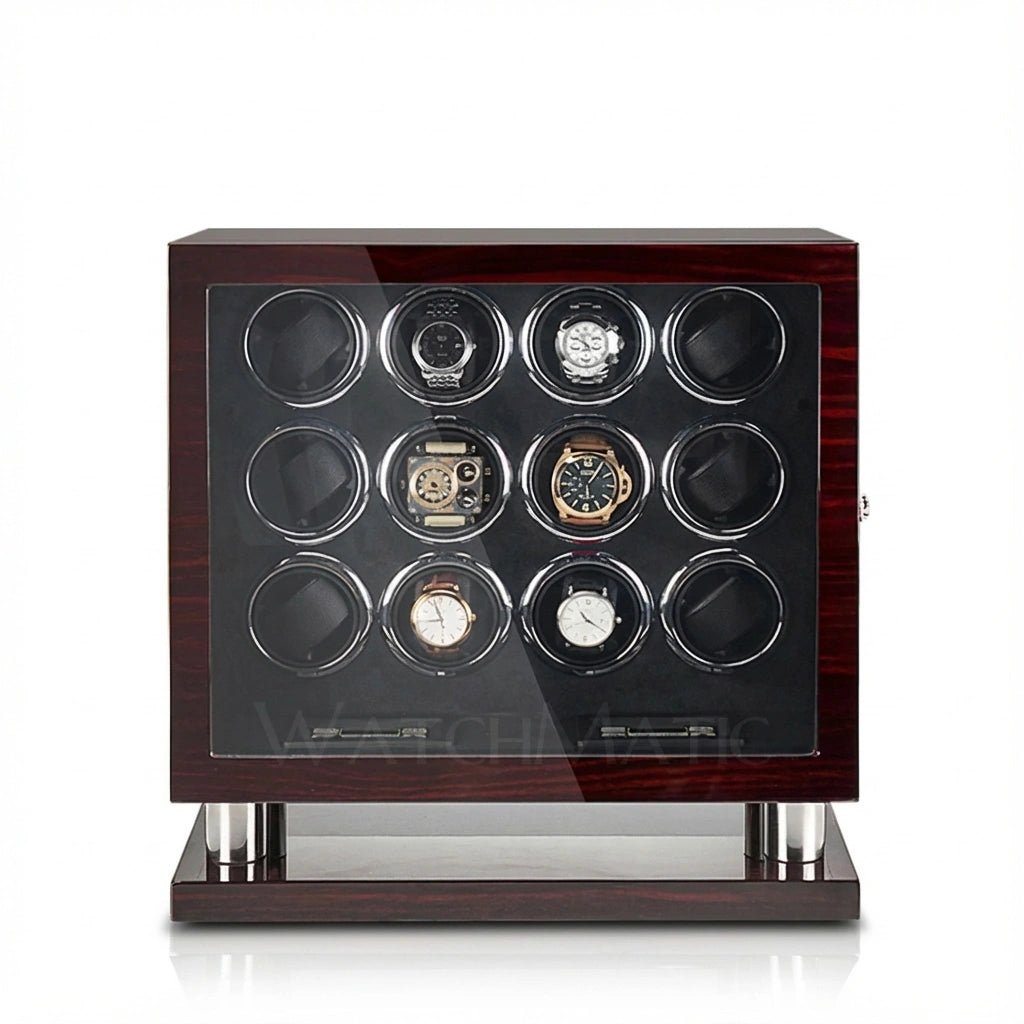
Other automatic-winding options can be explored in the WatchMatic Watch Winder Collection.
Watch Winder vs. Watch Safe for HYT Collectors
For HYT, the distinction is more straightforward than it is for many other luxury-watch brands.
|
Feature |
Conventional Watch Winder |
Stationary Watch Safe |
|---|---|---|
|
Winds current manual HYT calibers |
No |
No—manual winding still required |
|
Protects against unauthorized access |
Limited |
Yes, depending on construction |
|
Supports stationary long-term storage |
Not its primary purpose |
Yes |
|
Accommodates large HYT cases |
Model dependent |
Configurable |
|
Suitable for mixed automatic collection |
Yes |
With suitable powered modules |
|
Suitable for expensive manual HYT collection |
Limited benefit |
Stronger fit |
For collectors combining both winding and secure storage, the Watch Winder Safe Collection can be relevant.
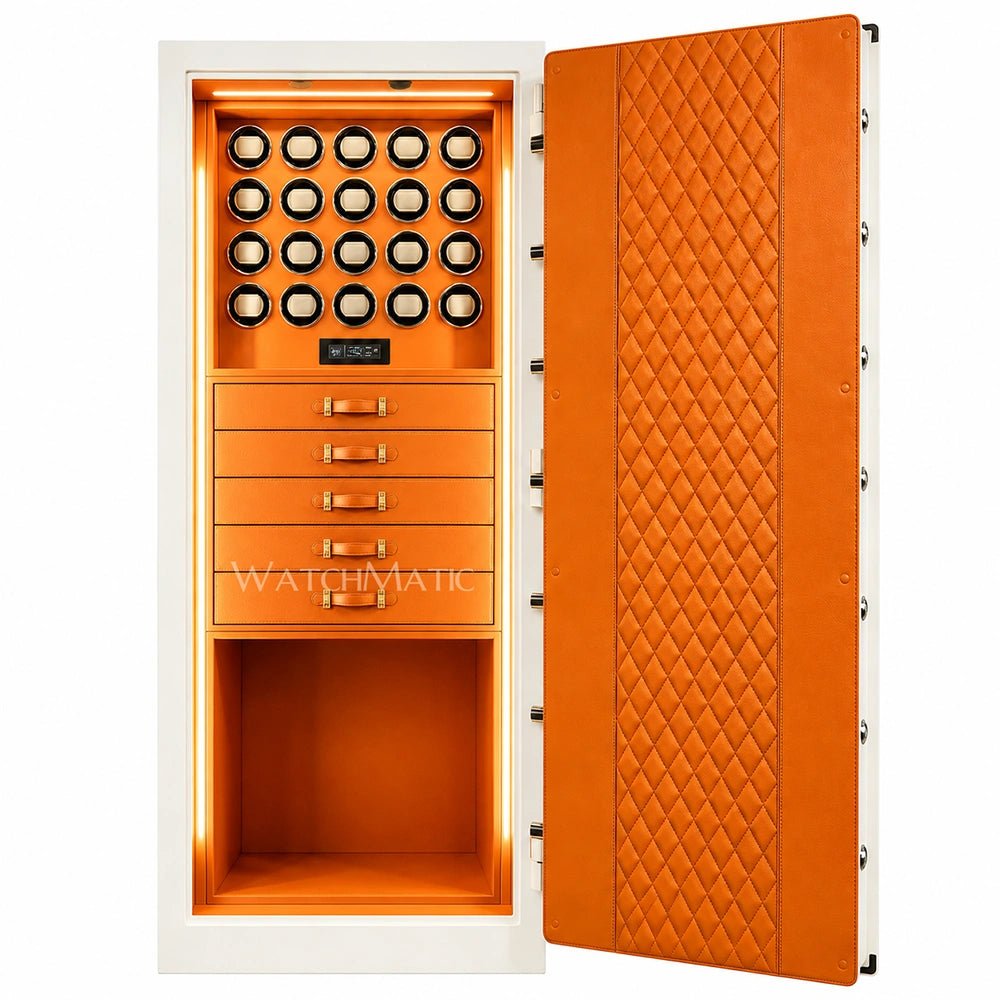
Titan Vault 20 for HYT Collectors

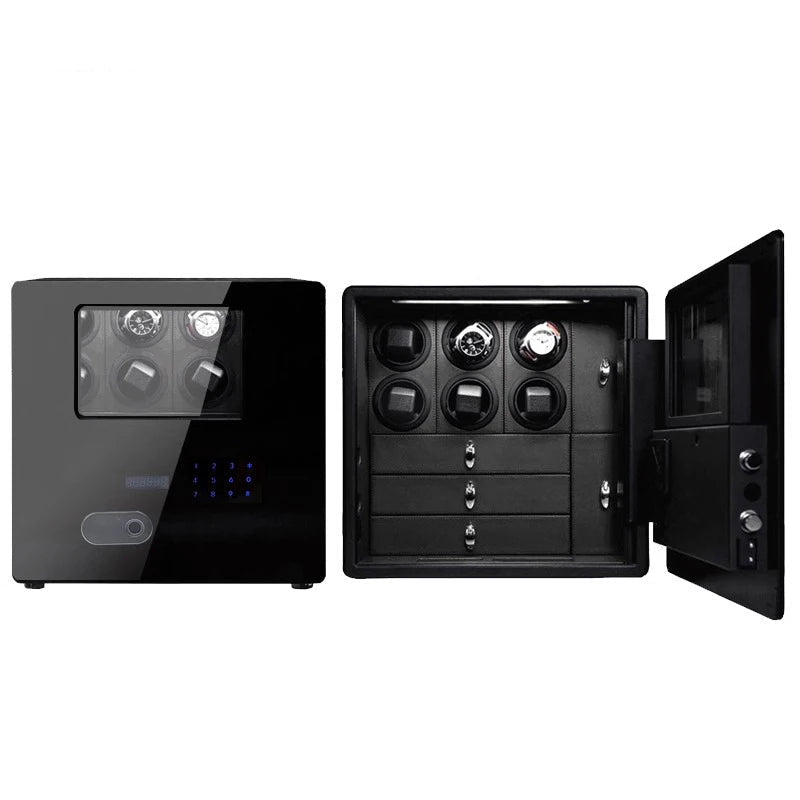
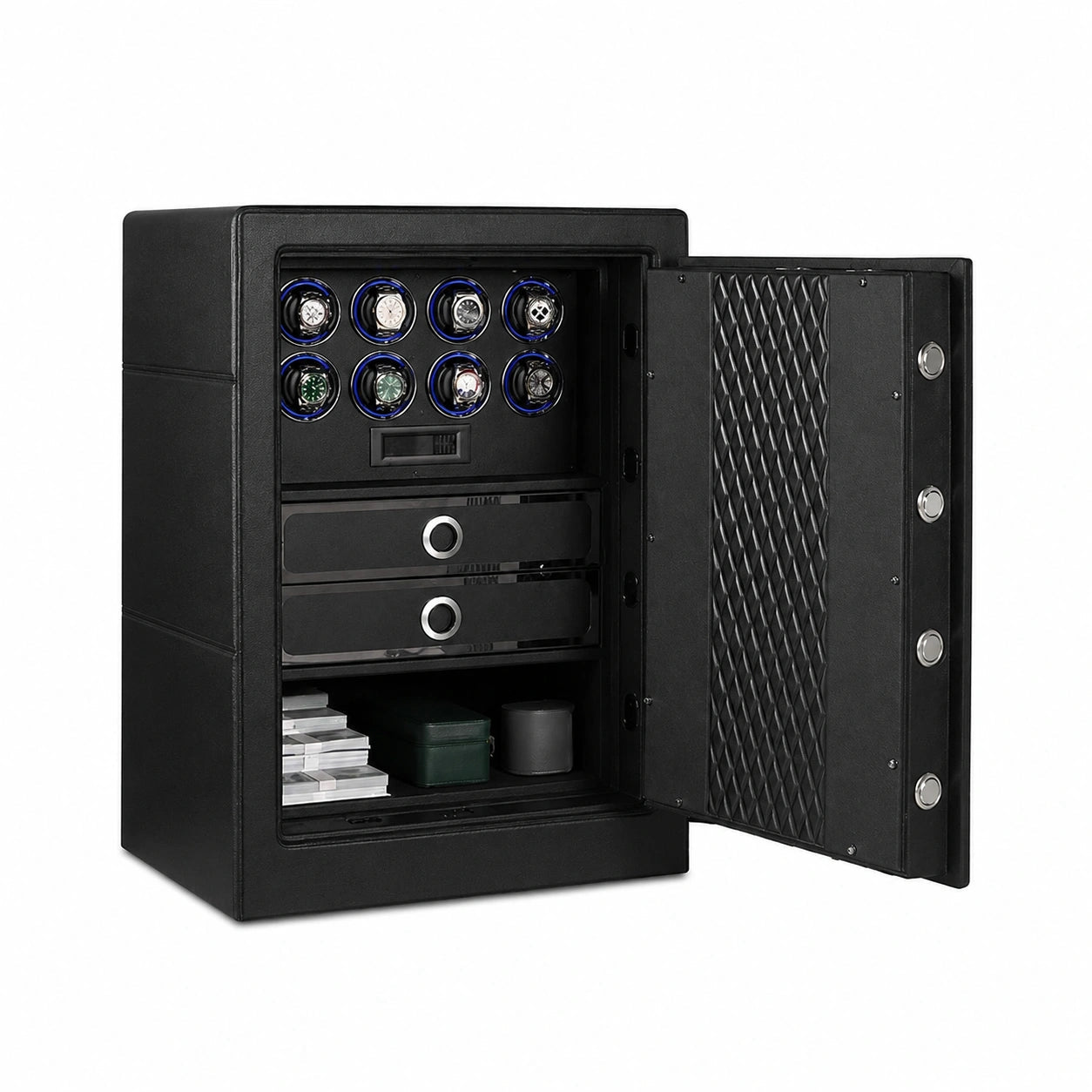
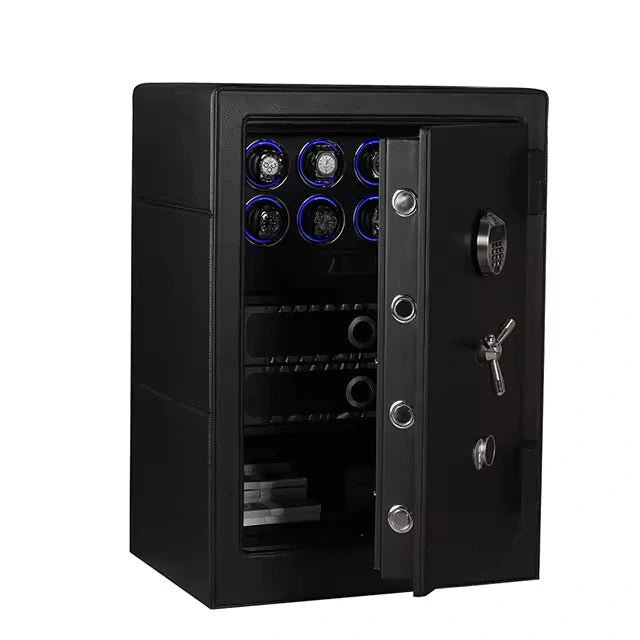
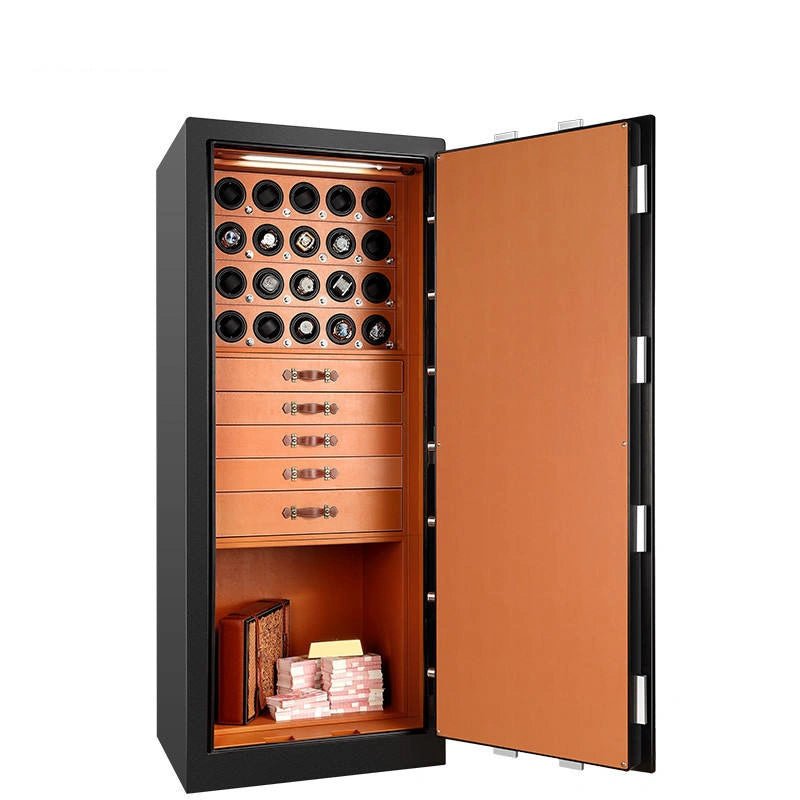
The Titan Vault 20 Watch Winder Safe combines secure watch storage architecture with 20 individually controlled winding positions.
Key available features include:
-
Monolithic solid-steel body
-
10-layer reinforced exterior shell
-
Biometric fingerprint access
-
Digital passcode
-
Manual key access
-
Floor anchoring
-
LCD touchscreen
-
Japanese Mabuchi winding motors
-
Independent winding controls
-
Programmable 650–2200 TPD
-
CW/CCW/bidirectional operation
-
Anti-magnetization protection
-
Adjustable interior lighting
-
10-year warranty
Enhanced fire and burglary certification configurations are available upon request and should not be assumed standard on every unit.
Why Titan Vault 20 May Be Relevant to HYT Collectors
The value of a large HYT collection can be substantial.
A collector might own:
-
S1
-
Moon Runner
-
Hastroid
-
Conical Tourbillon
-
Historical H2
-
Limited-edition HYT references
-
Automatic watches from other manufacturers
At that point, the primary requirement may be:
security and collection organization
rather than:
automatic winding for the HYT watches.
Important: HYT Watches Still Do Not Need Powered Positions
A Titan Vault 20 should not be presented as providing winding energy to manual HYT calibers.
If the collection is predominantly HYT, stationary compartments are the more useful component.
Custom Interior Planning Is Important
Before specifying an HYT storage configuration, confirm:
-
Number of manual HYT watches
-
Number of other automatic watches
-
Required stationary compartments
-
Case dimensions
-
Drawer height
-
Fluidic long-term storage procedures
-
Crown clearance
-
Availability of the desired custom interior arrangement
Conical Tourbillon Needs Special Attention
At approximately 25.15 mm thick, an HYT Conical Tourbillon should not automatically be assumed to fit a standard watch-winder rotor compartment.
The case and dome need to be checked against the actual interior dimensions.
Secure Stationary Storage May Be More Appropriate
For an HYT-only collection, a customizable stationary solution from the Luxury Watch Safe Collection may be more appropriate than maximizing powered winding positions.
High Value Does Not Mean Automatic Winding
This is one of the strongest lessons of HYT ownership.
A Conical Tourbillon can have a substantially higher price than many automatic luxury watches.
Yet:
701-TC → manual → no conventional winding benefit.
The watch's value affects security considerations.
It does not change the movement's winding architecture.
Conical Tourbillon: Security Matters More Than TPD
For a highly valuable Conical Tourbillon, the buyer should focus on:
-
Appropriate physical protection
-
Stable environmental conditions
-
Manufacturer-specified storage
-
Safe interior fit
-
Authorized service
Not:
-
650 vs. 1,000 TPD
-
Clockwise vs. counterclockwise winding
-
Continuous motor rotation
HYT in a Mixed Independent Haute Horlogerie Collection
HYT naturally appears alongside independent watchmakers known for experimental displays, unusual engineering and limited production.
A mixed collection might include:
HYT + URWERK + MB&F + HAUTLENCE + De Bethune + H. Moser & Cie.
Related WatchMatic guides include:
Best Watch Winder for URWERK Watches
Best Watch Winder for MB&F Watches
Best Watch Winder for HAUTLENCE Watches
Best Watch Winder for De Bethune Watches
Best Watch Winder for H. Moser & Cie. Watches
Each manufacturer requires movement-specific storage planning.
HYT vs. URWERK
Both brands are known for unconventional time indications.
But their current movement portfolios differ significantly.
URWERK has several self-winding watches with specialized rotor and turbine systems.
HYT's current documented collections are manually wound.
Therefore:
unconventional display ≠ shared winding technology.
HYT vs. MB&F
MB&F combines:
-
Automatic Machines
-
Manual Machines
-
Special winding systems
HYT's current collections are comparatively consistent in their manual-winding architecture.
A collector should not apply an MB&F automatic-winding program to an HYT solely because both brands produce avant-garde mechanical watches.
HYT vs. HAUTLENCE
Current HAUTLENCE includes:
-
B30 automatics
-
B60 automatics
-
D-series automatics
-
Manual A-series watches
HYT's current 501-CM, 601-MO and 701-TC are manual.
The visually unconventional appearance of both brands does not imply equivalent winding systems.
HYT vs. De Bethune
Both manufacturers offer significant manually wound haute horlogerie.
But HYT adds a distinctive fluidic mechanism that introduces model-specific storage and time-setting requirements.
This makes storage planning more specialized than merely choosing a cushion.
HYT vs. H. Moser & Cie.
H. Moser currently offers a broad range of automatic and manual calibers.
An H. Moser Streamliner automatic can benefit from a programmed winder.
An HYT S1 manual cannot.
How to Choose the Best Storage Solution for Your HYT
Step 1: Identify the Exact Collection
Determine whether the watch is:
-
S1
-
T1
-
Hastroid
-
Moon Runner
-
Conical Tourbillon
-
Historical H1/H2/H3/H4/H0/H5
-
Another limited edition
Step 2: Identify the Exact Movement
Important current calibers include:
-
501-CM
-
601-MO
-
701-TC
Step 3: Confirm Winding Type
Current documented examples:
501-CM → manual
601-MO → manual
701-TC → manual / dedicated tool
Step 4: Check Power Reserve
Representative values:
40 hours → 701-TC
72 hours → 501-CM / 601-MO
Step 5: Determine Whether Conventional TPD Is Relevant
For these movements:
No.
Step 6: Identify the Correct Manual Winding Procedure
For standard manually wound references, follow the crown-winding instructions.
For Conical Tourbillon, follow the specific winding-tool or crown procedure described by HYT.
Step 7: Review Fluidic Storage Instructions
If storing the watch for a prolonged period, check whether HYT specifies a particular fluid position.
Step 8: Measure the Complete Watch
Include:
-
Width
-
Length
-
Thickness
-
Sapphire dome
-
Crown clearance
-
Strap geometry
Step 9: Choose Secure Stationary Storage
Prioritize:
-
Suitable compartments
-
Soft surfaces
-
Appropriate environmental conditions
-
Access control
Step 10: Add Powered Positions Only for Other Automatics
If the owner also collects automatic watches, independently programmable winding positions can be useful for those watches.
For broader watch-winding, secure-storage and watch-protection resources, visit the WatchMatic Guide Hub.
Best Watch Winder for HYT Watches: Final Thoughts
The answer to “What is the best watch winder for HYT watches?” is fundamentally different from the answer for most automatic luxury-watch brands.
A conventional watch winder is not needed to wind the current HYT collections.
The S1, T1 and Hastroid use the manually wound 501-CM, with approximately 72 hours of power reserve.
The Moon Runner uses the manually wound 601-MO, also providing approximately 72 hours while supporting calendar and three-dimensional moon-phase indications.
The Conical Tourbillon uses the manually wound 701-TC, with approximately 40 hours and a dedicated winding-tool procedure.
These movements do not receive useful mainspring energy from conventional external rotational winding.
This creates three particularly important HYT lessons.
First:
Fluidic movement is not automatic winding.
The moving liquid is powered by the mechanical movement through the bellows.
It does not replenish mainspring energy.
Second:
Fluidic rewind is not mainspring rewinding.
The automatic return of colored liquid at the end of the 12-hour cycle describes the retrograde display, not automatic winding.
Third:
The Conical Tourbillon's dedicated winding tool is not a conventional watch winder.
The terminology is similar, but the mechanisms are completely different.
For HYT collectors, the priority should therefore be:
-
Correct manual winding
-
Correct fluidic handling
-
Reference-specific long-term storage procedures
-
Adequate case and sapphire clearance
-
Secure stationary storage
-
Appropriate environmental conditions
-
Authorized professional service
A conventional watch winder remains useful only for compatible automatic watches elsewhere in the collection.
The correct framework is:
HYT Reference → Caliber → Manual Winding Method → Power Reserve → Fluidic Care → Physical Dimensions → Secure Stationary Storage
For broader winding and collection-protection solutions, explore WatchMatic.