The best watch winder for MB&F watches depends first on the exact Machine and movement.
MB&F produces some highly unconventional automatic watches, but a large proportion of its current and important Horological Machines, Legacy Machines and Special Projects are manually wound.
Important automatic examples include:
- Horological Machine N°12 — in-house automatic double-rotor movement
- Horological Machine N°8 Mark 2 — automatic Girard-Perregaux-based movement
- Legacy Machine FlyingT — in-house automatic flying-tourbillon movement
Important manually wound examples include:
- Horological Machine N°11 — manual winding through rotation of the case
- Horological Machine N°10 Bulldog — manual
- Horological Machine N°9 — manual
- Legacy Machine Perpetual — manual
- Legacy Machine Perpetual EVO — manual
- Legacy Machine Sequential EVO — manual
- Legacy Machine Sequential Flyback — manual
- Legacy Machine Sequential Flyback EVO — manual
- Legacy Machine 101 EVO — manual
- Legacy Machine Split Escapement EVO — manual
- Legacy Machine X — manual
- Legacy Machine N°2 — manual
- Legacy Machine Thunderdome — manual
- Special Project One — manual
- Bvlgari x MB&F Serpenti — manual
Therefore:
Automatic MB&F → a properly configured conventional watch winder can be useful
Manual MB&F → conventional rotational winding provides no useful winding energy
The correct decision framework is:
Exact MB&F Machine → Movement → Automatic or Manual → Power Reserve → Winding Architecture → Case Geometry → TPD/Direction or Stationary Storage
Does an MB&F Watch Need a Watch Winder?
No automatic MB&F mechanically requires a watch winder.
An automatic mechanical movement uses one or more oscillating masses to convert movement into energy stored in the mainspring.
If the watch remains unworn beyond its available power reserve, it eventually stops.
That is normal.
A watch winder is primarily useful for:
- Keeping an automatic MB&F running between wears
- Reducing repeated restarting
- Maintaining time indications
- Keeping an automatic tourbillon ready
- Managing several self-winding Machines
- Maintaining a larger mixed independent-watch collection
It should not be regarded as a substitute for professional servicing or as a mechanism that automatically improves movement longevity by keeping the watch continuously running.
For the fundamentals, see the Watch Winder Guide.
Which MB&F Watches Can Use a Watch Winder?
Representative current and significant MB&F Machines include:
| MB&F Machine | Winding type | Approx. power reserve | Conventional winder? |
|---|---|---|---|
| HM12 | Automatic, double rotor | 84 h | Yes |
| HM8 Mark 2 | Automatic | 42 h | Yes |
| LM FlyingT | Automatic | 100 h | Yes |
| HM11 | Manual, case-rotation winding | 96 h | No |
| HM10 Bulldog | Manual | 45 h | No |
| HM9 | Manual | 45 h | No |
| LM Perpetual | Manual | 72 h | No |
| LM Perpetual EVO | Manual | 72 h | No |
| LM Sequential EVO | Manual | 72 h | No |
| LM Sequential Flyback | Manual | 72 h | No |
| LM Sequential Flyback EVO | Manual | 72 h | No |
| LM101 EVO | Manual | 60 h | No |
| LM Split Escapement EVO | Manual | 72 h | No |
| LMX | Manual | 168 h | No |
| LM2 | Manual | 45 h | No |
| LM Thunderdome | Manual | 45 h | No |
| SP One | Manual | 72 h | No |
| Bvlgari x MB&F Serpenti | Manual | 45 h | No |
This immediately reveals the central MB&F lesson:
extreme mechanical complexity does not predict automatic winding.
MB&F Is Not an “Automatic Watch Brand”
Many conventional luxury-watch manufacturers build most of their collections around automatic calibers.
MB&F does not.
Its current universe includes:
- Automatic double-rotor movements
- Automatic tourbillons
- Girard-Perregaux-based automatic architecture
- Conventional manual winding
- Three-barrel manual movements
- Dual-chronograph manual movements
- Triple-axis manual regulators
- A Machine wound by physically rotating its case
That makes exact reference identification essential.
This Guide Covers MB&F Machines, Not M.A.D.Editions
MB&F also operates the parallel M.A.D.Editions label.
Those watches should not automatically inherit the winding recommendations in this guide.
When researching:
“MB&F watch winder settings”
identify whether the watch is actually:
- An MB&F Horological Machine
- A Legacy Machine
- A Special Project
- A Performance Art collaboration
- Or a M.A.D.Editions watch
before selecting a winding program.
HM12: The Most Important New Automatic MB&F
The Horological Machine N°12 uses an in-house automatic movement with:
- Double winding rotor
- Approximately 84 hours of power reserve
- Flying tourbillon
- Jumping hours
- Trailing minutes
- 646 movement components
- 86 jewels
It is unequivocally self-winding.
Can HM12 Use a Watch Winder?
Yes.
Because HM12 contains an automatic winding system, conventional rotational motion can contribute to winding.
However, its unusual architecture means the winder must satisfy two separate requirements:
movement compatibility
and:
physical compatibility.
Double Rotor Does Not Mean Double TPD
HM12 provides one of the most useful MB&F-specific watch-winder lessons.
It uses:
two winding rotors.
That does not mean an owner should:
- Double the TPD
- Use maximum rotation
- Run the watch continuously
Rotor count does not translate directly into Turns Per Day.
The automatic system has been engineered as a complete mechanism.
Use movement-specific requirements.
Two Rotors Are Part of One Winding Architecture
Think of the two rotors as components of the complete winding system.
They do not represent two independent watches requiring separate daily-turn allocations.
Therefore:
double rotor ≠ 2 × conventional TPD.
HM12 Power Reserve
The HM12 provides approximately:
84 hours of reserve.
That is three and a half days.
A collector wearing it every two or three days may have little need for a winder.
A collector rotating many Machines may find continuous readiness more convenient.
HM12 Physical Dimensions
HM12 measures approximately:
- 49.3 mm long
- 43.6 mm wide
- 13.8 mm high
It also uses an unconventional case and lug architecture.
This means physical clearance should be verified before placing it in any standard rotating chamber.
Mobile Lugs Need Appropriate Support
HM12 includes mobile upper lugs.
A rigid watch cushion should not force the case or strap into an unnatural geometry.
Look for:
- Flexible support
- Natural strap curvature
- Stable watch-head positioning
- Sufficient chamber clearance
Guardian Mounting Does Not Change Winder Requirements
HM12 can also interact with its Guardian robot.
That is part of the concept and presentation architecture.
It does not change the automatic movement's winding requirement.
HM12 Tourbillon Does Not Require Higher TPD
The flying tourbillon is part of the regulating system.
The winding rotors replenish mainspring energy.
These are separate mechanisms.
Therefore:
tourbillon ≠ higher daily turns.
Best Watch Winder for HM8 Mark 2
The HM8 Mark 2 uses:
- Automatic winding
- Girard-Perregaux base movement
- 22K gold automatic rotor
- Approximately 42 hours of power reserve
- Jumping-hour display
- Trailing minutes
Among current MB&F Machines, this is one of the more straightforward candidates for a watch winder.
42 Hours Makes HM8 Mark 2 More Winder-Dependent
Compare HM8 Mark 2 with longer-reserve MB&F automatics.
HM8 Mark 2
42 hours
HM12
84 hours
LM FlyingT
100 hours
The HM8 Mark 2 will generally stop sooner during a multi-watch rotation.
That increases the convenience value of a winder.
Shorter Reserve Does Not Automatically Mean Higher TPD
A shorter power reserve tells you:
how long the movement runs
not:
how many turns the winder must deliver.
Therefore:
42-hour HM8 ≠ automatically higher TPD than 100-hour FlyingT.
HM8 Mark 2 Has Unusual Case Geometry
Representative dimensions are approximately:
47 × 41.5 × 19 mm.
This is not a conventional round watch.
Its automotive-inspired bodywork and sapphire architecture make chamber clearance important.
Vertical Time Display Does Not Affect Winding
HM8 Mark 2 uses sapphire prisms to project a horizontally mounted display into a vertical viewing plane.
This optical architecture does not determine:
- TPD
- rotor direction
- daily rotation
Girard-Perregaux Base Does Not Mean Generic GP Setting
The HM8 movement uses a Girard-Perregaux base.
But it also incorporates an MB&F-developed three-dimensional module.
Use the exact HM8 specification rather than assuming every Girard-Perregaux-based watch should use one generic program.
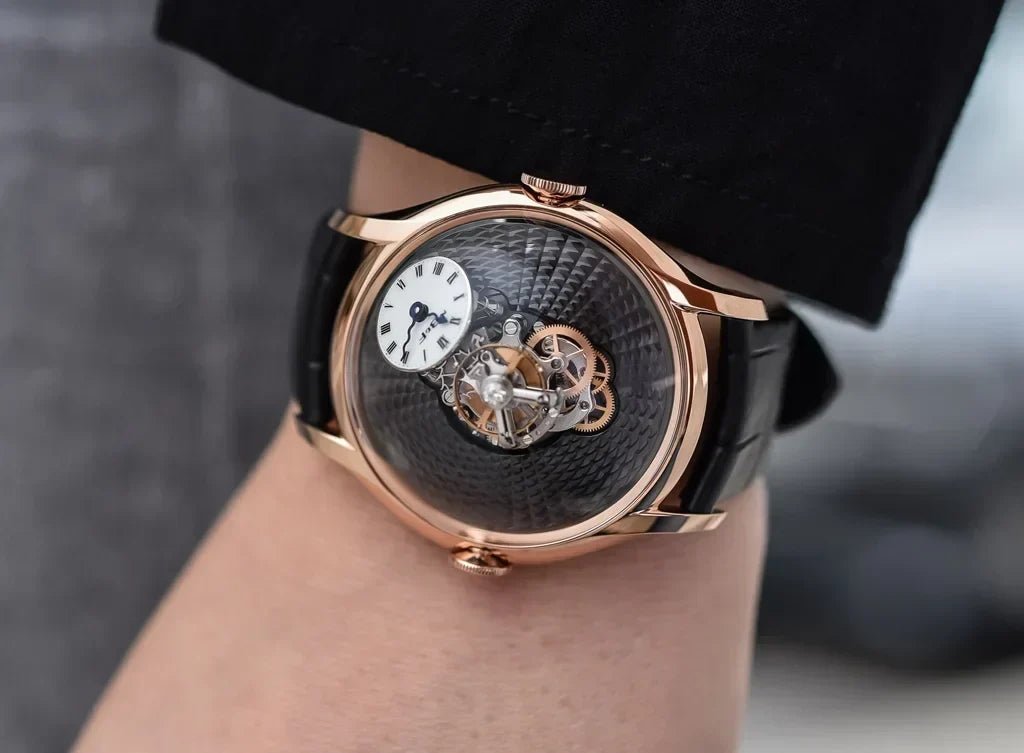
Legacy Machine FlyingT
The Legacy Machine FlyingT is one of the most important automatic MB&F references.
Its in-house movement provides:
- Automatic winding
- Central flying 60-second tourbillon
- Sun-shaped winding rotor
- Approximately 100 hours of power reserve
- 2.5 Hz frequency
Can LM FlyingT Use a Watch Winder?
Yes.
FlyingT is automatic.
That may surprise collectors because many high-end Legacy Machines are hand-wound.
The FlyingT is an important exception.
FlyingT Is a Tourbillon and Automatic
This gives MB&F a very useful contrast.
A tourbillon does not tell you whether a watch is:
- Automatic
- Manual
FlyingT uses an automatic rotor.
Other extremely complicated MB&F Machines use manual winding.
100 Hours Makes FlyingT Relatively Winder-Independent
FlyingT can run for approximately:
100 hours
or more than four days.
A frequent wearer may therefore have limited practical need for a watch winder.
The winder becomes more useful when the watch is part of a large rotation.
High Jewellery Does Not Change TPD
FlyingT editions may incorporate:
- Diamonds
- Precious stones
- Precious-metal cases
- Gem-set dial plates
These significantly affect:
- Value
- weight
- security requirements
- handling care
They do not directly determine:
- Winding direction
- TPD
- rotor efficiency
FlyingT Case Height Matters
FlyingT is approximately:
38.5 mm in diameter
but around:
20 mm high.
The diameter is compact.
The domed sapphire architecture is not.
Therefore:
height may matter more than diameter
when checking winder chamber clearance.
A Diamond-Topped Tourbillon Does Not Need More Rotation
Decorative or high-jewellery treatment does not increase automatic winding requirements.
Use the movement specification, not the retail value or gem count.
Automatic MB&F Comparison
| Machine | Automatic architecture | Approx. reserve |
|---|---|---|
| HM8 Mark 2 | Central automatic rotor | 42 h |
| HM12 | Double winding rotor | 84 h |
| LM FlyingT | Automatic sun-shaped rotor | 100 h |
This range alone shows why there should not be one:
“MB&F = X TPD”
setting.
Rotor Architecture Can Be Radically Different
Within just three automatic MB&F watches, the owner encounters:
- Conventional automatic architecture
- Double rotor
- Three-dimensional automatic tourbillon architecture
Independent programming is therefore preferable to one fixed-output system.
HM11: The Most Important Manual-Winding Exception
The HM11 Architect / Art Deco is one of the most unusual winding systems in modern horology.
Its movement is:
manual winding
with approximately:
96 hours / four days of power reserve.
But instead of winding through a conventional crown, the user winds the movement by:
rotating the entire case clockwise relative to its base architecture.
Does HM11 Need a Watch Winder?
No conventional automatic watch winder should be used to wind HM11.
This distinction is crucial.
HM11 is not automatic.
Why Rotating HM11 Is Different From a Watch Winder
HM11 winds when its case is deliberately rotated relative to the watch's fixed foundation.
A conventional watch winder rotates:
the entire watch + strap + cushion together.
It does not normally rotate HM11's winding case relative to its internal mounting structure.
Therefore:
watch-winder rotation ≠ HM11 case-winding action.
“The Watch Winds When Rotated” Is Not Enough
HM11 demonstrates why describing a movement simply as:
“wound by rotation”
can be misleading.
There are two fundamentally different mechanisms:
Automatic Watch
An internal rotor moves relative to the movement.
HM11
The case is intentionally rotated relative to the movement architecture.
A conventional winder is designed for the first system.
Ten Case Rotations Can Fully Wind HM11
The HM11 winding architecture is highly efficient.
A relatively small number of deliberate case rotations can replenish its long reserve.
This further reduces any reason to attempt to adapt an automatic winder to the watch.
HM11 Tourbillon Does Not Make It Automatic
HM11 contains a central flying tourbillon.
It remains manual.
Compare:
HM12
Flying tourbillon
Automatic
HM11
Flying tourbillon
Manual
Tourbillon is therefore not a winding classification.
HM11 Physical Size Also Favors Stationary Storage
HM11 measures approximately:
42 mm in diameter
and:
23 mm high.
Its highly three-dimensional structure makes it an unusual candidate for conventional rotating chambers even before considering the manual winding system.
Best Storage for HM11
Prioritize:
- Secure stationary support
- Adequate vertical clearance
- Natural strap positioning
- Easy access for case winding
- Soft contact surfaces
HM10 Bulldog
The HM10 Bulldog uses an in-house:
manual-winding movement
with approximately:
45 hours of power reserve.
Its movement has:
- Flying balance wheel
- Rotating hour and minute domes
- Jaw-style power reserve indicator
It has no automatic winding rotor.
Does HM10 Bulldog Need a Watch Winder?
No.
Rotating the entire watch does not replenish its mainspring.
It should be manually wound.
Rotating Display Domes Do Not Mean Automatic Winding
HM10 contains multiple moving visual elements.
That does not mean external rotational motion winds the watch.
Display motion and winding architecture are separate systems.
HM10 Physical Dimensions Are Extreme
Representative dimensions are approximately:
54 × 45 × 24 mm.
This makes HM10 a strong candidate for generous stationary storage rather than a standard compact winder chamber.
HM9 Flow
The HM9 uses an in-house:
manual-winding movement
with approximately:
45 hours of reserve.
Its architecture includes:
- Two independent balance wheels
- Planetary differential
- Three-dimensional case
- Multiple sapphire crystals
Does HM9 Need a Watch Winder?
No.
The movement contains no automatic winding rotor.
Two Balance Wheels Do Not Mean Two Rotors
HM9 contains:
two regulating organs.
That does not mean it has:
- Two automatic rotors
- Two winding systems
- Double TPD
Balance wheels regulate timekeeping.
Rotors wind automatic movements.
Aerodynamic Design Does Not Affect Winding
HM9's aviation or automotive styling has no relationship with TPD.
Mechanical theme and winding architecture should be treated separately.
HM8 vs. HM9 vs. HM10
This is one of the strongest Horological Machine comparisons.
| Model | Winding | Approx. reserve | Winder? |
|---|---|---|---|
| HM8 Mark 2 | Automatic | 42 h | Yes |
| HM9 | Manual | 45 h | No |
| HM10 | Manual | 45 h | No |
All three are visually unconventional MB&F Horological Machines.
Only one uses conventional automatic winding.
Similar Reserve Does Not Mean Similar Storage
HM8 runs roughly 42 hours.
HM9 and HM10 run roughly 45 hours.
Those figures are close.
But:
HM8 → automatic
HM9 / HM10 → manual.
Power reserve cannot determine winder compatibility.
Legacy Machine Perpetual
The LM Perpetual uses a fully integrated perpetual-calendar movement developed with Stephen McDonnell.
It has:
- Manual winding
- Two mainspring barrels
- Approximately 72 hours of reserve
- 581 components
- Mechanical processor
- Day/date/month/leap-year indications
Does LM Perpetual Need a Watch Winder?
No.
Despite being one of the watches where continuous operation would be very convenient, conventional rotation cannot wind it.
Perpetual Calendar Convenience Is High
If an LM Perpetual stops, multiple calendar indications eventually need to be restored.
Therefore, the owner may strongly prefer that it remain running.
But:
desire to keep running ≠ automatic-winder compatibility.
LM Perpetual EVO Is Also Manual
The sportier EVO architecture adds features such as:
- Improved water resistance
- Integrated strap
- FlexRing shock protection
It does not convert the movement to automatic winding.
LM Perpetual EVO remains manually wound.
EVO Does Not Mean Automatic
This deserves emphasis.
The term:
EVO
describes a more active, robust case architecture.
It does not mean:
self-winding.
FlexRing Does Not Affect TPD
The FlexRing shock-absorbing system is part of the case/movement support architecture.
It does not create or modify an automatic rotor.
LM Sequential EVO and Sequential Flyback
The Legacy Machine Sequential family uses a manual-winding dual-chronograph movement.
Representative characteristics include:
- Two independent chronographs
- Twinverter system
- Manual winding
- Double mainspring
- Approximately 72 hours of reserve
The Flyback versions add additional timing functionality.
Does LM Sequential Need a Watch Winder?
No.
Neither the original Sequential architecture nor the current flyback variants become automatic simply because of their complexity.
Dual Chronograph Does Not Mean Automatic
The movement can independently time multiple events.
It still receives mainspring energy manually.
Flyback Does Not Determine Winding Type
A flyback chronograph can be:
- Automatic
- Manual
MB&F's Sequential Flyback is manual.
Therefore:
flyback ≠ automatic.
619 Components Still Do Not Create a Rotor
The Sequential Flyback movement contains hundreds of components.
Component count has no relationship with whether a conventional winder can supply energy.
LM101 EVO
The LM101 EVO uses an in-house:
manual-winding movement
with approximately:
60 hours of power reserve.
Its architecture includes:
- Large flying balance
- Power-reserve indication
- Double hairspring
- EVO case features
Does LM101 EVO Need a Watch Winder?
No.
It is manually wound.
Double Hairspring Does Not Mean Automatic
Two hairsprings improve regulation.
They do not provide winding energy.
60 Hours Already Provides Moderate Autonomy
The watch can remain running for more than two days between full windings.
A stationary presentation and security solution is therefore more appropriate than a powered rotor.
LM Split Escapement EVO
The LM Split Escapement EVO uses:
- Manual winding
- Double mainspring barrels
- Approximately 72 hours of power reserve
- Split escapement
- FlexRing shock protection
Does Split Escapement Need a Watch Winder?
No.
The movement is manually wound.
Escapement Location Does Not Affect Winder Compatibility
The anchor and escape wheel are positioned on the opposite side of the movement from the prominent balance wheel.
This unusual geometry does not create automatic winding.
SP One
The current Special Project One uses an in-house:
manual-winding movement
with approximately:
72 hours of power reserve.
Its architecture includes:
- Signature balance wheel
- Inclined time dial
- Three-dimensional movement presentation
Does SP One Need a Watch Winder?
No.
The movement uses a manual mainspring barrel.
Compact 38 mm Case Does Not Mean Automatic
SP One is relatively compact compared with many MB&F Machines.
Case size does not determine winding type.
Special Project Does Not Mean Experimental Automatic Winding
The Special Project designation describes MB&F's creative program.
It does not imply any particular energy architecture.
Legacy Machine X
The LMX uses:
- Manual winding
- Three mainspring barrels
- Approximately 168 hours / seven days of reserve
- Two independently adjustable time zones
- Rotating three-dimensional power-reserve indicator
Does LMX Need a Watch Winder?
No.
It is manually wound.
Seven-Day Reserve Further Reduces Winding Intervention
A fully wound LMX can run for approximately a week.
That makes automatic rotational storage unnecessary even from a convenience perspective.
Three Barrels Do Not Mean Triple TPD
LMX contains:
three mainspring barrels.
But it is manual.
This demonstrates the weakness of simple numerical assumptions.
There is no equation such as:
three barrels = three times the winding.
LMX Dual Time Still Does Not Create Winder Compatibility
The watch contains two independently adjustable time displays.
Keeping them running would be convenient.
Conventional rotation still cannot wind the movement.
Legacy Machine N°2
The LM2 uses:
- Manual winding
- Two independent balance wheels
- Planetary differential
- Approximately 45 hours of reserve
Two Regulators Do Not Mean Automatic
The two balance systems regulate the rate.
They do not supply energy.
A conventional watch winder offers no winding benefit.
LM Thunderdome
The LM Thunderdome uses:
- Manual winding
- Three mainspring barrels
- Triple-axis regulating mechanism
- Approximately 45 hours of power reserve
It contains one of the most visually kinetic mechanisms MB&F has ever produced.
It is still manually wound.
Triple-Axis Rotation Does Not Mean Watch-Winder Rotation
The regulating mechanism rotates internally at multiple speeds.
A conventional watch winder rotates the entire watch externally.
These motions serve completely different purposes.
The Most Kinetic MB&F Can Still Be Manual
This is an important lesson.
A watch can contain:
- Multiple rotating cages
- Balance wheels
- different axes
- huge visible motion
while receiving zero useful winding energy from an external rotating box.
Bvlgari x MB&F Serpenti
The Bvlgari x MB&F Serpenti uses an MB&F in-house:
manual-winding movement
with approximately:
45 hours of power reserve.
It features:
- Rotating hour dome
- Rotating minute dome
- Large flying balance
- Separate winding and time-setting crowns
Does Bvlgari x MB&F Serpenti Need a Watch Winder?
No.
Its moving domes are display mechanisms.
The watch itself must be wound manually.
Rotating Eyes Do Not Equal Automatic Rotor
This is another useful example of the distinction between:
visible rotation
and:
automatic winding.
MB&F Power Reserve Comparison
| Machine | Winding | Approx. reserve |
|---|---|---|
| HM8 Mark 2 | Automatic | 42 h |
| HM9 | Manual | 45 h |
| HM10 | Manual | 45 h |
| LM2 | Manual | 45 h |
| LM Thunderdome | Manual | 45 h |
| Bvlgari x MB&F Serpenti | Manual | 45 h |
| LM101 EVO | Manual | 60 h |
| LM Perpetual | Manual | 72 h |
| LM Sequential Flyback | Manual | 72 h |
| LM Split Escapement EVO | Manual | 72 h |
| SP One | Manual | 72 h |
| HM12 | Automatic | 84 h |
| HM11 | Manual case-winding | 96 h |
| LM FlyingT | Automatic | 100 h |
| LMX | Manual | 168 h |
This table makes one point extremely clear:
power reserve does not identify winding architecture.
45 Hours Can Mean Automatic or Manual
Compare:
HM8 Mark 2 → approximately 42 h → automatic
with:
HM9 / HM10 / LM2 / Thunderdome → approximately 45 h → manual.
The reserves are similar.
The storage requirements are not.
Long Reserve Can Also Be Automatic or Manual
Compare:
LM FlyingT → 100 h → automatic
with:
HM11 → 96 h → manual
and:
LMX → 168 h → manual.
Again, reserve length does not tell you whether a conventional winder works.
MB&F Watch Winder TPD Settings
TPD means Turns Per Day—the approximate number of rotations performed by a watch winder during a daily program.
There should not be one universal recommendation such as:
“MB&F = 650 TPD.”
The automatic MB&F portfolio itself contains several very different architectures:
- HM8 Mark 2 automatic GP-based movement
- HM12 in-house double-rotor automatic movement
- LM FlyingT in-house automatic tourbillon movement
The correct process is:
- Identify the exact MB&F Machine.
- Identify the exact movement.
- Confirm automatic winding.
- Verify the movement's winding requirements.
- Select suitable TPD.
- Select suitable direction.
- Confirm that reserve remains adequately maintained.
For more detail, see the Watch TPD Guide.
Do Not Assign TPD to Manual MB&F Movements
TPD is irrelevant for conventional winding of:
- HM9
- HM10
- HM11
- LM Perpetual
- LM Sequential
- LM101
- LM Split Escapement
- LMX
- LM2
- Thunderdome
- SP One
- Bvlgari x MB&F Serpenti
These movements do not use conventional automatic rotors.
HM11 Is Still Not a TPD Watch
HM11 deserves special emphasis.
Its case rotates as part of the manual winding process.
That does not convert it into a Turns-Per-Day automatic watch.
The motion must occur through the watch's dedicated case-winding architecture.
What Rotation Direction Should You Use?
A high-quality programmable winder should support:
CW — Clockwise
CCW — Counterclockwise
Bi — Bidirectional
Do not assign one universal direction to every MB&F automatic.
The movement architectures are too different.
HM12's Double Rotor Does Not Define Direction by Itself
Knowing that HM12 has:
two rotors
does not by itself tell you:
- Optimal TPD
- Preferred external rotation direction
- Cycle duration
Those should come from movement-specific winding information.
LM FlyingT's Sun Rotor Does Not Define a Generic MB&F Setting
The sculptural rotor is part of FlyingT's movement architecture.
Its settings should not automatically be transferred to HM8 or HM12.
High TPD Is Not Automatically Better
An MB&F may contain:
- Hundreds of components
- Tourbillons
- chronographs
- multiple regulators
- multiple barrels
That does not mean the highest TPD is appropriate.
Higher TPD does not automatically:
- Improve accuracy
- Improve lubrication
- Maintain a tourbillon
- Service a chronograph
- Extend service intervals
- Increase power reserve capacity
- Protect a complication
Use:
appropriate maintenance winding
rather than:
maximum rotation.
Does an Automatic MB&F Need to Run Continuously?
No.
An automatic MB&F can stop normally after its reserve is exhausted.
Winder usefulness depends on:
power reserve + frequency of wear + collection size + convenience.
Which MB&F Watches Gain the Most Convenience From a Winder?
Stronger Convenience Case
- HM8 Mark 2 due to its shorter 42-hour reserve
- Automatic MB&F watches rotated within a large collection
Moderate Convenience Case
- HM12 with 84 hours
- LM FlyingT with 100 hours
No Conventional Winding Benefit
- HM11
- HM10
- HM9
- LM Perpetual
- LM Sequential
- LM101
- LM Split Escapement
- LMX
- LM2
- Thunderdome
- SP One
- Bvlgari x MB&F Serpenti
Complication Complexity and Winder Compatibility Are Independent
Consider:
HM12
Flying tourbillon
Jumping hours
Automatic
HM11
Flying tourbillon
Temperature display
Manual
LM FlyingT
Flying tourbillon
Automatic
LM Perpetual
Perpetual calendar
Manual
LM Sequential Flyback
Dual flyback chronograph
Manual
There is no simple complication hierarchy that predicts whether a winder is useful.
Should You Restart a Stopped Automatic MB&F Before Using a Winder?
A conventional watch winder is usually best treated as a:
maintenance-winding device.
For a stopped automatic MB&F:
restart according to the Machine's instructions → establish initial reserve → set the indications → place on correctly programmed winder → maintain
rather than:
stopped watch → maximum TPD.
MB&F Case Architecture Is Unusually Important
For many mainstream watches, movement programming is the main concern.
With MB&F, physical geometry can be equally important.
Representative dimensions include:
- HM8 Mark 2 — 47 × 41.5 × 19 mm
- HM12 — 49.3 × 43.6 × 13.8 mm
- HM11 — 42 × 23 mm
- HM10 — 54 × 45 × 24 mm
- HM9 — 57 × 47 × 23 mm
- LM FlyingT — 38.5 × 20 mm
- LM Perpetual — 44 × 17.5 mm
- Thunderdome — 44 × 22.2 mm
A winder or safe should therefore be evaluated in three dimensions.
Diameter Alone Is Almost Useless for Some MB&F Machines
A 38.5 mm FlyingT sounds compact.
At approximately 20 mm tall, it is not conventionally thin.
A 42 mm HM11 is also approximately 23 mm tall.
Therefore check:
length + width + height + crown/pusher projection
rather than only case diameter.
Sapphire Domes Need Extra Clearance
Many MB&F Machines use dramatic sapphire architecture.
The watch should never rotate close enough for the dome to contact:
- Door
- chamber wall
- neighboring watch
- hardware
Strap Geometry Can Be Unconventional
MB&F watches may use:
- Rubber
- Leather
- Velcro-style fastening
- folding buckles
- unusual lug placement
The cushion should support the actual watch rather than forcing it into a conventional round-watch geometry.
Best Watch Winder for One Automatic MB&F
For one confirmed automatic MB&F, choose a programmable system with:
- Adjustable TPD
- CW/CCW/bidirectional modes
- Controlled rest cycles
- Independent programming
- Smooth low-vibration motor operation
- Flexible cushion
- Generous chamber clearance
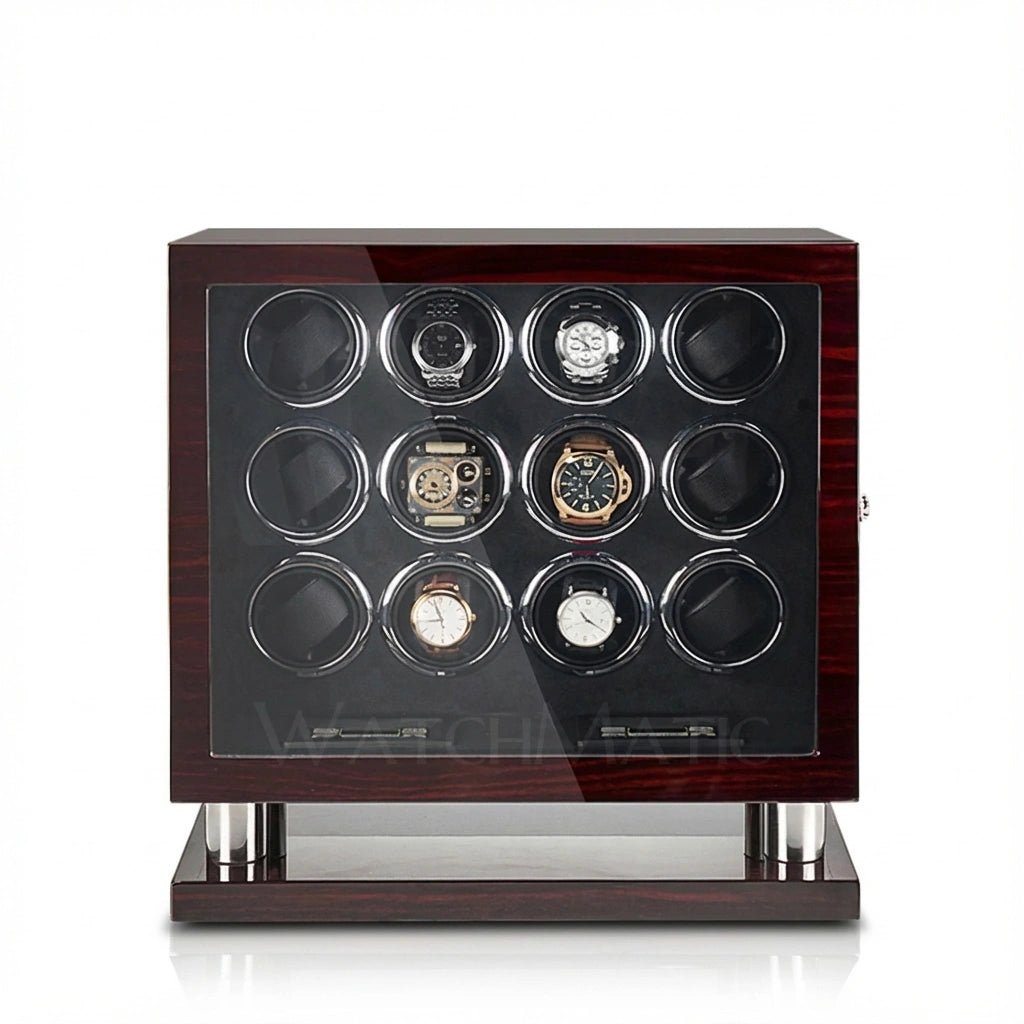
Suitable automatic-winding configurations can be explored in the WatchMatic Watch Winder Collection.
Best Watch Winder for Multiple MB&F Watches
Consider a collection containing:
- HM8 Mark 2
- HM12
- LM FlyingT
- LM Perpetual
- HM11
- LM Sequential Flyback EVO
There are six mechanical Machines.
Only three are conventional automatic-winder candidates.
A more rational setup is:
HM8 + HM12 + FlyingT → individually programmed winding positions
LM Perpetual + HM11 + Sequential → secure stationary storage
Mechanical Machine Count Should Not Equal Rotor Count
This principle is especially important with MB&F.
A collector could own ten MB&F Machines and require only a few powered positions.
Many of the most mechanically spectacular references are manual.
Vento Watch Winder for Automatic MB&F Machines

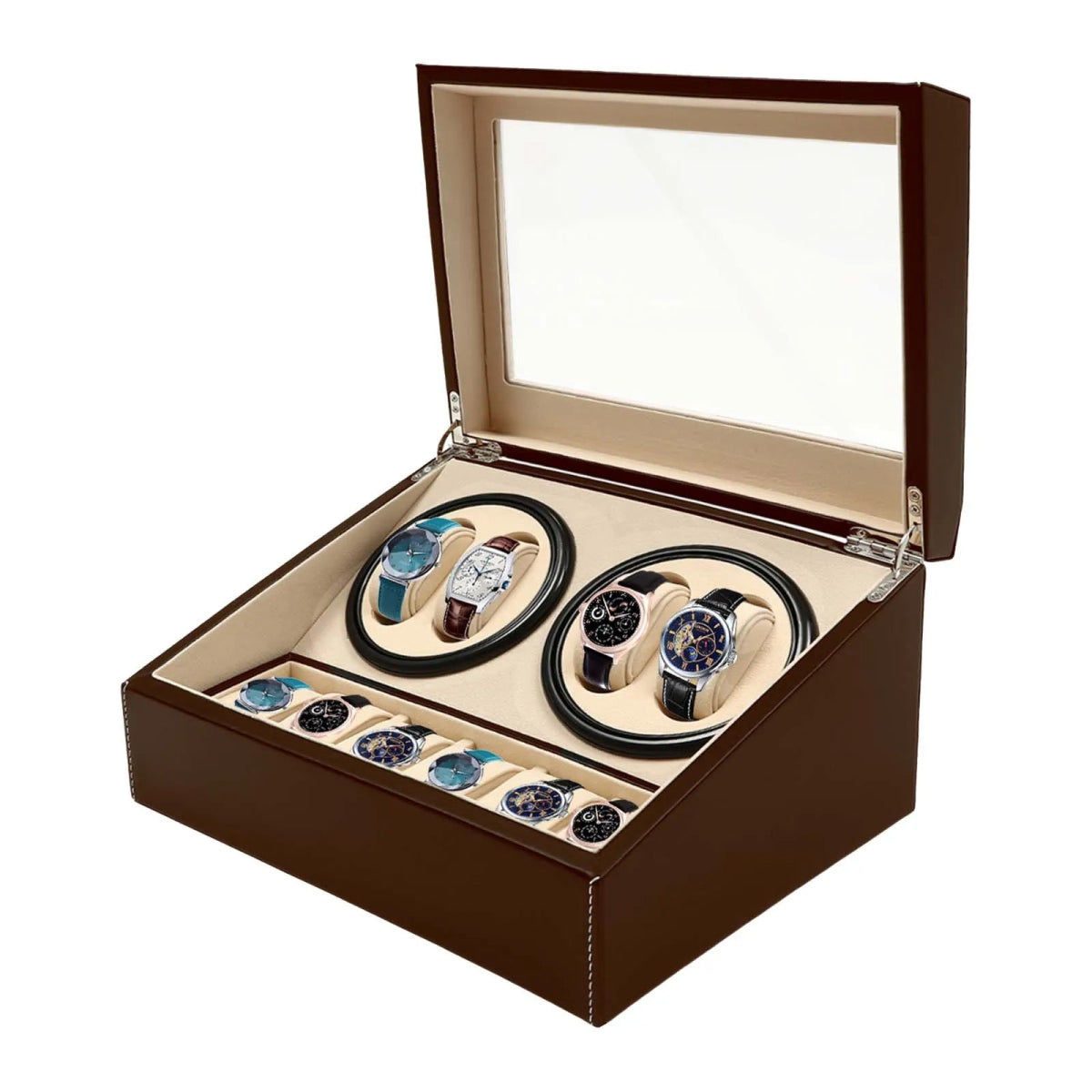
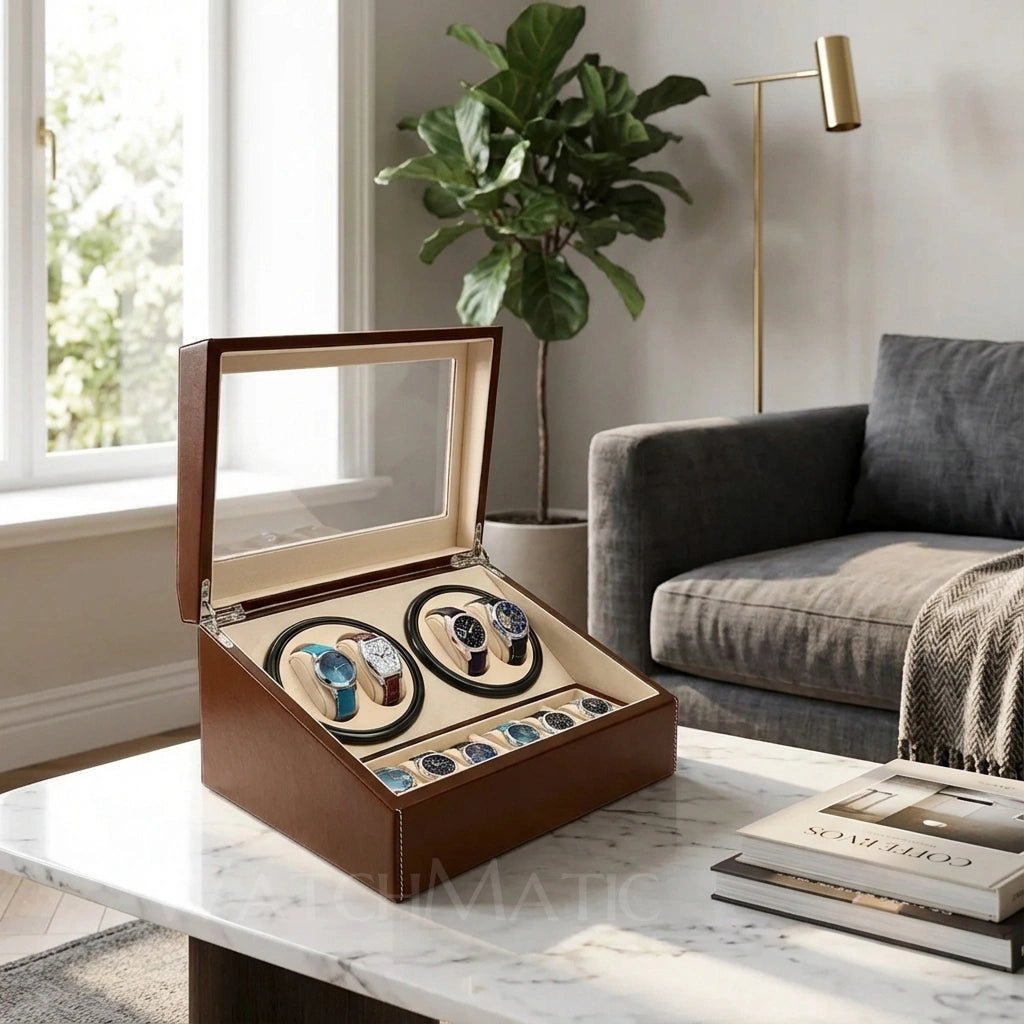
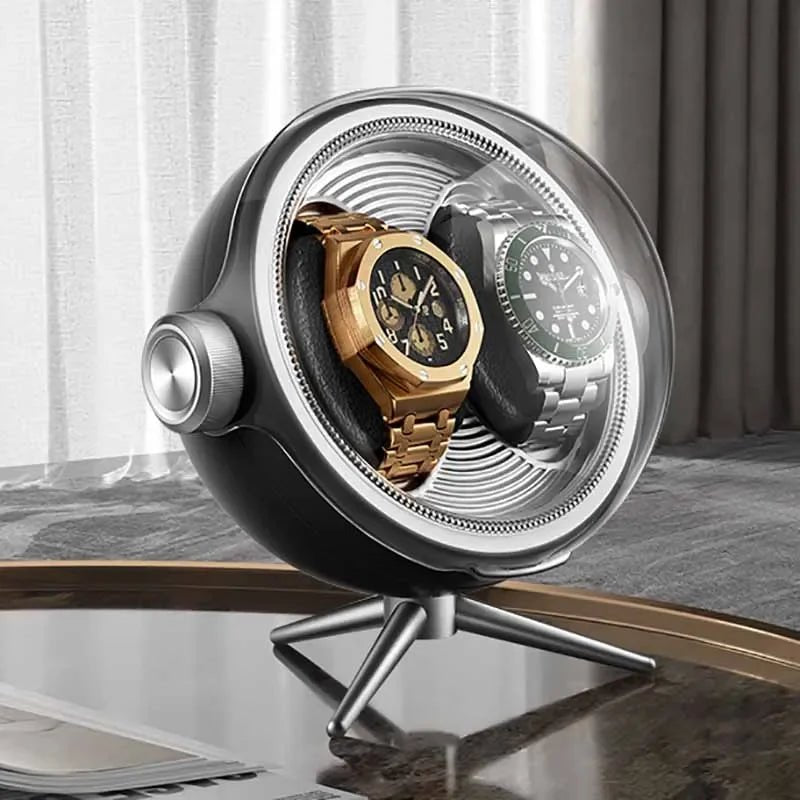
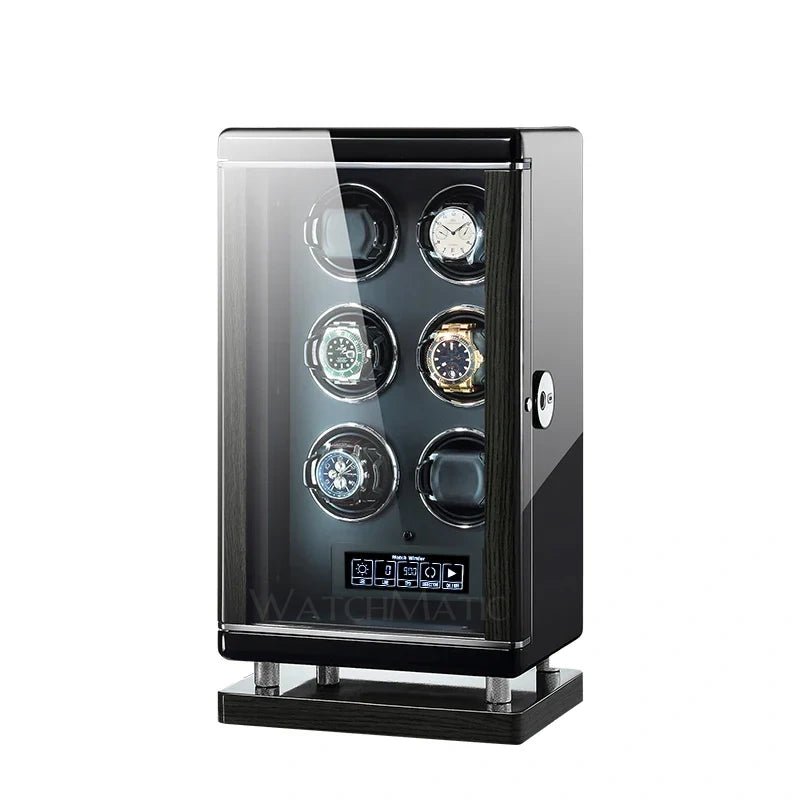
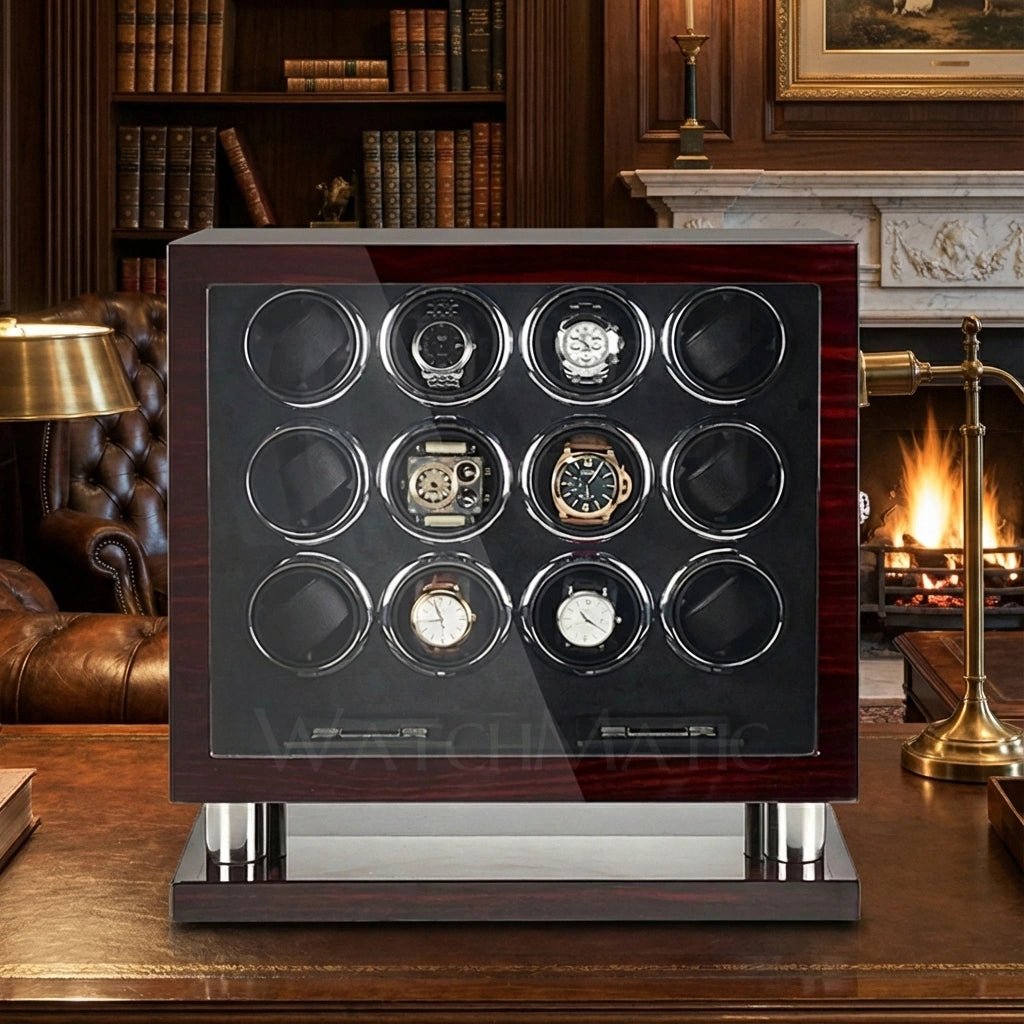
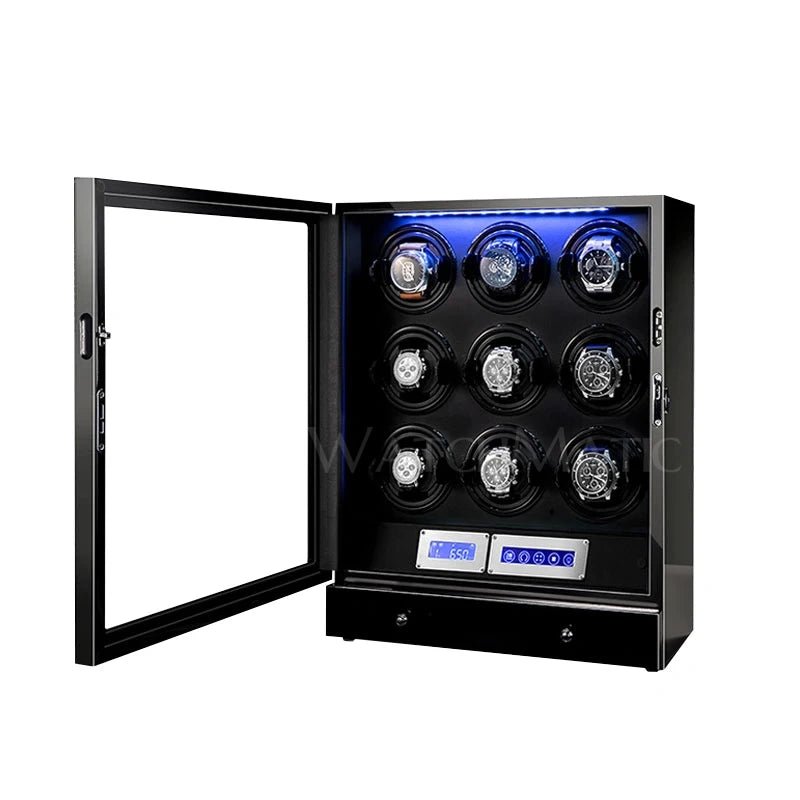
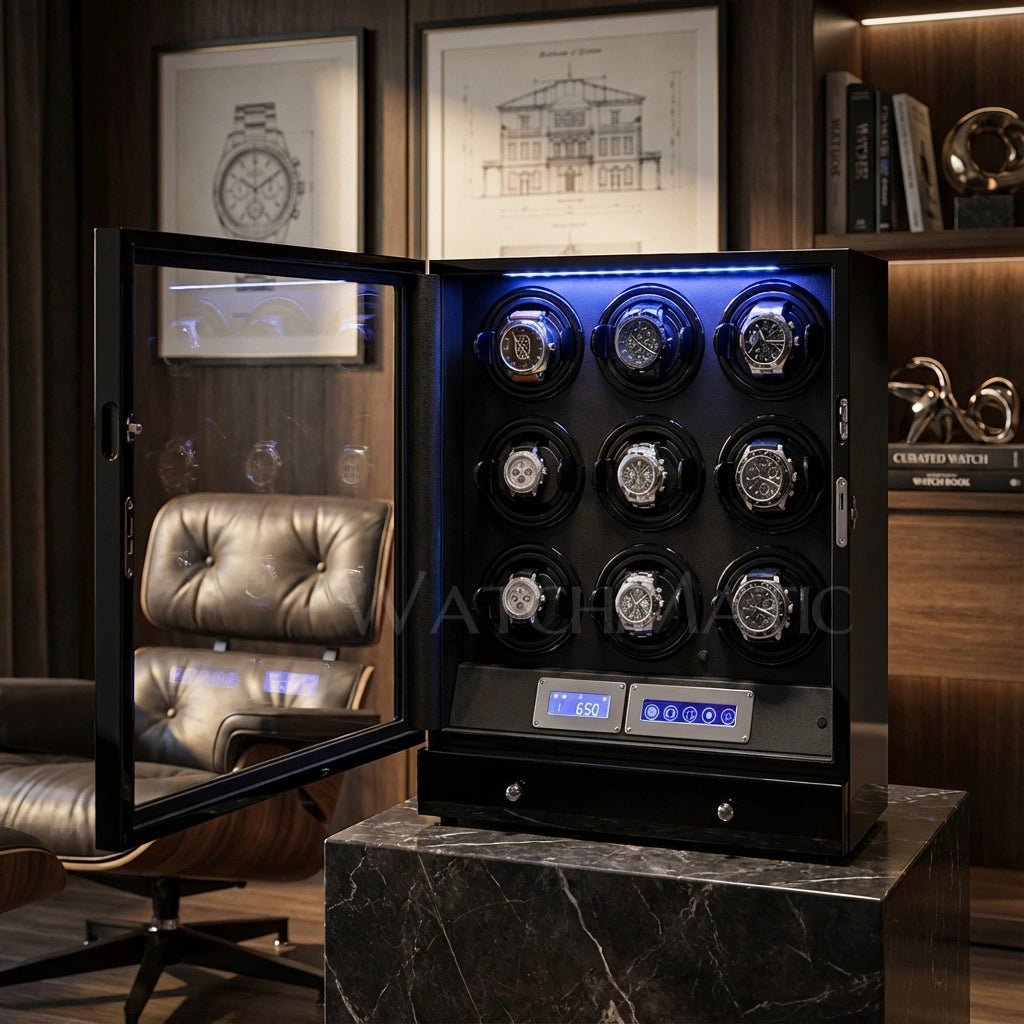
The Vento Luxury Quad Watch Winder can be useful for a compact group of compatible automatic MB&F watches because it provides four independently controlled winding positions.
Each rotor can be configured separately for:
- TPD
- Rotation direction
- Winding mode
This is particularly useful when a collection combines fundamentally different automatic architectures such as:
- HM8 Mark 2
- HM12
- LM FlyingT
- Another automatic watch from a different manufacture
Physical Fit Must Be Verified Before Using Vento
This warning matters more for MB&F than for most brands.
Several Machines have:
- Extreme thickness
- asymmetric cases
- sapphire domes
- unusual lugs
- unconventional strap angles
Movement compatibility does not guarantee chamber compatibility.
FlyingT May Be Compact in Diameter but Tall
A standard small-watch cushion does not solve a vertical-clearance problem.
Always verify the available depth above the watch.
HM8 and HM12 Need Three-Dimensional Fit Checks
Their case architectures cannot be judged by conventional diameter alone.
Check the actual Machine against the usable chamber dimensions before long-term rotation.
Do Not Use Vento Positions for Manual Machines Merely for Display
A manual:
- LM Perpetual
- HM11
- LM Sequential
- HM10
can physically sit on a rotating holder if dimensions allow.
That does not mean rotation provides winding benefit.
Is It Safe to Keep an Automatic MB&F on a Watch Winder?
A properly configured premium winder can be appropriate for a confirmed automatic MB&F.
Important factors include:
- Exact Machine identification
- Exact movement identification
- Appropriate TPD
- Appropriate rotation direction
- Controlled rest periods
- Low-vibration operation
- Stable physical support
- Sufficient three-dimensional clearance
If an automatic MB&F exhibits abnormal reserve or performance despite adequate winding, professional inspection is preferable to continually increasing TPD.
A Watch Winder Does Not Service an MB&F
A watch winder does not:
- Service a tourbillon
- Service a flying balance
- Regulate a movement
- Maintain a perpetual calendar
- Service dual chronographs
- Maintain a planetary differential
- Repair a rotating case-winding system
- Protect sapphire components from impact
- Replace professional servicing
Its mechanical function is limited to supplying motion to a compatible automatic winding system.
Watch Winder vs. Watch Safe for MB&F Collectors
MB&F is one of the strongest brands in this series for a mixed automatic-and-stationary secure-storage strategy.
| Feature | Standalone Winder | Watch Winder Safe |
|---|---|---|
| Automatic winding | Yes | Yes |
| Independent programming | Available | Available |
| Manual Machine storage | Possible | Yes |
| Physical security | Limited | High |
| Controlled access | Limited | High |
| Large-case storage | Model dependent | More configurable |
| High complications | Limited protection | High |
| Major MB&F collection | Moderate | Highly relevant |
Collectors requiring both winding and secure storage can explore the Watch Winder Safe Collection.
Titan Vault 20 for an MB&F Collection

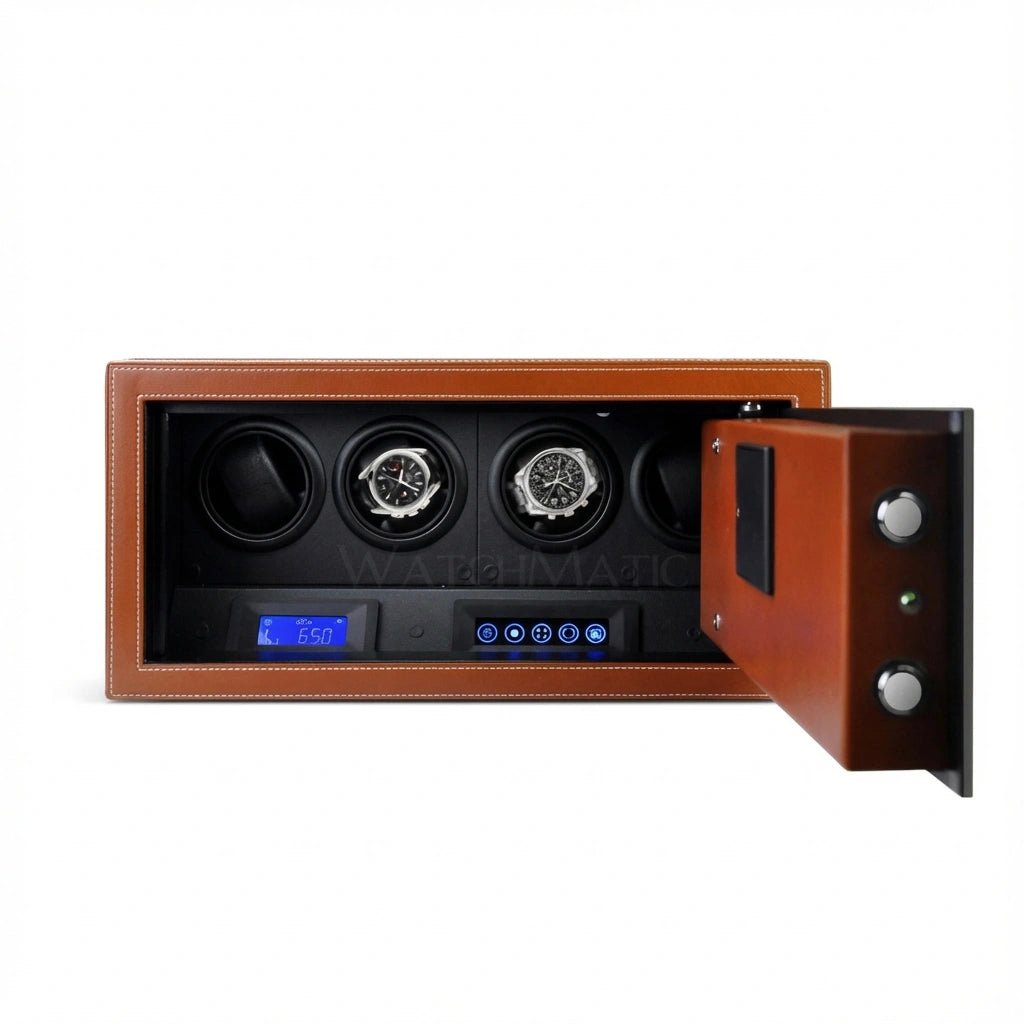
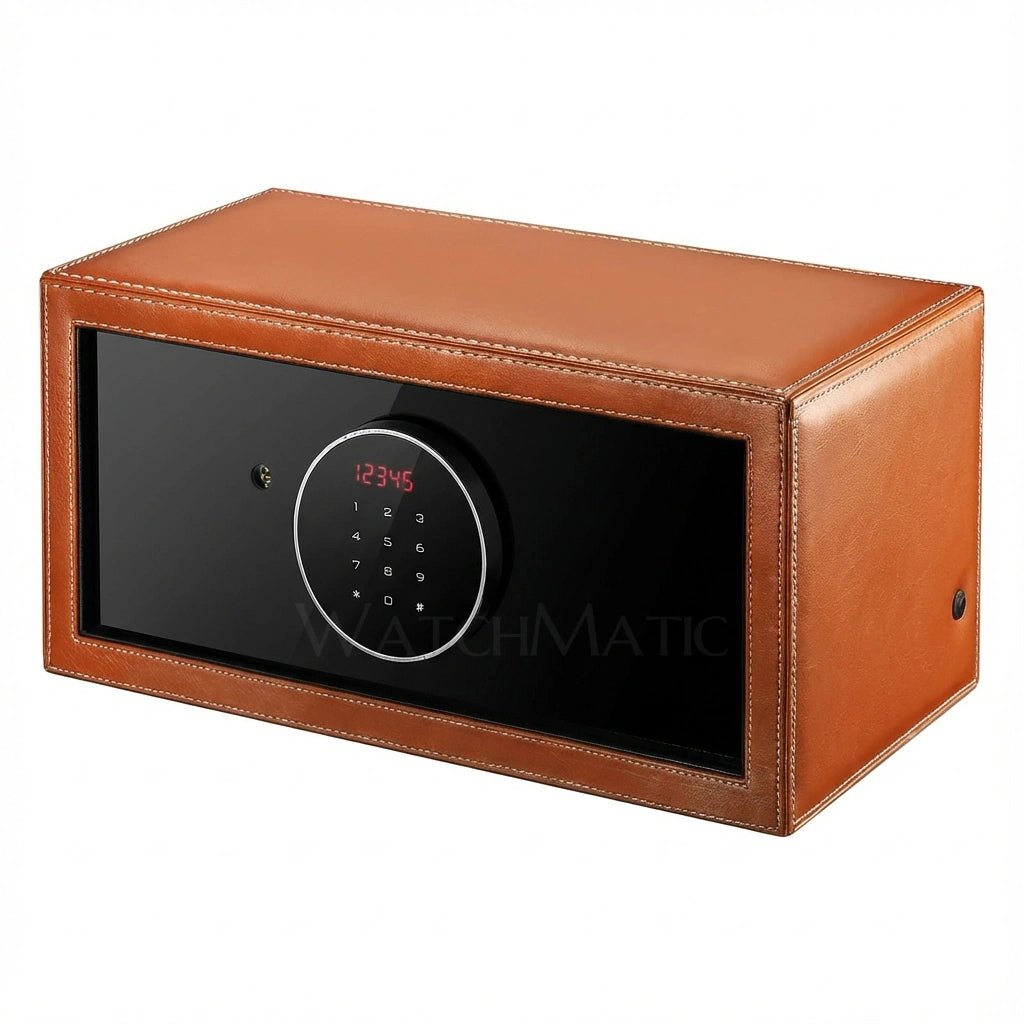
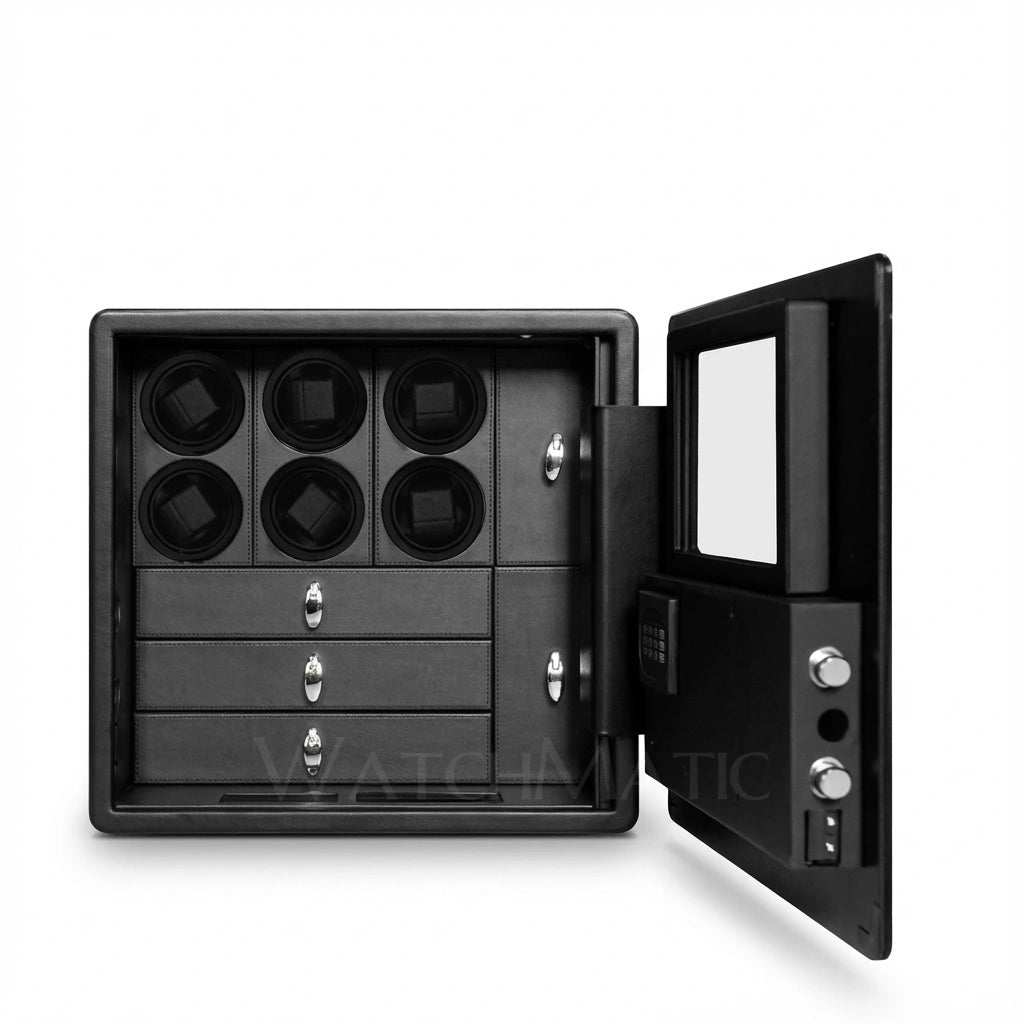
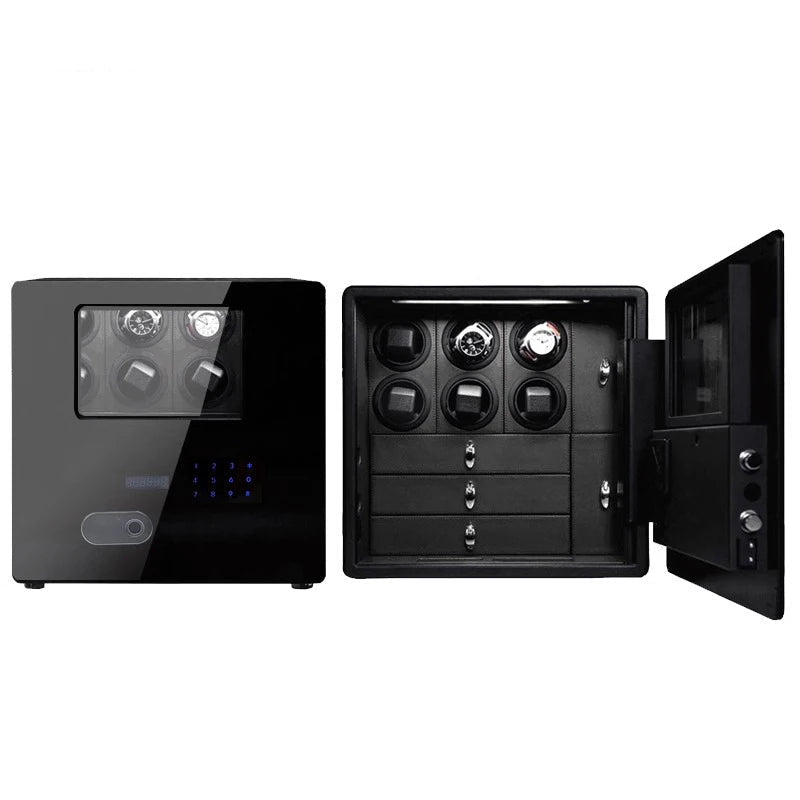
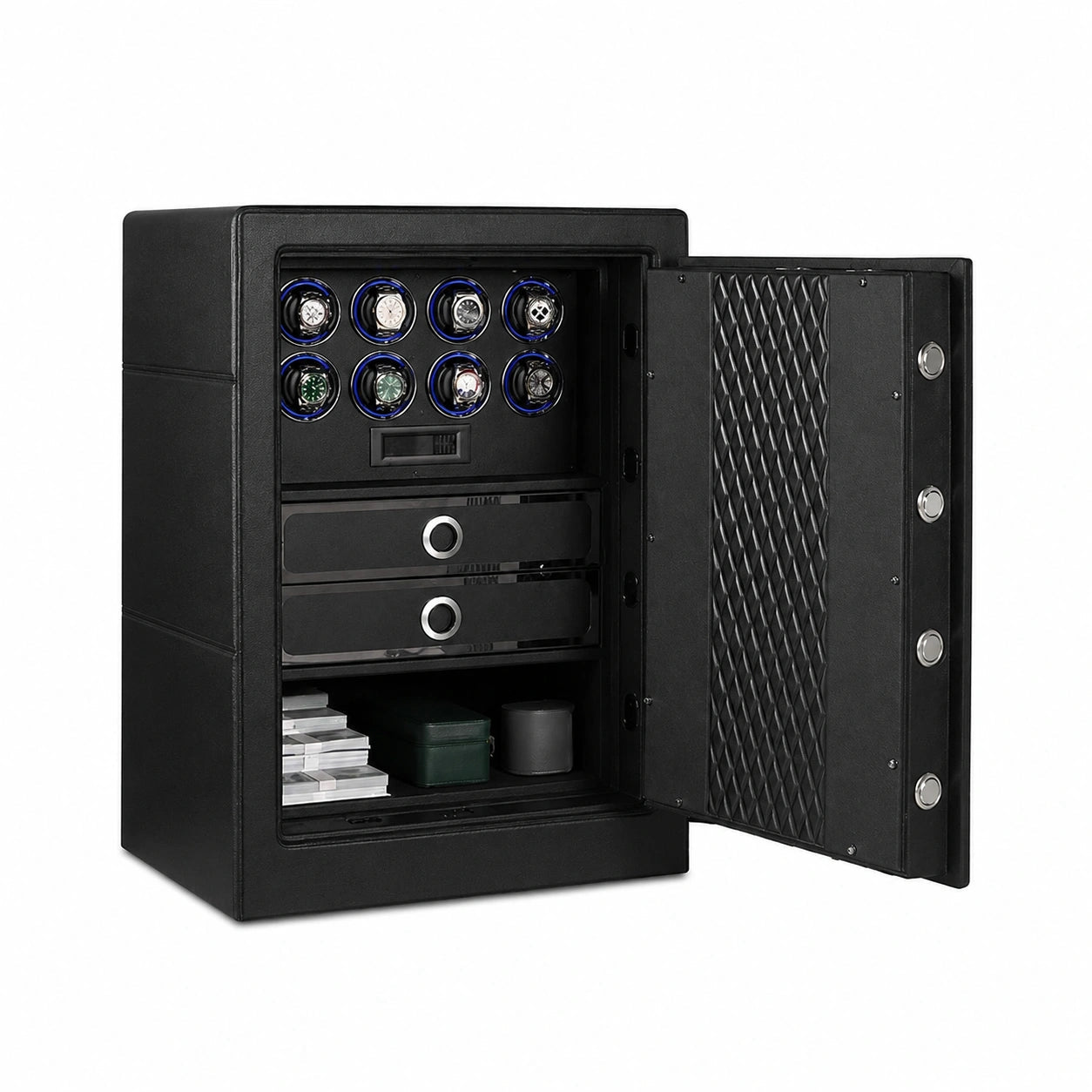
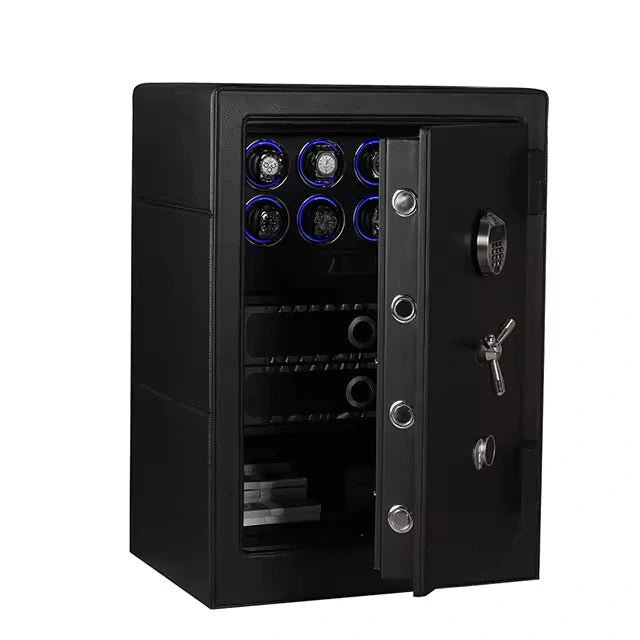
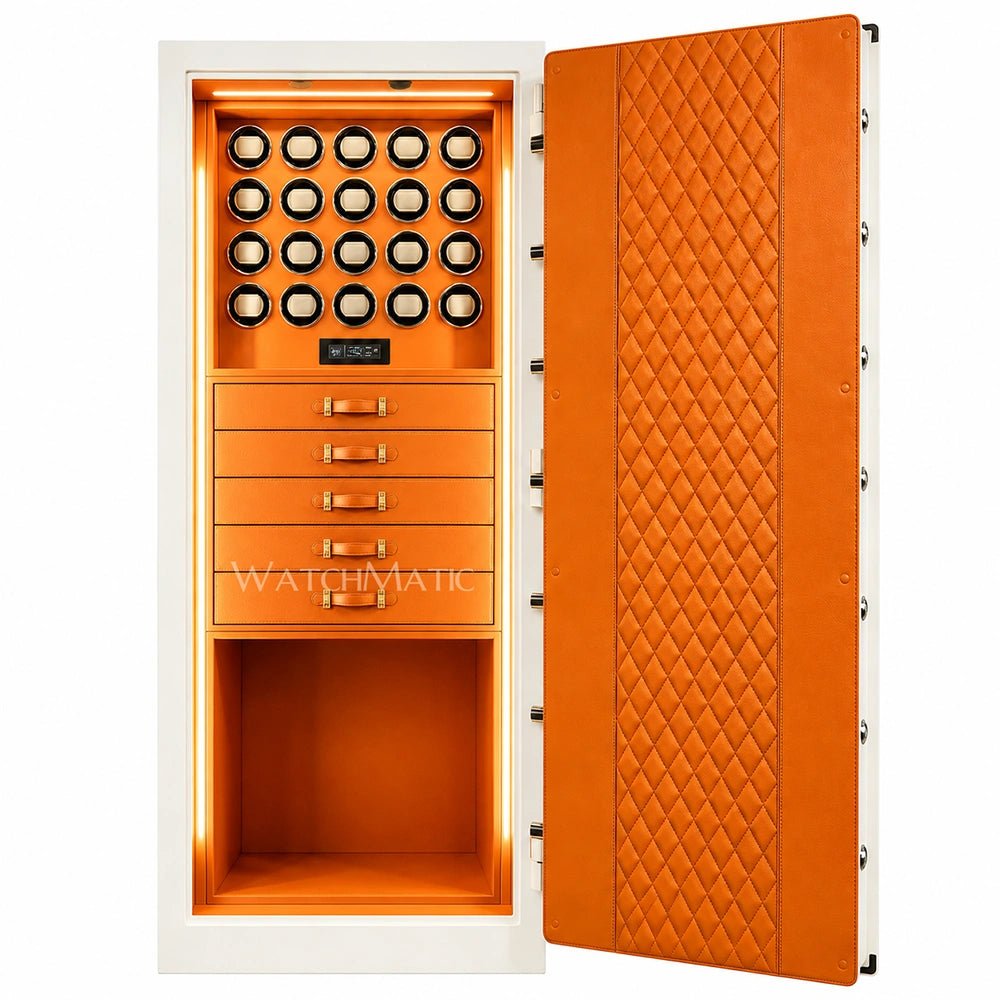
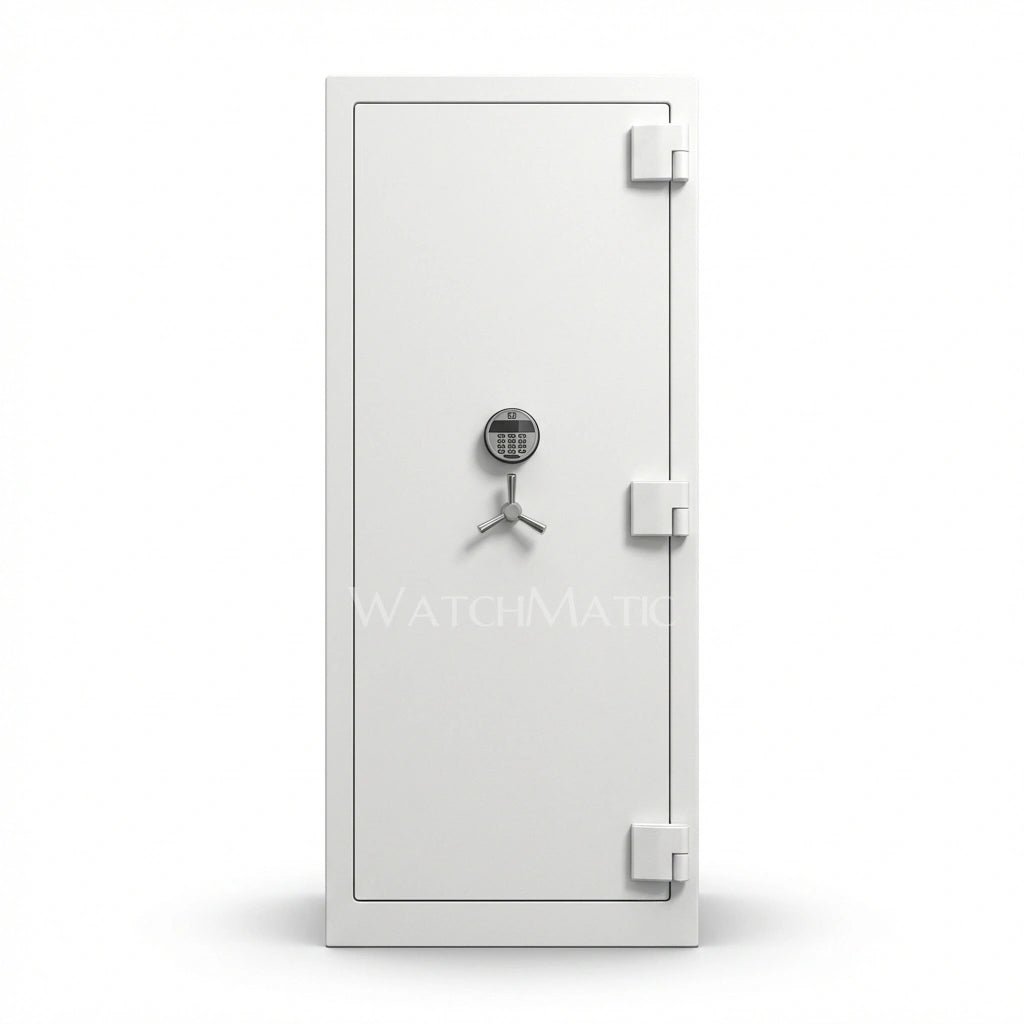
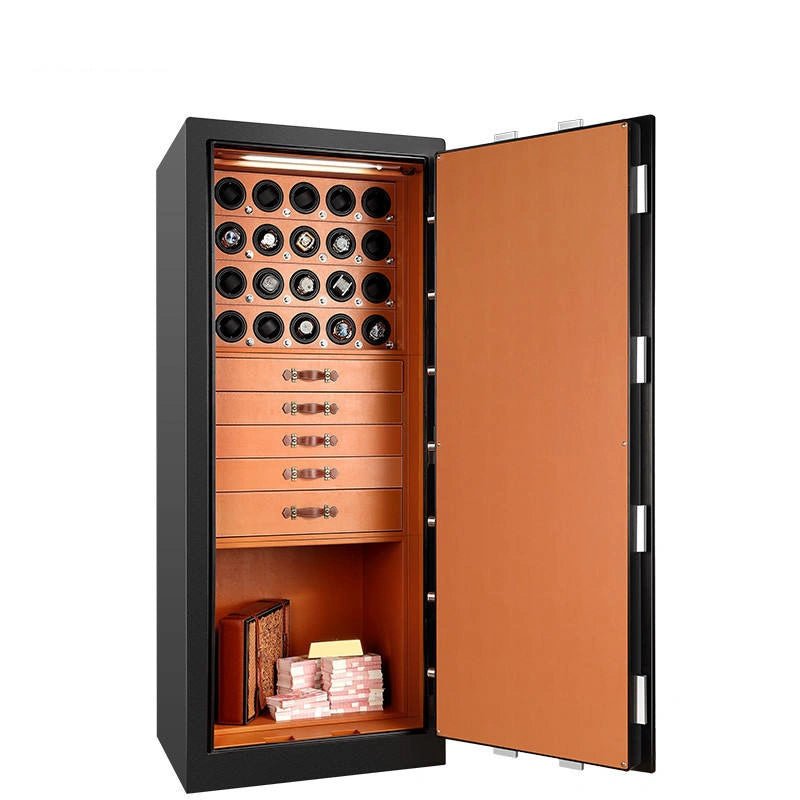
For a larger MB&F or mixed haute-horlogerie collection, the Titan Vault 20 Watch Winder Safe combines independently controlled winding positions with secure storage architecture.
Available features include:
- Monolithic solid-steel body
- 10-layer reinforced exterior shell
- Biometric fingerprint access
- Digital passcode
- Manual key access
- Floor anchoring
- LCD touchscreen
- Japanese Mabuchi motors
- Independent winding control
- 650–2200 TPD range
- CW/CCW/bidirectional operation
- Anti-magnetization protection
- Adjustable interior lighting
- Ultra-quiet operation below 10 dB
- 10-year warranty
Higher-level fire and burglary certifications are available upon request rather than being assumed as standard on every configuration.
Why Titan Vault 20 Has Very Strong Relevance for MB&F
This is not a brand where secure storage feels disproportionate.
Individual Machines can occupy very high price categories and may be produced in extremely small numbers.
A collection might include:
- HM12
- LM FlyingT
- LM Perpetual
- Sequential Flyback
- HM11
- Thunderdome
- SP One
- Bvlgari x MB&F Serpenti
At that point the storage problem is not simply:
“How do I keep a watch running?”
It is:
“How do I protect a high-value collection containing both automatic and manual three-dimensional Machines?”
The Most Valuable Machine May Not Need a Rotor
An LM Perpetual, Sequential Flyback, Thunderdome or special collaboration can be extraordinarily valuable.
Yet conventional rotation contributes no winding energy.
Meanwhile, an HM8 Mark 2 can benefit directly from a rotor position.
Therefore:
winding relevance ≠ security relevance.
Manual MB&F Machines Strengthen the Stationary-Storage Case
A serious MB&F safe should not be planned solely around motor count.
It should also account for:
- Manual watches
- unusual case dimensions
- large sapphire domes
- high jewellery
- bespoke and limited editions
Chamber Size Can Matter More Than Rotor Count
A 20-position safe is only useful if the individual watch positions can accommodate the actual Machines.
For MB&F, confirm dimensional fit for exceptionally large or tall references before final configuration.
Titan Vault 20 Can Serve Mixed Architecture
A rational collection design can use:
compatible automatics → powered positions
and:
manual Machines → secure stationary compartments.
This is generally more logical than trying to rotate every watch.
When a Stationary Watch Safe Is More Appropriate
If an MB&F collection is dominated by:
- LM Perpetual
- Sequential
- LM101
- HM9
- HM10
- HM11
- LMX
- Thunderdome
- SP One
then large-scale powered capacity may not be a priority.
In that situation, the Luxury Watch Safe Collection may be more relevant than maximizing watch-winder positions.
MB&F in a Mixed Independent Haute Horlogerie Collection
MB&F naturally appears alongside modern independent and high-complication manufacturers.
A mixed collection might include:
MB&F + Czapek + De Bethune + F.P. Journe + H. Moser & Cie. + Christophe Claret
Related WatchMatic guides include:
Best Watch Winder for Czapek Watches
Best Watch Winder for De Bethune Watches
Best Watch Winder for F.P. Journe Watches
Best Watch Winder for H. Moser & Cie. Watches
Best Watch Winder for Christophe Claret Watches
At this level, independent programming and mixed powered/stationary storage are far more useful than one universal brand setting.
MB&F vs. H. Moser & Cie.
Both brands currently offer:
- Automatic tourbillons
- manually wound high complications
- unconventional movement architecture
However, the exact movements are entirely different.
A FlyingT program should not be copied from an H. Moser automatic tourbillon.
MB&F vs. De Bethune
Current De Bethune is heavily manual.
MB&F also contains many manual high complications, but it retains several unusual automatics including:
- HM12
- HM8 Mark 2
- FlyingT
Both brands therefore reward exact reference identification.
MB&F vs. Czapek
Czapek's current portfolio is more consistently automatic in collections such as Antarctique.
MB&F is much less predictable.
Even within the same Horological Machine or Legacy Machine universe, winding architecture varies significantly.
MB&F vs. Christophe Claret
Both brands demonstrate that extreme complication is useless as a predictor of winding type.
Christophe Claret has automatic gaming watches and manual tourbillons.
MB&F has automatic flying tourbillons, manual perpetual calendars and manual triple-axis regulators.
How to Choose the Best Watch Winder for Your MB&F
Step 1: Identify the Exact Machine
Determine whether the watch is:
- HM12
- HM11
- HM10
- HM9
- HM8 Mark 2
- LM FlyingT
- LM Perpetual
- LM Sequential
- LM101
- LM Split Escapement
- LMX
- LM2
- Thunderdome
- SP One
- A Performance Art collaboration
Step 2: Confirm Automatic or Manual
Important examples:
HM12 → automatic
HM8 Mark 2 → automatic
LM FlyingT → automatic
HM11 → manual case-winding
HM10 → manual
HM9 → manual
LM Perpetual → manual
LM Sequential → manual
SP One → manual
Step 3: Check the Exact Movement Architecture
Do not stop at:
automatic
because MB&F automatics can use:
- Conventional rotor architecture
- Double rotor
- Three-dimensional tourbillon automatic architecture
Step 4: Check Power Reserve
Representative examples:
42 h → HM8 Mark 2 automatic
45 h → HM9/HM10 manual
60 h → LM101 EVO manual
72 h → multiple manual Legacy Machines
84 h → HM12 automatic
96 h → HM11 manual
100 h → LM FlyingT automatic
168 h → LMX manual
Step 5: Determine Whether TPD Is Relevant
TPD is only relevant when an internal automatic winding system exists.
Do not assign conventional TPD to HM11 merely because its case is manually rotated to wind it.
Step 6: Determine Winding Direction
For confirmed automatics, use movement-specific documentation.
Choose a winder capable of:
- CW
- CCW
- Bidirectional
Step 7: Consider the Complication
A:
- Tourbillon
- Perpetual calendar
- Dual chronograph
- Triple-axis regulator
- Jumping hour
does not tell you whether the watch is automatic.
Step 8: Check Full Three-Dimensional Dimensions
Do not rely on nominal case diameter.
Measure:
- Width
- Length
- Height
- Sapphire dome
- Crowns
- Pushers
- Strap angle
Step 9: Check Cushion Geometry
MB&F strap and lug architectures can be unconventional.
Use flexible support rather than forcing the watch into a standard shape.
Step 10: Match Powered Capacity to Automatic Machines
Do not equate:
number of mechanical MB&F watches
with:
number of powered rotor positions required.
For broader winding, TPD, secure-storage and collection-protection resources, visit the WatchMatic Guide Hub.
Best Watch Winder for MB&F Watches: Final Thoughts
Choosing the best watch winder for an MB&F requires exact Machine identification.
This is one of the least suitable brands for a generic:
“one TPD setting for the entire brand”
approach.
Important current automatic examples include:
HM8 Mark 2 → automatic → approximately 42 hours
HM12 → automatic double rotor → approximately 84 hours
LM FlyingT → automatic flying tourbillon → approximately 100 hours.
Each uses a substantially different automatic architecture.
At the same time, many of MB&F's most important Machines are manual.
The HM9 and HM10 provide approximately 45 hours.
The LM Perpetual, LM Sequential and LM Split Escapement sit around 72 hours.
The LM101 EVO provides approximately 60 hours.
The HM11 provides approximately 96 hours but is wound through deliberate rotation of its own case.
The LMX reaches approximately 168 hours / seven days.
None of these manual movements receives useful automatic winding energy from a conventional rotating watch winder.
Three comparisons summarize MB&F particularly well:
HM12 → double rotor → automatic → 84 h
versus:
HM11 → rotating-case winding → manual → 96 h.
LM FlyingT → flying tourbillon → automatic → 100 h
versus:
HM11 → flying tourbillon → manual → 96 h.
And:
HM8 Mark 2 → ~42 h → automatic
versus:
HM9 / HM10 → ~45 h → manual.
The central MB&F lesson is therefore:
visible motion, complication, case rotation and power reserve do not determine watch-winder compatibility.
For a confirmed automatic MB&F, prioritize:
- Adjustable TPD
- CW/CCW/bidirectional programming
- Independent controls
- Controlled rest cycles
- Smooth low-vibration motors
- Flexible cushions
- Generous three-dimensional clearance
- Secure retention
For manual Legacy Machines, HM9, HM10, HM11, SP One and similar references, prioritize premium stationary storage instead.
The most reliable framework is:
MB&F Machine → Exact Movement → Automatic or Manual → Power Reserve → Winding Architecture → Physical Geometry → TPD/Direction or Stationary Storage
For additional automatic-winding and secure-storage solutions, explore WatchMatic.