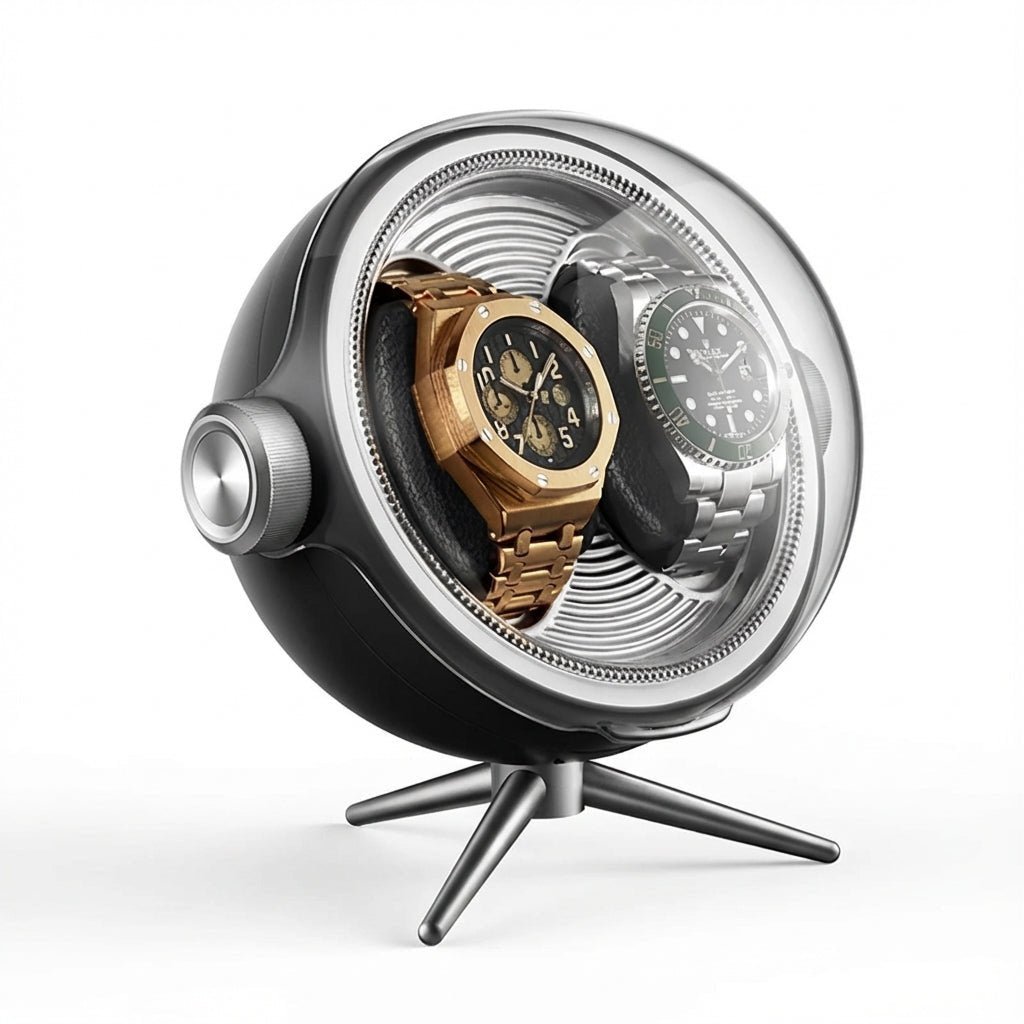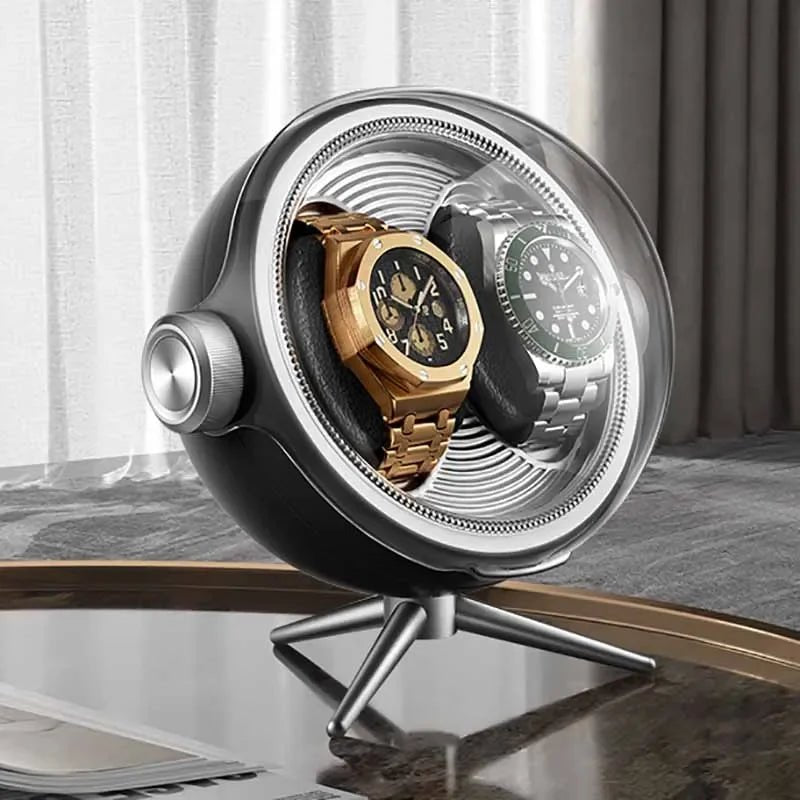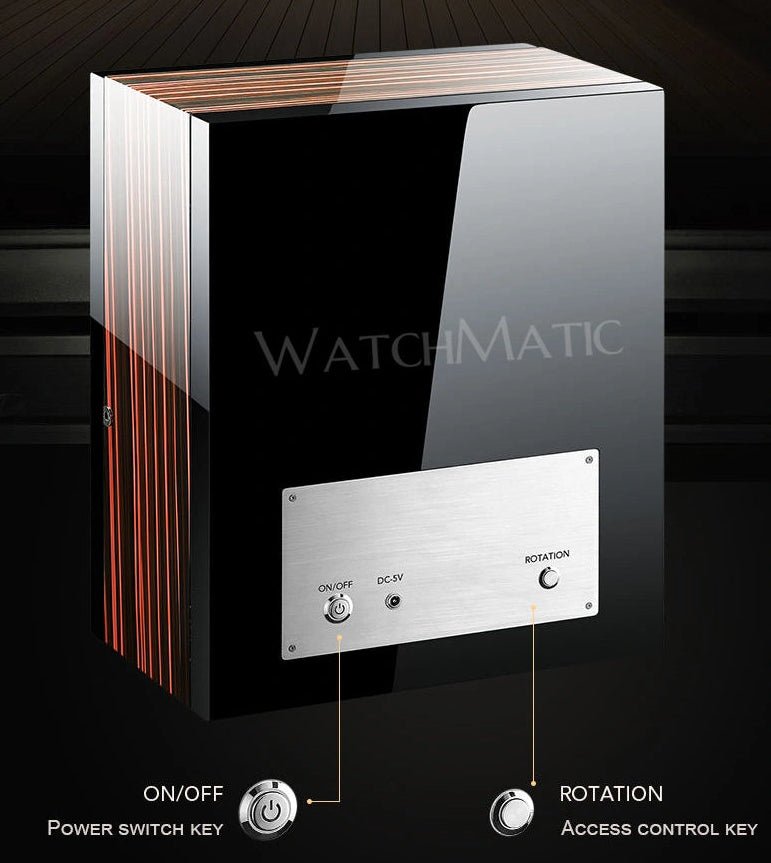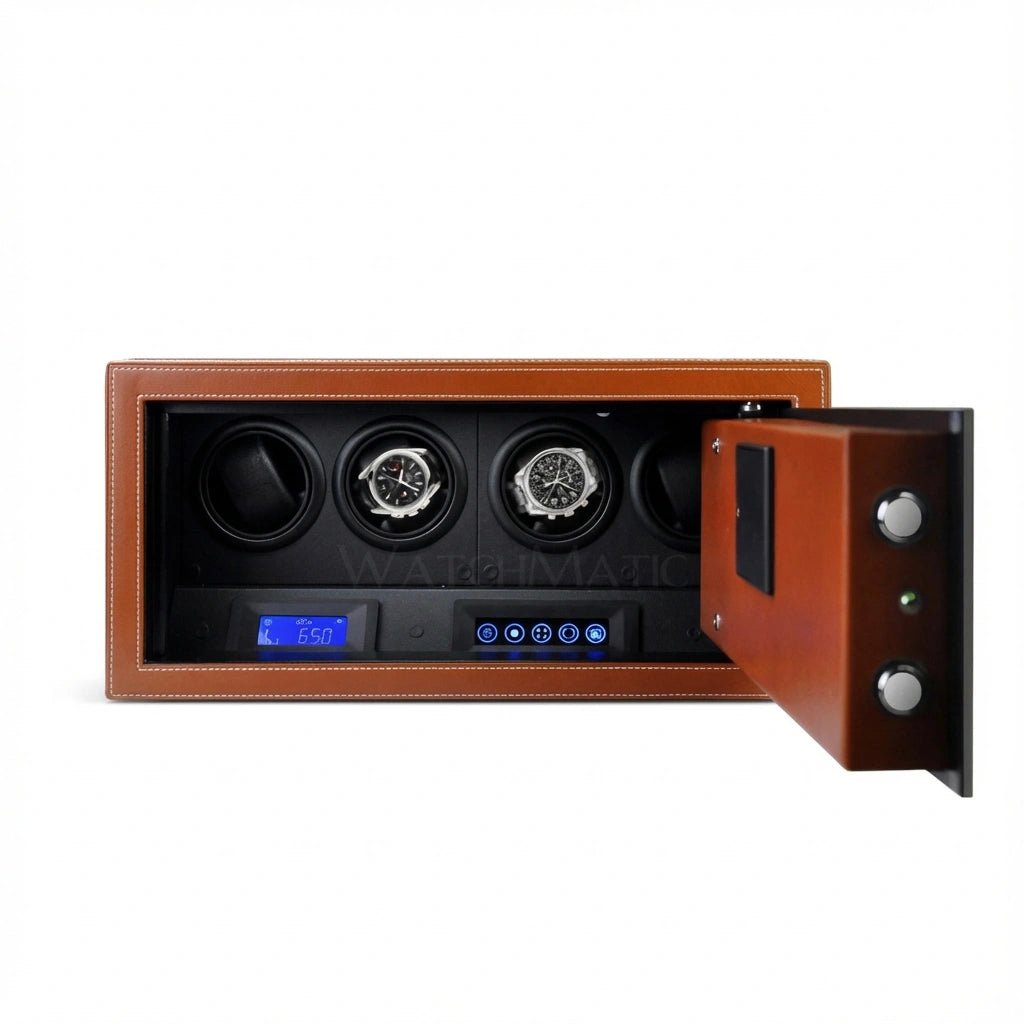
The best watch winder for URWERK watches is a highly programmable premium model with adjustable Turns Per Day (TPD), clockwise and counterclockwise rotation, independent controls, controlled rest cycles, smooth low-vibration operation, and enough physical clearance for URWERK's unusually shaped cases, sapphire structures, crowns, covers, and articulated straps.
However, URWERK requires more than simply identifying whether a movement is automatic.
The current and recent catalog includes:
- Conventional self-winding movements
- Turbine-regulated automatic winding
- Double-flow turbine automatic systems
- Rotor systems that can be completely disengaged
- Automatic Grinder winding architecture
- Manual-wound satellite watches
- Manual chronometry watches with electronic monitoring
- Watches that can be automatically wound only by a dedicated master-clock system
Important automatic examples include:
- UR-100V — UR 12.02
- UR-101 — current self-winding UR-1.01V-generation architecture
- UR-102 Reloaded — UR-2.02
- UR-120 — UR-20.01
- UR-150 Scorpion — UR-50.01
- UR-230 — UR-7.30 with switchable rotor system
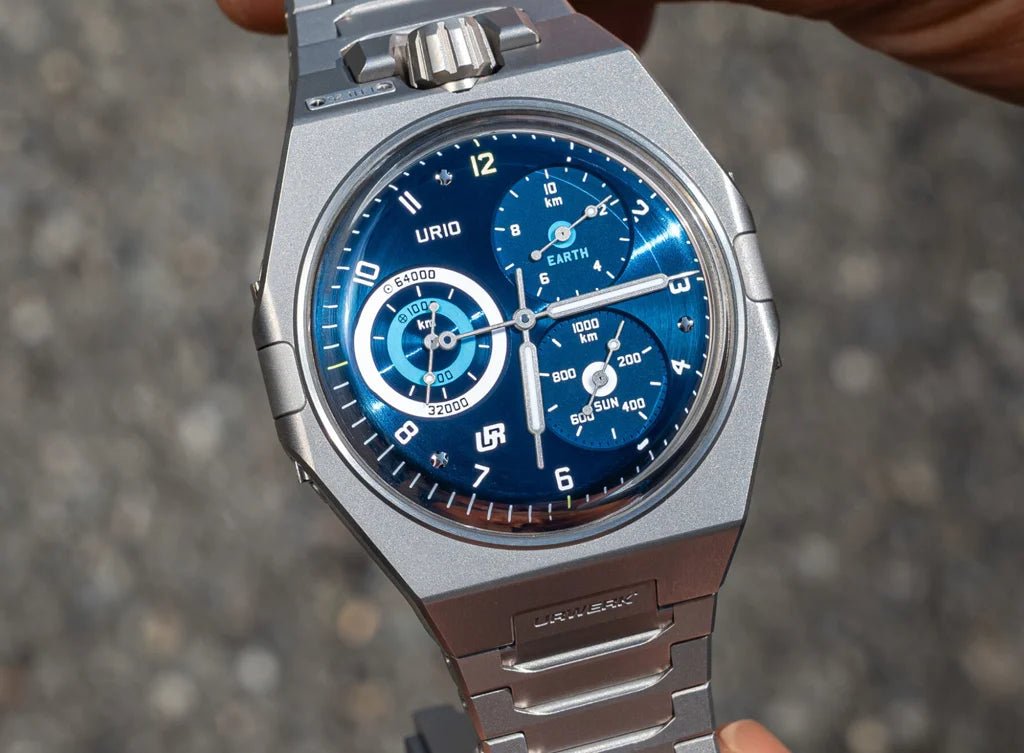
- UR-10 SpaceMeter — UR-10.01
- UR-111C — self-winding
- UR-112 — UR-13.01
- UR-1001 — self-winding
- UR-FREAK — automatic Grinder winding system
Important manual or non-conventional examples include:
- UR-220 — UR-7.20 manual
- EMC — manual
- EMC TimeHunter — manual
- Historical UR-103 — manual
- AMC — manually wound or wound by its dedicated atomic master clock
This creates three fundamental rules:
Automatic URWERK → a correctly configured conventional watch winder may be useful
Manual URWERK → conventional rotation provides no winding benefit
Switchable or special URWERK winding system → confirm the rotor/system configuration before using a conventional winder
The correct decision process is:
Exact Reference → Caliber → Automatic / Manual / Special Winding Architecture → Rotor/Turbine Status → Power Reserve → Case Geometry → TPD/Direction or Stationary Storage
Does an URWERK Watch Need a Watch Winder?
No automatic URWERK mechanically requires a watch winder.
A self-winding mechanical movement uses an oscillating mass or another automatic winding mechanism to convert movement into energy stored in the mainspring.
When the watch remains stationary beyond its available power reserve, it eventually stops.
That is normal.
A watch winder can provide convenience by:
- Keeping an automatic URWERK ready to wear
- Maintaining satellite-hour indications
- Reducing repeated restarting
- Keeping digital or jumping displays synchronized
- Maintaining complex calendar information on relevant references
- Managing several automatic independent watches
- Reducing manual resetting in a large collection
A watch winder does not:
- Replace servicing
- Improve lubrication simply by running continuously
- Service URWERK's turbine systems
- Maintain a retrograde mechanism
- Improve satellite-display accuracy
- Protect the movement from wear by maximizing rotation
For a broader explanation of automatic winding principles, see the Watch Winder Guide.
Which URWERK Watches Can Use a Watch Winder?
Representative current, recent, and technically relevant references include:
| URWERK watch | Caliber / architecture | Winding type | Approx. reserve | Conventional winder? |
|---|---|---|---|---|
| UR-100V | UR 12.02 + Planetary Turbine | Automatic | 48 h | Yes |
| UR-101 current generation | UR-1.01V family | Automatic | 48 h | Yes |
| UR-102 Reloaded | UR-2.02 | Automatic | 48 h | Yes |
| UR-120 | UR-20.01 | Automatic | 48 h | Yes |
| UR-150 Scorpion | UR-50.01 | Automatic | 43 h | Yes |
| UR-230 | UR-7.30 | Automatic / rotor can be disengaged | 48 h | Yes, when rotor is engaged |
| UR-10 SpaceMeter | UR-10.01 | Automatic + dual-flow turbine | 43 h | Yes |
| UR-111C | Reference-specific self-winding caliber | Automatic | 48 h | Yes |
| UR-112 | UR-13.01 | Automatic | 48 h | Yes |
| UR-1001 | UR-10.01 application | Automatic | 39 h | Yes |
| UR-FREAK | Grinder architecture | Automatic | Reference-specific | Yes |
| Historical UR-210 | UR-7.10 + turbine system | Automatic | 39 h | Yes, configuration matters |
| UR-220 | UR-7.20 | Manual | 48 h | No |
| EMC | UR-EMC | Manual | 80 h | No |
| EMC TimeHunter | UR-EMC2 | Manual | 80 h | No |
| Historical UR-103 | 3.03 | Manual | ~43 h | No |
| AMC | AMC caliber | Manual / master-clock winding | 80 h | Not through a conventional rotor winder |
This table explains why URWERK is not a one-setting brand.
Why URWERK Is Unusually Complex for Watch-Winder Owners
With many watch brands, the basic sequence is:
automatic → find TPD → choose direction.
URWERK can require additional questions:
- Is the movement automatic?
- Is its rotor regulated by turbines?
- Can the rotor be disengaged?
- Is an air-brake setting active?
- Does the watch use a dedicated automatic-winding technology?
- Is the movement automatic only when interacting with a dedicated master system?
- Does the watch physically fit in a conventional rotating chamber?
URWERK therefore adds a new layer:
movement state matters, not merely movement type.
URWERK Turbine Systems and Watch Winders
Turbine technology appears repeatedly in URWERK's history.
Depending on the reference, turbines can be used to:
- Regulate automatic winding
- Control rotor speed
- Modulate airflow
- Protect the movement
- Manage shock
- Reduce excessive winding activity
This matters because the automatic system is not necessarily a passive rotor sitting behind the movement.
Turbine Regulation Does Not Mean Higher TPD
The presence of:
- One turbine
- Multiple turbines
- Planetary turbines
- Dual-flow turbines
does not mean the watch requires more external rotation.
The turbines are part of the movement's winding-control architecture.
They do not create a simple equation such as:
more turbines = more TPD.
The Correct URWERK Philosophy
For an automatic URWERK:
use enough external movement to maintain adequate reserve while respecting the watch's own winding-control system.
Do not attempt to overpower the internal architecture with maximum TPD.
Best Watch Winder for URWERK UR-100V
The UR-100V uses:
UR 12.02
with:
- Self-winding mechanical movement
- Planetary Turbine Automatic System
- Approximately 48 hours of power reserve
- Satellite hours
- Orbital astronomical indications depending on reference
Representative dimensions are approximately:
41 × 49.7 × 14 mm
for standard versions.
Planetary Turbine Automatic System
URWERK uses its planetary turbine architecture to regulate the movement of the self-winding mass.
This is not merely decorative.
It forms part of how the automatic winding system behaves.
Can UR-100V Use a Watch Winder?
Yes.
The UR 12.02 is self-winding.
A properly configured conventional watch winder can therefore provide useful motion.
Do Not Override the Planetary Turbine With Excessive Rotation
The existence of the turbine system is a reason to use a controlled program, not a reason to maximize rotation.
The intended process is:
external movement → automatic mass → regulated automatic system → mainspring.
48 Hours Makes UR-100V Relatively Winder-Relevant
A 48-hour reserve is significantly shorter than modern 70–100-hour automatics.
In a large collection, a UR-100V can stop after only a few days off the wrist.
A winder therefore has meaningful convenience value.
UR-100V Lightspeed Ceramic Physical Fit
Certain UR-100V variants are slightly larger than the standard titanium watch.
For example, Lightspeed Ceramic approaches:
43 × 51.7 × 14.55 mm.
Always check:
- Width
- length
- height
- crown
- strap angle
rather than relying on nominal case diameter.
Astronomical Indications Do Not Need More TPD
The UR-100V can display information connected with:
- Earth's rotation
- Earth's orbit
- light travel through the solar system
depending on the version.
These indications are mechanically driven.
They do not automatically create a higher winding requirement.
Ceramic Does Not Change Winding Requirements
A ceramic UR-100V differs in:
- Weight
- scratch behavior
- physical handling
not in the basic principle of how the automatic caliber receives energy.
Best Watch Winder for Current URWERK UR-101
The current-generation UR-101 revives URWERK's earliest visual language while using a modern self-winding movement.
Current T-Rex and Diamond Sky technical documentation identifies a self-winding caliber with approximately:
48 hours of power reserve.
UR-101 Is Particularly Interesting Historically
The UR-101 design is rooted in URWERK's earliest work.
The current revival, however, should not automatically inherit the mechanical assumptions of the original 1990s pieces.
Therefore:
visual revival ≠ identical historical movement.
Best Winder Setup for UR-101
Prioritize:
- Adjustable TPD
- Multiple winding directions
- Controlled rest cycles
- Quiet motor
- Soft strap support
- Clearance around the crown-release architecture
Diamond Setting Does Not Change TPD
The current Diamond Sky incorporates extensive diamond setting.
That changes:
- Value
- weight
- security requirements
- handling care
It does not change the automatic movement's TPD requirement.
Bronze Patina Does Not Change TPD
The UR-101 T-Rex uses an extensively treated bronze case.
Patination has no relationship with:
- Rotor direction
- Power reserve
- Daily turns
Best Watch Winder for UR-102 Reloaded
The UR-102 Reloaded uses:
UR-2.02 self-winding
with approximately:
48 hours of power reserve.
This is another example where a design rooted in early URWERK history now uses automatic winding.
UR-102 Reloaded Is Automatic
This point deserves clarity because collectors familiar with very early URWERK may assume the watch is manually wound.
The Reloaded generation is self-winding.
Best Winder Setup for UR-102 Reloaded
Prioritize:
- Adjustable TPD
- CW/CCW/Bi capability
- Controlled rest cycles
- Quiet operation
- Flexible rubber-strap cushion
Its dimensions are relatively moderate for URWERK:
41 mm diameter
and approximately:
11.3 mm thick.
Round URWERK Is Physically Easier to Store
Compared with UR-230, UR-112, or earlier three-dimensional Machines, the UR-102 Reloaded is much easier to accommodate inside a conventional chamber.
Wandering Hours Do Not Determine Winding Type
The UR-102 uses URWERK's wandering-hour language.
Other wandering-hour URWERKs can be:
- Automatic
- Manual
Therefore:
satellite display ≠ automatic winding.
Best Watch Winder for URWERK UR-120
The UR-120 uses:
UR-20.01 self-winding
with approximately:
48 hours of power reserve.
Its indications include:
- Digital satellite hours
- Analog minutes
- Split-opening satellites
- Planetary gearing
Can UR-120 Use a Watch Winder?
Yes.
UR-20.01 is automatic.
A properly configured winder can help maintain the movement.
Planetary Gears Do Not Require Extra TPD
The UR-120's satellite system is unusually complex.
Each satellite splits and rotates through an elaborate sequence.
That does not imply:
more display motion = more winder rotation.
The automatic winding requirement must still be based on the caliber.
UR-120 Physical Dimensions
Representative dimensions are:
47 × 44 × 15.8 mm.
This is more demanding than a conventional round sports watch.
Check:
- Height
- crown clearance
- case edge clearance
- strap fit
Flexible Lugs Need Compatible Cushions
The UR-120 incorporates flexible lug architecture.
A rigid oversized cushion should not force the lugs or strap into an unnatural position.
Best Watch Winder for URWERK UR-150 Scorpion
The current UR-150 Scorpion uses:
UR-50.01 self-winding
with approximately:
43 hours of power reserve.
Its architecture includes:
- Satellite hours
- Flyback minutes
- High-speed retrograde reset
- 4 Hz frequency
- 50 m water resistance
43 Hours Creates Stronger Winder Convenience
The UR-150 has one of the shorter power reserves in the current UR-Satellite group.
In a large rotation, it can stop relatively quickly.
Therefore, a watch winder can be particularly useful for maintaining readiness.
Flyback Minutes Do Not Mean Chronograph
The UR-150 uses a flyback-style retrograde minute indication.
This is not the same as a chronograph flyback system.
The watch-winder requirement remains tied to the UR-50.01 automatic caliber.
Retrograde Reset Does Not Need More Rotation
The minute hand's rapid return is powered by the movement.
A conventional winder does not need to compensate for each flyback event by increasing TPD.
UR-150 Case Fit
Representative dimensions are approximately:
42.49 × 52.31 × 14.79 mm.
This makes longitudinal clearance important.
Steel, PVD and Precious-Metal Editions
Different UR-150 variants may use:
- Steel
- PVD treatments
- Precious-metal elements
These affect weight and security.
They do not establish TPD.
Best Watch Winder for URWERK UR-230
The UR-230 is arguably the most important URWERK model for understanding why a generic watch-winder article is insufficient.
It uses:
UR-7.30
with approximately:
48 hours of power reserve.
It includes:
- Automatic rotor
- Turbine-controlled airflow
- Shock-management turbines
- Rotor-engagement control
- Mechanical air-flow indicator
- Flyback minutes
- Satellite hours
UR-230 Can Disable Its Rotor
This is the key feature.
The UR-230 allows the owner to:
fully disengage the automatic rotor.
When disengaged, the watch effectively moves into:
manual-winding mode.
Can a Watch Winder Wind UR-230 With Rotor Locked?
No.
If the automatic rotor has been disengaged, external rotation of the entire watch will not provide normal automatic winding.
The owner must first ensure that the automatic system is in the appropriate operating state.
UR-230 Creates a New Decision Step
For most automatic watches:
automatic? → yes → choose winder settings.
For UR-230:
automatic? → yes → is rotor engaged? → what air-flow/winding-control state is selected? → then choose winder program.
Rotor Status Is as Important as TPD
A perfectly programmed 800 TPD cycle, for example, would be irrelevant if the movement's automatic rotor has been mechanically disengaged.
This is why:
configuration > raw TPD.
UR-230 Air Brake
The air-brake system is designed to modulate the automatic winding system according to activity.
That makes it inappropriate to assume that maximum external movement is always desirable.
Do Not Treat the Air Brake as a TPD Multiplier
A more restrictive turbine setting does not logically mean:
increase TPD until the winder overwhelms the restriction.
The internal system exists for a reason.
Follow the movement's intended configuration.
UR-230 Physical Dimensions
Representative dimensions are approximately:
44.81 × 53.55 × 18.38 mm.
This is a large three-dimensional watch.
Mobile Cover Requires Additional Clearance
The UR-230 includes a protective/mobile case architecture.
Check:
- Overall height
- cover clearance
- crown clearance
- strap angle
- neighboring rotor spacing
before placing it in a multi-watch winder.
Carbon Case Does Not Affect TPD
The extensive CTP carbon construction affects:
- Weight
- rigidity
- appearance
not the automatic winding requirement.
UR-230 Is a Strong Case for Independent Controls
If a collection contains:
- UR-230
- UR-100V
- UR-150
- another automatic independent watch
forcing all four onto one common program makes little sense.
UR-230 alone may have a different operational state.
Best Watch Winder for URWERK UR-10 SpaceMeter
The UR-10 SpaceMeter uses:
UR-10.01 self-winding
with approximately:
43 hours of power reserve.
Its automatic system incorporates a patented:
dual-flow turbine
with counter-rotating elements.
UR-10 Is a 2026-Relevant Reference
The latest SpaceMeter editions make UR-10 particularly important for a current guide.
It represents a different direction for URWERK:
- Rounder visual language
- Central hands
- Multiple spatial-distance counters
while retaining unconventional mechanics.
Dual-Flow Turbine Does Not Mean Double TPD
The UR-10 provides another clean lesson:
two turbine flows ≠ twice the external winding requirement.
The turbine system forms part of one automatic movement.
43 Hours Makes UR-10 Winder-Relevant
Like UR-150, the SpaceMeter's reserve is relatively short by contemporary standards.
A collector who wears it intermittently may find a winder useful.
Spatial Counters Do Not Require Extra Rotation
The watch can track conceptual distances related to:
- Earth's rotation
- Earth's revolution
These indications do not tell you anything about external Turns Per Day.
UR-10 Case Geometry
The UR-10 is relatively thin for URWERK:
approximately:
45.4 × 44 mm
and:
7.13 mm excluding its crystals.
However, crystal profile and bracelet fit should still be checked.
Best Watch Winder for URWERK UR-112
The UR-112 Aggregat uses:
UR-13.01 automatic
with approximately:
48 hours of power reserve.
Its indications include:
- Jumping digital hours
- Digital minutes
- Digital seconds
- Power reserve
UR-112 Is Automatic Despite Its Digital Presentation
This is an important terminology point.
The watch displays time digitally.
It is not a conventional electronic digital watch.
Its timekeeping architecture is mechanical and self-winding.
Digital Display Does Not Mean Quartz
Therefore:
digital display ≠ quartz
and:
digital display ≠ manual.
UR-112 is an automatic mechanical watch.
Best Watch Winder for UR-112
Prioritize:
- Adjustable TPD
- Multiple winding directions
- Controlled rest cycles
- Very generous chamber clearance
- Stable strap support
- Smooth low-vibration rotation
UR-112 Physical Dimensions
Representative dimensions are:
42 × 51 × 16 mm.
The geometry is highly unconventional.
Physical clearance should be confirmed before assuming compatibility.
Jumping Hours Do Not Require Higher TPD
Instantaneous hour changes use stored mainspring energy.
They do not create a simple need for additional daily turns.
Best Watch Winder for URWERK UR-111C
The UR-111C uses a self-winding movement with approximately:
48 hours of power reserve.
It includes:
- Jumping hours
- Retrograde linear minutes
- Digital minutes
- Digital seconds
- Unusual roller-style user interface
UR-111C Is Automatic
Its unconventional control architecture does not make it manually wound.
A conventional winder can supply automatic winding energy.
Crown Interface Does Not Determine Winding Type
UR-111C uses an unusual top-mounted roller/cylindrical control concept.
Control interface and automatic winding system are separate.
UR-111C Physical Fit
Representative dimensions are approximately:
42 × 46 × 15 mm.
Again, case shape should be checked in three dimensions.
Best Watch Winder for UR-FREAK
The UR-FREAK combines URWERK's wandering-hour language with Ulysse Nardin's Freak architecture.
It uses an:
automatic movement
with the patented:
Grinder winding system.
Grinder Is a Different Automatic Architecture
The Grinder system is designed for very efficient energy capture through a multi-blade arrangement.
It should not be treated as equivalent to:
- UR-100V's Planetary Turbine system
- UR-230's rotor/air-brake system
- UR-50.01 in the UR-150
Grinder Does Not Mean Maximum TPD
A highly efficient automatic system is generally an argument against assuming excessive rotation is necessary.
The correct program should follow the exact movement rather than using the highest available setting.
Crownless Design Does Not Mean Winder-Only
The Freak architecture is unusual from a control perspective.
That does not change the fact that the movement itself is automatic.
UR-FREAK and Physical Fit
At approximately:
44 mm
the watch is not extreme by URWERK standards, but integrated case/strap geometry should still be confirmed before long-term rotation.
Best Watch Winder for URWERK UR-1001
The UR-1001 is one of URWERK's most extreme complications.
It uses a self-winding movement with:
- Unidirectional automatic rotor
- Approximately 39 hours of power reserve
- Satellite hours
- Retrograde minutes
- Satellite calendar
- Day/night
- Long-term running-time indicators
UR-1001 Has Strong Convenience Value
The watch contains far more synchronized information than a simple time-only automatic.
Keeping it running can therefore reduce substantial resetting.
But UR-1001 Is Physically Extreme
Representative dimensions reach approximately:
106 × 62 × 23 mm.
This is far beyond the dimensions of a conventional wristwatch chamber.
Movement Compatibility Does Not Equal Winder Compatibility
This distinction is critical.
Mechanically:
UR-1001 is automatic.
Physically:
many ordinary watch winders will not accommodate it.
Therefore:
automatic movement compatibility + physical chamber compatibility must both be confirmed.
UR-1001 May Need Bespoke Storage
For a watch of this scale, a configurable safe or specially sized compartment may be more appropriate than a standard rotor module.
URWERK EMC
The EMC provides one of the best examples of why advanced technology does not mean automatic winding.
Its movement provides approximately:
80 hours of power reserve
from:
two mainspring barrels
and is:
manually wound.
Does EMC Need a Watch Winder?
No.
A conventional rotating winder provides no winding benefit to the mechanical movement.
But EMC Has an Electrical Generator
This can create confusion.
The EMC includes a manually powered generator used to energize its electronic monitoring system.
The electronics measure the mechanical watch's performance.
They do not automatically wind the mainspring.
Generator Does Not Mean Automatic
EMC therefore combines:
- Manual mechanical winding
- Electronic monitoring
- Manually energized generator
without using a conventional automatic rotor.
A Watch Winder Cannot Charge the EMC Monitoring System
The EMC monitoring generator is activated through its dedicated mechanical interface.
External case rotation is not a substitute.
Electronics Do Not Change the Mechanical Winding Type
The underlying mechanical timekeeping movement remains manual.
Therefore:
electronic monitoring ≠ quartz
but also:
electronic monitoring ≠ automatic rotor.
EMC TimeHunter
The EMC TimeHunter follows the same fundamental concept.
It uses:
- Manual winding
- Approximately 80 hours of mechanical reserve
- Electronic precision and amplitude monitoring
- Manually charged generator
No Conventional Winder Benefit
Again, external rotation does not wind the movement.
Stationary secure storage is appropriate.
URWERK AMC
The AMC is more unusual still.
Its mechanical watch can be:
- Manually wound
- Automatically wound by its dedicated atomic master clock
Does AMC Need a Conventional Watch Winder?
Not in the normal sense.
The automatic winding function is part of the interaction between the watch and its specialized master-clock system.
This is not the same as a wristwatch rotor converting rotational motion into mainspring energy.
Specialized Automatic Winding Is Not Conventional Self-Winding
This distinction matters.
There are at least two meanings of “automatic winding”:
Self-Winding Wristwatch
Internal rotor responds to motion of the watch.
AMC
Dedicated master clock mechanically interacts with the watch to wind and synchronize it.
A conventional rotating box is designed for the first.
Historical URWERK UR-220
The UR-220 uses:
UR-7.20 manual
with approximately:
48 hours of power reserve.
UR-220 Does Not Need a Watch Winder
Despite visual similarities to earlier automatic satellite watches, UR-220 deliberately returned to manual winding.
This makes it a useful generation-specific warning.
UR-220 vs. UR-230
This is one of the strongest URWERK comparisons.
UR-220
UR-7.20
Manual
48 h
No conventional winding benefit
UR-230
UR-7.30
Automatic with switchable rotor
48 h
Winder compatible when rotor engaged
Same approximate reserve.
Similar broader family language.
Completely different winding architecture.
Model Number Progression Does Not Preserve Winding Type
The evolution from:
UR-220 → UR-230
does not mean the winding system simply remained the same with a newer case.
It changed materially.
Historical UR-210
The UR-210 uses:
UR-7.10 self-winding
with approximately:
39 hours of reserve.
It includes:
- Unidirectional rotor
- Turbine system
- Winding-efficiency indicator
- Winding-efficiency selector
UR-210 Is Highly Relevant to Watch-Winder Owners
The watch actually monitors whether the wearer is generating more energy than the movement is consuming.
This is almost a mechanical visualization of the same problem a watch winder is trying to solve:
is enough energy entering the mainspring?
Winding Efficiency Indicator Is Not a TPD Counter
It does not tell the owner:
exactly how many external turns per day to use.
It measures an energy balance.
User-Adjustable Winding Efficiency Matters
Historical UR-210 references allow the owner to modify the behavior of the winding system.
Therefore, when using a winder:
movement configuration and external TPD must be considered together.
Historical UR-103
The UR-103 uses a:
manual-wind caliber
with approximately:
43 hours of power reserve.
It includes URWERK's satellite display and a rear control board.
Satellite Display Does Not Mean Automatic
Compare:
UR-103 → manual
with:
UR-100V → automatic
and:
UR-120 → automatic.
The signature display architecture tells you almost nothing about winding type.
URWERK Power Reserve Comparison
| Reference | Winding architecture | Approx. reserve |
|---|---|---|
| UR-1001 | Automatic | 39 h |
| Historical UR-210 | Automatic turbine-regulated | 39 h |
| UR-10 SpaceMeter | Automatic dual-flow turbine | 43 h |
| UR-150 | Automatic | 43 h |
| Historical UR-103 | Manual | ~43 h |
| UR-100V | Automatic planetary turbine | 48 h |
| UR-101 current | Automatic | 48 h |
| UR-102 Reloaded | Automatic | 48 h |
| UR-120 | Automatic | 48 h |
| UR-230 | Automatic / switchable rotor | 48 h |
| UR-111C | Automatic | 48 h |
| UR-112 | Automatic | 48 h |
| UR-220 | Manual | 48 h |
| EMC | Manual | 80 h |
| EMC TimeHunter | Manual | 80 h |
| AMC | Manual / master-clock winding | 80 h |
This makes the central point obvious:
power reserve does not identify winding architecture.
48 Hours Can Mean Automatic, Manual or Switchable
Compare:
UR-100V → automatic
UR-120 → automatic
UR-230 → automatic but rotor can be switched off
UR-220 → manual
all at approximately:
48 hours.
The reserve number alone is almost useless for determining conventional winder compatibility.
43 Hours Can Also Mean Automatic or Manual
Compare:
UR-150 → automatic
UR-10 → automatic
with:
historical UR-103 → manual.
Again:
same reserve class ≠ same winding method.
Longer Reserve Can Be Manual
EMC's approximately:
80 hours
is longer than most current automatic UR-Satellite references.
Yet EMC cannot be wound by conventional rotation.
URWERK Watch Winder TPD Settings
TPD means Turns Per Day—the approximate number of complete rotations a watch winder delivers during a programmed 24-hour cycle.
There should not be one universal recommendation such as:
“URWERK = 650 TPD.”
The automatic portfolio contains:
- Planetary turbine regulation
- Conventional self-winding
- Dual-flow turbine architecture
- Switchable rotor systems
- Grinder technology
- Historical unidirectional rotor/turbine systems
The correct process is:
- Identify the exact URWERK reference.
- Identify the exact caliber.
- Confirm that the movement is self-winding.
- Check whether its automatic system is engaged.
- Identify any turbine, air-brake or efficiency-control system.
- Verify winding direction.
- Verify appropriate TPD.
- Confirm physical chamber fit.
- Check that the watch maintains sufficient reserve.
For a broader explanation of Turns Per Day, see the Watch TPD Guide.
Do Not Derive TPD From Power Reserve
A:
39-hour
movement does not necessarily need more turns than a:
48-hour
movement.
Power reserve depends on:
- Barrel capacity
- Movement efficiency
- Display energy demand
- Frequency
- gearing
TPD depends on:
- Automatic winding architecture
- Rotor efficiency
- Winding direction
- movement configuration
Do Not Derive TPD From Number of Turbines
There is no valid generic formula such as:
one turbine = 650 TPD
two turbines = 1,300 TPD.
Turbines regulate the automatic system.
They are not a count of how many daily rotations are needed.
Do Not Derive TPD From Rotor Count
The same principle applies to other exotic winding systems.
Number of:
- rotors
- turbine blades
- planetary components
does not translate directly into TPD.
What Rotation Direction Should You Use for URWERK?
A premium winder should support:
CW — Clockwise
CCW — Counterclockwise
Bi — Bidirectional
Do not apply one direction to every URWERK.
Unidirectional Rotor Does Not Automatically Mean External CW
Some URWERK movements use unidirectional automatic winding.
That does not, by itself, tell the owner whether the entire watch should be externally rotated:
- CW
- or CCW
inside a winder.
Use exact reference-specific documentation.
Bidirectional or Turbine Architecture Still Needs Correct TPD
Direction and daily rotation are separate settings.
A movement may efficiently receive energy from multiple directions but still require an appropriate total amount of movement.
UR-230 Adds a Third Variable: Rotor Engagement
For UR-230, programming becomes:
direction + TPD + internal rotor state.
This is one of the strongest reasons to avoid generic settings.
Historical UR-210 Adds Winding-Efficiency Configuration
For UR-210, another parameter enters:
internal winding-efficiency selector.
Again:
external winder program cannot be separated completely from the watch's own controls.
High TPD Is Not Automatically Better
This is especially important with URWERK because several watches already contain systems designed to regulate automatic winding.
Higher TPD does not automatically:
- Improve accuracy
- Improve lubrication
- Improve satellite mechanisms
- Increase the rated reserve
- Improve turbine performance
- Maintain a flyback mechanism
- Protect a rotor
- Extend service intervals
The target should be:
sufficient maintenance winding
rather than:
maximum external motion.
Does an Automatic URWERK Need to Run Continuously?
No.
An automatic URWERK can stop normally after exhausting its reserve.
The value of a winder depends on:
power reserve + wearing frequency + resetting complexity + collection size.
Which URWERK Watches Have the Strongest Convenience Case?
Stronger convenience case
- UR-1001 because of its numerous synchronized indications
- UR-150 due to shorter reserve
- UR-10 due to shorter reserve
- UR-230 when frequently rotated among many watches
- UR-112 due to digital mechanical displays
- Large automatic URWERK collections
Moderate convenience case
- UR-100V
- UR-101
- UR-102 Reloaded
- UR-120
- UR-111C
No conventional winding benefit
- UR-220
- EMC
- EMC TimeHunter
- UR-103
- other manual historical references
Specialized case
- AMC
- UR-230 with rotor disengaged
Should You Restart a Stopped Automatic URWERK Before Using a Winder?
A watch winder is best understood as a:
maintenance-winding device.
For a fully stopped automatic URWERK:
restart according to the exact reference instructions → establish initial reserve → set indications → confirm rotor/turbine state → place on programmed winder → maintain
rather than:
stopped watch → maximum available TPD.
UR-230 Must Be Checked Before This Process
For UR-230, explicitly confirm:
rotor engaged or disengaged?
before expecting a winder to maintain the watch.
Physical Fit Is More Important for URWERK Than for Most Brands
Movement compatibility alone is not enough.
URWERK frequently uses:
- Long tonneau-style cases
- Tall sapphire architecture
- Mobile covers
- Large crowns
- Flexible lugs
- unconventional straps
- asymmetrical cases
Representative URWERK Dimensions
Examples include approximately:
- UR-102 Reloaded — 41 × 11.3 mm
- UR-100V — 41 × 49.7 × 14 mm
- UR-120 — 47 × 44 × 15.8 mm
- UR-150 — 42.49 × 52.31 × 14.79 mm
- UR-230 — 44.81 × 53.55 × 18.38 mm
- UR-111C — 42 × 46 × 15 mm
- UR-112 — 42 × 51 × 16 mm
- UR-1001 — 106 × 62 × 23 mm
This is not a collection that should be evaluated from case diameter alone.
Measure in Three Dimensions
Check:
width + length + height + crown/pusher/cover projection.
UR-230 Needs Substantial Depth
Its approximately 18.38 mm thickness plus case architecture can make compact rotor chambers unsuitable.
UR-1001 Is in a Different Physical Category
At more than 100 mm in length, UR-1001 should not be treated like a conventional wristwatch simply because its movement is automatic.
Sapphire Structures Need Clearance
A rotating URWERK should never allow sapphire components to contact:
- Winder door
- Side walls
- Adjacent watches
- Cushion hardware
Flexible Lugs Need Appropriate Support
UR-120 and other ergonomic URWERK designs should not be forced around overly rigid cushions.
Rubber and Technical Straps Should Not Be Overcompressed
A stable fit does not require extreme strap tension.
Choose a holder that keeps the watch centered while preserving natural strap curvature.
Best Watch Winder for One Automatic URWERK
For one compatible automatic URWERK, choose a premium programmable system offering:
- Adjustable TPD
- CW/CCW/bidirectional operation
- Controlled rest cycles
- Smooth low-vibration motors
- Quiet operation
- Flexible cushion
- Large three-dimensional clearance
- Stable retention
Suitable automatic-winding configurations can be explored in the WatchMatic Watch Winder Collection.
Best Watch Winder for Multiple URWERK Watches
Consider a collection containing:
- UR-100V
- UR-150
- UR-230
- UR-112
- UR-220
- EMC
There are six mechanical URWERKs.
Only four are conventional automatic-winder candidates.
The logical architecture is:
UR-100V + UR-150 + UR-230 + UR-112 → individually programmed powered positions
UR-220 + EMC → stationary secure storage
UR-230 Requires an Additional Check
Even within the powered group:
UR-230 only benefits if the automatic rotor is engaged.
This makes independent control and owner awareness especially important.
Mechanical Watch Count Should Not Equal Rotor Count
URWERK is another strong example of why:
six mechanical watches ≠ six required winding rotors.
The movement architecture determines rotor need.
Vento Watch Winder for Automatic URWERK Watches

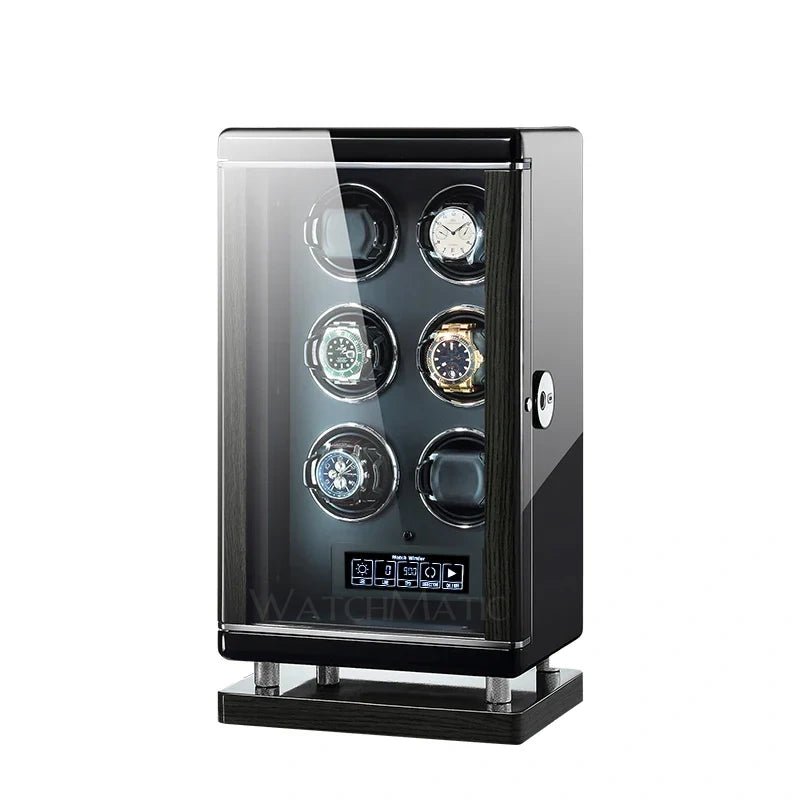
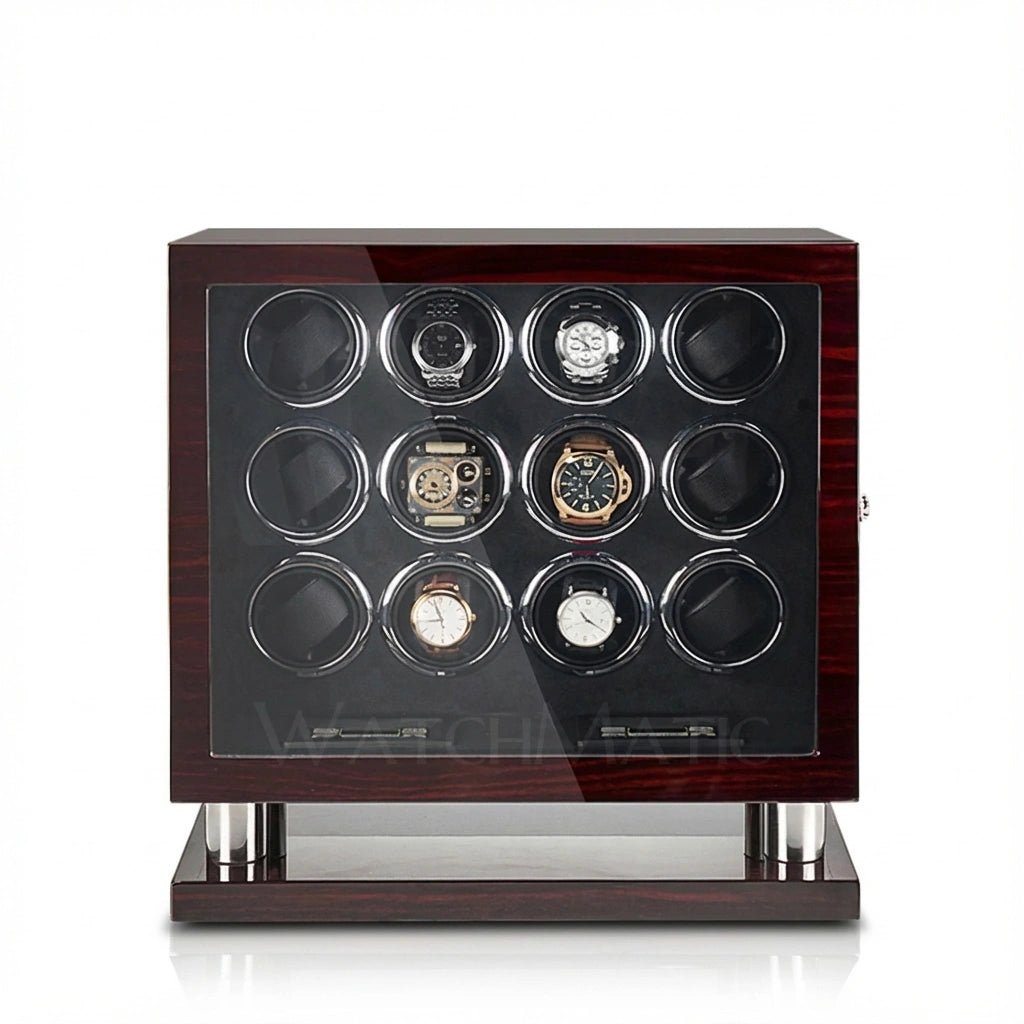
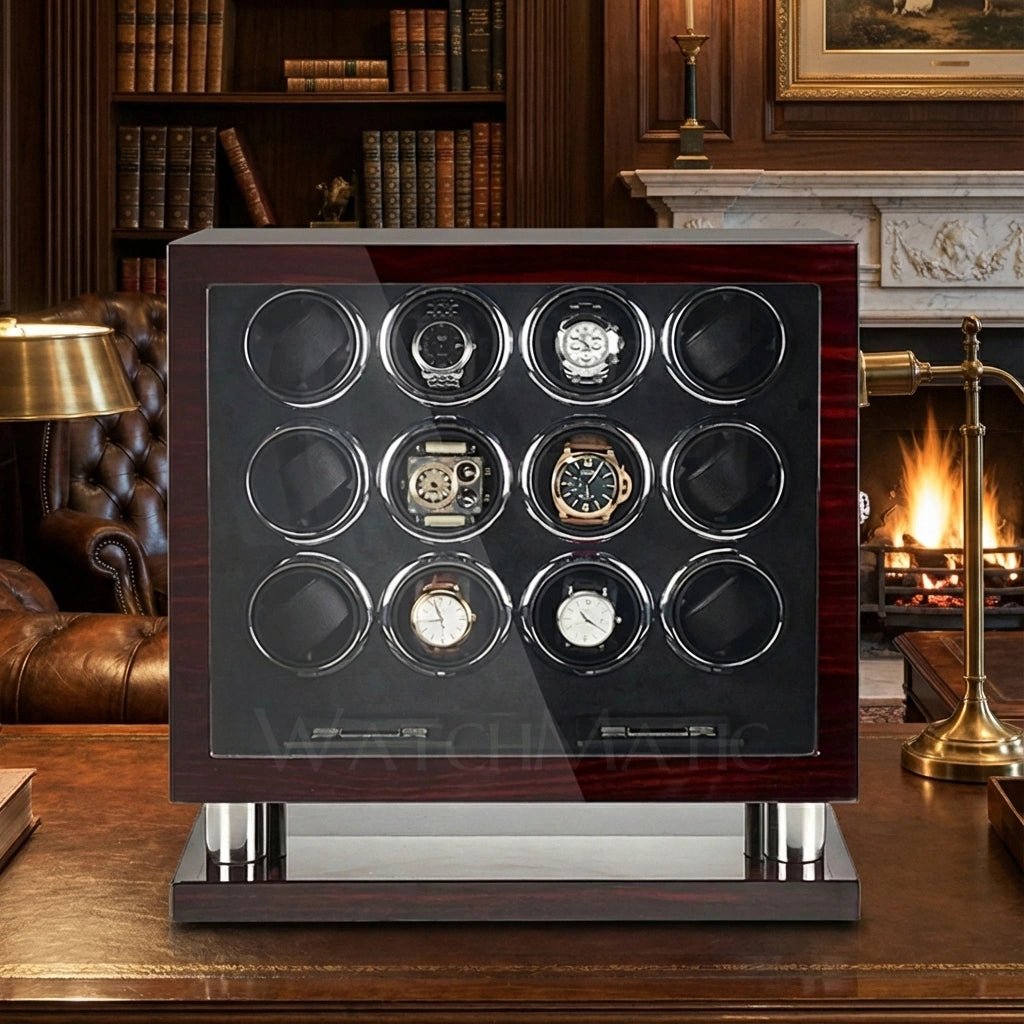
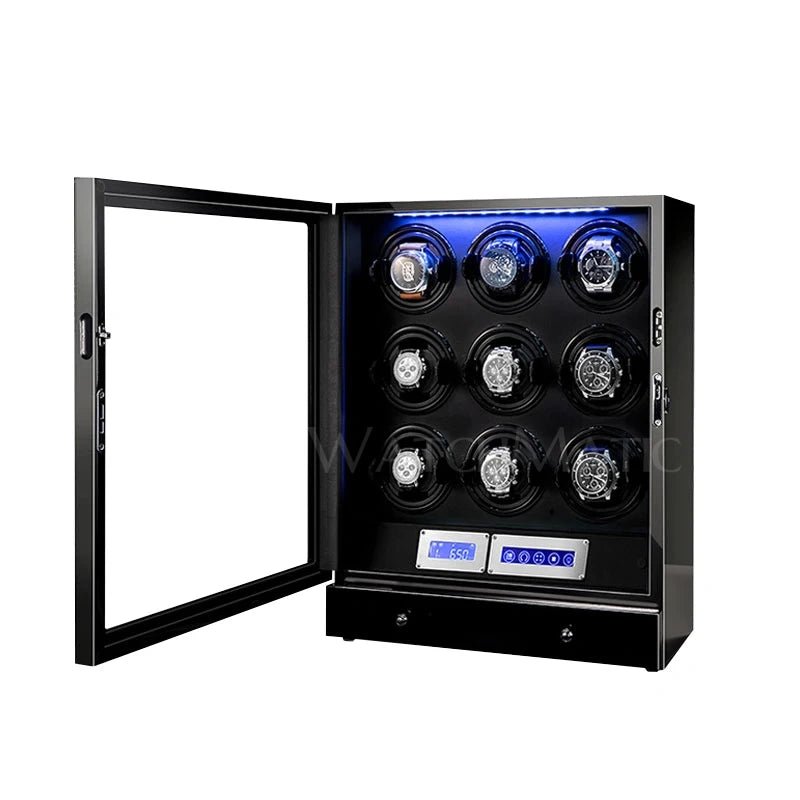
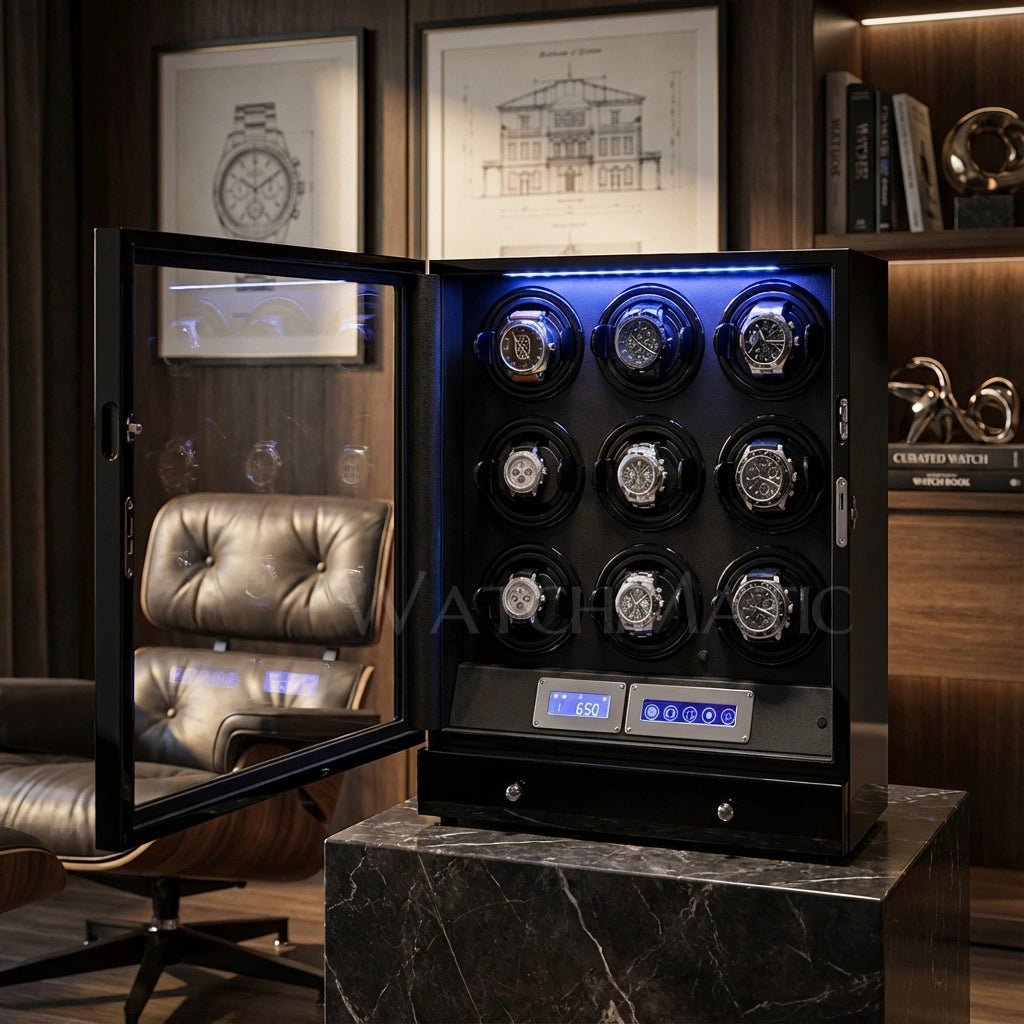
The Vento Luxury Quad Watch Winder provides four independently controlled winding positions and can make sense for a compact group of physically compatible automatic URWERK watches.
A possible four-watch architecture could include:
- UR-100V
- UR-150
- UR-102 Reloaded
- UR-120
Each position can be configured independently for:
- TPD
- Rotation direction
- Winding mode
Why Independent Control Is Especially Important for URWERK
A mixed automatic URWERK collection may contain:
- Planetary turbine system
- Standard automatic architecture
- Dual-flow turbine system
- Switchable rotor architecture
- Grinder winding
There is little justification for forcing these systems onto one common program.
Physical Fit Must Be Verified Before Using Vento
This warning is more important for URWERK than for mainstream round watches.
A movement can be fully compatible with automatic winding while the watch itself is:
- Too tall
- Too long
- Too close to the door
- Poorly positioned on the cushion
UR-230 May Be Too Demanding for Some Compact Chambers
Its length and approximately 18.38 mm height deserve particular attention.
UR-1001 Requires a Different Storage Strategy
UR-1001 should not be assumed to fit merely because a winder is described as suitable for “large watches.”
Its dimensions are exceptional.
Do Not Rotate Manual URWERKs Just to Fill a Position
A UR-220 or EMC may physically sit on a rotor.
That does not mean the rotation winds it.
Powered positions are better used for genuine automatic references.
Is It Safe to Keep an Automatic URWERK on a Watch Winder?
A properly configured premium winder can be appropriate for a confirmed automatic URWERK.
Important factors include:
- Exact reference identification
- Exact caliber identification
- Automatic-system status
- Appropriate TPD
- Appropriate rotation direction
- Controlled rest periods
- Low-vibration operation
- Stable physical support
- Sufficient chamber clearance
UR-230 Requires System-State Awareness
If the owner changes the rotor switch after setting up the winder, the effectiveness of the program can change completely.
Historical UR-210 Requires Similar Awareness
Its winding-efficiency controls can influence how the automatic system behaves.
A Watch Winder Does Not Service an URWERK
A winder does not:
- Repair turbine systems
- Service satellite gears
- Service retrograde mechanisms
- Maintain an EMC electronic module
- Regulate timing
- Replace lubricants
- Reset oil-change indicators
- Maintain a flyback system
- Service a Grinder mechanism
- Replace professional maintenance
Its mechanical role is limited to providing motion to a compatible automatic winding system.
Watch Winder vs. Watch Safe for URWERK Collectors
URWERK is one of the strongest brands in the series for a mixed powered-and-stationary secure-storage strategy.
| Feature | Standalone Winder | Watch Winder Safe |
|---|---|---|
| Automatic winding | Yes | Yes |
| Independent programming | Available | Available |
| Manual URWERK storage | Possible | Yes |
| Physical security | Limited | High |
| Controlled access | Limited | High |
| Unusual case storage | Model dependent | More configurable |
| High-value limited editions | Limited protection | High |
| Mixed automatic/manual collection | Moderate | Strong |
| Large URWERK collection | Moderate | Highly relevant |
Collectors requiring both automatic winding and secure storage can explore the Watch Winder Safe Collection.
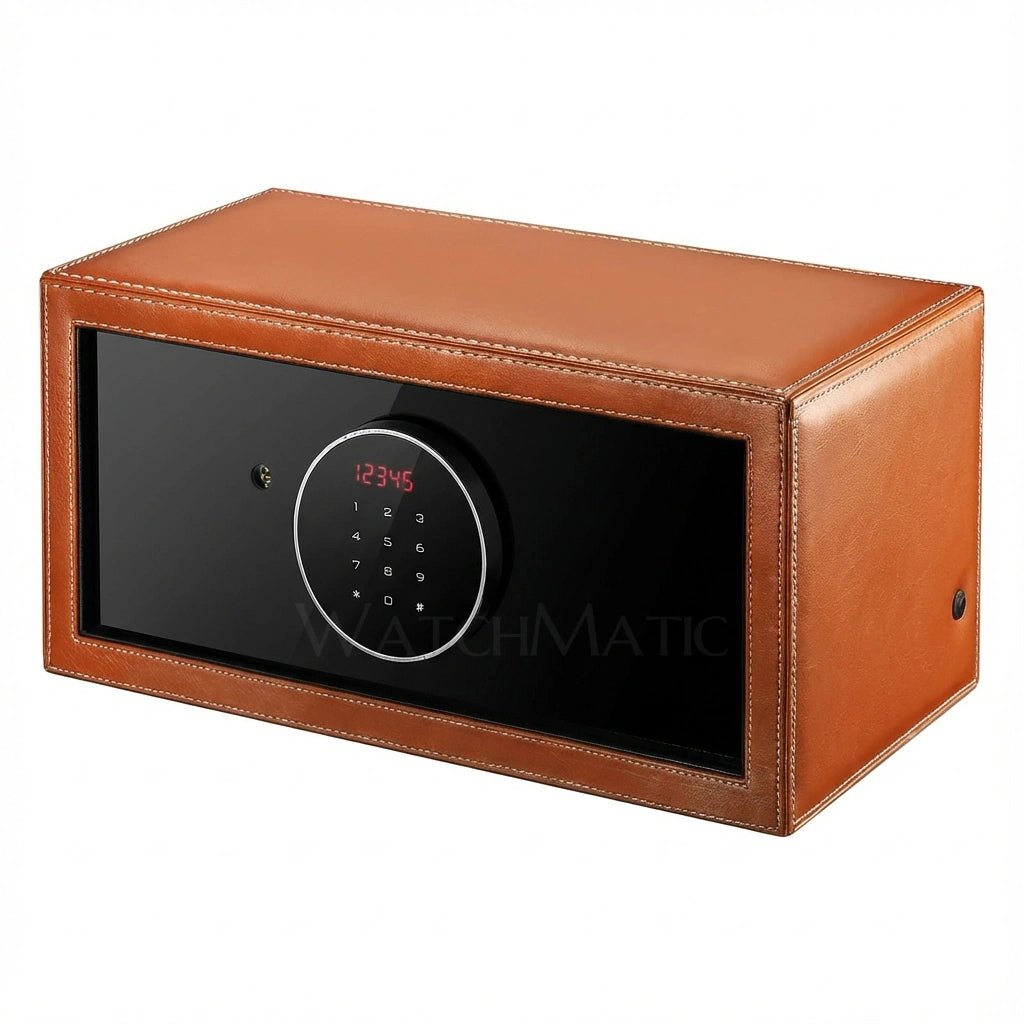
Titan Vault 20 for an URWERK Collection

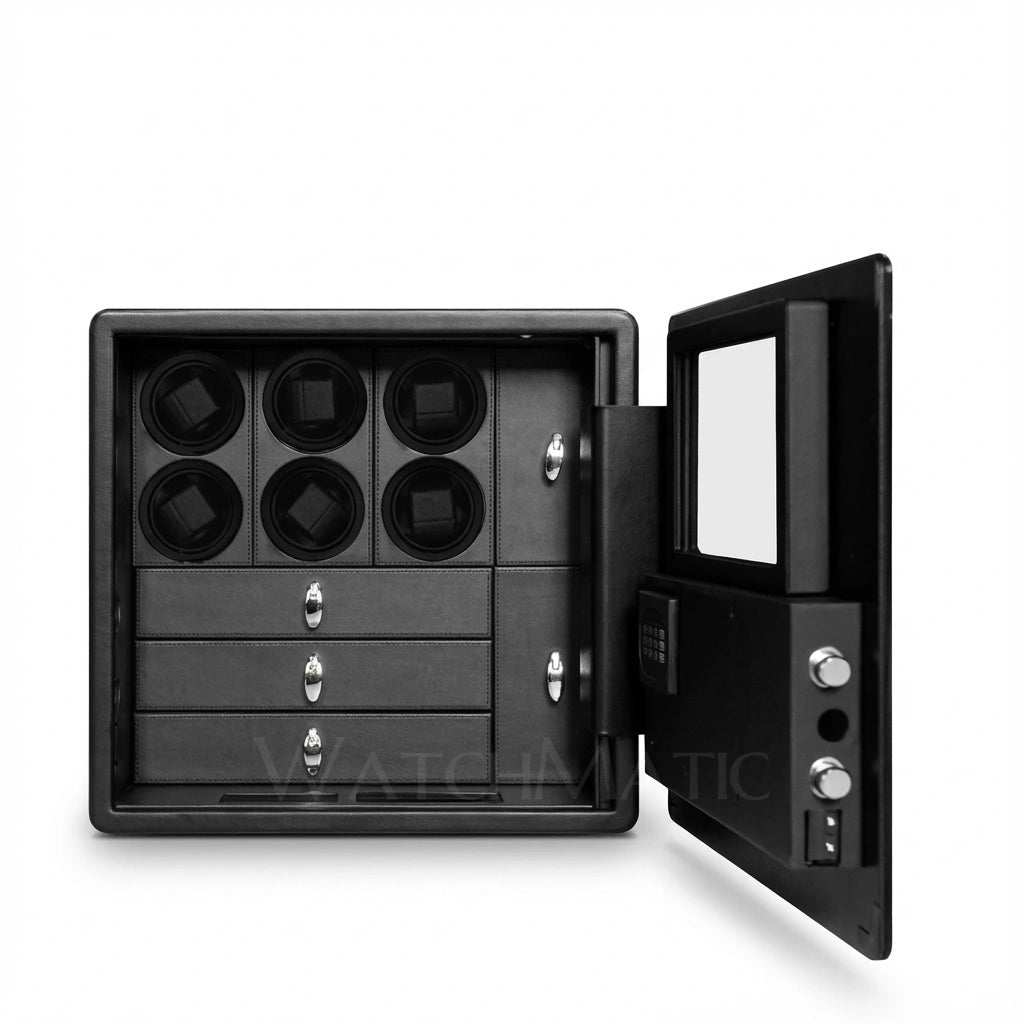
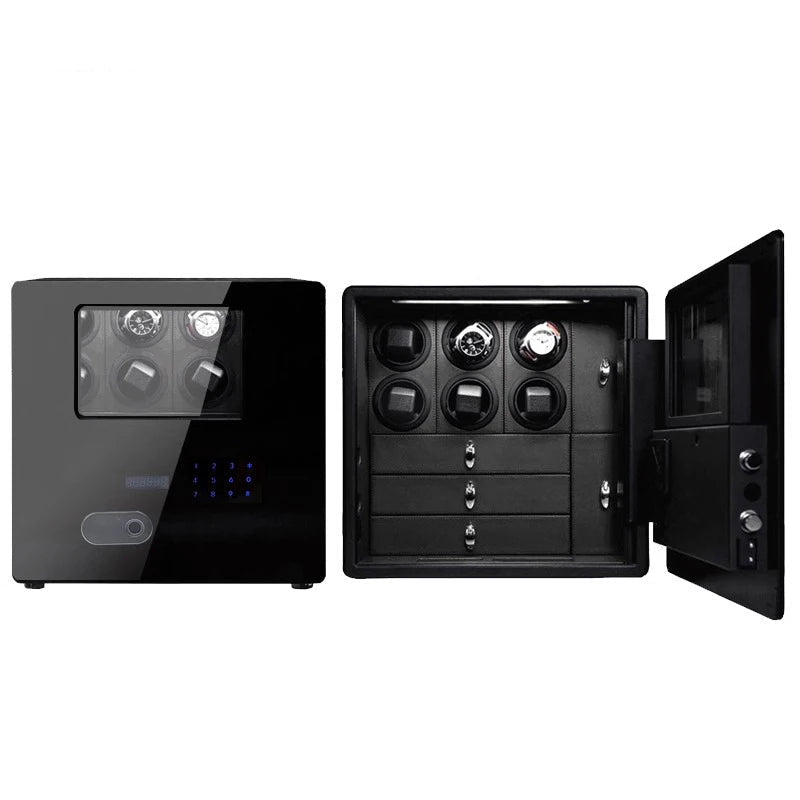
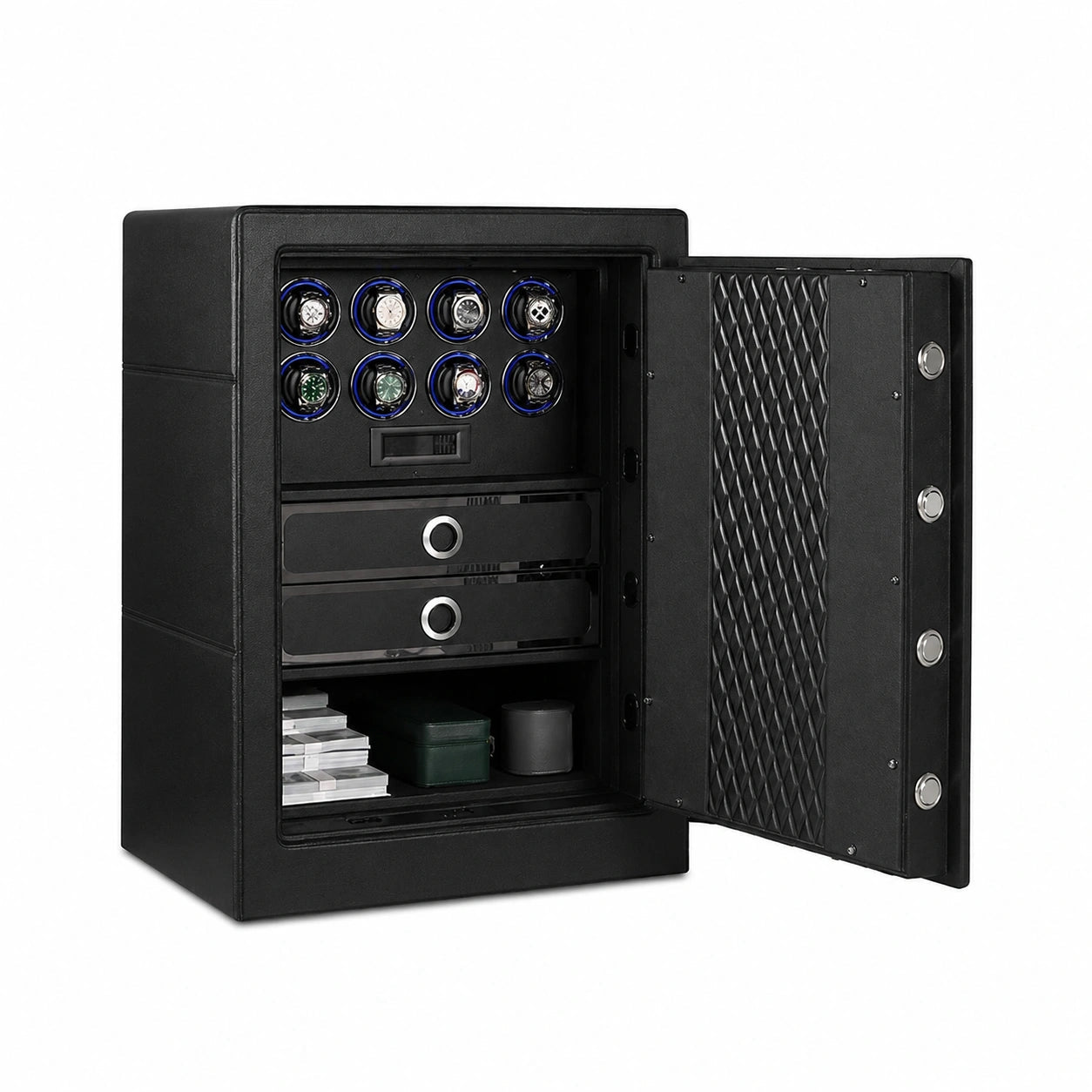
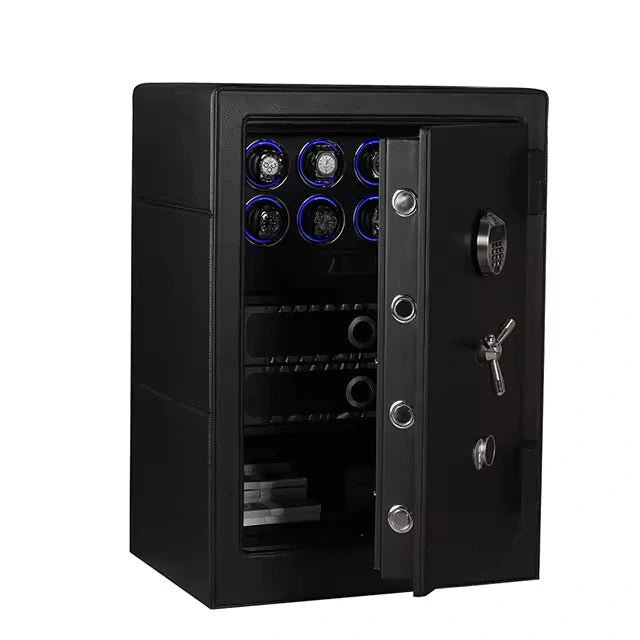
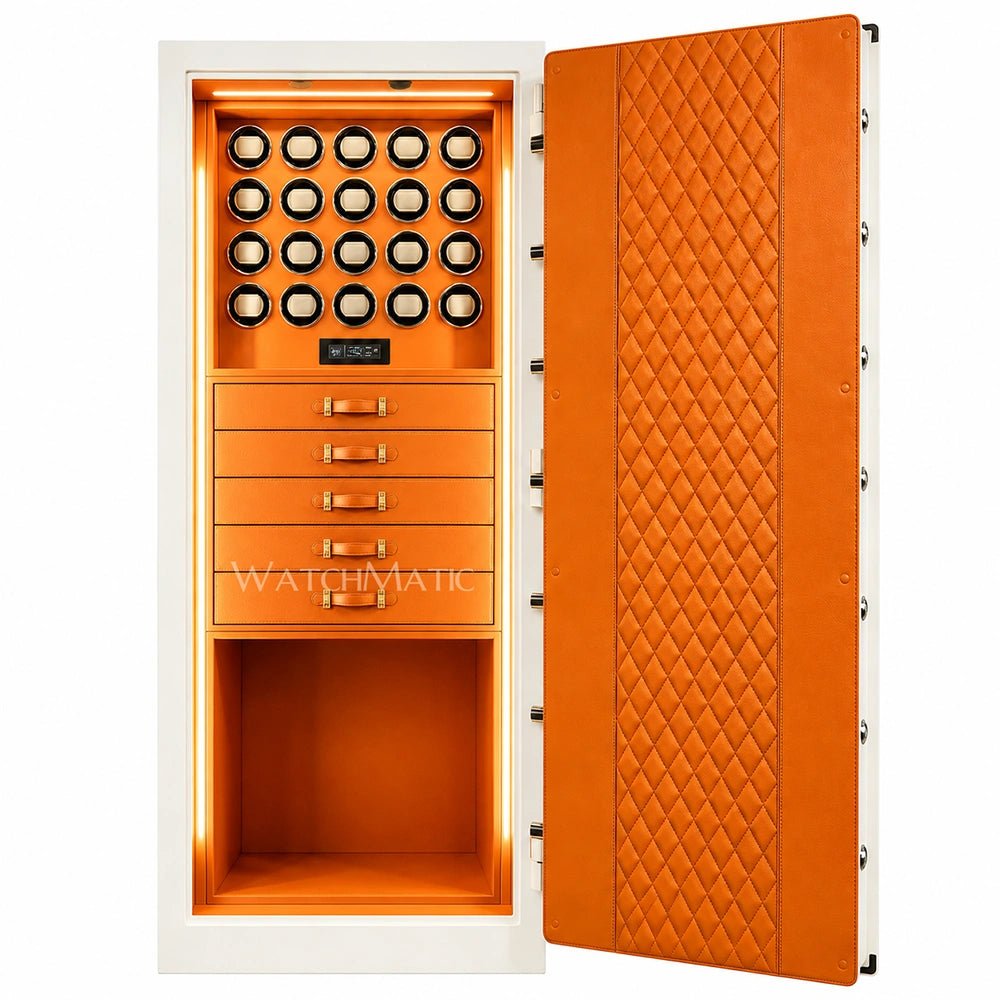
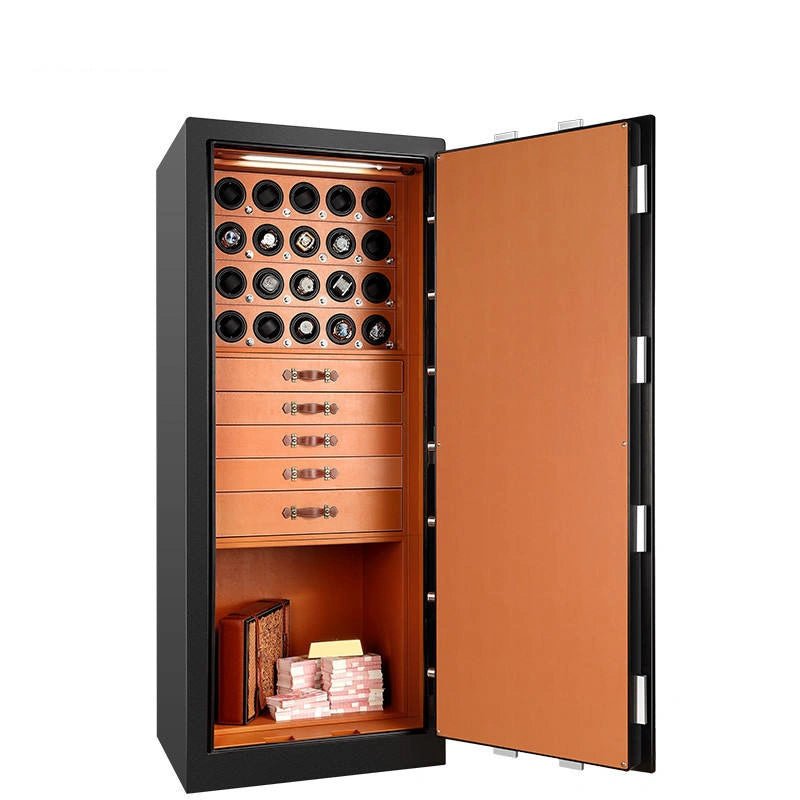
For a larger URWERK or mixed independent haute-horlogerie collection, the Titan Vault 20 Watch Winder Safe combines 20 individually controlled winding positions with secure storage architecture.
Available features include:
- Monolithic solid-steel body
- 10-layer reinforced exterior shell
- Biometric fingerprint access
- Digital passcode
- Manual key access
- Floor anchoring
- LCD touchscreen
- Japanese Mabuchi motors
- Independent winding controls
- Adjustable TPD from 650 to 2200
- CW/CCW/bidirectional operation
- Anti-magnetization protection
- Adjustable LED illumination
- Ultra-quiet operation below 10 dB
- 10-year warranty
EN 15659 LFS 60 P fire certification and UL TL-30 / EN 1143-1 Grade III security certification are available upon request, rather than being standard on every configuration.
Why Titan Vault 20 Has Strong Relevance for URWERK
URWERK is a materially stronger security case than mainstream enthusiast-watch brands.
A serious collection can include:
- UR-230
- UR-150
- UR-100V
- UR-112
- UR-FREAK
- EMC
- UR-220
- UR-1001
- Historical limited editions
Individual references can occupy very high-value and low-production categories.
Powered Positions Are Only Half the Story
Some URWERKs are:
- Automatic
- physically suitable for rotation
Others are:
- Manual
- highly valuable
- better stored stationary
Therefore, the ideal safe is not simply:
maximum rotor count.
It is:
appropriate powered positions + configurable stationary security.
The Most Valuable URWERK May Not Need a Rotor
A manually wound:
- EMC
- UR-220
- rare historical satellite
- special chronometry piece
can still have very high collector value.
Meanwhile, a current self-winding satellite watch may genuinely use a powered position.
Therefore:
security relevance ≠ winding relevance.
UR-1001 Demonstrates Another Issue
The challenge can be neither:
- automatic vs. manual
nor:
- security
but simply:
physical dimensions.
Large exceptional pieces may require bespoke internal configuration.
Titan Vault 20 Should Be Configured Around the Actual Collection
For URWERK, chamber dimensions and drawer layout can be as important as TPD range.
Before ordering, inventory:
- Case width
- Case length
- Height
- strap circumference
- automatic/manual architecture
for every Machine.
When Stationary Watch-Safe Storage Is More Appropriate
If an URWERK collection is dominated by:
- UR-220
- EMC
- EMC TimeHunter
- historical UR-103
- other manual special pieces
then a large number of motorized positions may be unnecessary.
In that situation, the Luxury Watch Safe Collection may be more appropriate.
URWERK in a Mixed Independent Haute Horlogerie Collection
URWERK naturally appears alongside brands known for unconventional movement architecture and independent watchmaking.
A mixed collection might include:
URWERK + MB&F + De Bethune + H. Moser & Cie. + Czapek + Christophe Claret
Related WatchMatic guides include:
Best Watch Winder for MB&F Watches
Best Watch Winder for De Bethune Watches
Best Watch Winder for H. Moser & Cie. Watches
Best Watch Winder for Czapek Watches
Best Watch Winder for Christophe Claret Watches
A collection at this level benefits far more from independent programming than from a universal luxury-watch setting.
URWERK vs. MB&F
Both brands use highly unconventional displays and case architecture.
Both also mix:
- Automatic
- Manual
- Special winding concepts
A visual impression of mechanical motion tells you very little about whether a conventional watch winder is useful.
URWERK vs. De Bethune
Current De Bethune is strongly manual-heavy.
Current URWERK Satellite and Special Project references contain a substantial number of automatics.
A multi-position winder is therefore easier to justify for an automatic-heavy URWERK collection.
URWERK vs. H. Moser & Cie.
Both brands demonstrate that movement architecture can change dramatically inside one manufacture.
However, URWERK goes further by integrating:
- Turbine controls
- Rotor switches
- efficiency selectors
- specialized automatic systems
into the winding question itself.
URWERK vs. Czapek
Czapek's automatic architecture is comparatively conventional despite sophisticated micro-rotors and complications.
URWERK often makes the automatic winding system itself part of the conceptual design.
How to Choose the Best Watch Winder for Your URWERK
Step 1: Identify the Exact Reference
Determine whether the watch is:
- UR-100V
- UR-101
- UR-102 Reloaded
- UR-120
- UR-150
- UR-230
- UR-10
- UR-111C
- UR-112
- UR-FREAK
- UR-1001
- EMC
- UR-220
- another historical reference
Step 2: Identify the Exact Caliber
Important examples include:
- UR 12.02
- UR-1.01V
- UR-2.02
- UR-20.01
- UR-50.01
- UR-7.30
- UR-10.01
- UR-13.01
- UR-7.20
- UR-EMC
- UR-EMC2
Step 3: Confirm Automatic, Manual or Specialized
Examples:
UR-100V → automatic
UR-102 Reloaded → automatic
UR-120 → automatic
UR-150 → automatic
UR-230 → automatic with rotor disengagement
UR-10 → automatic
UR-112 → automatic
UR-220 → manual
EMC → manual
AMC → manual or master-clock wound
Step 4: Check the Automatic System
For an automatic reference, determine whether it uses:
- Conventional rotor
- Planetary turbine system
- Dual-flow turbine
- Grinder
- Rotor with air-brake regulation
- Winding-efficiency selector
Step 5: Confirm Rotor State
This is especially important for UR-230.
A conventional winder cannot perform its job if the rotor is mechanically disengaged.
Step 6: Check Power Reserve
Representative figures include:
- 39 h — UR-1001 / historical UR-210
- 43 h — UR-10 / UR-150
- 48 h — many current UR-Satellite watches
- 80 h — EMC / EMC TimeHunter manual
Power reserve does not determine winding type.
Step 7: Determine TPD
Use verified caliber-specific information.
Do not derive TPD from:
- Turbine count
- Rotor count
- Complication
- Power reserve
Step 8: Determine Rotation Direction
Choose a winder supporting:
- CW
- CCW
- Bidirectional
Then use exact movement-specific guidance.
Step 9: Measure Physical Dimensions
For URWERK, check:
- Width
- length
- thickness
- sapphire height
- cover movement
- crown/pusher projection
- strap angle
Step 10: Match Rotor Capacity to Automatic Watches
Do not equate:
total URWERK collection size
with:
powered-position requirement.
For broader resources covering winding, TPD, storage, and collection protection, visit the WatchMatic Guide Hub.
Best Watch Winder for URWERK Watches: Final Thoughts
Choosing the best watch winder for an URWERK requires more than determining whether the movement is automatic.
The current portfolio contains several distinct automatic architectures.
The UR-100V UR 12.02 uses a Planetary Turbine Automatic System and provides approximately 48 hours of power reserve.
The current UR-101 generation is self-winding with approximately 48 hours.
The UR-102 Reloaded UR-2.02 is self-winding with approximately 48 hours.
The UR-120 UR-20.01 is automatic with approximately 48 hours.
The UR-150 UR-50.01 is automatic with approximately 43 hours.
The UR-10 SpaceMeter UR-10.01 is automatic, uses a patented dual-flow turbine, and provides approximately 43 hours.
The UR-112 UR-13.01 is automatic with approximately 48 hours.
The UR-FREAK uses automatic Grinder winding architecture.
And the UR-230 UR-7.30 uses one of the most sophisticated systems of all: automatic winding with turbine-controlled airflow and a rotor that can be completely disengaged.
This makes UR-230 particularly important:
automatic watch + rotor locked = conventional watch winder cannot provide normal automatic winding.
At the same time, important URWERKs are manual.
The UR-220 UR-7.20 is manual with approximately 48 hours.
The EMC and EMC TimeHunter are manual with approximately 80 hours, despite their advanced electronic monitoring systems.
Historical UR-103 references are manually wound.
And the AMC uses an even more specialized architecture in which winding can occur through its dedicated atomic master clock rather than through a conventional wristwatch rotor.
Three comparisons summarize URWERK especially well:
UR-220 → manual → 48 h
versus:
UR-230 → automatic/switchable rotor → 48 h.
UR-150 → automatic → 43 h
versus:
historical UR-103 → manual → approximately 43 h.
And most importantly:
UR-230 rotor engaged → watch-winder compatible
versus:
the same UR-230 with rotor disengaged → external rotation cannot provide normal automatic winding.
The central URWERK lesson is therefore:
exact reference and winding-system configuration matter more than collection name, complication, turbine count or power reserve.
For a confirmed automatic URWERK, prioritize:
- Adjustable TPD
- CW/CCW/bidirectional programming
- Independent controls
- Controlled rest cycles
- Smooth low-vibration motors
- Large three-dimensional clearance
- Flexible cushions
- Stable support
- Awareness of rotor/turbine configuration
For UR-220, EMC and other manually wound references, prioritize premium stationary secure storage instead.
The most reliable framework is:
URWERK Reference → Caliber → Automatic / Manual / Specialized → Rotor/Turbine State → Power Reserve → Physical Geometry → TPD/Direction or Stationary Storage
For additional automatic-winding and secure-storage solutions, explore WatchMatic.