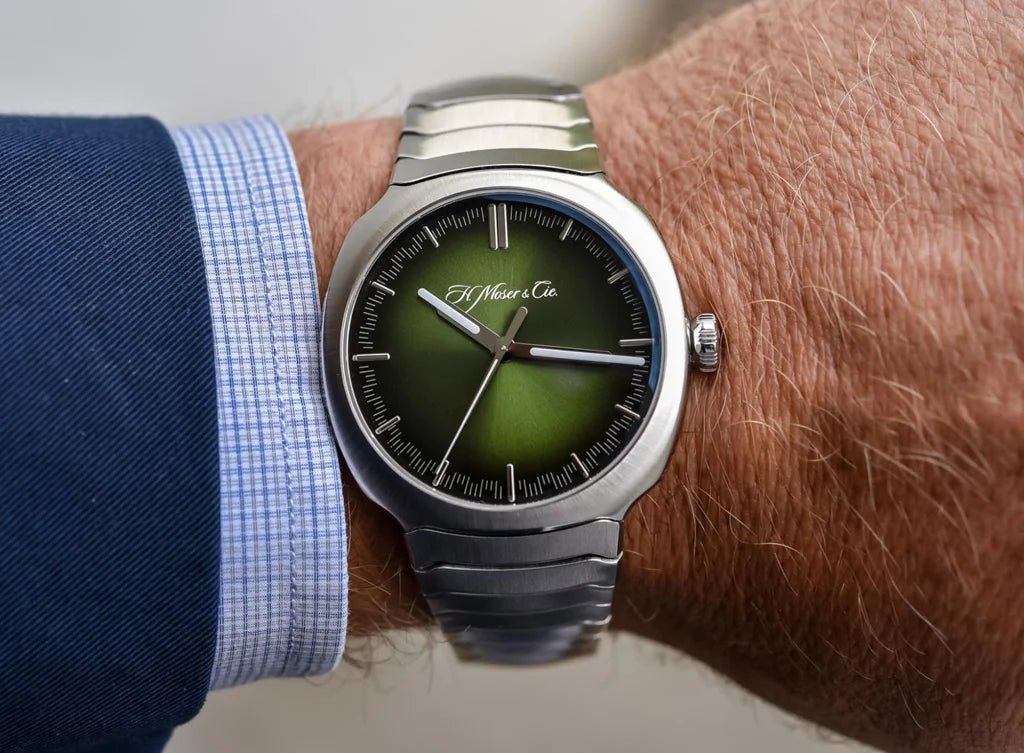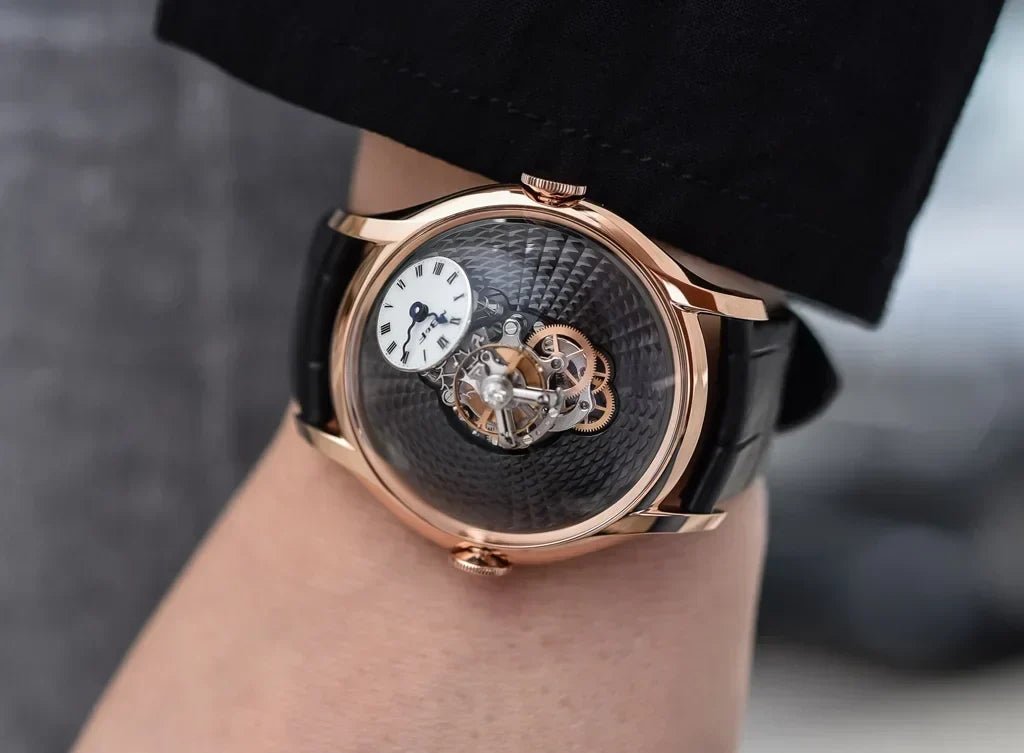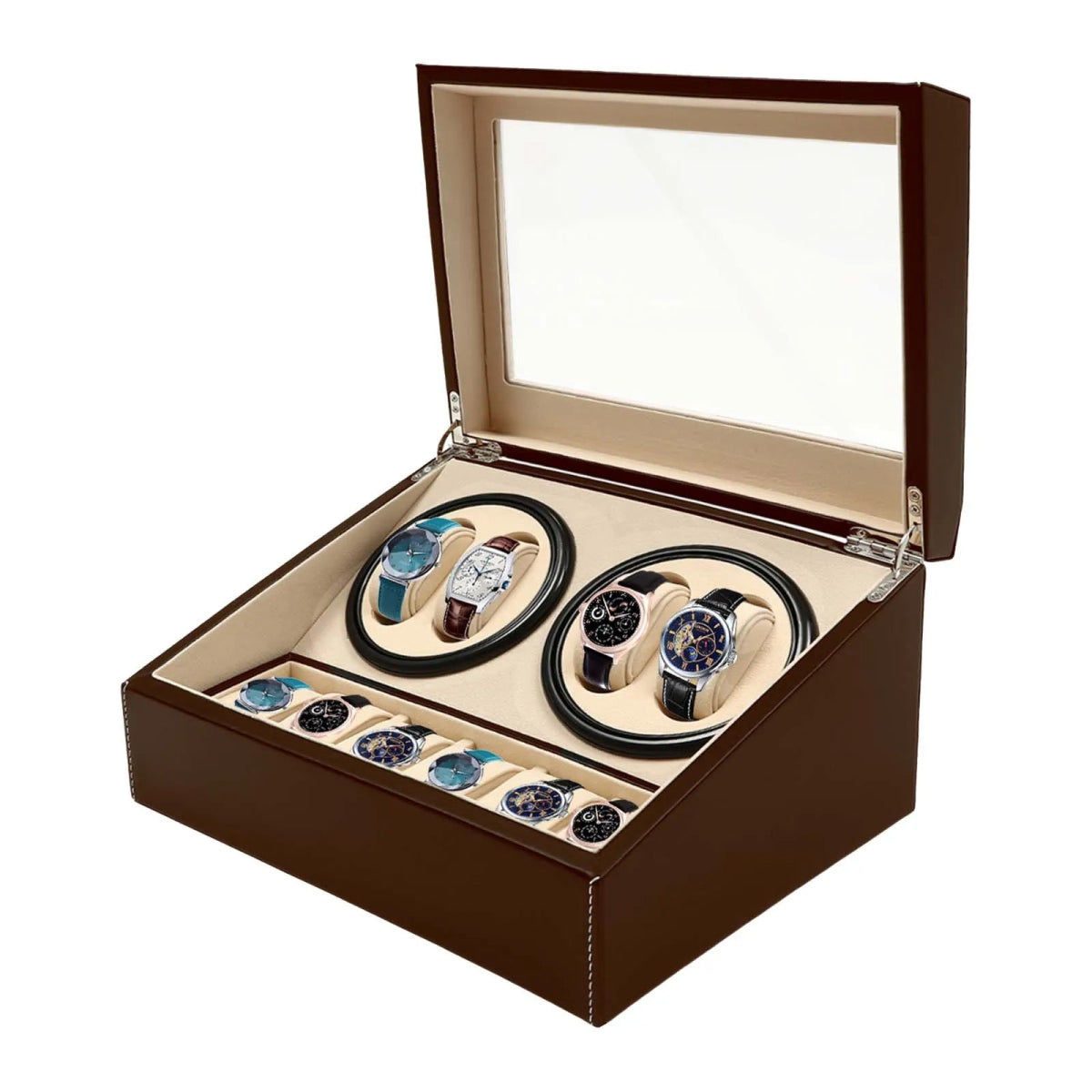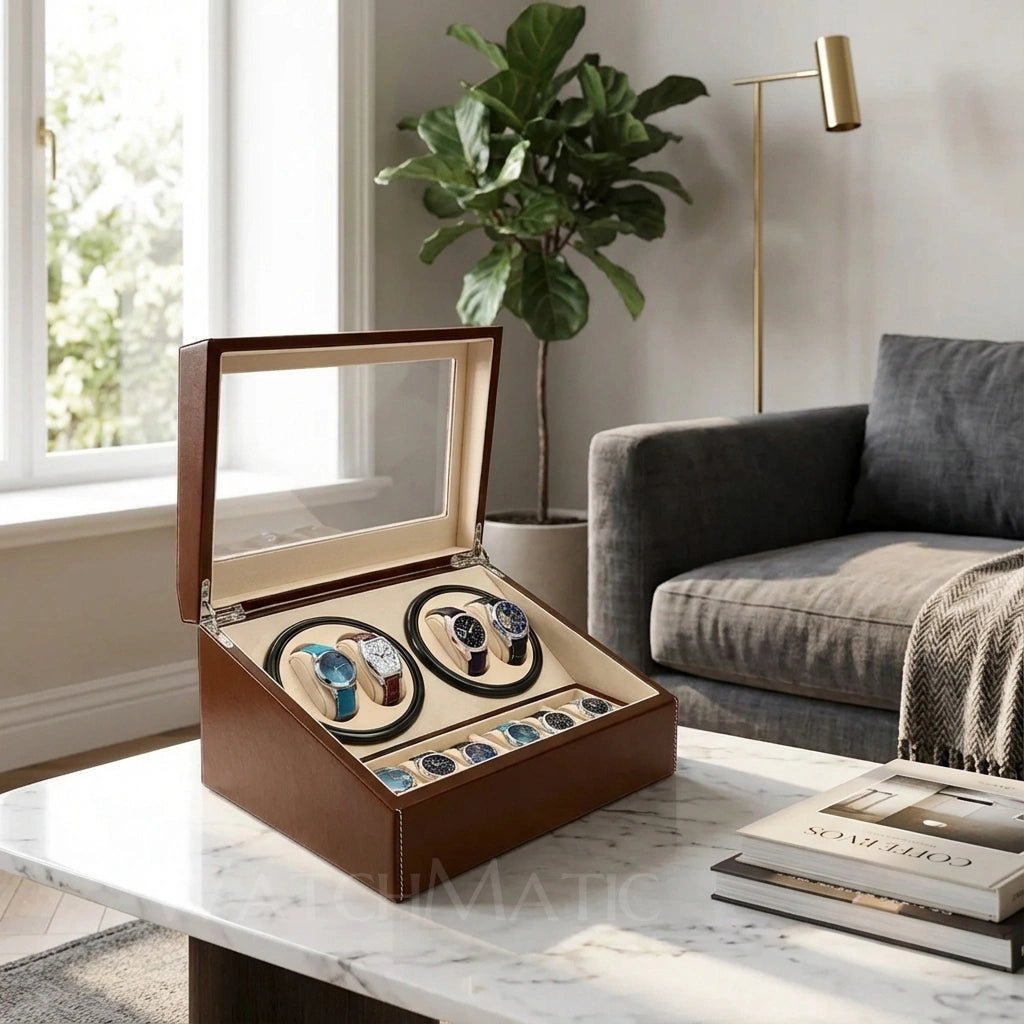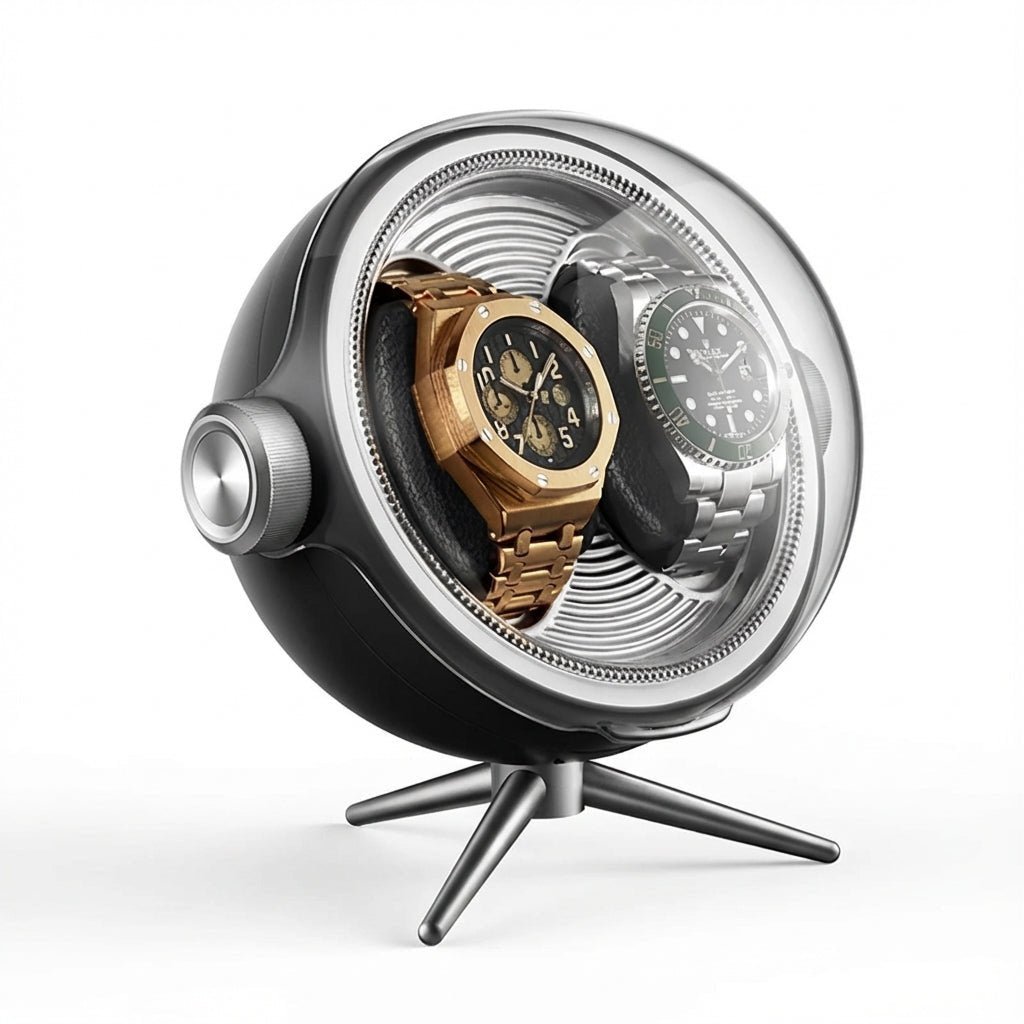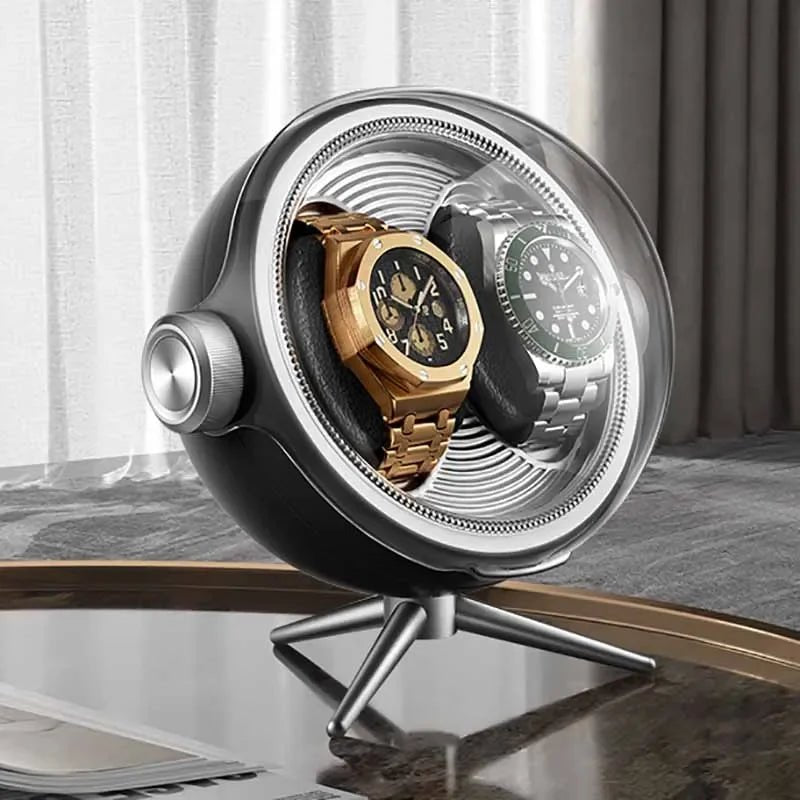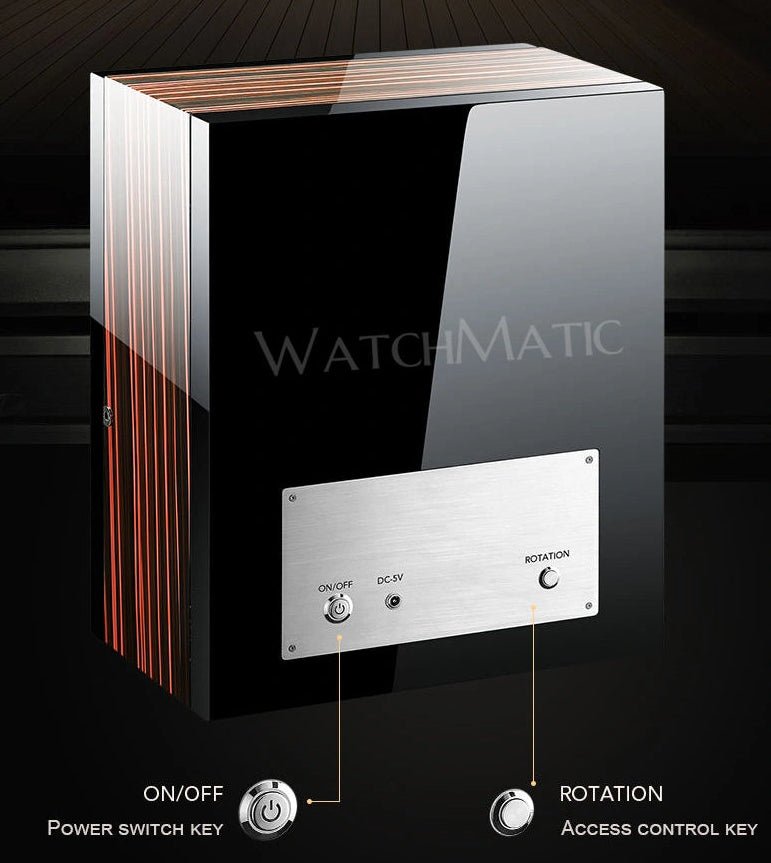
The best watch winder for Formex watches is a programmable model with adjustable Turns Per Day (TPD), clockwise and counterclockwise rotation options, independent controls, controlled rest cycles, quiet operation, and flexible watch cushions for Formex's wide range of bracelets, leather straps, rubber straps, and lightweight titanium cases.
Unlike many mechanical-watch brands, Formex's principal current collections are predominantly automatic.
Important current examples include:
- Aria — FX01 manufacture micro-rotor
- Essence ThirtyNine — Sellita SW200-2 Power+
- Essence FortyOne — Sellita SW200-2 Power+
- Essence Leggera — reference-dependent SW200-1 or SW200-2 Power+
- Essence Ceramica — Soprod Newton P092
- Essence Ceramica Skeleton — Sellita SW200-1 SC
- Reef — Sellita SW300-1
- Reef GMT — Sellita SW330-2
- Field Automatic — Sellita SW200-2 Power+
- AirField — Sellita SW200-2 Power+
- Stratos UTC — ETA 2892 with Dubois-Dépraz GMT module
Representative current power reserves span approximately:
41 hours → 44 hours → 56 hours → 65 hours → 72 hours
depending on the reference.
Therefore, the main Formex watch-winder question is not simply:
automatic or manual?
It is:
Which exact Formex reference and movement do you own?
The correct process is:
Exact Reference → Generation → Caliber → Power Reserve → Winding Architecture → Physical Fit → TPD and Rotation Direction
Does a Formex Watch Need a Watch Winder?
No automatic Formex mechanically requires a watch winder.
A self-winding mechanical watch uses an oscillating rotor to convert wrist movement into energy stored in the mainspring.
If the watch remains unworn longer than its available power reserve, it eventually stops.
A watch winder is therefore primarily a convenience and storage device.
It can help:
- Keep a Formex automatic running between wears
- Maintain the time and date
- Keep GMT indications synchronized
- Keep the Stratos UTC ready for travel
- Reduce repeated restarting
- Maintain several Formex watches in rotation
- Organize a mixed automatic-watch collection
Allowing a modern Formex automatic watch to stop normally is not inherently harmful.
A watch winder should not be treated as a maintenance substitute or as something that automatically extends movement life.
For a broader explanation, see the Watch Winder Guide.
Formex's Own Watch-Winder Philosophy
Formex is unusually useful in this discussion because the brand itself has addressed watch-winder use.
Its published guidance makes several sensible distinctions.
A watch winder can be convenient.
It is not automatically beneficial for mechanical longevity.
A poorly configured winder can create unnecessary operating time.
The important variables are:
- Correct Turns Per Day
- Correct rotation direction
- Controlled operating cycles
- Appropriate rest periods
That aligns with the central principle of this guide:
use enough winding to maintain the watch, not the maximum winding available.
Which Formex Watches Can Use a Watch Winder?
Representative current and recent references include:
| Formex watch | Movement | Type | Approx. power reserve | Conventional winder? |
|---|---|---|---|---|
| Aria | FX01 | Automatic micro-rotor | 72 h | Yes |
| Essence 39 current generation | SW200-2 Power+ | Automatic | 65 h | Yes |
| Essence 41 current generation | SW200-2 Power+ | Automatic | 65 h | Yes |
| Essence Leggera selected updated refs | SW200-2 Power+ | Automatic | 65 h | Yes |
| Essence Leggera earlier / selected refs | SW200-1 | Automatic | 41 h | Yes |
| Essence Ceramica | Soprod Newton P092 | Automatic | 44 h | Yes |
| Essence Ceramica Skeleton | SW200-1 SC | Automatic skeleton | 41 h | Yes |
| Reef 39.5 / 42 | SW300-1 | Automatic | 56 h | Yes |
| Reef GMT | SW330-2 | Automatic GMT | 56 h | Yes |
| Field Automatic | SW200-2 Power+ | Automatic | 65 h | Yes |
| AirField | SW200-2 Power+ | Automatic | 65 h | Yes |
| Stratos UTC | ETA 2892 + DD module | Automatic GMT | 42 h | Yes |
The important lesson is:
the Formex name alone is not enough to determine the correct winder program.
Why Formex Requires Exact Reference Identification
Formex has changed movements quite aggressively.
An owner researching an older article may find:
SW200-1 → 41 hours
while a new reference that looks very similar may now use:
SW200-2 Power+ → 65 hours.
Likewise, two watches sharing the Essence name can use completely different movement families.
Examples include:
- SW200-2 Power+
- SW200-1
- SW200-1 SC
- Soprod Newton P092
That makes generation identification particularly important.
2026 Is an Important Formex Movement Transition Year
Several major Formex collections received significant movement updates in 2026.
The current Essence 39 moved from an earlier approximately 41-hour platform to:
SW200-2 Power+ → 65 hours
The Essence 41 also uses:
SW200-2 Power+ → 65 hours
The Field Automatic moved to the same 65-hour architecture.
The new AirField also launches with the Power+ movement.
And above the mainstream collections, the new Aria introduced:
FX01 → micro-rotor → 72 hours.
This creates a noticeably different movement landscape from Formex articles written only a few years earlier.
Best Watch Winder for Formex Aria
The Formex Aria Manufacture Chronometer is the most technically important new watch in the current collection.
It uses:
FX01
a manufacture micro-rotor caliber developed specifically for Formex.
Representative specifications include:
- Automatic micro-rotor winding
- Tungsten micro-rotor
- 72-hour power reserve
- 25,200 vibrations per hour
- Silicon hairspring
- Silicon escape wheel
- Silicon pallet fork
- COSC certification
- 25 jewels
It is also the first exclusive manufacture movement used by Formex.
Why FX01 Matters for Watch-Winder Research
Before Aria, much of Formex's collection relied on familiar Swiss third-party architectures.
FX01 changes this.
A generic setting copied from:
- SW200
- SW300
- ETA 2892
should not automatically be applied to the Aria simply because all are Swiss automatic movements.
The exact FX01 requirements should take priority.
Micro-Rotor Does Not Mean Higher TPD
The FX01 uses a micro-rotor rather than a full-diameter central rotor.
A common misconception is:
smaller rotor = more rotations required.
That is not a safe assumption.
The movement was specifically engineered around its tungsten micro-rotor and high-efficiency winding architecture.
The correct approach is:
movement-specific TPD
rather than:
compensating for rotor size with maximum TPD.
Best Watch Winder Setup for Formex Aria
For an Aria, prioritize:
- Adjustable TPD
- CW/CCW/bidirectional capability
- Controlled rest cycles
- Smooth acceleration and stopping
- Low vibration
- Independent programming
- Compressible integrated-bracelet support
The movement is sophisticated enough that a fixed-output cheap winder is a poor match.
72 Hours Reduces Aria's Dependence on a Winder
The Aria provides approximately:
72 hours of power reserve.
That gives the owner roughly three days of autonomy under ideal conditions.
For a frequent wearer, this may make a winder unnecessary.
For example:
Frequent wearer
Aria on Monday.
Another watch Tuesday.
Aria again Wednesday.
The FX01 may remain running.
Larger collection owner
Aria worn once every week or two.
The movement will eventually stop.
A winder becomes more useful.
Therefore:
longer reserve reduces dependence on a winder.
Ultra-Thin Does Not Mean Fragile Winder Requirements
The Aria is only approximately:
6.9 mm thick
despite being automatic.
That slimness comes partly from the micro-rotor architecture.
It does not mean the watch needs:
- Faster rotation
- Slower rotation
- Special TPD simply because it is thin
The movement still determines the winding program.
Aria Integrated Titanium Bracelet Fit
The Aria uses a fully integrated Grade 5 titanium bracelet.
This creates an important physical consideration.
A bracelet sized closely to a smaller wrist may not fit around an oversized rigid cushion.
Choose a holder that:
- Compresses sufficiently
- Allows natural clasp closure
- Does not tension the links
- Keeps the lightweight watch centered
Lightweight Titanium Does Not Reduce TPD
The complete Aria is exceptionally light for an integrated-bracelet mechanical watch.
That changes:
- Cushion loading
- wearing comfort
- physical stability
It does not directly change:
- Rotor winding requirement
- Power reserve
- Appropriate TPD
Therefore:
lighter watch ≠ lower TPD.
Silicon Technology Does Not Determine Winder Settings
FX01 uses extensive silicon components.
This contributes to:
- Low friction
- Magnetic resistance
- movement efficiency
It does not create a specific watch-winder setting.
Therefore:
silicon escapement ≠ special TPD program.
Best Watch Winder for Formex Essence 39
The current Essence ThirtyNine received an important 2026 movement upgrade.
Current-generation references use:
Sellita SW200-2 Power+
with approximately:
65 hours of power reserve.
That is a substantial increase over previous SW200-1-based versions.
Essence 39: 41 Hours to 65 Hours
This is one of the strongest Formex-specific information-gain points.
Earlier Essence 39 references can be encountered with approximately:
41 hours
while current-generation models now provide:
65 hours.
The current Power+ movement also introduces improvements in winding efficiency and shock resistance.
Therefore, advice written for an earlier Essence should not automatically be reused for the latest generation.
Exact Generation Matters
Consider:
Earlier Essence 39
SW200-1 family
Approximately 41 hours
Current Essence 39
SW200-2 Power+
Approximately 65 hours
Both watches may look recognizably like an Essence 39.
Their movement generation differs.
Therefore:
Essence 39 generation > collection name alone
when selecting a winder program.
Best Winder Setup for Current Essence 39
Prioritize:
- Adjustable TPD
- Multiple rotation modes
- Controlled rest cycles
- Quiet motor
- Bracelet and leather-strap compatibility
- Smooth winding cycles
The case itself is compact:
39 mm diameter
and approximately:
10 mm thick.
Physical chamber clearance should rarely be an issue.
65 Hours Makes Weekend Storage Easier
A 65-hour reserve significantly reduces the likelihood that the watch stops during a short weekend rotation.
That means many Essence owners may not need a powered winder at all if they regularly return to the watch.
The winder becomes more useful as total collection size grows.
Best Watch Winder for Formex Essence 41
The current Essence FortyOne also uses:
Sellita SW200-2 Power+
with approximately:
65 hours of power reserve.
Representative specifications include:
- 41 mm case
- Approximately 10.6 mm thickness
- COSC-certified movement
- Screw-down crown
- Case Suspension System
- Steel bracelet or interchangeable straps
Essence 39 vs. Essence 41
Current models share the same broad movement architecture.
| Feature | Essence 39 | Essence 41 |
|---|---|---|
| Movement | SW200-2 Power+ | SW200-2 Power+ |
| Winding | Automatic | Automatic |
| Reserve | 65 h | 65 h |
| Diameter | 39 mm | 41 mm |
| Main physical difference | Smaller fit | Larger fit |
This is an example where two different case sizes can legitimately share similar movement logic.
Larger Case Does Not Need More TPD
The 41 mm model does not require more daily turns simply because it is larger.
Case size affects:
- Cushion fit
- visual proportions
- weight
not the automatic winding requirement.
Case Suspension System Does Not Change TPD
The patented Formex Case Suspension System allows parts of the case to move relative to each other using integrated springs.
Its objectives include:
- Comfort
- Impact absorption
It is not part of the winding train.
Therefore:
Case Suspension System ≠ automatic winding system
and:
Case Suspension System ≠ special TPD requirement.
Shock Protection Does Not Mean Aggressive Winding Is Appropriate
A watch engineered to withstand shocks should still be rotated smoothly inside a winder.
There is no reason to use:
- Abrupt starts
- High-speed motion
- Continuous spinning
simply because the case includes shock-absorption technology.
COSC Certification Does Not Determine TPD
Many Formex watches are COSC-certified.
COSC concerns chronometric accuracy.
It does not prescribe:
- Daily turns
- Winding direction
- Winder cycle timing
Therefore:
COSC chronometer ≠ one universal Formex winder setting.
Best Watch Winder for Formex Essence Leggera
The Essence Leggera deserves special attention because movement specifications vary by exact reference and production generation.
Some references use:
SW200-1 → approximately 41 hours
while updated references can use:
SW200-2 Power+ → approximately 65 hours.
This makes Leggera one of the clearest examples where owners should verify the exact watch.
Do Not Assume Every Essence Leggera Has 41 Hours
Older product pages and earlier reviews often describe the Leggera with:
SW200-1 / 41 hours.
That information remains correct for those references.
It is not automatically correct for newer Power+ versions.
Do Not Assume Every Leggera Has 65 Hours Either
The reverse error is also possible.
Some special editions and existing references continue to be documented with SW200-1 architecture.
Therefore:
Leggera → exact reference → movement
is the appropriate research order.
Carbon Fiber and Ceramic Do Not Change TPD
Leggera uses:
- Proprietary carbon-fiber composite
- Zirconium-oxide ceramic
These substantially change:
- Weight
- scratch resistance
- case feel
They do not directly determine:
- Movement winding direction
- TPD
- Power reserve
Lightweight Construction and Cushion Stability
Because Leggera is extremely light, it places relatively little load on the winder motor.
That does not mean programming becomes irrelevant.
A lightweight watch still needs:
- Correct movement settings
- Secure cushion fit
- Controlled cycles
Best Watch Winder for Formex Essence Ceramica
The current Essence Ceramica is mechanically distinct from the steel Essence.
It uses:
Soprod Newton P092
with approximately:
44 hours of power reserve.
Representative specifications include:
- Automatic winding
- 23 jewels
- Date
- COSC certification
- Chronofiable endurance testing
- Custom skeletonized rotor
Essence Ceramica Is Not Simply a Ceramic Essence With the Same Movement
This is a particularly useful distinction.
Compare:
Current Steel Essence 41
SW200-2 Power+
65 hours
Essence Ceramica
Soprod Newton P092
44 hours
Both are:
- 41 mm
- COSC-certified
- Essence-family watches
- Automatic
But their movements are fundamentally different.
Same Collection Language Does Not Mean Same Movement
This is one of the key Formex lessons.
A consumer might assume:
Essence = SW200
That is no longer accurate across the entire family.
The Ceramica demonstrates why the exact reference matters.
44-Hour Reserve Makes Winder Convenience More Noticeable
At approximately 44 hours, the P092 has less autonomy than the current 65-hour Power+ Essence.
If both watches leave the wrist on Friday:
- The Ceramica is more likely to stop earlier
- The Power+ Essence has greater weekend tolerance
Therefore, the Ceramica can derive somewhat more practical convenience from a winder in a larger rotation.
Chronofiable Testing Does Not Determine Winder Program
The Soprod Newton P092 undergoes durability and shock testing.
That tells the owner something about movement validation.
It does not provide a TPD number.
Therefore:
endurance certification ≠ daily-turn specification.
Full Ceramic Bracelet Fit
The Essence Ceramica can be fitted with a full zirconium-oxide ceramic bracelet.
This makes physical fit important.
Ceramic is extremely hard but can behave differently from steel under severe localized impact.
A holder should:
- Fit without forcing the bracelet
- Allow natural clasp closure
- Prevent the case from moving
- Keep the ceramic away from hard enclosure edges
Best Watch Winder for Essence Ceramica Skeleton
The Essence Ceramica Skeleton uses another movement entirely:
Sellita SW200-1 SC
with approximately:
41 hours of power reserve.
It is automatic and COSC-certified.
Ceramica vs. Ceramica Skeleton
This is arguably one of the strongest Formex technical comparisons.
| Feature | Essence Ceramica | Essence Ceramica Skeleton |
|---|---|---|
| Movement | Soprod Newton P092 | SW200-1 SC |
| Automatic | Yes | Yes |
| Reserve | 44 h | 41 h |
| Display | Conventional dial | Openworked/skeleton |
| COSC | Yes | Yes |
The two watches share:
- Collection
- Case concept
- Ceramic architecture
but not the same movement.
Skeletonization Does Not Determine TPD
The visible gearing of the SW200-1 SC does not mean it needs more winding than a conventional movement.
The openworked architecture is primarily:
- Structural
- aesthetic
The automatic winding requirement remains caliber-specific.
41 vs. 44 Hours Is Not the Main Difference
The numerical difference in reserve is small.
The more important distinction is:
different movement architecture.
Therefore, do not simply average the two and create one “Ceramica setting.”
Best Watch Winder for Formex Reef
Current Reef 39.5 mm and Reef 42 mm watches use the:
Sellita SW300-1
with approximately:
56 hours of power reserve.
The movement is automatic and available in COSC-certified Chronometer grade.
Best Winder Setup for Formex Reef
Prioritize:
- Adjustable TPD
- Multiple rotation directions
- Controlled rest cycles
- Rubber-strap compatibility
- Steel-bracelet compatibility
- Quiet motor
- Secure support
The Reef is particularly easy to configure physically because its strap and bracelet system is highly modular.
56 Hours Provides Useful Autonomy
A 56-hour reserve is longer than the 41–44-hour Ceramica family but shorter than the 65–72-hour current Power+ and Aria movements.
This places Reef in the middle of the current Formex power-reserve spectrum.
Reef 39.5 vs. Reef 42
Both use the SW300-1 architecture.
Their movement logic is therefore broadly similar.
Physical fit differs because of:
- Case diameter
- total weight
- bracelet sizing
300m Water Resistance Does Not Mean More TPD
The Reef is a 300-meter dive watch.
That affects:
- Case construction
- crown sealing
- gaskets
- water resistance
It does not establish:
- Winding direction
- TPD
- Rest cycle
Therefore:
300 m diver ≠ stronger watch-winder program.
Interchangeable Bezel Does Not Affect Winding
Reef's bezel can be exchanged without conventional watchmaking tools.
That feature changes:
- Appearance
- dive or everyday configuration
It does not alter the movement.
Best Watch Winder for Formex Reef GMT
The Reef GMT uses:
Sellita SW330-2
with approximately:
56 hours of power reserve.
Formex specifically documents this movement as:
automatic winding in both directions.
This is useful because the winding direction is clearly stated by the watch manufacturer for this exact application.
Reef GMT Is One of the Best Formex Candidates for a Winder
A GMT contains more synchronized information than a simple three-hand watch.
If it stops, the owner may need to restore:
- Local time
- Date
- 24-hour GMT hand
- relationship with the GMT bezel
Keeping it running reduces repeated setup.
Bidirectional Movement vs. Bidirectional Bezel
The Reef GMT contains two different concepts that should not be confused.
Automatic movement
The SW330-2 is documented as winding in both directions.
GMT bezel
The external bezel can also rotate in both directions.
These are completely separate systems.
One determines:
how the movement winds
The other determines:
how the wearer tracks another time zone.
Bidirectional Winding Does Not Mean Any TPD Is Correct
Even when both rotation directions are useful, the total daily rotation still matters.
Therefore:
bidirectional winding ≠ unlimited rotation.
TPD and direction remain separate programming variables.
GMT Convenience Does Not Mean Continuous Operation Is Required
Allowing the Reef GMT to stop is mechanically normal.
The winder simply provides:
- Readiness
- Convenience
- Reduced resetting
It does not preserve the GMT complication mechanically.
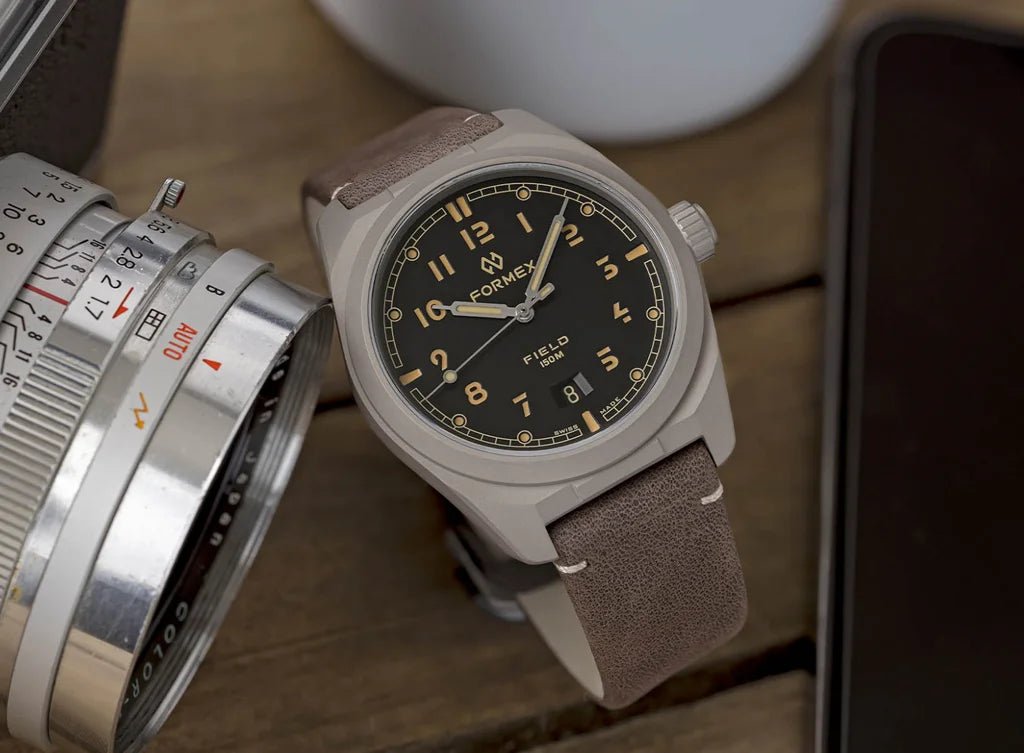
Formex Field Automatic
Current Field Automatic watches use:
Sellita SW200-2 Power+
with approximately:
65 hours of power reserve.
Representative specifications include:
- 40 mm case
- Hard-coated Grade 2 titanium
- 150 m water resistance
- 28,800 vibrations per hour
- Date
- Automatic winding
Best Watch Winder for Formex Field
For a Field Automatic, prioritize:
- Adjustable TPD
- Controlled rest cycles
- Multiple rotation modes
- Nylon/Velcro strap compatibility
- Leather-strap compatibility
- Quiet operation
Its lightweight titanium construction is physically easy on a quality winding motor.
150m Water Resistance Does Not Change TPD
The Field's tool-watch characteristics are independent from its automatic winding requirements.
Therefore:
field watch durability ≠ more daily rotation.
Hard-Coated Titanium Does Not Change Movement Settings
The case can be hardened to approximately 900 Vickers.
This affects:
- Scratch resistance
- surface durability
It does not alter:
- Rotor
- mainspring
- Power reserve
- TPD
Formex AirField
The new AirField extends the Field concept toward aviation.
It uses the same current:
Sellita SW200-2 Power+
with approximately:
65 hours of power reserve.
Representative specifications include:
- 40 mm titanium case
- 150 m water resistance
- Aviation-inspired dial
- Nylon/Velcro or leather strap
- Automatic movement
Field vs. AirField
Movement-wise, current versions are closely related.
| Feature | Field | AirField |
|---|---|---|
| Movement | SW200-2 Power+ | SW200-2 Power+ |
| Reserve | 65 h | 65 h |
| Automatic | Yes | Yes |
| Case | Hardened titanium | Hardened titanium |
| Main theme | Field/tool | Aviation |
The main difference for winding is therefore not the dial concept.
Aviation Design Does Not Affect TPD
Pilot-style hands, numerals, or an aircraft counterweight on the seconds hand do not change automatic winding requirements.
The caliber determines the program.
New AirField References Should Not Be Treated as Old Field Specifications
Because Formex has upgraded its movement platform, older Field articles may mention previous specifications.
For current 2026 references:
check the exact Power+ movement documentation.
Formex Stratos UTC
The Stratos UTC is mechanically very different from other current Formex watches.
It uses:
ETA 2892 automatic base movement
with a:
custom Dubois-Dépraz true-GMT module
and approximately:
42 hours of power reserve.
Best Watch Winder for Formex Stratos UTC
This is one of the strongest Formex use cases for winder convenience.
The watch contains:
- Local time
- UTC/home-time indication
- Quick-set local hour
- Quick-set date
- Day/night indicator
- Third-time-zone capability through the bezel
If it stops, more information must be restored than on a basic three-hand watch.
42 Hours Makes Stratos More Dependent on a Winder
Compared with:
- Aria — 72 h
- Power+ Essence — 65 h
- Reef — 56 h
the Stratos has a shorter reserve:
42 hours.
Therefore, in a large rotation it is more likely to stop between wears.
True GMT Complication Strengthens Convenience Value
The Stratos is designed around travel functionality.
Keeping it running can help preserve:
- UTC reference
- Local time relationship
- Date
- Day/night indication
Again, this is convenience rather than mechanical necessity.
Pushers Do Not Determine Winder Settings
Stratos uses side pushers to move the local hour hand forward or backward.
These pushers are part of the GMT module.
They do not affect:
- Rotor direction
- TPD
- automatic winding efficiency
ETA 2892 Architecture Is Different From SW200 Power+
Even though both are Swiss automatic movements, they should not simply be assigned identical settings.
The Stratos uses:
ETA 2892 + module
while current Essence and Field use:
SW200-2 Power+.
Exact caliber remains the better basis for programming.
Formex Movement Comparison
A simplified current-generation picture looks like this:
| Movement | Main Formex application | Reserve |
|---|---|---|
| SW200-1 SC | Ceramica Skeleton | 41 h |
| ETA 2892 + DD module | Stratos UTC | 42 h |
| Soprod Newton P092 | Essence Ceramica | 44 h |
| SW300-1 | Reef | 56 h |
| SW330-2 | Reef GMT | 56 h |
| SW200-2 Power+ | Essence / Field / AirField | 65 h |
| FX01 | Aria | 72 h |
This range explains why one universal Formex TPD setting is inappropriate.
Longer Reserve Does Not Mean More TPD
Consider:
Ceramica Skeleton → 41 h
Reef → 56 h
Essence Power+ → 65 h
Aria FX01 → 72 h
This does not form a TPD ladder where every longer-reserve watch should receive more daily rotations.
Power reserve and winder requirement are different specifications.
Shorter Reserve Does Not Automatically Mean Higher TPD Either
A shorter reserve may make a winder more useful from a convenience perspective.
It does not automatically mean the movement requires more turns per day.
For example, the Stratos' 42-hour reserve makes it more likely to stop in a rotation.
That tells you about:
ownership convenience
not necessarily:
winding efficiency.
Formex Watch Winder TPD Settings
TPD means Turns Per Day—the approximate number of complete rotations performed by a watch winder during a programmed day.
There should not be one blanket recommendation such as:
“Formex = 650 TPD.”
Current and recent Formex automatic architectures include:
- FX01
- SW200-2 Power+
- SW200-1
- SW200-1 SC
- Soprod Newton P092
- SW300-1
- SW330-2
- ETA 2892 with module
The correct process is:
- Identify the exact Formex model.
- Identify the generation.
- Identify the caliber.
- Determine the winding architecture.
- Determine the appropriate TPD.
- Determine the rotation direction.
- Check whether adequate reserve is maintained.
For a broader explanation of movement-specific TPD programming, see the Watch TPD Guide.
Formex Itself Emphasizes Correct TPD
This is worth highlighting.
Formex has publicly emphasized that a watch winder should not simply run an automatic watch continuously at maximum output.
An automatic movement has mechanisms that manage a fully wound mainspring.
That does not make unnecessary rotation desirable.
The practical target should be:
the minimum effective program that reliably maintains reserve.
What Rotation Direction Should You Use?
A premium programmable watch winder should provide:
CW — Clockwise
CCW — Counterclockwise
Bi — Bidirectional
One exact direction should not be assigned blindly to every Formex movement.
The current portfolio contains several unrelated automatic calibers.
Reef GMT Has Explicit Bidirectional Winding
For the SW330-2 used in the Reef GMT, Formex specifically documents:
automatic winding in both directions.
That gives owners a clear movement-specific data point.
It should not automatically be generalized to:
- FX01
- Newton P092
- every historical Formex caliber
Bezel Direction Is Not Rotor Direction
This deserves emphasis because Formex uses several rotating bezels.
Terms such as:
- unidirectional dive bezel
- bidirectional GMT bezel
describe the external bezel.
They do not describe the automatic winding rotor.
High TPD Is Not Automatically Better
A higher setting does not mean better maintenance.
Once a movement is maintaining adequate reserve, additional turns may provide no practical benefit.
Higher TPD does not automatically:
- Improve COSC accuracy
- Improve lubrication
- Extend service intervals
- Improve shock resistance
- Improve silicon escapement performance
- Increase power-reserve capacity
- Protect a GMT complication
Use:
appropriate winding
rather than:
maximum winding.
Does a Formex Automatic Need to Run All the Time?
No.
Current Formex automatic watches can stop normally.
There is no general requirement to keep them running continuously.
In fact, Formex's own discussion of watch winders explicitly separates convenience from mechanical longevity.
Which Formex Watches Benefit Most From a Winder?
From a practical convenience perspective:
Stronger convenience case
- Stratos UTC — 42 h plus travel complication
- Reef GMT — 56 h plus GMT
- Ceramica Skeleton — 41 h
- Essence Ceramica — 44 h
- Large mixed collection
Moderate convenience case
- Reef — 56 h
- Standard current Essence — 65 h
- Field — 65 h
- AirField — 65 h
Lower dependence
- Aria FX01 — 72 h
- Frequently worn Power+ models
This is not a ranking of quality.
It is simply a measure of how useful continuous readiness may be.
Complication Can Matter More Than Reserve
Compare:
Aria
72 hours
Simple time display
Easy to reset
Stratos UTC
42 hours
Multiple timezone indications
More setup after stopping
The Stratos has the shorter reserve and the more complicated reset procedure.
A winder therefore has a stronger convenience case.
Should You Restart a Stopped Formex Before Using a Winder?
A watch winder is best understood as a:
maintenance-winding device.
If a Formex automatic has fully stopped:
restart according to the movement instructions → establish initial reserve → set indications → place on programmed winder → maintain
rather than:
stopped watch → maximum available TPD.
Manual Crown Winding vs. Winder Use
Most Formex automatics can also be manually wound through the crown.
A few crown turns are useful to restart a depleted movement.
The watch winder can then maintain it.
This is different from using repeated heavy manual winding as a permanent substitute for normal automatic winding.
Formex Custom Rotors Do Not Create One Setting
Several Formex watches use custom-designed skeletonized rotors.
The rotor design contributes to:
- aesthetics
- brand identity
- movement finishing
But a customized rotor does not mean every Formex watch shares one automatic-winding specification.
Formex Case Suspension System and Winder Use
The Case Suspension System is central to the Formex identity.
It integrates spring-loaded case architecture designed to:
- absorb impacts
- improve wrist comfort
It does not mean the watch should move loosely inside a winder.
The watch should still be firmly and correctly supported.
Case Suspension Does Not Replace Proper Cushion Fit
Even with suspension technology, a watch should not:
- bounce on the holder
- move laterally
- contact enclosure walls
- strike another watch
The winder itself should supply smooth movement.
What to Look for in a Formex Watch Winder
Adjustable TPD
Essential because Formex now uses several automatic architectures.
CW, CCW and Bidirectional Modes
This provides compatibility across movement families.
Independent Controls
Especially valuable in a collection containing:
- FX01
- SW200-2 Power+
- Newton P092
- SW300-1
- SW330-2
- ETA 2892
Controlled Rest Cycles
A watch does not need continuous uninterrupted spinning.
Smooth Motor Operation
Formex emphasizes mechanical engineering and efficiency.
A suitable winder should use controlled movement rather than abrupt rotation.
Quiet Motors
Low noise matters in:
- Bedrooms
- Offices
- Dressing rooms
- Living spaces
Flexible Cushions
Formex uses a broad range of:
- Integrated bracelets
- Conventional steel bracelets
- Mesh bracelets
- Rubber
- Leather
- Nylon
- Velcro
Compressible Bracelet Support
Especially important for:
- Aria
- Essence
- Reef
- Essence Ceramica
Adequate Crown and Pusher Clearance
Particularly relevant for:
- Stratos UTC
- Multi-crown or bezel-oriented models
Soft Interior Surfaces
Important for:
- Ceramic
- Titanium
- polished steel
- meteorite or special-edition watches
Formex Bracelets and Micro-Adjustment
Formex invests heavily in bracelet and clasp adjustability.
This can make winder fitting easier.
However, the bracelet should not be extended unnaturally just to fit a large cushion.
Use a holder that matches the actual watch circumference.
Full Ceramic Bracelets Need Careful Support
Ceramic is highly scratch-resistant.
It should still be supported correctly.
Avoid:
- excessive clasp tension
- hard point loading
- impact against the enclosure
Titanium Watches Need Stable but Not Oversized Cushions
Lightweight titanium models such as:
- Aria
- Field
- AirField
do not need heavy clamping.
The goal is:
secure positioning without unnecessary strap or bracelet tension.
Best Watch Winder for One Formex Automatic
For one Formex automatic, a compact programmable winder is generally sufficient.
Prioritize:
- Adjustable TPD
- CW/CCW/bidirectional operation
- Controlled rest cycles
- Smooth operation
- Low noise
- Correct cushion fit
Suitable options can be explored in the WatchMatic Watch Winder Collection.
Best Watch Winder for Multiple Formex Watches
Consider a collector who owns:
- Aria
- Essence 39
- Reef GMT
- Essence Ceramica
All four are automatic.
But the movements are:
- FX01
- SW200-2 Power+
- SW330-2
- Soprod Newton P092
This is exactly where independent programming becomes useful.
Same Brand Does Not Mean Same Rotor Program
A four-watch Formex collection can contain four fundamentally different automatic architectures.
Therefore:
brand-level setting → poor approach
while:
caliber-level setting → better approach.
Vento Watch Winder for Formex Watches

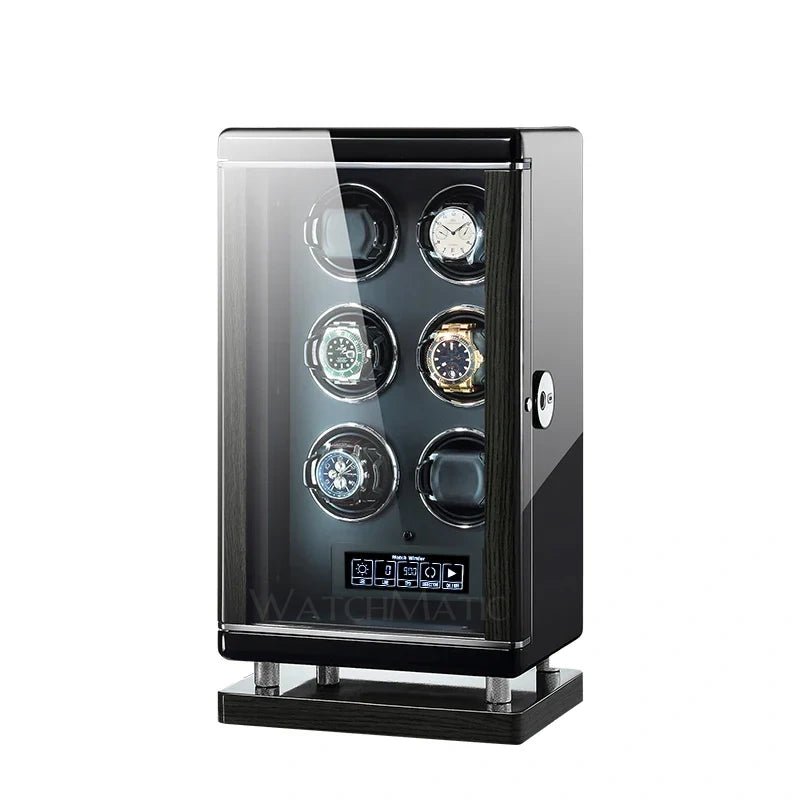
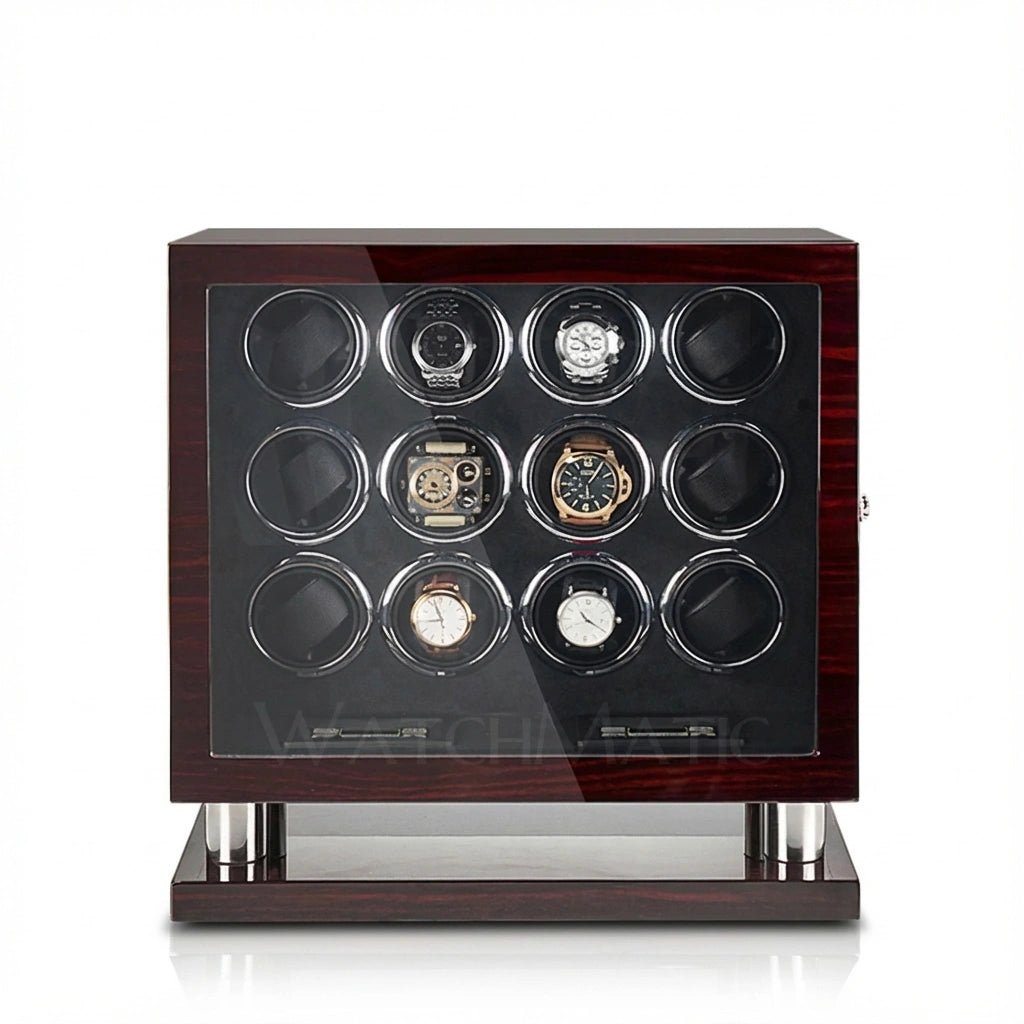
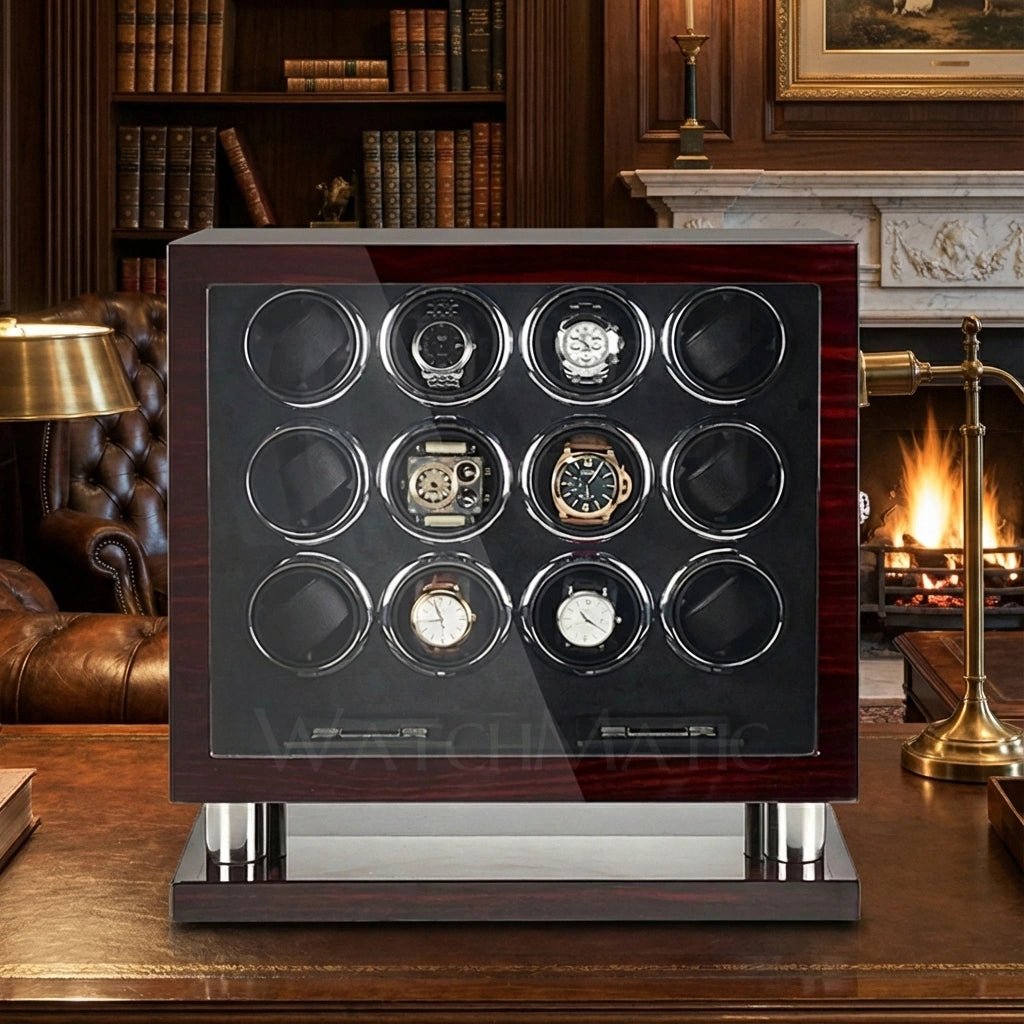
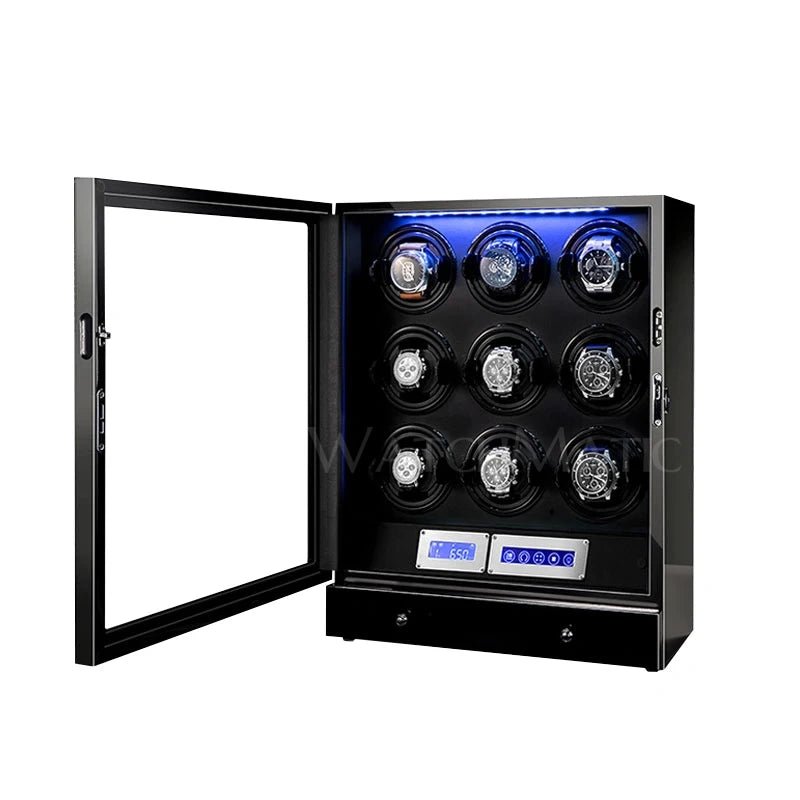
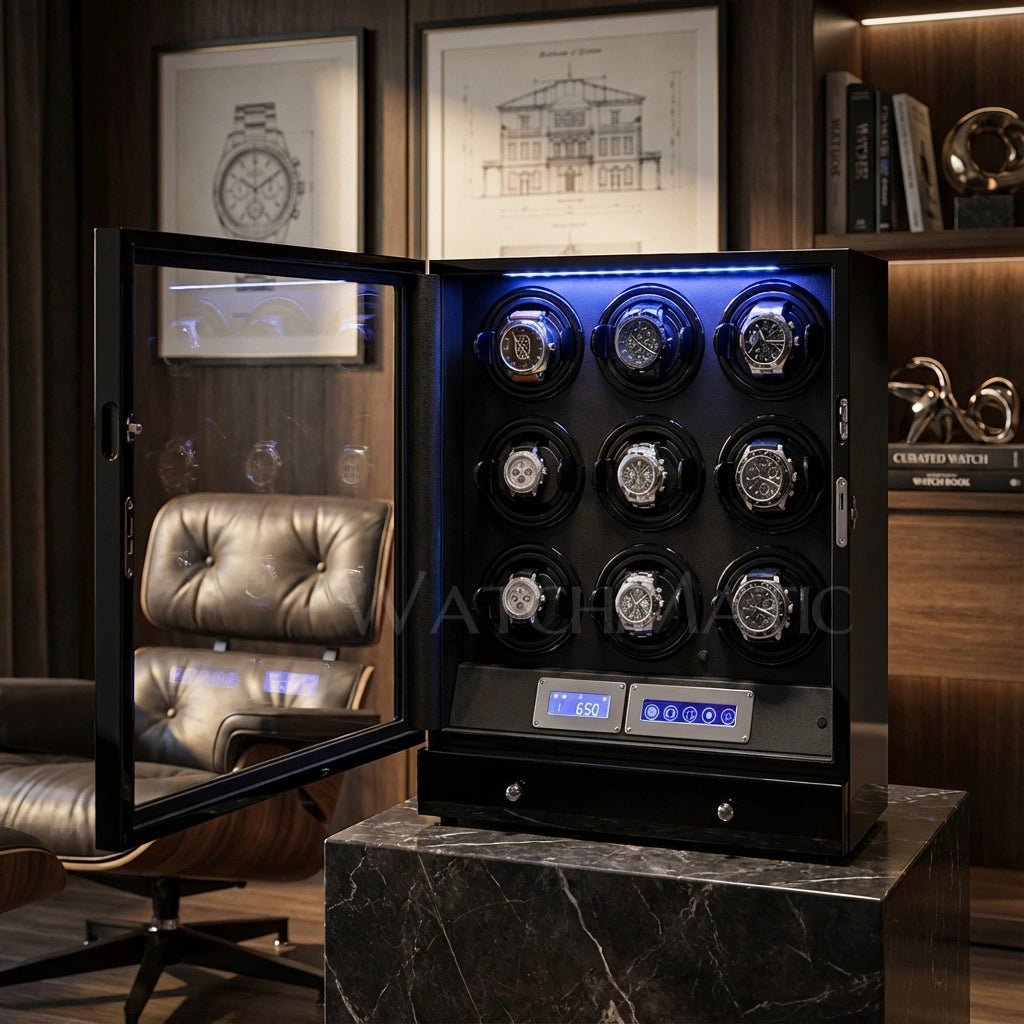
The Vento Luxury Quad Watch Winder is particularly well matched to a compact Formex collection because all four winding positions can be controlled independently.
A practical four-watch setup could contain:
- Aria FX01
- Essence SW200-2 Power+
- Reef GMT SW330-2
- Essence Ceramica Newton P092
Each movement can receive its own:
- TPD
- Rotation direction
- Winding program
rather than forcing the entire collection onto one common setting.
Why Vento Is a Strong Commercial Match for Formex
Formex is one of the better fits for a four-position programmable winder.
Unlike De Bethune or Armin Strom, where many important current watches are manual, Formex's principal current collections are almost entirely automatic.
That means a Formex collector can realistically fill all four powered positions with watches that actually benefit from rotational winding.
A Realistic Four-Watch Formex Collection
For example:
Essence 39 + Reef + Reef GMT + Aria
All four:
- Are automatic
- Use different movement architectures
- Benefit from independent control
- Span different power reserves
This is a natural use case for Vento.
Independent Control Matters More Than Matching Power Reserves
Even two watches with similar reserves may use different calibers.
For example:
Reef → SW300-1 → 56 h
Reef GMT → SW330-2 → 56 h
Same approximate reserve.
Different movement.
Independent control preserves flexibility.
Is It Safe to Keep a Formex on a Watch Winder?
A properly configured quality winder can be used with an automatic Formex.
Important factors include:
- Exact movement identification
- Appropriate TPD
- Appropriate rotation direction
- Controlled rest cycles
- Secure watch support
- Low-vibration motor operation
- Adequate crown clearance
Formex's Own Guidance Supports Moderate Use
The brand's published discussion of watch winders is unusually balanced.
The core idea is straightforward:
a watch winder can be useful, but more winding is not automatically better.
This is particularly relevant for a collection of simple three-hand Formex automatics where restarting the watch manually is already easy.
A Watch Winder Does Not Service a Formex
A watch winder does not:
- Replace lubricants
- Improve COSC regulation
- Repair a rotor
- Restore water resistance
- Maintain shock resistance
- Repair the Case Suspension System
- Service a GMT module
- Extend service intervals
Its function is limited to maintaining energy in a compatible automatic movement.
Watch Winder vs. Watch Safe for Formex Collectors
For most Formex-only collections, a standalone winder is generally the more proportionate first solution.
A watch winder safe becomes more relevant as Formex becomes part of a larger luxury collection.
| Feature | Standalone Winder | Watch Winder Safe |
|---|---|---|
| Automatic winding | Yes | Yes |
| Independent programming | Available | Available |
| Physical security | Limited | High |
| Controlled access | Limited | High |
| 1–4 Formex watches | Highly suitable | Usually unnecessary |
| Larger luxury collection | Moderate | More suitable |
| Aria + multiple premium watches | Suitable | Increasingly relevant |
Collectors requiring combined security and winding can explore the Watch Winder Safe Collection.
Titan Vault 20 for a Larger Formex Collection

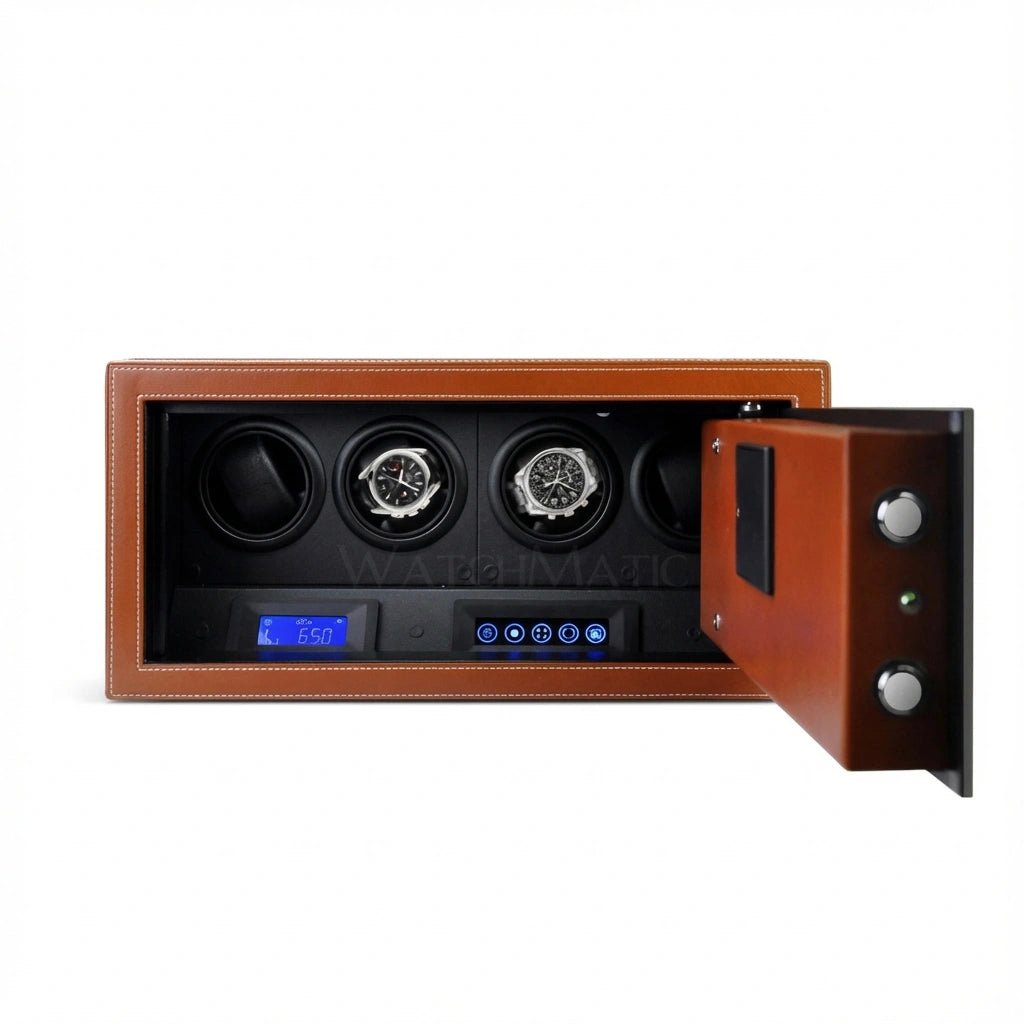
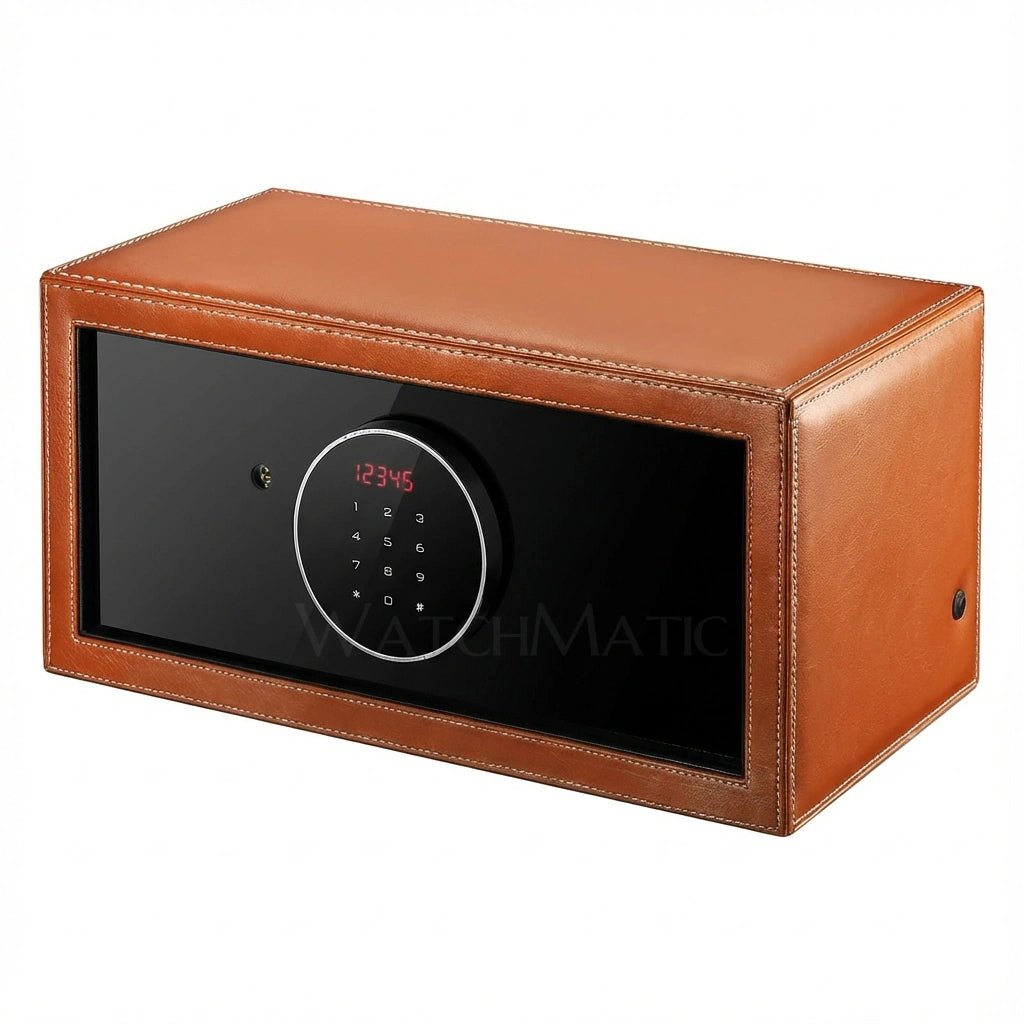
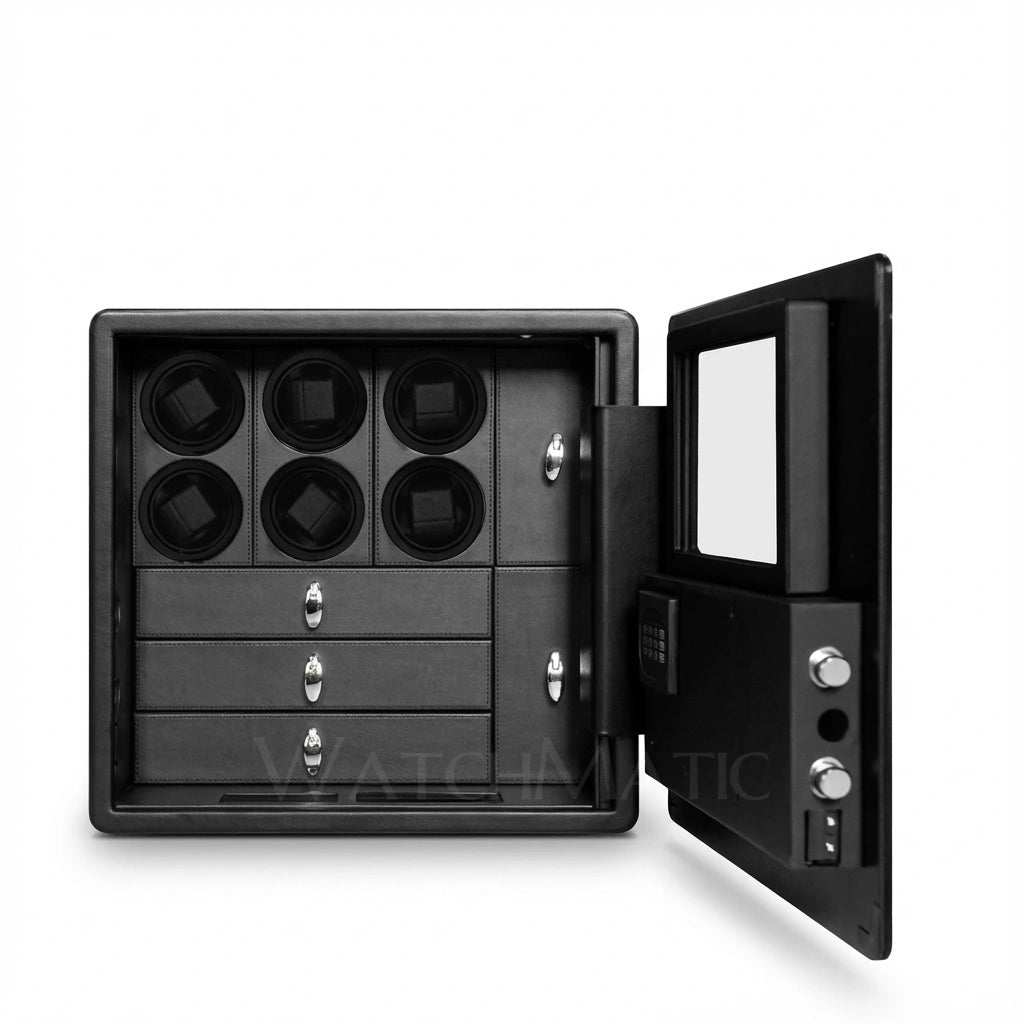
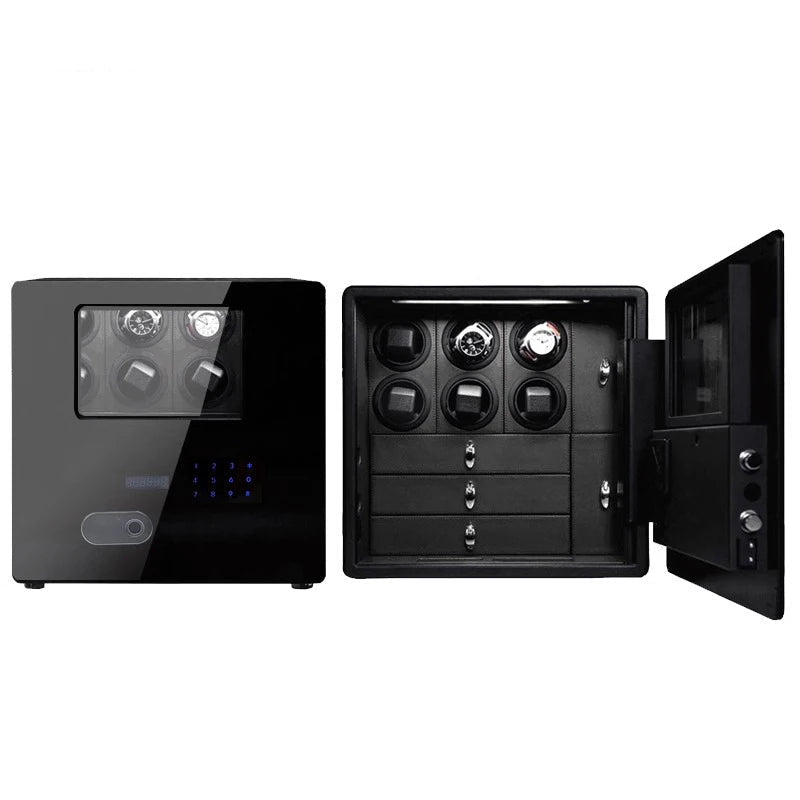
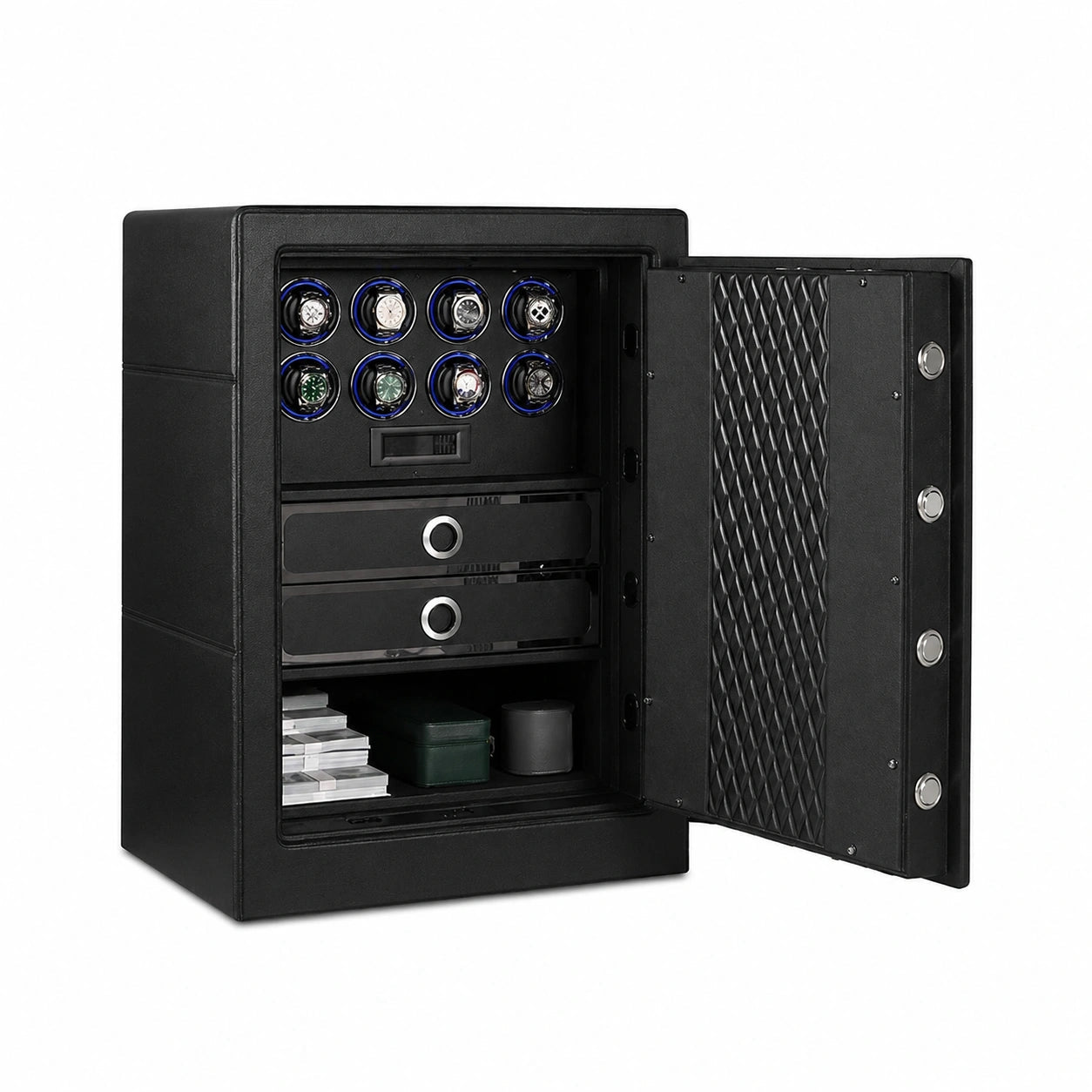
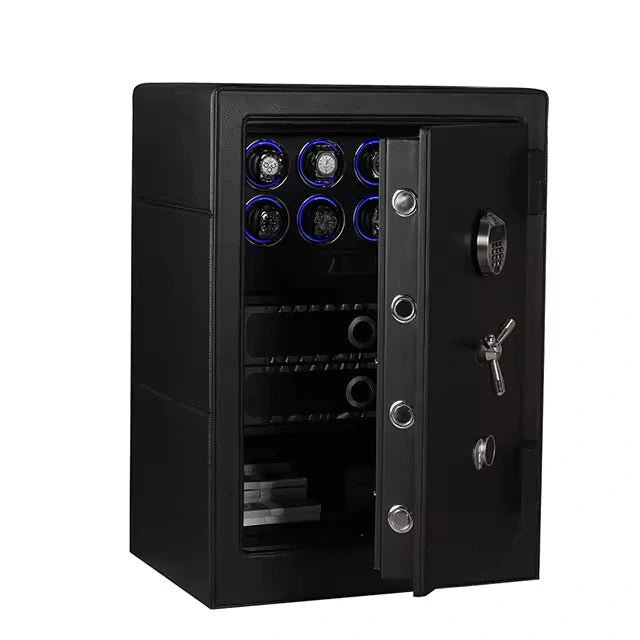
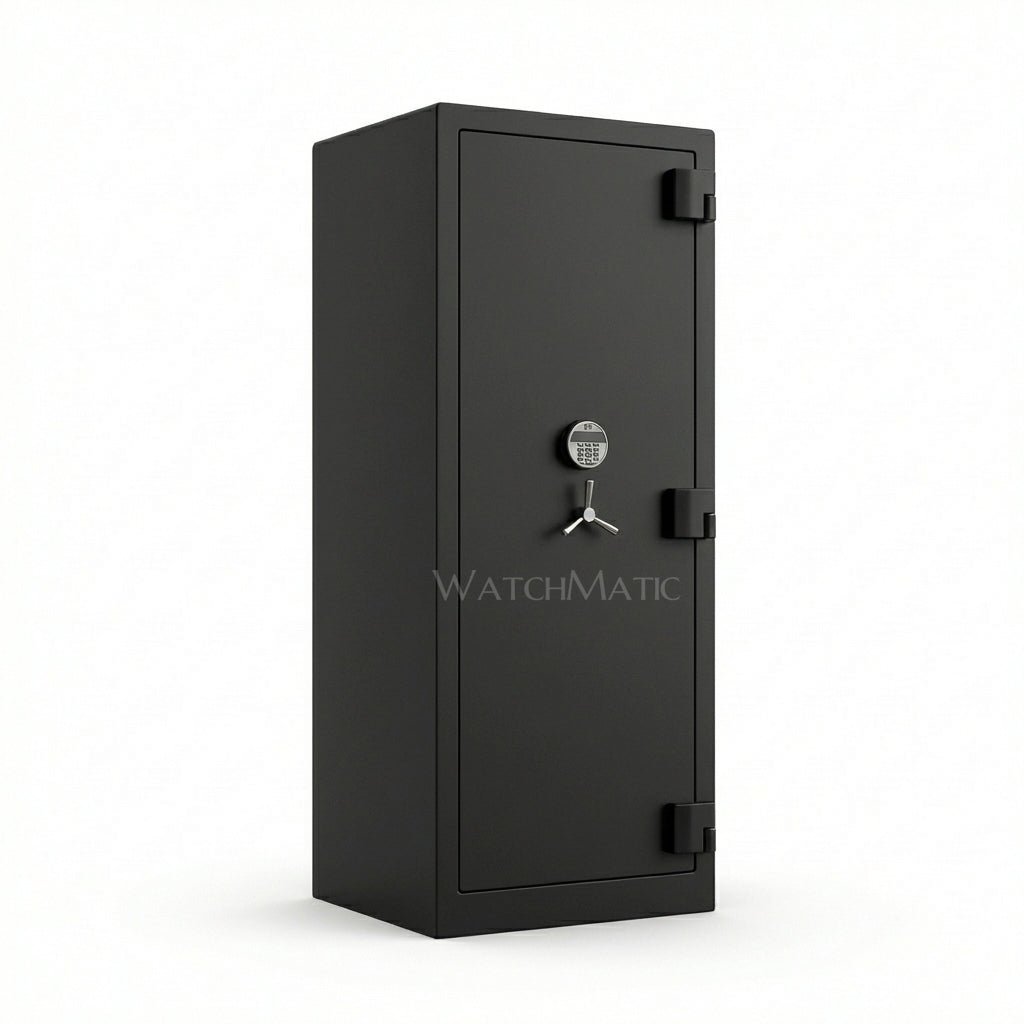
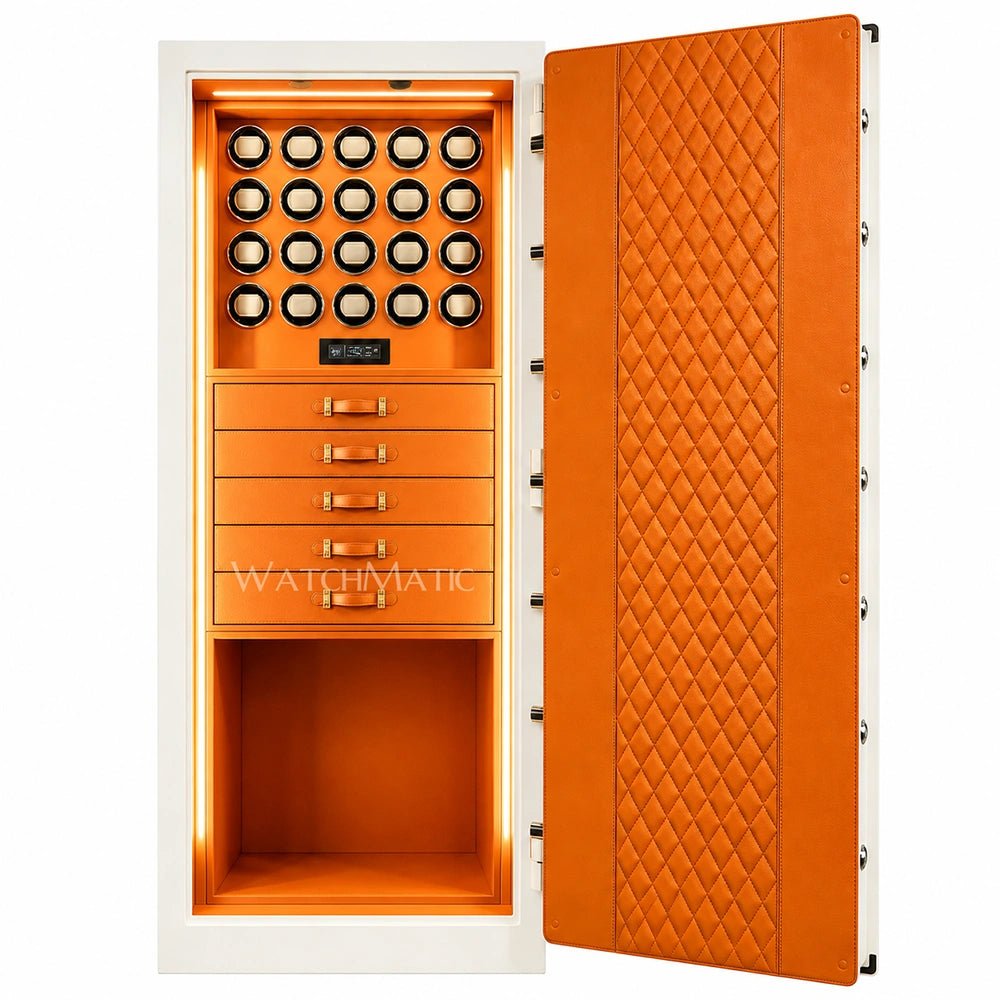
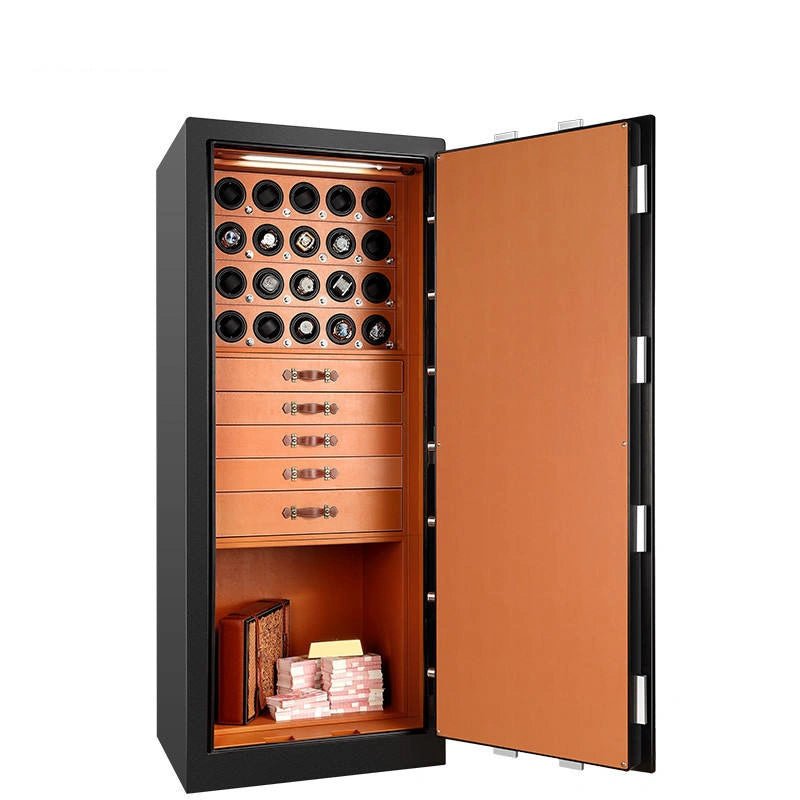
For Formex watches inside a larger luxury or enthusiast collection, the Titan Vault 20 Watch Winder Safe combines independently controllable winding positions with secure storage architecture.
Available features include:
- Monolithic solid-steel body
- 10-layer reinforced exterior shell
- Biometric fingerprint access
- Digital passcode
- Manual key access
- Floor anchoring
- LCD touchscreen
- Japanese Mabuchi motors
- Independent winding controls
- Adjustable 650–2200 TPD range
- CW/CCW/bidirectional operation
- Anti-magnetization protection
- Adjustable LED illumination
- Ultra-quiet operation below 10 dB
- 10-year warranty
EN 15659 LFS 60 P fire certification and UL TL-30 / EN 1143-1 Grade III security certification are available upon request, rather than assumed as standard on every configuration.
Titan Vault 20 Is a Collection-Level Recommendation
Titan Vault 20 should not be positioned as necessary for someone who owns only:
- One Essence
- One Field
- One Reef
That would be disproportionate.
It becomes more logical when Formex is part of a collection containing watches such as:
- Rolex
- Omega
- Grand Seiko
- Tudor
- Cartier
- Breitling
- Independent Swiss brands
Aria Makes the Security Argument Slightly Stronger
The Aria moves Formex into a materially higher price and movement category than the brand's traditional sub-CHF 2,000 core.
A collection containing:
- Aria
- Ceramica
- Reef GMT
- several watches from other luxury brands
creates a more credible case for integrated winding and security.
Security and Winding Are Different Questions
A Formex owner should evaluate separately:
Does the watch benefit from automatic winding?
and:
Does the overall collection justify secure storage?
The answer to the first is movement-dependent.
The answer to the second depends on:
- Total value
- Collection size
- Theft exposure
- Replacement difficulty
When a Stationary Watch Safe Makes Sense
A collector may also decide that automatic readiness is less important than security.
In that case, watches can simply be allowed to stop and stored securely.
Stationary options can be found in the Luxury Watch Safe Collection.
Formex in a Mixed Enthusiast Collection
Formex frequently appears in enthusiast collections containing brands that combine engineering, strong value, and Swiss mechanical movements.
A mixed collection might include:
Formex + Christopher Ward + Farer + Baltic + Sinn + Longines
Related WatchMatic guides include:
Best Watch Winder for Christopher Ward Watches
Best Watch Winder for Farer Watches
Best Watch Winder for Baltic Watches
Best Watch Winder for Sinn Watches
Best Watch Winder for Longines Watches
Even when brands share Sellita-derived movements, exact caliber identification remains preferable to one generic Swiss-watch setting.
Formex vs. Christopher Ward
Both brands use multiple Swiss movement architectures and appeal heavily to enthusiast collectors.
However, neither should be reduced to:
“Sellita automatic = one setting.”
Formex now uses:
- Sellita
- Soprod
- ETA
- Exclusive FX01 manufacture architecture
which makes movement-specific programming increasingly important.
Formex vs. Farer
Farer currently mixes automatic and hand-wound movements extensively.
Formex's current core range is more heavily automatic.
Therefore, a four-position winder is generally a more natural fit for a Formex-only collection than for a Farer collection containing several manual watches.
Formex vs. Baltic
Baltic combines automatic and manual movements from multiple suppliers.
Formex also uses multiple suppliers, but its current main lineup is overwhelmingly self-winding.
Again, the ratio of:
automatic watches : total watches
changes the ideal storage setup.
Formex vs. Sinn
Both brands place strong emphasis on engineering.
However, case technologies such as:
- Formex Case Suspension
- Sinn TEGIMENT
- magnetic-field protection
- dehumidifying systems
do not themselves determine winding requirements.
The movement remains the relevant factor.
Formex Movement Generation Is More Important Than Brand-Wide TPD
A person searching:
“Formex watch winder settings”
may encounter information covering an older generation dominated by:
- SW200-1
- 41-hour movements
The 2026 catalog now includes:
- SW200-2 Power+ 65 h
- FX01 72 h
- Newton P092 44 h
- SW300-1 56 h
- SW330-2 56 h
- ETA 2892 modular GMT 42 h
That makes outdated brand-wide recommendations increasingly unreliable.
How to Choose the Best Watch Winder for Your Formex
Step 1: Identify the Exact Collection
Determine whether the watch is:
- Aria
- Essence 39
- Essence 41
- Essence Leggera
- Essence Ceramica
- Essence Ceramica Skeleton
- Reef
- Reef GMT
- Field
- AirField
- Stratos UTC
- Another historical or special reference
Step 2: Identify the Generation
This is especially important for:
- Essence 39
- Essence 41
- Essence Leggera
- Field
Movement upgrades can materially change the power reserve and winding architecture.
Step 3: Identify the Movement
Important current examples include:
- FX01
- SW200-2 Power+
- SW200-1
- SW200-1 SC
- Soprod Newton P092
- SW300-1
- SW330-2
- ETA 2892 with Dubois-Dépraz module
Step 4: Check Power Reserve
Representative values include:
41 h → SW200-1 SC and selected SW200-1 references
42 h → Stratos UTC
44 h → Newton P092 Ceramica
56 h → SW300-1 / SW330-2
65 h → SW200-2 Power+
72 h → FX01 Aria
Step 5: Determine Rotation Direction
Use verified movement-specific information.
Choose a winder capable of:
- CW
- CCW
- Bidirectional
The Reef GMT SW330-2 is specifically documented by Formex as winding in both directions.
Step 6: Determine TPD
Do not infer TPD from power reserve alone.
Use the exact caliber's winding requirement.
Step 7: Consider the Complication
A GMT or UTC watch may have a stronger convenience reason to remain running than a simple three-hand watch.
That does not automatically mean it requires more TPD.
Step 8: Check Bracelet and Strap Fit
Formex uses:
- Integrated titanium bracelets
- Steel bracelets
- Ceramic bracelets
- Mesh
- Rubber
- Leather
- Nylon
- Velcro
Step 9: Check Case Architecture
Pay attention to:
- Stratos pushers
- GMT bezels
- ceramic bracelets
- integrated Aria bracelet
- Case Suspension System
Step 10: Match Rotor Capacity to the Actual Collection
With a current Formex-only collection, many watches are likely to be automatic.
A multi-position programmable winder can therefore be highly practical.
For broader resources covering winding, TPD, storage, and collection protection, visit the WatchMatic Guide Hub.
Best Watch Winder for Formex Watches: Final Thoughts
Choosing the best watch winder for a Formex in 2026 requires more than knowing that the watch is automatic.
The current movement portfolio has become significantly more diverse.
The new Aria FX01 uses a manufacture micro-rotor movement with approximately 72 hours of power reserve.
Current Essence 39, Essence 41, Field and AirField models use the newer SW200-2 Power+ with approximately 65 hours.
The Reef SW300-1 and Reef GMT SW330-2 provide approximately 56 hours.
The Stratos UTC uses an ETA 2892 base with a Dubois-Dépraz GMT module and approximately 42 hours.
The Essence Ceramica uses the Soprod Newton P092 with approximately 44 hours.
The Essence Ceramica Skeleton instead uses an SW200-1 SC with approximately 41 hours.
And within the Essence Leggera family, owners can encounter both older or reference-specific SW200-1 41-hour configurations and newer SW200-2 Power+ 65-hour configurations.
That creates three particularly important Formex lessons.
First:
same brand does not mean same automatic movement.
Second:
same collection name does not always mean same movement generation.
Third:
longer power reserve does not automatically mean higher TPD.
Formex itself also takes a relatively measured position on watch winders: keeping an automatic running can be convenient, but a winder is not a mechanical longevity upgrade and should be configured according to the actual movement.
For a Formex automatic, prioritize:
- Adjustable TPD
- CW/CCW/bidirectional programming
- Independent winding controls
- Controlled rest cycles
- Smooth low-vibration motors
- Quiet operation
- Flexible cushions
- Bracelet and strap compatibility
- Adequate crown and pusher clearance
The most reliable decision framework is:
Formex Reference → Generation → Caliber → Power Reserve → Winding Architecture → Complication → Physical Fit → TPD/Direction → Winder Program
For additional automatic-winding and secure-storage solutions, explore WatchMatic.